
Face and Residue: a printed figure, spent down, and what it leaves behind
Somebody willing to commit £15.00 cannot buy £15.00. Prepaid money comes in fixed steps, the lowest one clearing that minimum is £20.00, and so £5.00 nobody intended to expose is exposed. A match at 150 per cent prints £30.00 on top of the load, and a ceiling holds credit at £30.00 however large the load grows. What is credited carries an obligation to stake £1,200.00, priced at £48.00 in expectation, which finishes £18.00 below nothing.
The face £30.00 at the ceiling What draws it down £48.00 of expected cost What is stranded £5.00 on the step
Faces priced at this end of the market
Paid placement: every operator on this rack pays this site a commission when a reader registers through a button here, and that commission is what buys the position.

Albion
700% + 700 FS No GB licence- Wagering and payout
- On the operator's own terms page
- Licence
- Offshore, verify on the register
Terms and licence for Albion
What is printed
Terms
Offshore licence, verify on the register.

Tweedbet
470% welcome pack No GB licence- Wagering and payout
- On the operator's own terms page
- Licence
- Offshore, verify on the register
Terms and licence for Tweedbet
What is printed
Terms
Offshore licence, verify on the register.

WinBeast
€5,000 + 500 FS + €650 free bet No GB licence- Wagering and payout
- On the operator's own terms page
- Licence
- Offshore, verify on the register
Terms and licence for WinBeast
What is printed
Terms
Offshore licence, verify on the register.

Night Luck
805% + 280 FS No GB licence- Wagering and payout
- On the operator's own terms page
- Licence
- Offshore, verify on the register
Terms and licence for Night Luck
What is printed
Terms
Offshore licence, verify on the register.
None of the operators above holds a Great Britain licence. The duties that licence carries stop at its edge: an independent dispute service, a duty to say how player money is protected, and deposit limits on offer. A Gamstop registration covers licensed British operators only, so it gives no cover on these sites, and anyone who has excluded themselves should stay away.
1
One instrument, and the three questions it asks
This publisher took its method from the thing in its own domain name. A prepaid voucher is bought at a counter for a printed sum, that sum is loaded somewhere, and it is spent down until something sits at the bottom. The printed sum is a face. What sits at the bottom is a residue. Between those two words lives everything a reader wants to know and almost nothing an advertisement says.
Three questions come out of the instrument, and every sheet filed here puts the same three to whatever it is costing.
First: what is the face? Not an adjective and not a count of spins, but the figure as printed, before any term has been applied to it. Where a headline gives a count rather than a sum, it is multiplied by an assumed unit price until it becomes a sum, because a count carries no denomination and cannot be set beside anything.
Second: what draws it down? A play-through multiple, a game weighting, a clock, a stake ceiling, a charge at either end. Every one of those is a deduction with a size, and a size can be written in pence.
Third: what is stranded? That is the question nobody else answers. Some part of a face was never coming off at all, because a ceiling held it, a floor stood above it, a denomination rounded past it, or a clause took it back. Name that part and a headline stops being a number and starts being a price.
Nothing here is played. No account gets opened, no spin gets taken, no payout gets chased. What happens instead is arithmetic over published rules and declared assumptions, with the rule named and the assumption flagged as one. A figure on these sheets models an offer. It does not report one.
2
What a denomination costs before anything begins
Begin where a reader begins, at a till. Prepaid money is sold in steps, and a ladder of six runs through these pages: ten pounds and twenty at the foot, then twenty-five, fifty, seventy-five, and one hundred at the head. Holding that ladder fixed lets one sheet’s sums be set beside another’s. It is a declared assumption, nothing more.
Suppose a qualifying minimum of £15.00 and a reader content to expose precisely that. Nowhere on the ladder is there a step of £15.00. The lowest step clearing the minimum costs £20.00, so £5.00 that was to stay in a pocket goes in with everything else. A third again on top of the intention, and it has gone before any offer has been accepted.
Rounding upwards is not a trivial effect, and it hurts most at the bottom of the ladder. Somebody after £3.00 pays £10.00 and commits £7.00 beyond the intention, which is over twice the sum that prompted the purchase. Somebody after £26.00 pays £50.00. Proportional damage falls as the figures rise, which is precisely backwards for a reader on a small budget.
Now put a headline on top. Take a match at 150 per cent of the qualifying load, with credit held to £30.00 however large the load. That one ceiling changes the character of every step past the second.
| Step bought | Over the intention | Match at 150 per cent | Credit once the ceiling bites | Stakes due, forty times over | Expected to survive |
|---|---|---|---|---|---|
| £10.00 | under the minimum | nothing matched | nothing credited | none due | nothing kept |
| £20.00 | £5.00 | £30.00 | £30.00 | £1,200.00 | minus £18.00 |
| £25.00 | £10.00 | £37.50 | £30.00 | £1,200.00 | minus £18.00 |
| £50.00 | £35.00 | £75.00 | £30.00 | £1,200.00 | minus £18.00 |
| £75.00 | £60.00 | £112.50 | £30.00 | £1,200.00 | minus £18.00 |
| £100.00 | £85.00 | £150.00 | £30.00 | £1,200.00 | minus £18.00 |
Follow the second column downwards and unintended exposure grows by £80.00 from top step to bottom. Follow the fourth column downwards and credit simply stops growing. Past the third row a reader is buying obligation and nothing else, and the final row pays £85.00 of exposure it never meant to pay for credit that £20.00 would have bought outright.
3
Printed, credited, and the gap between
A face turns up in one of two shapes, and the first job on any sheet is getting both of them into pence.
A sum is straightforward. Thirty pounds of credit is a face of £30.00 and the arithmetic can start. A count resists, because spins have no denomination. Multiply a count by a unit price and it becomes a sum, and the unit price held throughout these pages is 10p.
That assumption does real work, so here is why it is one. Among the primary sources behind this site, nothing fixes the cash value of a spin. No minimum appears, no maximum, and no obligation to show the figure at all. Two sourced duties graze it without setting it. RTS requirement 3C obliges a licensee to put the chance of winning where a customer can find it, ahead of the decision to stake. Social Responsibility Code 5.1.1 obliges an incentive to carry terms that are clear and reachable. Hence ten pence, declared and held, never dressed up as a market finding.
Faces of identical size can also be credited in quite different ways, which decides what happens next. Credited as cash, a sum behaves simply. Credited into a separate bonus pot, it behaves otherwise, because a requirement attaches and a clause can cancel. Winnings off a count landing in such a pot have a multiple fastened to them, and a British licence permits no more than ten of those. Is a spin bonus funds in its own right? Nothing this site could read answers that, so these pages leave it open rather than answering by guess.
4
What forty times does to £30.00
A play-through requirement obliges somebody to send money round a game until total wagers reach a stated figure. Nothing is taken away at the start. The taking happens circuit by circuit, as a share of everything staked, and that is exactly why a multiple costs so much more than it appears to.
The share is whatever a game does not return. At 96 per cent back, four pence in each pound staked stays where it lands. Forty times £30.00 comes to £1,200.00 of stakes, and four pence in the pound across that is £48.00. Set the credit of £30.00 against a cost of £48.00 and the requirement has swallowed the face whole and gone £18.00 into money the reader brought.
One line holds the mechanism, with each letter defined at how a face is priced:
Four declared assumptions sit inside that line. A spin priced at ten pence. A return of ninety-six pence in each pound. A multiple of forty, which is the sort of figure a package away from the British licence tends to want. A weighting of one, under which staking a pound discharges a pound of the obligation. Weighting beneath one is the quiet multiplier: halve the contribution rate and the stakes needed double while the headline requirement stays precisely where it was.
Time hides inside a multiple too, and it converts without trouble. Twelve hundred pounds of stakes, spent ten pence at a time, is 12,000 game cycles. Slots under a British licence have a pace limit, and RTS requirement 14D sets it at two and a half seconds from the beginning of one cycle to the beginning of the following one. Twelve thousand cycles at that limit occupy 30,000 seconds, or 8 hours and 20 minutes of unbroken play. The standard carrying that rule prints no commencement date, and none is invented here. Outside the British licence no pace limit is imposed at all, so an identical obligation can be discharged far quicker, and quicker is the worse outcome.
5
Twenty-five, the hinge in all of it
A single integer turns everything on this site, and it repays the paragraph needed to see where it comes from.
Expected survival equals a credit less the expected cost of the stakes demanded of it. That cost is the multiple, times the credit, times whatever slice a game keeps. Put survival at nothing and the credit cancels out of both sides, leaving the multiple equal to the reciprocal of the slice. With 96 per cent returned the slice is 0.04, and one divided by 0.04 is 25.
Twenty-five times, then, is no convention and nobody’s preference. It marks where a credit has become worth nothing before anybody touches it. Under the figure, something survives. Over it, the requirement has eaten the credit and begun work on the reader’s own balance. Forty times, assumed across these pages, stands at 1.6 times that pivot.
The pivot shifts whenever the return shifts, which is why the pair have to travel together. Return 98 per cent and the slice is two pence, putting the pivot at fifty times. Return 90 per cent and the slice is ten pence, dragging the pivot down to ten. A ceiling quoted with no return beside it, and a return quoted with no ceiling beside it, are each half a fact.
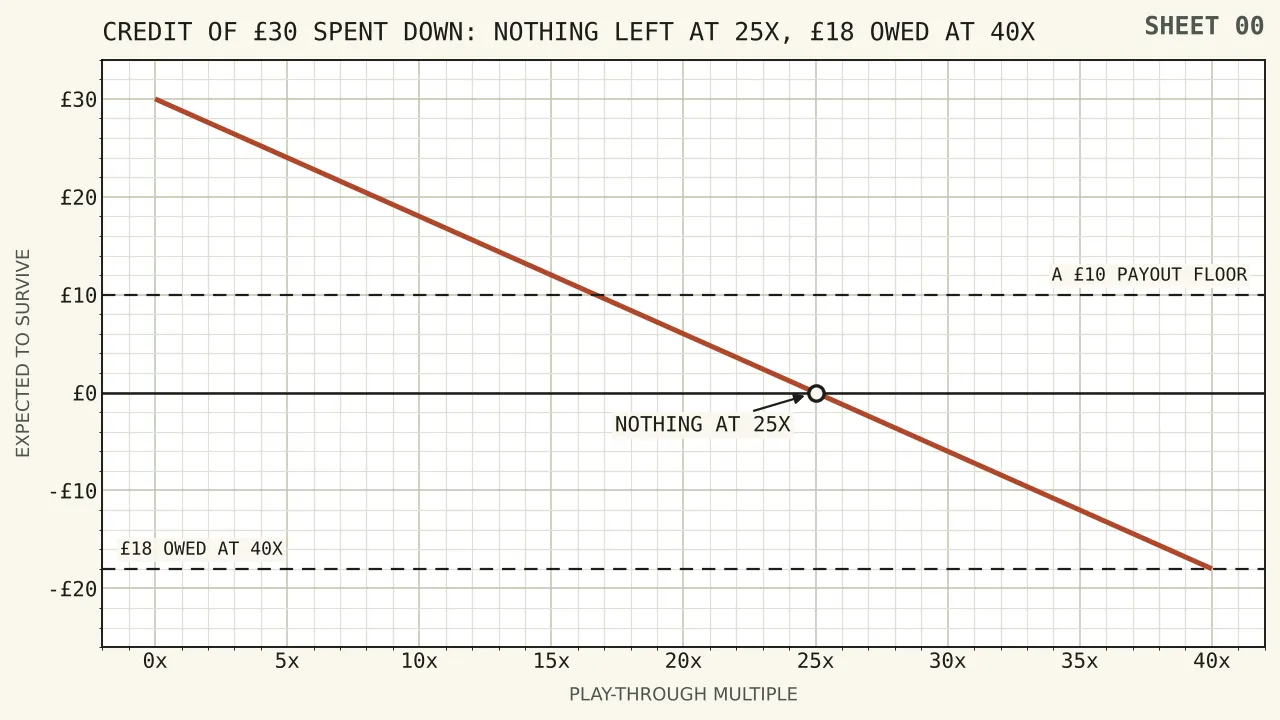
| Multiple demanded | Expected to survive | Gone off the face |
|---|---|---|
| None at all | £30.00 | nothing |
| Ten times | £18.00 | £12.00 |
| Twenty times | £6.00 | £24.00 |
| Twenty-five times | nothing | £30.00 |
| Thirty times | minus £6.00 | £36.00 |
| Forty times | minus £18.00 | £48.00 |
6
The part that was never coming off
A residue has nothing to do with bad luck. It is the share of a face put beyond reach on the day the terms were drafted, and it arises in four familiar ways.
A denomination does it first, priced in part 2 at £5.00 against a £15.00 intention. A conversion ceiling does it second, and the ladder above shows the shape: at the third step a match of £37.50 is held to £30.00, which leaves £7.50 that only ever existed in the headline. A payout floor does it third, finishing off small balances, since the sole way to grow a balance is to stake it and staking costs four pence in each pound put through. A forfeiture clause does it fourth.
On that fourth cause a published enforcement outcome can be cited rather than an opinion offered. The money is public: £170,000, decided on 3 July 2025, against the licensee behind Fafabet, which is Taichi Tech Limited. What drew the penalty was a discretion kept back in the promotional rules written for new casino customers, under which an account could be shut or winnings taken off it. Transparency was found absent, unfair results were held possible, and the condition breached was the one requiring terms to be fair and open. None of which amounts to a ruling that wording of that shape has no legal force, and nobody here will pretend otherwise.
A distinction gets blurred constantly and is worth ten seconds. Cash a reader paid in is protected by name: a term setting any maximum on taking money back out of a paid-in balance is prohibited, and the regulator publishes a specimen of the wording it has in mind. A ceiling on what credit may turn into is a separate animal standing outside that prohibition. Both can therefore hold at one cashier on one day, and a page failing to say which is which has misled somebody. The stranded part gathers each of those causes in one place and sizes them.
7
A one-way rail and the floor beneath it
Prepaid instruments are built to move money one way. Bought with cash or with a card, loaded onto a balance, finished. Whatever survives has to leave by some other route, and every route has a charge and a minimum attached.
Assume the good case for once. The obligation is cleared and £8.00 is still there. Where a cashier pays nothing out beneath £10.00, that £8.00 is not money at all. It is £2.00 away from being money, and shutting a £2.00 gap by playing on means pushing at least £50.00 through a game, hoping variance delivers what expectation will not, at an expected price of £2.00 for the attempt. Floors are where small residues go to die.
One British rule bears directly on this, and it is RTS requirement 14B. Having asked to be paid, a customer may not then be handed the option of withdrawing the request, and money already requested should not be sitting there ready to stake again. That single line removes the costliest mistake available to anybody waiting on a payment. Nothing matching it appears in the Curaçao rulebook read for the sheet this site works from. What every exit route costs, and what each floor strands, gets worked through at the way out.
8
Why a shape like that is printed abroad
No British licensee could advertise a package of this shape, and the reason is arithmetic rather than taste. Forty times a credit is four times as much play-through as Great Britain permits. The ceiling stands at ten times whatever the bonus funds are, written into limb 3(a) under Social Responsibility Code 5.1.1, with licensees held to it from 19 January 2026. Two technical categories of licence sit outside the ceiling and every other category sits inside. Multiples reaching sixty were what needed fixing, on the regulator’s own account of the market it was regulating.
A package demanding forty times is therefore, on the arithmetic alone, printed somewhere that holds no Great Britain licence. The gap shows up in money and the sum is short. Keep inside the ceiling and credit of £30.00 is expected to leave £18.00. Push to forty times and the same credit is expected to take £18.00. Thirty-six pounds separates the two positions on a single £30.00 line, which is six pounds more than the face.
What else is given up is a list of named duties rather than a vague unease, and five of them bear on a face like this one. Stakes on an online slot cannot pass £5.00 in one game cycle, and the ceiling falls to £2.00 for a player who has not yet turned twenty-five. Dates for the pair come from the regulator’s guidance: 9 April 2025 for the first and, six weeks afterwards, 21 May 2025 for the second. Slots are the whole of their reach, so roulette and blackjack are untouched. Verification comes before play rather than before payment, and it covers bonus play and free-to-play alongside money of a reader’s own. Self-exclusion across the entire licensed market is itself a licence condition, which puts a cashier holding no licence beyond its reach. A complaint runs on a clock with eight weeks at the end of it, and an approved dispute-resolution body picks it up from there. A slot cannot be hurried along by a turbo control, and a losing spin cannot be presented as a near miss.
Two facts cut the other way and dropping them would be dishonest. Offshore does not mean complaint-free: version 1.1 of the Curaçao player complaints guidelines, dated 18 June 2025, allows six months for raising a matter and four weeks for a reply, extendable once, which arrives at the same eight weeks. British gaming duty, meanwhile, attaches to the customer rather than to the licence, so an operator taking money from a usual resident of the United Kingdom is inside its scope regardless. Remote gaming profit has carried a rate of 40 per cent since 1 April 2026. Offshore names a narrower and more specific loss than the word suggests, and off the register prices that loss duty by duty.
9
Seven sections and the question each answers
These sheets are filed under seven headings, one for each place a face loses value. Any heading reads on its own, and none of them needs the others to make sense.
Headlines that print a figure and then stop get taken apart under the face, where a count turns into pence and one sum can be set beside the next. Two hundred spins at the unit price used here is £20.00, and two thousand is £200.00, which is the entire drama of a four-figure headline.
The rung holds denomination arithmetic, along with minimum loads and the smallest sums a cashier will take at all. Round a £3.00 intention up to the lowest step available and the rounding alone costs better than twice the intention, which no headline mentions.
Something is always taken between the crediting of a balance and the keeping of it, and that interval belongs to the spend-down: multiples, weightings, maximum stakes while a requirement runs, and the clock a credit expires against. Its arithmetic is the line in part 4, applied to whatever wording is in front of it.
Where a balance gets held back
Ceilings, conversion caps and clauses able to reclaim a balance are collected under the stranded part, whose job is putting a figure on the share of a face that was out of reach from day one.
Moving money away from a cashier gets costed under the way out, route by route, with a minimum payout treated as what it is: a floor stranding everything beneath it, down to the final penny.
Faces printed where no British licence is held get priced under off the register, duty by duty, in pounds rather than adjectives. Its method is the one in part 8, worked at length and tied to the rule it names.
Where a face must be spent decides a great deal about what remains of it, and that belongs to the room: the game or category a credit is locked to, how quickly it can be played, and what a published return does to every sum above.
Two further sheets stand outside the seven. The formula, its assumptions and the point where the method stops working are set out at how a face is priced. The commercial arrangement behind the links, and what it cannot buy, is stated at how this site is paid. Anybody who arrived with an immediate problem rather than an arithmetical one should turn instead to staying in control, which lists the free protections already available and how each is put to use.
10
One credit, three sets of terms
The sheets above take an offer apart one piece at a time. This part puts a single credit through three sets of terms in one table, so that the pieces can be seen acting together. The credit is £30.00 and it arrives whole, with no ceiling to hold it. The settings are the ones used everywhere here: a press of 10p, 96 pence returned in each pound, and a weighting of one unless a row says otherwise. Only two things change from row to row, the multiple and the contribution, which is how much of every pound staked is allowed to count towards the requirement.
| Terms | Multiple | Contribution | Stakes due | Presses at 10p | Time at 2.5 seconds a cycle | Expected cost | Expected to survive |
|---|---|---|---|---|---|---|---|
| Inside the British ceiling | Ten | A pound | £300.00 | 3,000 | 2 hours 5 minutes | £12.00 | £18.00 |
| Beyond it, full contribution | Forty | A pound | £1,200.00 | 12,000 | 8 hours 20 minutes | £48.00 | minus £18.00 |
| Beyond it, two fifths counting | Forty | Forty pence | £3,000.00 | 30,000 | 20 hours 50 minutes | £120.00 | minus £90.00 |
Each step down the table has one cause. Between the first row and the second only the multiple moves, and the swing is the £36.00 already seen in part 8. Between the second row and the third the multiple stays at forty while the contribution falls from a pound to forty pence, and the swing is £72.00, twice as large, with nothing in the advertised headline changing at all. A comparison of multiples alone would call the last two rows the same offer. They sit £72.00 apart in expectation and 12 hours 30 minutes apart on the clock.
Time is worked at the licensed interval of two and a half seconds for all three rows, so that the column compares like with like. A different pace would stretch or shorten each sitting by the same proportion, and it would leave the cost where it was, because cost follows the stakes and the stakes are set by the terms.
Scaling the three sets of terms up the ladder
A credit does not have to be £30.00. Taken at each of the six steps as a plain credit, the same three sets of terms give the finishes below. The ratio between the columns is the same on every step, and only the size of the sum moves.
| Credit | Ten times, full contribution | Forty times, full contribution | Forty times, two fifths counting |
|---|---|---|---|
| £10.00 | £6.00 | minus £6.00 | minus £30.00 |
| £20.00 | £12.00 | minus £12.00 | minus £60.00 |
| £25.00 | £15.00 | minus £15.00 | minus £75.00 |
| £50.00 | £30.00 | minus £30.00 | minus £150.00 |
| £75.00 | £45.00 | minus £45.00 | minus £225.00 |
| £100.00 | £60.00 | minus £60.00 | minus £300.00 |
The first column keeps three fifths of the credit. The middle column finishes three fifths of the credit below nothing, and the last finishes three times the credit below nothing. In the middle column the expected cost is 1.6 times the credit and in the last it is 4 times, and everything above one times the credit is the reader’s own money. A credit is a fixed sum, and it cannot absorb the extra cost of a contribution set below one.
What each missing number is assumed to be
A set of terms may leave out a number that a table like this one needs. Where that happens these sheets put in the figure that changes the least, and say so, because a gap left open tends to get filled with whatever the headline suggests.
| Missing from the terms | Figure assumed here | What a worse figure does to a £30.00 credit |
|---|---|---|
| The multiple | Ten inside a British licence, forty beyond it | Each further ten turnovers takes another £12.00 |
| The contribution | A pound counted for each pound staked | At two fifths the stakes come out two and a half times larger |
| The price of a press | Ten pence | At twenty pence the count at ten times halves to 1,500 presses, and the cost stays at £12.00 |
| The payout floor | £10.00, wherever an example needs one | A floor of £20.00 would hold the £18.00 that the first row is expected to leave |
| The return | 96 pence in each pound | At 94 pence the pivot falls from twenty-five turnovers to sixteen and two thirds |
A headline read back into terms
The same method works on a headline in front of somebody. Take a model case, which is not an offer from anywhere: a step of £50.00 matched in full, forty times the bonus to play, slots counting at one half, and nothing paid out below £20.00. Read in order, the headline gives a face, an obligation and a pivot.
| Reading | Working | Result |
|---|---|---|
| The face | Matched in full on a step of £50.00 | £50.00 of credit |
| The obligation as printed | Forty times the credit | £2,000.00 |
| The obligation as the contribution reads it | £2,000.00 divided by one half | £4,000.00 |
| Presses at ten pence | £4,000.00 divided by ten pence | 40,000 |
| The expected cost | Four pence in each pound of £4,000.00 | £160.00 |
| The expected survival | £50.00 less £160.00 | minus £110.00 |
| The same headline at a full contribution | £50.00 less £80.00 | minus £30.00 |
| The pivot at this contribution | One half divided by four pence | 12.5 times |
| The printed multiple against that pivot | Forty divided by twelve and a half | 3.2 times |
The reading of the contribution is the whole difference between the two survival lines. Printed on its own the requirement is £2,000.00 of stakes and the credit is expected to finish minus £30.00. Read with the contribution it is £4,000.00 of stakes, and the credit is expected to finish minus £110.00. At a contribution of one half the pivot is twelve and a half times, so a headline that looks like 1.6 times its pivot is really 3.2 times it.
The floor in that headline never gets a chance to matter. Nothing is expected to survive, so there is no balance for it to hold. A floor does its work only where the arithmetic leaves a balance behind, and the way out takes up that case.
Questions
- What does face value mean on this site?
- The figure as printed, before any term has touched it. Credit advertised at thirty pounds has a face of £30.00. A headline advertising a count instead of a sum gets converted at the unit price assumed here, ten pence, so 300 spins also has a face of £30.00. Insisting on a face matters because it is the one figure in an advertisement that cannot be argued with, and every deduction can then be measured against it.
- Why would somebody meaning to spend £15.00 part with £20.00?
- Because prepaid money is sold in fixed steps and £15.00 is not among them. Six steps are worked throughout these pages, from ten pounds at the bottom to a hundred at the top. A minimum of £15.00 is beyond the first step, so the second gets bought and £5.00 goes in that was never meant to. In proportion it is worst at the bottom: a £3.00 intention rounded up to the lowest step commits £7.00 more than planned.
- What exactly is a residue?
- The share of a face that was never coming off, settled by the terms rather than by luck. Four things cause it. A denomination rounding past the sum somebody wanted. A conversion ceiling stopping part of a credit from ever becoming cash. A payout floor standing above whatever balance survives. A clause that takes back what is left. Each of those can be sized in pence, which is the entire purpose of this publisher.
- Where does twenty-five come from?
- From the return, and from nowhere else. Expected survival is a credit minus the multiple times the credit times the slice a game keeps. Put survival at nothing, the credit cancels, and the multiple is left equal to one divided by that slice. At a 96 per cent return the slice is 0.04, and one divided by 0.04 is 25. Beneath twenty-five times something survives in expectation, at twenty-five nothing does, and above it the requirement is working on money the reader brought.
- Is a forty times requirement allowed in Great Britain?
- No. Ten times the bonus funds is where Great Britain stops, at limb 3(a) under Social Responsibility Code 5.1.1, binding from 19 January 2026 and reaching all but two technical categories of licence. Sixty times was the high end of what the regulator found before it legislated. A package demanding forty times is accordingly, by arithmetic alone, printed somewhere outside that licence.
- Can a balance leave by the route it arrived on?
- Rarely, because prepaid instruments carry money one way only. Whatever survives departs by another route, and that route has a minimum. A balance of £8.00 against a payout floor of £10.00 is £2.00 away from being money, and the only method of closing the gap is to stake it, at a price of four pence in each pound pushed through. One British rule helps squarely here: a request to be paid cannot afterwards be handed back for cancelling.
- What does a reader lose with no Great Britain licence behind a cashier?
- Specific duties, each nameable. Ten times as the ceiling on a wagering requirement. A stake ceiling on an online slot of £5.00 in a game cycle, falling to £2.00 where a player is under twenty-five, which the regulator’s guidance dates to the spring of 2025 and which reaches slots alone. Verification before play rather than before payment. Membership of the national self-exclusion scheme, which follows the licence. A complaints clock with eight weeks at the end of it and an approved dispute-resolution body after that. A pace limit of two and a half seconds between one spin and the next. And bans on turbo controls and on losing spins presented as near misses.
- Are these figures tested, or worked out?
- Worked out. Nothing gets played here, no account gets opened and no payout gets chased. Every figure is arithmetic over published rules and four assumptions declared on the page: ten pence a spin, a 96 per cent return, a weighting of one, and a multiple named wherever one appears. Where a source publishes nothing, these sheets print the gap rather than closing it. A return a room has never published cannot be asserted, and no sheet here asserts one.
- What changes if only the contribution is lower?
- The cost, and by a wide margin, while the headline stays where it was. On a credit of £30.00 at forty times, a contribution of two fifths asks for £3,000.00 of staking in place of £1,200.00, an expected cost of £120.00 in place of £48.00, and an expected finish of minus £90.00. The advertised multiple has not moved. Twelve thousand presses have become thirty thousand.
- How long would the staking on a £30.00 credit take?
- At ten pence a press and the licensed interval of two and a half seconds, ten times the credit is 3,000 presses and 2 hours 5 minutes of play. Forty times is 12,000 presses and 8 hours 20 minutes. The clock changes with the pace and the cost does not, because cost follows the stakes and not the time they take.
- Where does the pivot sit if only half of each stake counts?
- At twelve and a half times. The pivot is the contribution divided by the slice a game keeps, so at one half and a 96 per cent return it is 0.5 divided by 0.04, which is 12.5. Forty times is then 3.2 times the pivot, in place of 1.6 times when a pound counts for a pound. On a credit of £50.00 that reading moves the expected survival from minus £30.00 to minus £110.00.