Section F Revision 1 Terms read 16 October 2026
The face
A headline of a hundred is £1.00 if the unit is a penny, £10.00 if it is a 10p press, and £100.00 if it is a pound. That spread of a hundred times is the first thing this section measures, because a figure with no unit on it is not a quantity. Nineteen notes stand under this heading. Each begins by naming the unit, then strikes four per cent off for the edge before a single term has been read.
The face £10.00 as printed What draws it down 40p before a term What is stranded £4.24 at ten turnovers
What a face of this size is worth
Every destination on this rack is bought advertising. The site takes a fee if a reader goes on to register, and no figure printed below moves because of it.
Face and Residue
Strip No 01
Betportal
Ceiling as a multiple
Priced at this site's own 10p a spin
What is printed
What draws it down
What is stranded
No Great Britain licence
Licensed in Anjouan, Comoros, run by BetPortal Gaming Ltd, with Excite Ultra Media Ltd, reference ALSI-202601040-FI2.
Terms read 16 October 2026
Open the offer at Betportal, opens in a new tabFace and Residue
Strip No 02
WinBeast
Ceiling as a sum
Priced at this site's own 10p a spin
What is printed
What draws it down
What is stranded
No Great Britain licence
Licensed in Curaçao, operator not named on the site.
Terms read 16 October 2026
Open the offer at WinBeast, opens in a new tabFace and Residue
Strip No 03
EliteSpin
Longest spin window
Priced at this site's own 10p a spin
What is printed
What draws it down
What is stranded
No Great Britain licence
Licensed in Costa Rica, run by PrimeTier Limited.
Terms read 16 October 2026
Open the offer at EliteSpin, opens in a new tabFace and Residue
Strip No 04
Crown Jewelz
Multiple unpublished
No residue struck
What is printed
What draws it down
What is stranded
No Great Britain licence
Licensed in Curaçao, number not verified, operator not named on the site.
Terms read 16 October 2026
Open the offer at Crown Jewelz, opens in a new tabThe two figures in the second and third registers are this site's own arithmetic and nothing an operator has published: the face as printed, less the share a spin gives back at 96 per cent return to player, less what playing the wagering through costs at the same return, and then less whatever a published ceiling, a charge on the way out or a floor on the smallest withdrawal takes off what survives that. The residue is what is left of the face when all of it is accounted for. It describes the offer, not one reader's afternoon. Where the conditions price above the face the strip prints nothing coming off rather than a negative sum, and where a figure the sum needs is unpublished it prints the condition in the operator's words instead.
A face paid as spins has no unit of its own, so one is supplied. Where an operator publishes what a spin of its own is worth, that figure stands in the first register's own line and is labelled as theirs. Where it does not, this site's own 10p a spin stands there and says so, and every figure below moves in proportion: at half the price, half the money. The share of the face that does come off is also given as pence in the pound, which is the figure that compares a large face against a small one.
Money goes onto a prepaid voucher in fixed denominations, so a smallest deposit published in pounds is rounded up to the first rung of the ladder this site works in, £10, £20, £25, £50, £75 and £100, and the strip prints what that rounding strands. That is the reader's own money and it is never netted into a residue. A smallest deposit published in euros is printed as the operator publishes it, because the ladder here is a sterling one and rounding a euro sum to it would be an invented figure.
Three words stand in the amount column where no figure can. Noted is a published condition that takes value away without leaving the sum a figure to take. Unpriced is a condition whose figure nobody has published, or a credit that is not a sum until a deposit of your own sets it. Own money is money of yours, which is never part of a residue.
Not one of the operators printed above holds a Great Britain licence, so the duties that licence carries do not reach them. All online gambling companies licensed in Great Britain must be part of Gamstop Online, and a reader who has shut themselves out through the scheme is therefore not shut out here. The ceiling of ten times the bonus funds on a wagering requirement, in force since 19 January 2026 under Social Responsibility Code 5.1.1, is a condition of that licence and binds the companies that hold one. On an unlicensed site the Gambling Commission describes consumers as facing unfair gaming practices, financial loss and a lack of recourse if things go wrong, and it names blocked payouts and withdrawal limits set so high they are unattainable among what it has seen. Nobody under 18 may hold an account at any of them.
Every term printed on a strip is the operator's own, and each strip carries the day it was read. The oldest of those readings is 16 October 2026. What binds a reader is the operator's own full terms, and not a line printed here.
1
The question this section answers
What is a headline worth before anything has touched it? That is the whole of this section, and the answer is almost never the number printed.
Two things stand between a printed figure and a usable quantity. One is a unit. At the 10p press assumed throughout, a hundred spins and a hundred pounds stand ten times apart; make the press a penny and they stand a hundred times apart. The other is the return, taking four pence from every pound of expectation before any term in the offer has acted at all. Only after both of those has a reader got a number they can use.
So each note here begins at the same place. Name the unit. Multiply out the face. Take the edge off. Then, and only then, read the terms. Doing it in that order is the difference between a figure a reader can test and a figure a reader has merely been shown.
Fixed quantities across this site, used in every note under this heading: a 10p press, a return of 96 pence in each pound, weighting at one, and a ladder of six prepaid denominations between £10.00 and £100.00. Multiples are named wherever they appear, and the regulated ceiling of ten turnovers is used as the working figure except where a note says otherwise.
No Great Britain licence stands behind headlines of this kind, and the duty bearing hardest on one of them holds a play-through to ten turnovers. Where that cap is absent, the same figure can carry forty turnovers instead, which turns a £10.00 face from £5.76 of expected survivor into a £5.76 expected deficit. That swing, £11.52 on a face of ten pounds, is what one missing number is worth.
2
A hundred of what, exactly
Take one headline figure and give it six different units. Nothing about the number changes and everything about the money does.
| Unit it names | Face it makes | Expectation after the edge | Survivor at ten turnovers | Against a £10.00 floor |
|---|---|---|---|---|
| A penny a press | £1.00 | Ninety-six pence | £0.58 | Held, by £9.42 |
| Five pence a press | £5.00 | Four pounds eighty | £2.88 | Held, by £7.12 |
| Ten pence a press | £10.00 | Nine pounds sixty | £5.76 | Held, by £4.24 |
| Twenty pence a press | £20.00 | Nineteen pounds twenty | £11.52 | Clear, by £1.52 |
| Fifty pence a press | £50.00 | Forty-eight pounds | £28.80 | Clear, by £18.80 |
| A pound in cash | £100.00 | A hundred pounds | £60.00 | Clear, by £50.00 |
The last column is where the ambiguity becomes money. Three of those six readings produce a balance a payout floor holds entire, and three produce one it lets through. A reader who sees the headline and not the unit has been handed a coin toss between a residue of nothing much and a residue of everything.
Row six carries a distinction the others do not. Money credited as money arrives whole, the edge still ahead of it, so a full £100.00 stands there to be staked. Presses credited as presses arrive already reduced, since the presses themselves are what carry the edge. Row three therefore shows £9.60 against a printed ten pounds, and a count is not the same thing as a sum of equal size.
No published rule fixes the price of a press, and this site will not supply one. Two neighbouring rules do exist: chance information has to be within reach before anybody commits to gamble, and an incentive has to carry terms that are clear and fair and reachable by whoever it was offered to. Neither of those puts a figure on a spin, so a headline naming a count without a price is not in breach of anything; it is simply one number short of a sum.
A hundred times, between the cheapest reading and the dearest
3
Four per cent, charged before anything else
The second deduction arrives without being announced. Four pence stay behind out of every pound at a game paying 96 back, so a face written out in presses holds 96 per cent of its printed size from the instant of crediting, and nothing in the offer’s terms brought that about.
On this site’s figures the arithmetic is one multiplication. Ten pence a press over a hundred presses prints ten pounds and expects £9.60, so 40p has gone before a reader reads a word. Two hundred presses lose 80p. A thousand presses lose £4.00. The loss is always four hundredths of the face, which makes it the one deduction on this site that is genuinely proportional at every size.
No note in this section reports a smaller residue than that 40p, and none can waive it. Strike the play-through out altogether and it still goes, the loss belonging to the game rather than to the terms. Find a headline with nothing attached and what remains are two deductions, the edge and the floor, of which the floor is far the heavier.
Then the terms arrive. Ten turnovers on a face of £10.00 ask £100.00 of staking, which costs £4.00 in expectation, so £5.76 is what the whole exercise is expected to leave. The notes under this heading do that sum on nineteen different headlines, and the pattern never changes: name the unit, take 4 per cent, then take 4 per cent of the multiple again.
4
Where the face stops being worth anything
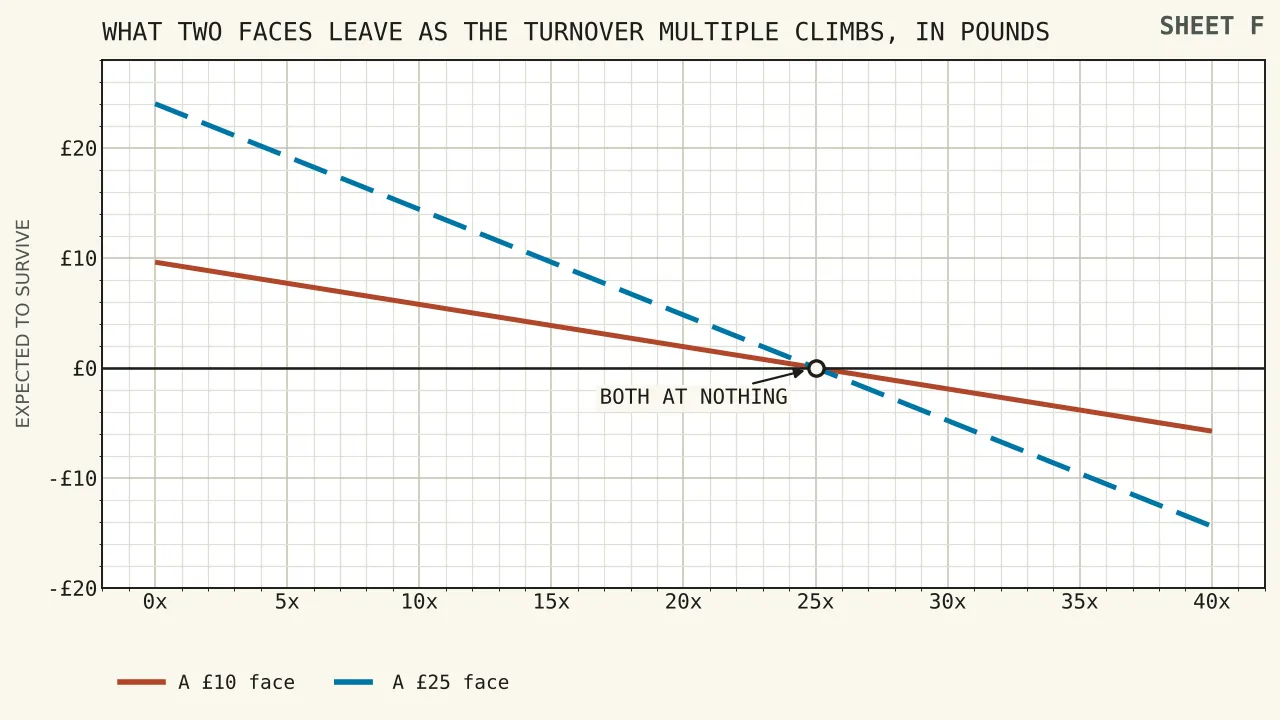
One figure governs every note in this section and it is not a term anybody wrote. Take a face, apply a multiple, and the expectation left is the face times one less four hundredths of that multiple. At twenty-five turnovers that bracket is empty whatever the face, because four hundredths is the keep of a game paying 96 pence back and 0.04 fits into 1 twenty-five times over.
| Turnovers asked | Share expected to survive | On a £10.00 face | On a £25.00 face | What the ceiling permits |
|---|---|---|---|---|
| Five | Four fifths | £7.68 | £19.20 | Inside the British cap |
| Ten | Three fifths | £5.76 | £14.40 | The cap exactly |
| Fifteen | Two fifths | £3.84 | £9.60 | Above it |
| Twenty | One fifth | £1.92 | £4.80 | Above it |
| Twenty-five | Nothing | Nil | Nil | Above it |
| Forty | A deficit of three fifths | Minus £5.76 | Minus £14.40 | Far above it |
Three things follow and each one does work in the notes below. First, the figures in the two middle columns are proportional to the face, so a reader who knows the share surviving at their multiple can price any headline in their head. Second, the ceiling of ten turnovers under a British licence is not a mild restriction: it is the row at which three fifths survive, and the rows beneath it run all the way to a deficit. Third, the last row is where a headline costs a reader their own money rather than merely failing to pay out, and a face of £25.00 at forty turnovers is expected to take £14.40 of it.
That ceiling has a date and a shape, stated once here. Since 19 January 2026 a British licence stops a play-through at ten turnovers of the credit, and what stops there is any requirement to stake a total before a part of it turns withdrawable. Only the multiple is held. A bigger percentage therefore leaves the turnover per pound of credit alone and lifts the credit instead, lifting the staking by the same proportion.
5
Nineteen notes, grouped by their unit
These notes divide by what their headline actually names, which is the division part 2 says matters most. Ten of them name a count of presses, six name a sum of money, and three name something else entirely.
The counts run from the smallest to the largest face this site prices. 5 free spins no deposit takes a face of 50p and finds a survivor standing 34.72 times below the lowest payable sum. 10 free spins prices the unit every other count is built from, at a pound. 25 free spins on registration no deposit turns a near miss into one number. 40 free spins no deposit is the one page where the count and the multiple agree. 100 free spins no deposit measures a face in seconds of entitlement rather than in pounds. 150 free spins no deposit is the nearest miss on the site and the most expensive one. 200 free spins is about a clock rather than a ceiling. 1000 free spins no deposit lands on the ladder’s top step exactly. Free spins no deposit is the general case, priced in pence. And 20 free spins on registration no deposit is the page where the price of a press is left unstated, which puts the face anywhere between a pound and twenty.
The sums of money behave differently, because they arrive whole. Free £5 no deposit casino is a credit below every denomination, so the instrument cannot express it. Free £10 no deposit sets a sum against a count of the same size and prices the 40p between them. £20 free no deposit casino lands on a rung at both ends, so the ceiling does all the stranding by itself. £30 free no deposit is two rungs exactly going in and an awkward figure coming out. Casino no deposit bonus prices the middle of the range to the penny. And 100 free welcome bonus no deposit required is the page part 2 was written for, where one headline has two readings £54.24 apart.
Three notes name a unit of their own. Free daily spins pays a face in thirty instalments and lets a clock do the stranding. Bingo no deposit bonus counts in tickets rather than presses, which changes which rules apply. And Crypto casino no deposit bonus is quoted in one unit while the floor it has to clear is quoted in another.
| The group | The missing number | What it decides |
|---|---|---|
| A count of presses | The price of one press | The face, by a factor of up to a hundred |
| A sum of money | Nothing, the face is given | Only the multiple and the floor remain |
| Instalments | How many arrive before the clock | What share expires uncollected |
| Tickets | The price of one ticket | The face, and which product rules bite |
| A unit that is not sterling | What the unit fetches that day | Both the face and the floor |
6
Six other questions about the same figure
Seven questions get put to a prepaid face on this site and this section asks the first of them. The other six have their own headings, and a reader whose real problem is a denomination or a weighting is in the wrong place here.
| Heading | Its question | Bearing on a headline |
|---|---|---|
| This one | What is printed, before anything | Supplies the face itself |
| The rung | What the instrument costs | Rounds a wanted sum upward |
| The spend-down | What clearing costs | Takes four pence in the pound |
| The stranded part | Which slice never comes off | Caps a headline from above |
| The way out | What leaving costs | Decides whether any of it is money |
| Off the register | What a missing licence is worth | Removes the ceiling on the multiple |
| The room | Where it has to be spent | Raises the staking per pound |
The spend-down is the natural step from here, since this heading stops at what a headline is worth and that one starts with what happens to it.
7
What the rule on incentives actually holds
A single code provision governs every headline in this section on the licensed side, and what it reaches is worth knowing. Hand over money, goods, services or any other advantage, by way of a reward, an incentive or an arrangement of that sort, to a customer or a prospective one, and the provision bites. Its first demand is on the terms: clear, fair, and put where the person offered the thing can find them.
| Prohibited | What it protects in a headline | Figure it bears on |
|---|---|---|
| A multiple above ten | The share expected to survive | Three fifths, in part 4 |
| Two product types, one incentive | The rule set that governs a face | The ticket group in part 5 |
| Repricing an early finish | The figure as advertised | Everything, where it moves |
| Travel tied to expected play | Nothing in a headline of this kind | None here |
Two more limbs deal with customers marked high value, asking that incentives aimed at them sit with the licensing objectives and with guidance the regulator publishes on exactly that. Scope runs wide, taking in ancillary remote licences and leaving out only the technical and software ones. That condition’s page gives no effective date at all.
One figure belongs beside the table in part 4, and on the sheet behind this site it is the lone market multiple the regulator itself can be quoted for. Up to sixty times, it records, was being applied by some licensees. Feed sixty into part 4’s arithmetic: ten pounds of face finishes £14.00 beyond the end of itself and twenty-five pounds of face finishes £35.00 beyond it. Both are expected losses of a reader’s own money on something advertised as costing nothing, and both are what a ceiling of ten turnovers displaced.
A second figure from the same place needs its owner attached. Answering the consultation, one operator reported three quarters of its own offers already sitting between one and ten times. That belongs to one operator describing its own offers, not to the regulator describing a market, and this site never lets the first stand in for the second.
8
The figures this section declines to invent
The most important absence on this page is the price of a press. No primary source puts a value on a free spin, identifies whoever settles that value, or imposes any duty to publish it. The number of pence a press is worth is a commercial choice, and a reader will find it in the terms or not at all. Every note under this heading uses 10p as a stated assumption and shows what changes when it moves, which is the honest response to a gap of that size.
Beside it sits a second absence. Nobody has published whether the ceiling reaches a free press as bonus funds. These notes say only the narrower thing, which is that a requirement on winnings from a free press, once those winnings land in a bonus balance, stops at ten times. Further than that in either direction is barred, and no note here goes there.
Nor is there a published game-contribution table, a standard maximum-win cap on credit winnings, or a rule converting winnings into bonus funds. None of those appears here as a figure. Where a note needs a weighting it says what it has assumed, and the section on the room exists precisely because that assumption does so much work.
Two last refusals. These notes carry no payout speed for any counter and no promotion code, both being the most perishable facts in the subject. And nothing here bears on reaching a site a reader has shut against themselves, or on getting past a bank’s gambling block. A British licence cannot be held without belonging to the national exclusion scheme, which puts every licensed company inside it, and the scheme itself reports that companies outside it lie beyond anything it can do. The care note below carries the free helpline.
Questions
- Why is a headline not a quantity?
- Because it may carry no unit at all. A hundred comes to £1.00 at a penny a press, £10.00 at ten pence, £50.00 at fifty, and £100.00 read as cash. Across that spread of a hundred times, half the readings leave a balance a £10.00 payout floor holds entire and half do not.
- What does the edge take before any term applies?
- Four pence out of every pound of face, that being the keep of a game paying 96 pence back. Expressed as presses, a ten pound face is worth £9.60 at the instant of crediting, so 40p is gone before a word has been read. The deduction is the game’s rather than the terms’, which is why no offer waives it.
- Is a count the same as a sum?
- No, and on a ten pound face the difference is 40p. Money credited as money arrives whole with the edge still in front of it. Presses credited as presses arrive reduced already, the presses being what carry the edge. Equal printed sizes therefore do not make equal offers.
- What is the highest multiple worth having?
- Anything beneath twenty-five, and the nearer to nothing the better. Survivor is the face times one less four hundredths of the multiple, which empties at twenty-five and goes three fifths into deficit at forty. Forty turnovers on a £25.00 face are expected to take £14.40 of a reader’s own money.
- Does a bigger percentage match improve the ratio?
- No. Only the multiple is capped, never the percentage, so a larger match lifts the credit and lifts the staking by the same proportion. Against a £10.00 payment the ratio holds at ten to one whether £10.00 or £40.00 is issued, and the bigger headline is simply the bigger obligation.
- Who fixes the price of a free press?
- The operator does, as a commercial choice. No primary source puts a value on a free spin, identifies who settles it, or imposes a duty to publish it, so 10p serves here as an assumption stated out loud and then moved to show what depends on it. A count with no price beside it is one number short of a sum.
- What does the incentive rule demand of the terms?
- Clarity, fairness, and a place where whoever was offered the thing can find them. What the provision bites on is the handing over of money, goods, services or any other advantage, by way of a reward, an incentive or an arrangement of that sort, to a customer or a prospective one, and its scope leaves out only the technical and software licences.
- How high did multiples go before the ceiling?
- As high as sixty times, by the regulator’s own account, and that is the one market multiple quotable to the regulator instead of to somebody else. Sixty turnovers carry ten pounds of face £14.00 beyond the end of itself, and twenty-five pounds of face £35.00 beyond it, both being expected losses of a reader’s own money on something advertised as costing nothing.
- What does the ten-turnover ceiling actually cap?
- A requirement to stake some total before any part turns withdrawable, stopped at ten turnovers of the credit since 19 January 2026. Nothing holds it where a British licence is absent, so the same face may carry forty turnovers instead, and on ten pounds that is £5.76 surviving against £5.76 of deficit.
- Which notes here should a reader start with?
- The one matching the unit in their headline. Ten of these notes price a count of presses, six price a sum of money, and three price something else: instalments across a month, tickets rather than presses, and a face quoted in a unit that is not sterling. Part 5 sorts all nineteen by that test.
- Is a free press covered by the ten-turnover cap?
- Unpublished, and this site will not guess at it. What the ceiling is written about is bonus funds, so a requirement on winnings from a free press, once those land in a bonus balance, stops at ten times. Whether free presses themselves are caught is stated nowhere, and no note here claims it in either direction.
- What is the smallest residue any of these notes reports?
- Forty pence, on a face of £10.00 expressed as a hundred presses at ten pence. That is the edge alone, with no play-through, no ceiling and no clock involved. Everything larger in this section is a term doing something on top of it, and the largest residue reported is the whole face.