Note M03 Revision 1 Terms read 16 October 2026
New casino sites: pricing a room with no history behind it
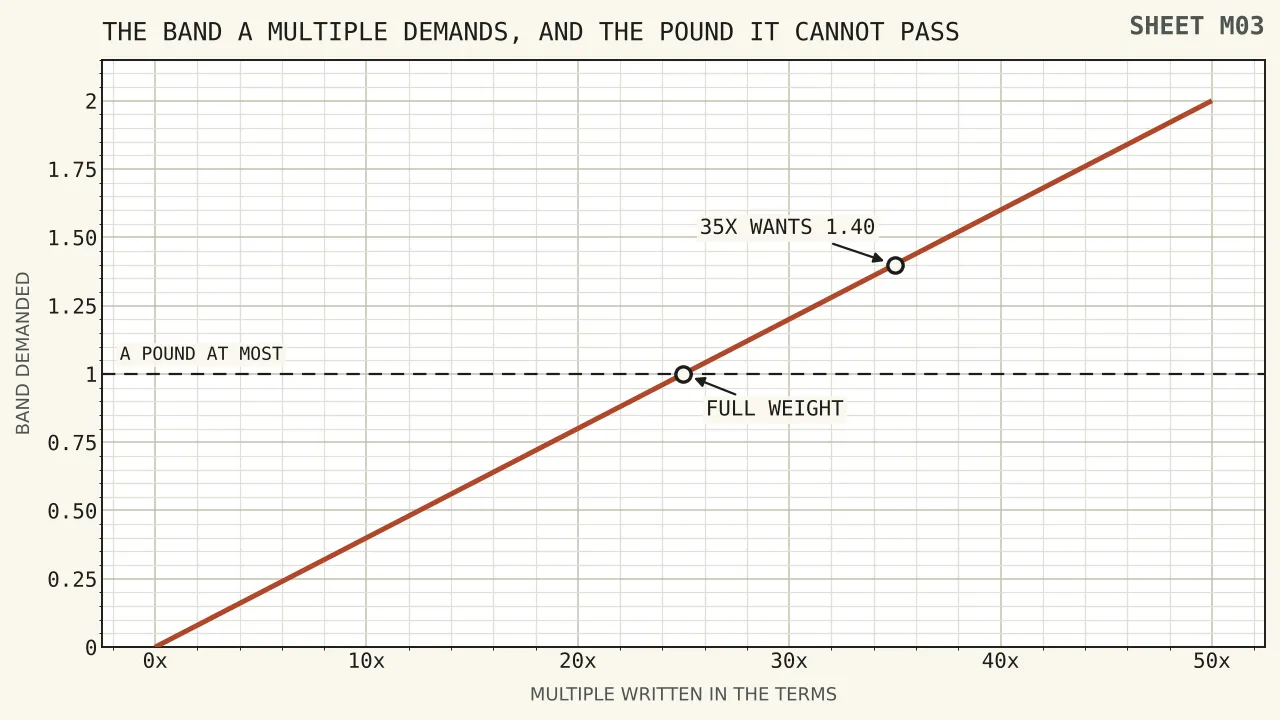
A room that opened last month has published no return, no contribution schedule and no payout record. What it has published is a multiple, and a multiple on its own fixes the weighting a reader would need. At thirty-five times the band wanted is 1.40, which is above anything that exists, and a £50.00 credit is then asked for £70.00 of expected cost. The rung strands £5.00 before any of that starts.
The face £50.00 of credit What draws it down £70.00 asked for What is stranded £5.00 and the face
What a face of this size is worth
Every destination on this rack is bought advertising. The site takes a fee if a reader goes on to register, and no figure printed below moves because of it.
Face and Residue
Strip No 01
Betportal
Ceiling as a multiple
Priced at this site's own 10p a spin
What is printed
What draws it down
What is stranded
No Great Britain licence
Licensed in Anjouan, Comoros, run by BetPortal Gaming Ltd, with Excite Ultra Media Ltd, reference ALSI-202601040-FI2.
Terms read 16 October 2026
Open the offer at Betportal, opens in a new tabFace and Residue
Strip No 02
WinBeast
Ceiling as a sum
Priced at this site's own 10p a spin
What is printed
What draws it down
What is stranded
No Great Britain licence
Licensed in Curaçao, operator not named on the site.
Terms read 16 October 2026
Open the offer at WinBeast, opens in a new tabFace and Residue
Strip No 03
EliteSpin
Longest spin window
Priced at this site's own 10p a spin
What is printed
What draws it down
What is stranded
No Great Britain licence
Licensed in Costa Rica, run by PrimeTier Limited.
Terms read 16 October 2026
Open the offer at EliteSpin, opens in a new tabFace and Residue
Strip No 04
Crown Jewelz
Multiple unpublished
No residue struck
What is printed
What draws it down
What is stranded
No Great Britain licence
Licensed in Curaçao, number not verified, operator not named on the site.
Terms read 16 October 2026
Open the offer at Crown Jewelz, opens in a new tabThe two figures in the second and third registers are this site's own arithmetic and nothing an operator has published: the face as printed, less the share a spin gives back at 96 per cent return to player, less what playing the wagering through costs at the same return, and then less whatever a published ceiling, a charge on the way out or a floor on the smallest withdrawal takes off what survives that. The residue is what is left of the face when all of it is accounted for. It describes the offer, not one reader's afternoon. Where the conditions price above the face the strip prints nothing coming off rather than a negative sum, and where a figure the sum needs is unpublished it prints the condition in the operator's words instead.
A face paid as spins has no unit of its own, so one is supplied. Where an operator publishes what a spin of its own is worth, that figure stands in the first register's own line and is labelled as theirs. Where it does not, this site's own 10p a spin stands there and says so, and every figure below moves in proportion: at half the price, half the money. The share of the face that does come off is also given as pence in the pound, which is the figure that compares a large face against a small one.
Money goes onto a prepaid voucher in fixed denominations, so a smallest deposit published in pounds is rounded up to the first rung of the ladder this site works in, £10, £20, £25, £50, £75 and £100, and the strip prints what that rounding strands. That is the reader's own money and it is never netted into a residue. A smallest deposit published in euros is printed as the operator publishes it, because the ladder here is a sterling one and rounding a euro sum to it would be an invented figure.
Three words stand in the amount column where no figure can. Noted is a published condition that takes value away without leaving the sum a figure to take. Unpriced is a condition whose figure nobody has published, or a credit that is not a sum until a deposit of your own sets it. Own money is money of yours, which is never part of a residue.
Not one of the operators printed above holds a Great Britain licence, so the duties that licence carries do not reach them. All online gambling companies licensed in Great Britain must be part of Gamstop Online, and a reader who has shut themselves out through the scheme is therefore not shut out here. The ceiling of ten times the bonus funds on a wagering requirement, in force since 19 January 2026 under Social Responsibility Code 5.1.1, is a condition of that licence and binds the companies that hold one. On an unlicensed site the Gambling Commission describes consumers as facing unfair gaming practices, financial loss and a lack of recourse if things go wrong, and it names blocked payouts and withdrawal limits set so high they are unattainable among what it has seen. Nobody under 18 may hold an account at any of them.
Every term printed on a strip is the operator's own, and each strip carries the day it was read. The oldest of those readings is 16 October 2026. What binds a reader is the operator's own full terms, and not a line printed here.
1
What newness can and cannot tell you
A reader looking for a room that opened recently is looking for something specific, and it is worth saying plainly what it is. Fresh offers, usually. A cashier that has not yet learned to be slow. Occasionally a licence granted so recently that the account number is high.
What newness cannot supply is the one thing this section cares about: a record of what the room does to a face once it has been credited. There is no payout history to read, no complaints record, and no accumulation of published terms to compare against last year’s. A new room is a set of promises with no past tense.
So the method here runs the other way round from the usual one. Instead of taking what a room publishes and pricing it, this page takes the only figure a new room reliably prints, the play-through multiple, and works out what the room would have to be like for that multiple to leave anything behind. The answer is a weighting, and it is exact.
g > W ÷ 25 at a 96 per cent return: the band a multiple demands
Read it as a demand rather than as a description. A requirement at ten times demands a band above 0.40 before a penny survives. Twenty times demands above 0.80. Twenty-five demands 1.00 and leaves zero at it. Thirty-five demands 1.40, and 1.40 is not available to anybody, since a staked pound contributes at most a pound. The multiple is published, the demand follows from it, and whether the room can meet the demand is a separate question the room need not answer.
That is a more useful posture towards a new room than trust or suspicion. It converts an unknown into a conditional. Where the schedule counts qualifying games whole, ten times against £50.00 of credit leaves £30.00 expected. Where it counts them at a fifth, the same requirement leaves nothing and spends £200.00 of staking establishing that.
One more thing newness does not change. A room opened last month and holding no Great Britain licence is subject to exactly what any other unlicensed room is subject to, which is the rulebook of wherever it is registered and nothing of the British one. Part eight prices that, and the new-room case has a particular sharpness to it, because a reader has no track record to fall back on and no regulator obliged to answer.
Four figures are held constant across this site, so notes can be read against each other: 10p for a unit of play, 96 per cent back from a game, forty times as the house multiple, and g at 1.00 wherever no sentence says otherwise. Section m exists to move g, so it moves here often and the mover is always named.
2
A £50.00 rung against a £45.00 line
New rooms tend to ask for a larger qualifying deposit than established ones, and the reason is not sinister: a new cashier has no history with which to price a small depositor. Take a qualifying line of £45.00. The prepaid ladder has no step on £45.00, so the £50.00 step is what gets bought, and £5.00 of the purchase buys nothing.
| Step bought | Clears the line | Left above it |
|---|---|---|
| £10.00 | No | Nothing opened |
| £20.00 | No | Nothing opened |
| £25.00 | No | Nothing opened |
| £50.00 | Yes | £5.00 |
| £75.00 | Yes | £30.00 |
| £100.00 | Yes | £55.00 |
Note how the gaps widen going down the ladder. Between £25.00 and £50.00 there is a £25.00 jump, and a qualifying line anywhere inside that jump produces a residue between a penny and £24.99. The ladder’s own shape therefore decides the residue, and the residue is largest where the steps are furthest apart. At £45.00 the reader is near the top of the gap and gets off lightly with £5.00.
Five pounds sits in the position that defines a residue on this site. Above the qualifying line, so it earned nothing. Beneath a £10.00 payout floor, so it cannot come back off. Neither of those positions is the result of a term, which is why neither is fixed by the rule that does govern terms at the exit.
That rule bears stating once. Deposit balances are not to be capped by any term at all, on the way out or otherwise. As a specimen of wording that offends, the regulator prints a £50 day limit alongside a £500 week limit; annualised, that keeps the player’s own money below £26,000. Deposit balance is the limit of its reach, and whatever ceiling sits on a bonus outcome is outside it.
So £5.00 of a £50.00 purchase has two possible endings and no third. It is staked into the room, where 4p of every pound goes to the edge, or it stays on the account indefinitely. A new room is no more able to pay out £5.00 against a £10.00 floor than an old one.
3
Working the crossing backwards from the multiple
Here is the whole table, built from the one figure a new room prints. The credit is £50.00 throughout. The return is the 96 per cent this site assumes. The weighting column is a demand, not an observation.
| Multiple written | Band demanded | Can a room meet it | Staking at full weight | Cycles at 10p | Expected cost | Left of £50.00 |
|---|---|---|---|---|---|---|
| 10 times | 0.40 | Yes, on a mixed floor | £500.00 | 5,000 of them | £20.00 | £30.00 |
| 15 times | 0.60 | Yes, on stronger bands | £750.00 | 7,500 of them | £30.00 | £20.00 |
| 20 times | 0.80 | Only near full weight | £1,000.00 | 10,000 of them | £40.00 | £10.00 |
| 25 times | 1.00 | Zero exactly, at full weight | £1,250.00 | 12,500 of them | £50.00 | Nothing |
| 30 times | 1.20 | No band reaches it | £1,500.00 | 15,000 of them | £60.00 | £10.00 past zero |
| 35 times | 1.40 | No band reaches it | £1,750.00 | 17,500 of them | £70.00 | £20.00 past zero |
| 40 times | 1.60 | No band reaches it | £2,000.00 | 20,000 of them | £80.00 | £30.00 past zero |
| 50 times | 2.00 | No band reaches it | £2,500.00 | 25,000 of them | £100.00 | £50.00 past zero |
Column three is actionable with no other knowledge of the room at all. Above twenty-five times, the demand exceeds full weight and no choice of game closes the gap. That is not a judgment about a new room’s honesty. It is a statement that the arithmetic has no solution, in the same way that no sequence of correct play turns a negative expectation positive.
Thirty-five times is the row this page is written against, because it sits comfortably inside what this part of the market writes and comfortably outside what any weighting can satisfy. At thirty-five times a £50.00 credit asks £1,750.00 of staking at full weight. The expected cost of that staking is £70.00. The credit is £50.00. So the gap closes out of the reader’s own money, or the requirement is left unfinished.
British practice puts a hard edge on that. Ten times bonus funds has been the licensee’s ceiling since 19 January 2026, and provision 5.1.1 carries it as the third of its prohibitions, at (a). Gaming machine technical and gambling software are the two classes outside it, so remote casino is inside. Only the first row of that table is therefore available to a licensee, and the bottom four cannot be written at all.
The replaced figure is the regulator’s, not this site’s: multiples as high as 60 were in use among some licensees. At sixty times on a £50.00 credit the staking at full weight is £3,000.00, the expected cost £120.00, and the shortfall £70.00. Reading the lid against the condition, it looks less like a tightening of terms and more like the deletion of a category whose sums never closed.
Two gaps are recorded here rather than filled. Bonus funds are what the lid is written about, and nothing published addresses a requirement that also reaches the deposit. Whether a spin given away is itself bonus funds has no published answer. A new room’s terms may well do either, and this page does not guess which.
4
Twelve hours of cycles behind thirty-five times
Cycles convert to time wherever a floor exists to multiply by. On the licensed side one does, and reel-based play is what it covers: an interval of 2.5 seconds, taken from one game’s start to the soonest a further game may begin, with the start control let go and pressed again between.
Apply that to the rows of part three and the obligation acquires a duration. Seventeen thousand five hundred cycles at 2.5 seconds is 43,750 seconds. That is 12 hours 9 minutes and 10 seconds of continuous play, at the fastest a licensed reel is permitted to run, and no allowance for looking at a screen or picking a game.
| Multiple | Cycles bought | Time, at the least | Seconds behind it | Expected hourly |
|---|---|---|---|---|
| 10 times | 5,000 | 3 hours 28 minutes | 12,500 | £8.64 |
| 15 times | 7,500 | 5 hours 12 minutes | 18,750 | £3.84 |
| 20 times | 10,000 | 6 hours 56 minutes | 25,000 | £1.44 |
| 25 times | 12,500 | 8 hours 40 minutes | 31,250 | Nothing |
| 35 times | 17,500 | 12 hours 9 minutes | 43,750 | Nothing |
Dividing survival by the least possible time gives the hourly column. At ten times the figure is £8.64 an hour in expectation. At fifteen times it is £3.84. At twenty times it is £1.44. From twenty-five upwards it is nothing per hour for the whole of a working day, and beyond twenty-five the reader is funding the tail of it themselves.
Three rules keep that floor standing where a British licence governs, and a new room beyond the licence keeps none. Auto-play has no place in online gaming; the commitment is cycle by cycle, poker blinds posted automatically being the exception. Hurrying a result is barred, with turbo, quick spin and slam stop each named in guidance. And a system may not provide the functionality that eases simultaneous play, which takes in split screens along with multi-screen layouts.
Strip those away and 17,500 cycles do not become cheaper. They become shorter, and shorter is worse, because the cost per hour of a negative expectation rises exactly as fast as the pace does. A room that can run four cycles a second delivers the same £70.00 of expected cost inside 73 minutes. The money is identical and the number of decisions a reader gets to reconsider has fallen by a factor of ten.
17,500 cycles: 12 hours 9 minutes at the licensed floor, 73 minutes with no floor at all
5
Statuses on the register, and what each one is
A new room’s licence position is the one fact about it that can be checked on day one, free, from a public source. The register publishes businesses, personal licences and premises, each searchable and each downloadable, alongside regulatory actions and public statements. Operators recorded on 31 March 2026 numbered 2,154, with 3,097 licensed activities between them.
What the register does not publish is any guidance on reading itself. No page on it explains what a domain listed against a licensee means, or how to interpret a status word. That absence matters here more than anywhere, because a new room is precisely the case where the status words carry the information.
| What the register shows | What it means | What it does not mean |
|---|---|---|
| Active, on a licence | The activity is authorised | Nothing about the terms offered |
| Pending, on a licence | An application exists | No authorisation yet |
| Surrendered, on a licence | The holder gave it up | Not a current permission |
| Active, on a domain | Listed against that account | Nothing about who runs the brand |
| Inactive, on a domain | Listed, not in use there | Not evidence the site is gone |
| White Label, on a domain | A licensed domain on another’s licence | Not an unlicensed domain |
Each row of that table is a real distinction and three of them produce real mistakes. Take Pending first. One licensee’s account carries four General Betting Standard applications recorded as Pending, with the licence number given as a string of zeros and no start date against any of them. An application sitting there is not a licence, and a room advertising an activity it has only applied for is advertising something the register does not yet authorise.
Then Surrendered, which is the status a reader looking for new rooms will least expect to meet. One account’s four remote licences, bingo, casino and two betting categories, are all recorded as surrendered with an end date of 9 March 2026, and the brand’s domain shows as Inactive. A site can therefore stop being licensed while its name goes on meaning something to a search engine. Newness and currency are different properties, and only the second can be checked.
Then the two-account case, which is the commonest confusion. One brand’s domain may show Inactive against one account and Active against a second, the brand having changed licence holder. Account 51250 carries the domain for one well-known brand with status Inactive, and that company’s only current licence is for remote gambling software; account 60629 carries the same domain Active, with remote bingo and remote casino licences both running from 29 September 2023. Reading only the first account would put the brand outside the licensed sector, and reading only the second would miss that it used to sit elsewhere.
Newness itself does show up on the register, and it shows up as a date. One account’s four remote licences, covering bingo, casino and both betting categories, all start on 28 August 2025, which made that brand’s British authorisation barely over a year old when the register was downloaded on 15 October 2026. That is what a genuinely new licensed room looks like in the data: a high account number and a single recent start date across every activity.
The check the regulator itself recommends takes about a minute. A licensed status appears somewhere on the room’s pages; the link under it reaches the register; and the activities and domains recorded there either match the page’s claims or they do not. Any page using register data should publish the day it looked, because nothing on the register is dated for the reader.
6
A term in new-casino bonus rules has drawn a penalty
One published enforcement outcome lands squarely on this page’s subject, and it is the sharpest available fact about the terms a new room attaches to an offer. A sum of £170,000. A decision dated 3 July 2025. A licensee named Taichi Tech Limited, trading as Fafabet.
Where the wording sat was the bonus rules governing that operator’s new casino promotions, and what it reserved was discretion over an account’s closure and over winnings already credited. Fair and open dealing, as a licensing condition, was treated as breached. Transparency was described as lacking and consumer outcomes as potentially unfair, with a third-party audit ordered independently over anti-money-laundering controls and over safer gambling ones.
Two things follow; one does not. A clause of that shape is the only item in a new room’s bonus terms with a published penalty standing behind it, so it is the item to read first. The penalty attaches to a licensee, so the deterrent exists where a licence does and nowhere else. What does not follow is that the term was struck down: a fine is not that, and no page should call it one.
Priced on this page’s figures, a discretionary forfeiture is the only mechanism that can take the whole £50.00 with no arithmetic involved at all. Everything else in this note is probabilistic and slow: 4p in the pound, 17,500 cycles, 12 hours. A forfeiture clause does the same work in one line of a document and needs no play-through to get there.
Alongside that sits a quieter problem a new room can produce without any discretion at all, and one operator’s own pages showed it on a single day. A promotions page body said a 50 per cent match worth up to £100, with small print giving a £100 maximum bonus. A registration banner on the same page advertised 50 per cent up to £200, carrying identical small print that said £100. The safest reading for a reader is the small print, and the safest reading for a page is to record both and pick neither.
The same small print carried a conversion term worth isolating, because it is not a winnings cap and is often mistaken for one: the maximum bonus conversion to real funds was set equal to lifetime deposits, up to £250. That ties what can be taken out to what has been put in. On a £50.00 first purchase, the convertible ceiling is £50.00 until more is deposited, however the play goes.
A conversion ceiling tied to lifetime deposits caps a £50.00 depositor at £50.00
Prominence rather than silence is what the advertising rules ask. A significant condition whose omission would be likely to mislead belongs in the material, clearly and prominently. Four kinds sit on the worked list. Eligibility, by newness or age or place. A deposit or a wagering requirement. A deadline, either for claiming or for using. And a minimum on odds, or a restriction by bet type. Online, a click is about the distance the full terms may sit at, and a footer link is not within it.
7
The exit, and the £5.00 beneath it
Suppose the friendliest row of part three. Ten times, full weight, nothing forfeited, and £30.00 of the £50.00 credit expected through. A £10.00 payout floor is cleared three times over, so that money gets out. The £5.00 from part two is in a different position entirely.
Five pounds against a £10.00 floor is £5.00 short, which is the neatest version of this site’s problem: the sum needed to release the residue is identical to the residue. Playing it up is the obvious move, and the arithmetic declines. A single circuit of £5.00 through a game paying 96 per cent costs 20p expected. Five circuits cost £1.00. Twenty-five circuits cost the £5.00 entire. Volume does not improve an expectation, since the edge never changes sign.
£5.00 under a £10.00 floor, £5.00 short, at 20p of expected cost per circuit
Adding money has a symmetry to it that is worth printing. The reader needs £5.00 to reach the floor. The smallest step on the ladder costs £10.00. Buying it produces a balance of £15.00 against a £10.00 floor, which clears, and leaves £5.00 of fresh purchase doing nothing the moment the £10.00 goes out. The residue is not removed by topping up. It is reproduced one step further along.
What holds the exit open where a British licence governs is set out below. None of it is a property of new rooms or old ones. All of it is a property of the licence.
| What is required | Of whom |
|---|---|
| No cancel button on a request | Every licensee |
| No redepositing requested funds | Per the guidance |
| Friction kept down | As far as achievable |
| No ceiling on the deposit balance | Absolute |
| Reasonableness on size and number | Where limits exist |
| No document demand at the exit | Where asking earlier was open |
Away from the licence, the regulator has described the failure. On 21 October 2025 its enforcement and intelligence director gave two mechanisms: a blocked pay-out, and a withdrawal threshold nobody attains. For a new room both are available immediately and neither leaves a trace a reader could have checked beforehand, which is the precise respect in which newness is a cost rather than a feature.
8
What a new room off the register does not carry
A room this new holds no Great Britain licence, and the absence costs more here than elsewhere, because the usual stand-in for regulation is reputation and a room four weeks old has neither. What follows is the itemised version, priced against the £50.00 credit this note has used throughout.
| What a British licence imposes | Priced on £50.00 |
|---|---|
| A lid of ten on the multiple | £30.00 survives rather than £20.00 past zero |
| An interval of 2.5 seconds | 12 hours 9 minutes rather than 73 minutes |
| A per-cycle stake lid | £5, or £2 for a player under 25 |
| A penalty behind a forfeiture clause | £170,000, on one published decision |
| An entry a reader can check | Account number, activities, domains, free |
| A complaints clock | Fifty-six days, then an approved adjudicator |
| Verification before play | Name, address, date of birth |
| Membership of the exclusion scheme | One registration, every licensed account |
Take the register row on its own for a moment, since it is the one this page has leaned on hardest. A licensed room produces an account number, a set of activities with start dates, and a list of domains, all published by somebody other than the room. An unlicensed room produces a claim in a footer. Those two are not the same kind of fact, and the difference is free to check in one direction and impossible to check in the other.
The enforcement machinery is the other item with real money in it. Suspensions are published beside penalties and are the sharper instrument. Spribe OÜ, 30 October 2025. VGC Leeds Limited, 31 October 2025. Deadheat Racing Limited, 21 November 2025. BresBet Ltd with Bet St George Ltd, 28 August 2026. Targetlocal Ltd, 21 September 2026. For a cashier never recorded on the register, no part of that machinery applies.
It reaches the suppliers, though, which is a point a reader of new rooms should hold on to. One supplier settled at £4.75m. Evolution Malta Holding Limited, 23 July 2026, six unlicensed sites open to British consumers, its games on all of them, and visits across December 2023 to November 2024 described as large in volume. So a familiar game in a new lobby is evidence of a supply arrangement and of nothing else at all.
Curaçao’s rulebook is the comparison that matters for much of this part of the market, and a fair reading of it is owed. Eight mandatory areas are set out in version 1.0, dated 21 February 2025: checks on age, information a player can reach, self-assessment, monitoring of behaviour, cooling-off and exclusion in the player’s own hands, limits on deposits, principles for marketing, and training extending to affiliates and to influencers. A footer is prescribed too: the holder’s name, its registered address, a licence number, a statement of the authority’s oversight, a seal, and links to support bodies, with British ones among the examples.
What appears nowhere in it: a ceiling on a wagering multiple, a cap on a stake, a floor under a cycle, a bar on auto-play, or any restraint on a fanfare over a return beneath the stake. Read against part three, that list of absences is the entire explanation of how a thirty-five times requirement comes to be written.
On one point it is stricter, and an honest page says so. A cut to a deposit limit takes effect at once under that policy, while a rise waits a week, against the British 24 hours. Its thin point is the entrance: date of birth taken at registration, with photographic identification held for later money-laundering milestones and advanced only where age is doubted. So a new room offshore can credit and spend a face with no document seen, and put the document check at the exit instead.
Adjudication exists either side and differs in authorship. A British licensee may use only an entity the Commission approves, of which eight are published. Offshore, that policy makes adjudication compulsory and costless to the player, the operator paying for it, while allowing the operator to set its parameters: whether its outcome binds, and what a claim must be worth to qualify. Neither regulator recovers money. No ombudsman is how the British one describes itself, and it states that a gambling complaint is not something it can resolve.
The scheme is the last item and the one with no money in it. Participation follows a British licence, so a new licensed room joins on authorisation and a new unlicensed room never does. Published figures of 16 July 2026: 614,738 registered, growth of 16 per cent across six months, and May 2026 at 12,236, a record. Under-25 sign-ups grew 26 per cent on the preceding year, and close to one self-exclusion in three is now from that age band, which a new room’s marketing reaches most easily of all.
Tax runs the opposite way to the licence, and one line covers it. Residence of the customer is what the duty tracks, not the authorisation of the operator, so a new offshore cashier taking British money sits inside British gaming duty whatever omits it. Remote gaming has carried 40 per cent from 1 April 2026. No page may say winnings are declared exempt: the published answer is to a narrower question about trading, and it is no. None of this is tax advice.
Questions
- How do I price a room that has published almost nothing?
- Work backwards from the only figure it does publish. A multiple fixes the weighting band a room would need before anything survives, and the band is the multiple divided by 25 at a 96 per cent return. Ten times demands above 0.40. Twenty times demands above 0.80. Thirty-five times demands 1.40, which no schedule can supply, because a pound of stake cannot contribute more than a pound.
- What does thirty-five times cost on a £50.00 credit?
- £70.00 in expectation at full weight, against £50.00 of credit. Staking required is £1,750.00, or 17,500 cycles at 10p, and 4p of each pound goes to the edge. So the obligation outweighs its credit by £20.00, and that gap is either funded by the reader or the requirement is left incomplete.
- Can a new site legally ask thirty-five times in Britain?
- No. Ten times bonus funds has bound a British licensee from 19 January 2026, under the third prohibition of provision 5.1.1. Outside it sit gaming machine technical and gambling software licences only, so remote casino is in. A room with no British licence is unbound, and the Curaçao rulebook supplies no substitute.
- Is a new licence visible on the register?
- Yes, as a date and an account number. One account’s four remote licences, covering bingo, casino and both betting categories, all begin on 28 August 2025, which made that authorisation barely a year old when the register was downloaded on 15 October 2026. A high account number with one recent start date across every activity is what a genuinely new licensed room looks like in the published data.
- What is the difference between Pending and Active?
- Authorisation. One account carries four betting applications recorded as Pending, with a licence number of zeros and no start date against any of them. An application is not a licence, so a room promoting an activity it has only applied for is promoting something the register does not yet authorise. Active means the activity is authorised and says nothing whatever about the terms being offered.
- Why does a surrendered licence matter when I am looking for new sites?
- Because newness and currency are different properties. One account’s four remote licences are all recorded as surrendered with an end date of 9 March 2026, and the brand’s domain shows Inactive, yet the name still means something to a search engine. A site can stop being licensed without the search results noticing, so the status word is the thing to read rather than the ranking position.
- Has any penalty ever attached to a new-casino bonus term?
- Yes. One decision, dated 3 July 2025, put £170,000 on a licensee called Taichi Tech Limited. Fafabet is the trading name. What drew the penalty was a discretion written into the bonus rules for its promotions aimed at new casino players: an account could be closed, or winnings taken away. Fairness and openness, as a licence condition, was found breached, and an audit followed. Nothing published says the term itself was struck out, so void is the wrong word.
- What does a conversion ceiling tied to deposits do?
- It caps what can be taken out by what has been put in, which is a different mechanism from a winnings cap. One published set of small print set the maximum bonus conversion to real funds equal to lifetime deposits, up to £250. On a £50.00 first purchase that is a £50.00 ceiling until more money is deposited, whatever the play produces, and it is unaffected by the rule that bars capping withdrawals from a deposit balance.
- How long would thirty-five times take?
- 12 hours 9 minutes at the fastest a licensed reel may run. Seventeen thousand five hundred cycles at 2.5 seconds each is 43,750 seconds. Remove the floor, as a room with no British licence may, and software running four cycles a second delivers the same £70.00 of expected cost inside 73 minutes. The money does not change and the number of decisions a reader can reconsider falls tenfold.
- What is stranded here even on the best outcome?
- £5.00. A room asking £45.00 to qualify meets a ladder whose smallest adequate step costs £50.00, and the £5.00 left over earned nothing and sits £5.00 below a £10.00 payout floor. Twenty-five circuits through a 96 per cent game would consume all of it in expectation, and buying a £10.00 step to release it reproduces a £5.00 residue one step further along.
- Does a familiar game tell me a new site is safe?
- No. A notice published on 20 January 2025 sets out the position: a game supplied under licence has been found operating on sites that hold none. One supplier settled at £4.75m. Evolution Malta Holding Limited, 23 July 2026, six unlicensed sites open to British consumers, its games on all of them, and visits across December 2023 to November 2024 described as large in volume. A game a reader knows proves a supply arrangement and proves nothing about a licence.
- What is the cheapest check I can do before depositing?
- The regulator’s own recommendation, and it is free. A licensed status should be on the room’s pages, the link under it should reach the public register, and the activities and domains recorded there should match what the page claims. Write down the day you looked: the register publishes neither a guide to reading it nor a date for the reader.