Section X Revision 1 Terms read 16 October 2026
The way out
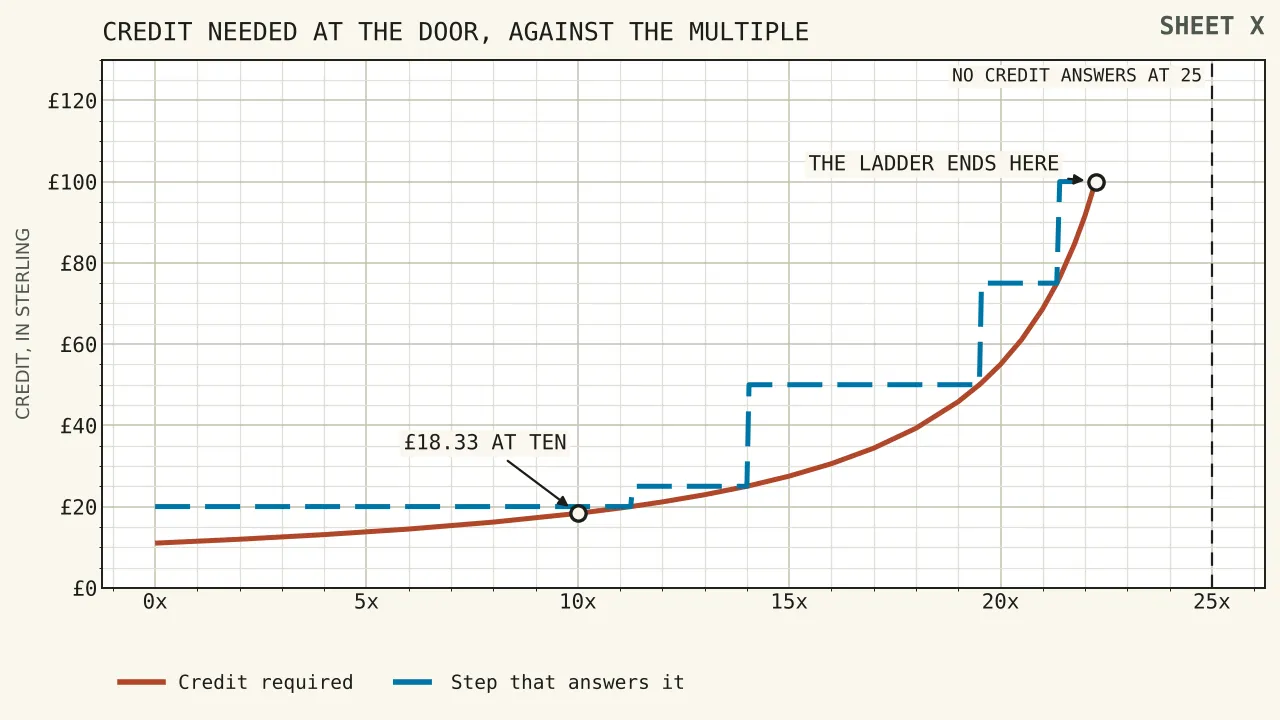
Up to the door, a residue is a forecast. At the door it becomes the amount that never left. One law governs the whole section: a credit has to be worth the floor plus the charge divided by the share that survives, which is £18.33 at ten turnovers, £27.50 at fifteen, £55.00 at twenty and no figure at all at twenty-five. Six notes stand under this heading and each takes one deduction apart.
The face £20.00, the second rung What draws it down Ten turnovers, £8.00 What is stranded £9.00, or 45 per cent
What a face of this size is worth
Every destination on this rack is bought advertising. The site takes a fee if a reader goes on to register, and no figure printed below moves because of it.
Face and Residue
Strip No 01
Betportal
Ceiling as a multiple
Priced at this site's own 10p a spin
What is printed
What draws it down
What is stranded
No Great Britain licence
Licensed in Anjouan, Comoros, run by BetPortal Gaming Ltd, with Excite Ultra Media Ltd, reference ALSI-202601040-FI2.
Terms read 16 October 2026
Open the offer at Betportal, opens in a new tabFace and Residue
Strip No 02
WinBeast
Ceiling as a sum
Priced at this site's own 10p a spin
What is printed
What draws it down
What is stranded
No Great Britain licence
Licensed in Curaçao, operator not named on the site.
Terms read 16 October 2026
Open the offer at WinBeast, opens in a new tabFace and Residue
Strip No 03
EliteSpin
Longest spin window
Priced at this site's own 10p a spin
What is printed
What draws it down
What is stranded
No Great Britain licence
Licensed in Costa Rica, run by PrimeTier Limited.
Terms read 16 October 2026
Open the offer at EliteSpin, opens in a new tabFace and Residue
Strip No 04
Crown Jewelz
Multiple unpublished
No residue struck
What is printed
What draws it down
What is stranded
No Great Britain licence
Licensed in Curaçao, number not verified, operator not named on the site.
Terms read 16 October 2026
Open the offer at Crown Jewelz, opens in a new tabThe two figures in the second and third registers are this site's own arithmetic and nothing an operator has published: the face as printed, less the share a spin gives back at 96 per cent return to player, less what playing the wagering through costs at the same return, and then less whatever a published ceiling, a charge on the way out or a floor on the smallest withdrawal takes off what survives that. The residue is what is left of the face when all of it is accounted for. It describes the offer, not one reader's afternoon. Where the conditions price above the face the strip prints nothing coming off rather than a negative sum, and where a figure the sum needs is unpublished it prints the condition in the operator's words instead.
A face paid as spins has no unit of its own, so one is supplied. Where an operator publishes what a spin of its own is worth, that figure stands in the first register's own line and is labelled as theirs. Where it does not, this site's own 10p a spin stands there and says so, and every figure below moves in proportion: at half the price, half the money. The share of the face that does come off is also given as pence in the pound, which is the figure that compares a large face against a small one.
Money goes onto a prepaid voucher in fixed denominations, so a smallest deposit published in pounds is rounded up to the first rung of the ladder this site works in, £10, £20, £25, £50, £75 and £100, and the strip prints what that rounding strands. That is the reader's own money and it is never netted into a residue. A smallest deposit published in euros is printed as the operator publishes it, because the ladder here is a sterling one and rounding a euro sum to it would be an invented figure.
Three words stand in the amount column where no figure can. Noted is a published condition that takes value away without leaving the sum a figure to take. Unpriced is a condition whose figure nobody has published, or a credit that is not a sum until a deposit of your own sets it. Own money is money of yours, which is never part of a residue.
Not one of the operators printed above holds a Great Britain licence, so the duties that licence carries do not reach them. All online gambling companies licensed in Great Britain must be part of Gamstop Online, and a reader who has shut themselves out through the scheme is therefore not shut out here. The ceiling of ten times the bonus funds on a wagering requirement, in force since 19 January 2026 under Social Responsibility Code 5.1.1, is a condition of that licence and binds the companies that hold one. On an unlicensed site the Gambling Commission describes consumers as facing unfair gaming practices, financial loss and a lack of recourse if things go wrong, and it names blocked payouts and withdrawal limits set so high they are unattainable among what it has seen. Nobody under 18 may hold an account at any of them.
Every term printed on a strip is the operator's own, and each strip carries the day it was read. The oldest of those readings is 16 October 2026. What binds a reader is the operator's own full terms, and not a line printed here.
1
The question this section answers
Every other section of this site asks what a face is worth. This one asks a narrower question: what does it cost to get the surviving part away, and which part of it was never leaving?
The distinction is not academic. A play-through is a forecast and a forecast can be revised. The door is where a forecast stops being one. Request a payout and the figure that arrives is the figure, and whatever did not arrive has joined the residue permanently rather than provisionally. That is why the deductions collected here are worth separating from the ones upstream of them, and why this section carries a different kind of arithmetic from the rest of the site.
Three deductions wait there. A minimum payout, which takes everything beneath it or nothing at all. A charge, which takes the same cash whatever the sum. And an asymmetry between the way money goes on and the way it comes off, which is where a rail that looked free turns out not to be. The notes under this heading take those apart in that order, and part 5 says which does which.
Worked quantities are fixed across this site: 10p to a press, a game handing back 96 pence per pound, unity as the weighting, and a ladder of six prepaid denominations whose bottom step is £10.00 and whose top step is £100.00. For this page, a floor of £10.00 and a charge of £1.00, both modelled rather than quoted, for the reason in part 8.
And the position every page here states plainly: offers priced out here hold no Great Britain licence. Three duties missing because of that are exit duties, and they are the hinge of this whole section. A term ceilinging payouts out of a deposit balance is barred under that licence. Offering to cancel a payout request is barred. And paperwork obtainable at the start may not be turned into the price of a withdrawal at the end. Part 7 turns each into something a reader can check in a minute.
2
Three deductions, three different shapes
Lay the three side by side on one £12.00 balance, which is what the second rung is expected to leave after ten turnovers, and the shapes separate at once.
| The deduction | Takes from £12.00 | Share of it | Takes from £60.00 | Share of that |
|---|---|---|---|---|
| A £10.00 floor | Nothing | None, once cleared | Nothing | None, once cleared |
| A £15.00 floor | £12.00 | All of it | Nothing | None, once cleared |
| A £1.00 charge | £1.00 | 8.33 per cent | £1.00 | 1.67 per cent |
| A two per cent slice | £0.24 | Two per cent | £1.20 | Two per cent |
| A five per cent move in a unit | £0.60 | Five per cent | £3.00 | Five per cent |
Rows two and three are the ones to hold in mind together. Raise a floor by £5.00 and a £12.00 balance goes from paying a charge of £1.00 to losing everything, a step of twelve times, while a £60.00 balance notices nothing. Floors behave that way at every size. All from a few, none from the others, and the denomination a reader bought decided which of those two happened to them.
A charge behaves in the opposite way, and the two columns of shares show it. The same pound is 8.33 per cent of the smaller balance and 1.67 per cent of the larger, so a fixed charge is a tax on small payouts expressed as a flat fee. A slice holds its share and grows in cash, which makes it the gentler shape at the bottom and the harsher one at the top. Where those last two swap places is the charge over the rate, and £1.00 divided by 0.02 lands on £50.00.
The bottom row belongs to a balance denominated in something other than sterling, and it is the only deduction in the set with no sign attached. A five per cent move can go either way, which means it is the one row where the arithmetic is not simply against a reader. The asymmetry is in the consequences: a favourable move shaves pence off a charge, while an unfavourable one can push a balance under a floor and take all of it.
£50.00, where a pound flat and two per cent are level
3
The crossing point, and the law behind it
Here is the single piece of arithmetic that makes this section its own, and it joins the door back to the headline. A credit carrying some multiple is expected to leave the credit multiplied by the share that survives, which is one less four hundredths of the multiple. So the least credit expected to deliver a payable balance comes to the floor plus the charge over that share.
Put the modelled £10.00 floor and £1.00 charge into it and the requirement is £11.00 of surviving balance. The ladder of credits that produces is short and it climbs fast.
| Turnovers asked | Share surviving | Credit required | Nearest denomination that works | Surplus bought |
|---|---|---|---|---|
| Five | Four fifths | £13.75 | The twenty pound step | £6.25 |
| Ten | Three fifths | £18.33 | The twenty pound step | £1.67 |
| Twelve and a half | A half | £22.00 | The twenty-five pound step | £3.00 |
| Fifteen | Two fifths | £27.50 | The fifty pound step | £22.50 |
| Twenty | A fifth | £55.00 | The seventy-five pound step | £20.00 |
| Twenty-two | Three twenty-fifths | £91.67 | The hundred pound step | £8.33 |
| Twenty-five | Nothing | No answer | Nothing on the ladder | Not applicable |
Three readings come off that table. The first is the crossing point itself: twenty-five turnovers, where the share surviving closes to nothing because 0.04 divides into 1 exactly twenty-five times. Below it a credit has a requirement; at it the requirement is infinite; above it the expectation is a deficit rather than a residue, and the question of a payout does not arise.
The second is the last column, which prices the instrument rather than the terms. A denomination ladder cannot express £18.33, so a reader meeting that requirement buys £20.00 and carries £1.67 of surplus into the arithmetic. At fifteen turnovers the gap is £22.50, because the requirement lands between the twenty-five pound and fifty pound steps and the step above is the only one that answers. The ladder’s coarseness is a cost of the exit even though it is charged at the entrance.
The third is what the bottom denomination does. Three fifths of £10.00 is £6.00, and £6.00 is under £10.00, so the smallest face this instrument sells cannot reach a £10.00 floor at any multiple whatever. That is not a term anybody wrote. It is what the three fixed quantities of this site do to each other.
4
Free coming in, dear going out
The second thing this section exists to say is that the two directions are priced separately, and a reader usually only reads one of the two prices.
Money goes on in whole denominations, so the cost at that end is the rounding: want £18.00 and buy £20.00, and £2.00 is stranded before anything happens. Money comes off through a different arrangement entirely, with a floor, a charge and sometimes a ceiling on one payment, none of which had anything to say when the money went on. A rail advertised as costing nothing to use is being described in one direction only.
| Stage | What it takes | Running total gone |
|---|---|---|
| Buying the denomination | Nothing, where the sum wanted is a rung | Nil |
| Paying it in | Nothing, on the model used here | Nil |
| Ten turnovers | Four pence in each pound staked | Eight pounds |
| The floor test | Nothing at £10.00, everything at £15.00 | Eight pounds, or twenty |
| The payout charge | One pound | Nine pounds |
| Arriving | Eleven pounds arrives | Nine pounds, or 45 per cent |
Nine pounds of a £20.00 face, and eight of those nine were spent before the door came into view. That proportion is worth remembering, because it sets the limits of what this section can do for a reader: the exit is where a residue is settled, not where most of it is made. What the exit settles is whether the £11.00 still standing is money or a figure on a screen, and a floor settles that unaided.
One further asymmetry runs through every note here, and it is about speed rather than cost. Where a payout can be cancelled and returned to a playable balance, the money meets the house edge afresh, at four pence per pound for each turnover put through it. No other part of a payout timetable carries a price, and a British licence closes this one by forbidding the offer of a cancellation outright.
5
Six notes, and what divides them
Each note under this heading takes one of the three shapes from part 2 and pushes it until it breaks. They are not six versions of one page: the deduction under the microscope is different each time, and so is the figure that comes out.
Two of them are about a balance held in something that is not sterling, which adds the only deduction in the set without a sign. Crypto casino asks what happens when the floor itself is written as a quantity of units, and finds that 98p of movement in the unit’s price can turn a residue of 50p into a residue of £11.52. USDT casino asks whether pinning the unit to a currency fixes that, and prices the answer at a penny in the pound, because a dollar peg leaves a sterling reader holding a sterling question.
Two are about the shape of the charge. Best bitcoin casino takes a superlative with no units attached and gives it one, showing that a fixed charge and a percentage swap places at a single sum and that the cheaper shape is therefore a property of the payout rather than of the counter. Ethereum casino asks what a ceiling on one payment does to a charge levied per payment, and finds it converts a flat fee into a rate of five per cent on any sum at all.
One is about the clock. Fast withdrawal casinos separates when a payment lands from how much lands, finds that no published source carries a payout speed for anybody, and prices the one thing a short wait genuinely buys.
And one is about the reel the balance was spent on. Bitcoin slots sets the hourly bill against the per-payout bill and shows the same £20.00 lasting three and a half hours at one stake and four minutes at another.
| The note | Deduction it takes apart | The figure it arrives at |
|---|---|---|
| A balance kept in units | A floor that moves in sterling | A step of 23.04 times in the residue |
| A comparative with no unit | Fixed against proportional | One crossing sum, and two wrong answers |
| A charge per operation | A ceiling on one payment | Five per cent, whatever the balance |
| A pegged unit | Two conversions, one exposure | Four per cent, as a break-even |
| A clock | Reversal inside a pending window | Four pence per pound per turnover |
| The reel itself | An hourly rate set by the stake | Fifty times, between two stakes |
6
The same face, asked six other questions
A prepaid face can be interrogated from seven directions and this is one of them. The other six are worth knowing about, because a reader whose problem is really a denomination or really a weighting will get a better answer somewhere else on this site.
The face asks what a headline is worth before anything has touched it, which matters because spins counted out are not pounds until a price per spin is named. The rung asks what the instrument itself costs, since a ladder of fixed denominations cannot express every sum and the difference goes nowhere useful. The spend-down asks what clearing a credit costs between the moment it is granted and the moment it is kept, which is the four pence in the pound this page keeps borrowing.
The stranded part asks which portion of a face had no prospect of coming off, pinned by a ceiling or a cap or a forfeiture instead of by arithmetic. Off the register asks what the absence of a British licence is worth in pounds, duty by duty, rather than asserting that it is worth something. And The room asks where a face has to be spent, because a game counting a fraction of each stake raises the staking needed without raising the credit.
Of those six, two bear directly on this one. The spend-down decides what reaches the door, and the room decides whether a credit can reach it at all. This section decides what happens once it is there.
7
Four lines to read before paying anything in
Published terms carry all of it, and they carry it before a penny moves, which makes this section the most usable on the site. Four lines, read in this order.
| What to look for | What it settles | Where the figure appears above |
|---|---|---|
| The smallest payout | Whether a balance can leave at all | Part 3, as the requirement it sets |
| The charge, and its shape | How much a payout costs, and at which size | Part 2, and the crossing in its last line |
| A ceiling on one payment | How many charges a balance will meet | Part 5, at five per cent of any sum |
| Whether a request can be undone | Whether a payout can go back to a reel | Part 4, at four pence in the pound |
Three lines out of four are governed on the licensed side and governed in no other place, and saying it that way is the honest version of what a missing British licence costs at this door. Ceilings over a deposit balance are barred, the barred shape as published putting a daily ceiling alongside a weekly one. Floors are not barred, reasonableness being the only published test of a payment’s size and of how often one comes. And offering to cancel a requested payout is barred outright.
Line four, the charge, is governed in neither regime. Nothing in either one caps what a payout may cost, so comparing counters on that line compares commercial choices and not compliance. That is worth knowing because it tells a reader which of the four lines to spend their attention on: the two that are unregulated everywhere, the floor and the charge, are the two that decide the figures in parts 2 and 3.
8
What this section will not put a figure on
Floors, charges, ceilings and unit prices across these six notes are modelled parameters, stated as such at each appearance, and the reason is not caution for its own sake. How any of them are distributed away from the British register goes unpublished by every source this site will accept. Such figures do circulate, in trade publications and on affiliate pages, and neither counts here. So the method is uniform: name a parameter, move it, and report which conclusions survive the move. That is why these notes carry ladders rather than single numbers.
The sourced contrast wants no parameter whatever. From 19 January 2026 a play-through under a British licence stops at ten turnovers, and the thing stopped is a requirement to stake some stated total before any of it becomes withdrawable. Turn to the offshore responsible gaming document this site goes through most carefully and find no ceiling in it of any size: none on the multiple, none on the stake, none on the interval between one game cycle and the next. Pull an absence out of a document anyone may open and it beats every adjective on offer.
Three more absences are deliberate. Payout speeds appear for no counter, none being published anywhere citable. Methods are not identified as ones a counter accepts, in either direction, and no method is weighed against another for counters lacking a British licence, that sort of comparison being of use chiefly to somebody set on defeating a block. And reopening an account somebody has shut against themselves is not a subject this section touches.
The facts on that point run in the opposite direction. No British licence is held without membership of the national exclusion scheme, that being one of the licence’s own conditions, and the scheme says of itself that companies standing outside lie beyond its reach. The National Gambling Helpline, which GamCare runs, answers at any hour of any day and charges nothing for a call. A reader wanting the registration periods, or the cost-free British route to blocking software, will find both set out in the section on faces priced outside the register.
Questions
- What makes the exit different from the rest of the arithmetic?
- Finality. Before a payout is requested, a stranded figure is a forecast and forecasts move. Afterwards the sum that arrived is the sum, and anything which failed to arrive has joined the residue for good. Deductions in this section settle a number instead of predicting one.
- What is the smallest credit worth buying?
- Floor plus charge, over the share that survives. Against a £10.00 floor and a £1.00 charge that comes to £18.33 for ten turnovers, £22.00 for twelve and a half, £27.50 for fifteen and £55.00 for twenty. Twenty-five turnovers have no answer whatever, since by then the surviving share has closed to nought.
- Why does twenty-five keep appearing?
- Because 0.04 divides into 1 exactly twenty-five times, four hundredths being what a game paying back 96 pence keeps on each pound. Twenty-five turnovers leave a credit expected to be worth nought, so no floor gets cleared and no charge gets paid, whatever the credit was.
- Which hurts more, a floor or a charge?
- A floor, by a wide margin, though only for the readers it catches. Lift one from £10.00 to £15.00 and a £12.00 balance goes from paying a pound to losing twelve, a step of twelve times over, while a £60.00 balance notices nothing. Charges take a little from everybody. Floors take everything from a few.
- When is a fixed charge better than a percentage?
- Past the sum where the two cost alike, which is the charge over the rate. A pound flat and a two per cent slice are level at £50.00. Beneath it the slice costs less, taking 24p from £12.00 against a whole pound. Beyond it the flat charge costs less, taking a pound from £200.00 against £4.00.
- Can the bottom denomination ever reach a £10.00 floor?
- No, at any multiple whatever. Three fifths of a credit survive ten turnovers, which leaves the ten pound step expecting £6.00, and no denomination beneath ten pounds exists to do better. Ladder, return and multiple produce that between them, with nobody’s terms involved.
- Does a denomination ladder cost anything at the exit?
- Yes, through rounding. Ten turnovers set the requirement at £18.33, which no denomination expresses, so £20.00 gets bought and £1.67 of surplus comes along. Fifteen turnovers set it at £27.50, where the nearest workable step is £50.00 and the surplus is £22.50. The cost lands at the entrance while the reason for it waits at the exit.
- What does a reversal cost?
- Four pence per pound, for each turnover the money subsequently meets. An undoable payout sits in a window, and that window is the one priced part of any payment timetable, which is what makes a short wait worth something. A British licence bars the offer of a cancellation, so no such window exists there.
- Is a minimum payout against the rules?
- No. Ceilings are what a British licence bars: terms fixing an upper limit on payouts drawn from a deposit balance, the published example pairing a daily figure with a weekly. Minimums are a different object, tested only for reasonableness, so every floor modelled through this section survives the rule.
- Why model the charges instead of quoting them?
- Because the distribution of payout charges, of ceilings and of floors beyond the British register goes unpublished by every source this site will take, and the places carrying such numbers are not among them. Each parameter is therefore named and then moved, and what gets reported is the set of conclusions that survive the move.
- What should a reader check before paying anything in?
- Four lines, in order: the smallest payout, the charge and its shape, any ceiling over a single payment, and whether a request can be undone. Each appears in published terms, and the first two between them decide every figure in parts 2 and 3 above.
- Where does this section sit against the other six?
- At the end of them. What reaches the door is the spend-down’s business and whether anything can reach it is the room’s, while the face, the rung and the stranded part between them describe what the figure held to start with. This section covers only what happens once a balance is standing there.