Note F03 Revision 1 Terms read 16 October 2026
A 25-spin face, priced: free spins on registration, no deposit
At 10p a spin, 25 of them average £2.40. Ten times leaves £1.44. A £10.00 payout floor then wants that £1.44 to become 6.94 times itself, and 6.94 is the residue of this whole offer expressed as a single number.
The face £2.50 What draws it down £1.06 What is stranded £1.44
What a face of this size is worth
Every destination on this rack is bought advertising. The site takes a fee if a reader goes on to register, and no figure printed below moves because of it.
Face and Residue
Strip No 01
Betportal
Ceiling as a multiple
Priced at this site's own 10p a spin
What is printed
What draws it down
What is stranded
No Great Britain licence
Licensed in Anjouan, Comoros, run by BetPortal Gaming Ltd, with Excite Ultra Media Ltd, reference ALSI-202601040-FI2.
Terms read 16 October 2026
Open the offer at Betportal, opens in a new tabFace and Residue
Strip No 02
WinBeast
Ceiling as a sum
Priced at this site's own 10p a spin
What is printed
What draws it down
What is stranded
No Great Britain licence
Licensed in Curaçao, operator not named on the site.
Terms read 16 October 2026
Open the offer at WinBeast, opens in a new tabFace and Residue
Strip No 03
EliteSpin
Longest spin window
Priced at this site's own 10p a spin
What is printed
What draws it down
What is stranded
No Great Britain licence
Licensed in Costa Rica, run by PrimeTier Limited.
Terms read 16 October 2026
Open the offer at EliteSpin, opens in a new tabFace and Residue
Strip No 04
Crown Jewelz
Multiple unpublished
No residue struck
What is printed
What draws it down
What is stranded
No Great Britain licence
Licensed in Curaçao, number not verified, operator not named on the site.
Terms read 16 October 2026
Open the offer at Crown Jewelz, opens in a new tabThe two figures in the second and third registers are this site's own arithmetic and nothing an operator has published: the face as printed, less the share a spin gives back at 96 per cent return to player, less what playing the wagering through costs at the same return, and then less whatever a published ceiling, a charge on the way out or a floor on the smallest withdrawal takes off what survives that. The residue is what is left of the face when all of it is accounted for. It describes the offer, not one reader's afternoon. Where the conditions price above the face the strip prints nothing coming off rather than a negative sum, and where a figure the sum needs is unpublished it prints the condition in the operator's words instead.
A face paid as spins has no unit of its own, so one is supplied. Where an operator publishes what a spin of its own is worth, that figure stands in the first register's own line and is labelled as theirs. Where it does not, this site's own 10p a spin stands there and says so, and every figure below moves in proportion: at half the price, half the money. The share of the face that does come off is also given as pence in the pound, which is the figure that compares a large face against a small one.
Money goes onto a prepaid voucher in fixed denominations, so a smallest deposit published in pounds is rounded up to the first rung of the ladder this site works in, £10, £20, £25, £50, £75 and £100, and the strip prints what that rounding strands. That is the reader's own money and it is never netted into a residue. A smallest deposit published in euros is printed as the operator publishes it, because the ladder here is a sterling one and rounding a euro sum to it would be an invented figure.
Three words stand in the amount column where no figure can. Noted is a published condition that takes value away without leaving the sum a figure to take. Unpriced is a condition whose figure nobody has published, or a credit that is not a sum until a deposit of your own sets it. Own money is money of yours, which is never part of a residue.
Not one of the operators printed above holds a Great Britain licence, so the duties that licence carries do not reach them. All online gambling companies licensed in Great Britain must be part of Gamstop Online, and a reader who has shut themselves out through the scheme is therefore not shut out here. The ceiling of ten times the bonus funds on a wagering requirement, in force since 19 January 2026 under Social Responsibility Code 5.1.1, is a condition of that licence and binds the companies that hold one. On an unlicensed site the Gambling Commission describes consumers as facing unfair gaming practices, financial loss and a lack of recourse if things go wrong, and it names blocked payouts and withdrawal limits set so high they are unattainable among what it has seen. Nobody under 18 may hold an account at any of them.
Every term printed on a strip is the operator's own, and each strip carries the day it was read. The oldest of those readings is 16 October 2026. What binds a reader is the operator's own full terms, and not a line printed here.
1
Twenty-five spins, priced
A registration offer is the smallest object in this category, and that is what makes it the clearest. Nothing is paid in, nothing is matched, so the headline is the entire figure. No second number hides behind the first, and the arithmetic runs end to end without interruption.
Twenty-five spins at 10p apiece gives £2.50 of face. Multiply by 0.96, the return assumed on every page here, and the count averages £2.40. The 10p difference is house edge, and it is gone before a word of the terms has been read.
Neither input is set by any rule. What one spin is worth is fixed nowhere: no floor beneath the figure, no ceiling above it, no duty to state it as a figure. Whoever wrote the promotion chose it. So 10p is this site’s declared assumption, carried everywhere so that any two offers sit on a single scale, and it is not a finding about any market.
25 spins, £2.50 of face, £2.40 of expectation, 10p of edge
Three further figures follow at once, and each matters more than the £2.50. Cycles: 25. Minimum seconds for 25 cycles at a British licensed slot: 62.5, since 2.5 seconds has to elapse before the next cycle may begin. Expected return per cycle: 9.6p. What a reader has acquired is a minute of play and a shade over two pounds of expectation.
From there this page follows the £2.40 through three things that happen to it. A wagering rule takes a share of it. A payout floor decides whether the remainder may leave. And a registration process decides whether it exists at all, which is why that comes second rather than last.
2
A lock on the door, in six limbs
At a British licensed cashier, a registration offer cannot be credited on registration. The sequence runs the other way about, and licence condition 17.1.1 is what turns it round. Six limbs of it bear on £2.50 of spins, and they are shorter as a table than as a paragraph.
| Limb | What it does |
|---|---|
| 1. The floor | Three items at the least, verified ahead of any gambling: a name, an address, a birth date. Included, the condition says, rather than restricted to |
| 2. The warning | Ahead of a deposit, a customer learns what identity documents could be needed, the point at which they could be, and how to supply them |
| 3. The upkeep | Reasonable steps so that identity information already held stays accurate |
| 4. The trapdoor | No demand at the exit for anything askable earlier, saving what another legal duty wants at that moment |
| 5. Who is inside | Every remote licence, including an ancillary remote betting licence for bets by telephone or by email |
| 6. Who is outside | Lottery licences of the low-frequency and subscription-only sort, plus 5 further kinds: host licences, gambling software licences, gaming machine technical licences, and the ancillary remote pair for casino and for bingo |
No effective date appears on that condition page, so none is attached to it here.
Then the part reaching a free-spin page head on, because it is the reason a face cannot be credited on a form being submitted. Verification of a name, a birth date and an address goes ahead of gambling, on the Commission’s own announcement. A bonus or a free bet funds play that is inside the age check too, which is not restricted to a customer’s own stake. Free-to-play versions of games sit inside it too, and the reasoning is given in the regulator’s own terms: no prize is involved, so those games are not technically gambling, and no legitimate reason appears for a child to reach them.
Two dates and a caution go with that. An age check once had 72 hours allowed for it. 7 February 2019 is the article’s date. Commencement in it reads 7 May, with no year attached, so 7 May 2019 is a reading of the article’s own date rather than something the page states, and that is how this site presents it.
For the £2.40 the consequence is easy to miss. Expectation does not begin at the moment a sign-up form is finished. It begins when checks have cleared. A reader who walks away at the document stage has lost nothing, because there was nothing there yet to lose.
3
Which documents, and why no list exists
The player-facing guidance states the duty in a line: before anybody gambles, an online gambling business asks them to prove age and identity. The check has 3 purposes: confirming a person’s age, confirming their self-exclusion status, and confirming they are who they say.
On documents the guidance is deliberately open, and that openness is the fact rather than a gap in the fact.
| Question | The published answer |
|---|---|
| Which documents? | Three examples appear: a household bill, a driving licence, a passport |
| Is a list mandated? | No. Which documents to ask for is expressly left unspecified |
| At the exit? | Age and identity may not be a condition of withdrawing, where asking was possible earlier |
| Money-laundering checks? | Sought promptly, rather than at the moment funds are wanted |
| A delayed payout? | Short identity information may leave the operator in breach of condition 17 |
| How fresh is the page? | Published on 23 September 2020. Updated once since, on 13 April 2022 |
That last row is the reason part 2 quotes the condition itself. Identity wording that is current lives in the condition, and the guide earns its place here for the player-facing framing alone.
Against a £2.50 face all of this is time rather than money, and the time is worth pricing anyway. Ten minutes of document handling against £2.40 works out at £14.40 an hour, the best rate on this page and the only one beating the play. Set 62.5 seconds of minimum play beside 10 minutes of form-filling and the sign-up is roughly 90 per cent of the elapsed time of the entire exercise.
62.5 seconds of play behind a sign-up measured in minutes
4
The limit at the door, in six specifications
A second duty lands at the same moment as the identity check, and on an offer with nothing paid in it is the one a reader clicks past fastest. RTS requirement 12A wants financial limit facilities easily reachable from registration onward, with a prompt either inside registration or at a first payment in. What a limit has to look like is specified rather than left open.
| Element | The specification |
|---|---|
| The control | A free text box, or by telephone its equivalent, rather than a menu of the operator’s making |
| The level | Account level, as a minimum |
| The kind | Gross deposit limits as prominent as any other sort, that phrase reserved for a limit genuinely restricting what goes in across a period |
| The periods | 3 at the least: 24 hours, 7 days, 1 month |
| The default | A limit is the default, and declining one takes a deliberate act |
| The start | In place as soon as practicable, with the customer told when it bites |
Two limits at once are settled by one principle and one worked example. Tighter wins. Put £10 a day against £100 a week and £10 a day with £70 a week is what the system must allow, 7 lots of £10 being the smaller figure. Reaching a limit stops further deposits until a period restarts or the customer acts, subject to a 24-hour cooling off.
Directions travel at unequal speed. Downward: immediate, barring a systems or technical failure. Upward: three steps. A request. A minimum 24 hours before anything moves. Then a positive act of confirmation. Prompts to look over an account and its transactions arrive at 6-month intervals at the least, on any account active inside a rolling 12 months.
Why that belongs on a page about £2.50 of spins is a fair question with a short answer. The face is not the product. The account is the product, and the face is what the account cost to open. A limit fixed at the door, in the one minute when nothing whatever is at stake, is the most valuable item a reader carries out of a sign-up, and the price of it is £0.00.
Accessibility is specified as well, and ten seconds will check it. A link straight from the homepage, visible and reachable. Visible and reachable on a deposit page or screen, or by a link from one. And the fewest possible clicks or pages in between.
5
One prompt, two wordings, three dates
Here two sources disagree, and a page pretending otherwise is misreporting. The deposit-limit prompt is worded two ways on two Commission pages, and the difference is substantive rather than stylistic.
| Source | The prompt | Shape |
|---|---|---|
| The live standard | Inside registration, or at a first payment in | Two trigger points |
| The summary page | As early as possible | A direction of travel |
Practice on this site is to quote the standard, to name the summary page where looser phrasing is needed, and to present neither as the only wording. That summary page covers changes taking effect from 31 October 2025. It also puts the annual review prompt under RTS 12E, and puts both the immediate reduction and the 6-monthly review prompt under RTS 12D. Carrying no publication or last-updated date of its own is the reason the live standard’s own lettering is preferred here.
Three dates attach to the standard itself, and they do not agree with each other, which is worth recording rather than tidying.
| Field | Date |
|---|---|
| Published | 2 February 2021 |
| Last updated, in the body | 30 September 2026 |
| Modified, in the metadata | 31 October 2025 |
No implementation date is stated for RTS 12 itself, and its scope is all gambling bar subscription lotteries. Where two fields on one page disagree, both of them get recorded here and neither is picked as the winner.
One last feature of the standard matters to a reader who declines at the door. An annual review prompt at the least is owed to an existing customer who set no limit, so a decision taken in one minute on day one comes round again. On an account opened for £2.50 of spins, that may be the most consequential thing in the arrangement.
6
What ten times leaves of £2.40
Now the arithmetic the face was bought for. The British ceiling is ten times the bonus funds, which on £2.40 works out at £24.00 of turnover and nothing beyond it. Social Responsibility Code 5.1.1 holds the figure at limb 3(a), and 19 January 2026 is when it began to bite.
Where 96 per cent comes back, £1.00 of turnover costs 4p. So £24.00 costs 96p in expectation and £1.44 comes through. Set the other multiples alongside and the shape appears at once.
| Multiple | Reading | Cycles | Turnover | Cost | Left |
|---|---|---|---|---|---|
| None | Paid as cash | 0 | £0.00 | £0.00 | £2.40 |
| 10 times | The British ceiling | 240 | £24.00 | £0.96 | £1.44 |
| 20 times | A fifth remaining | 480 | £48.00 | £1.92 | £0.48 |
| 25 times | Exactly nothing | 600 | £60.00 | £2.40 | £0.00 |
| 40 times | £1.44 beyond nothing | 960 | £96.00 | £3.84 | £0.00 |
Zero is crossed at 25, and 25 is no market convention. Divide 1 by 0.04 and 25 is the answer, so expected survival reaches £0.00 there on a face of any size whatever. Forty times is the multiple assumed across this site, that being the sort a cashier off the register can write, and there an obligation runs £1.44 beyond what the credit can carry.
Look again at the cycle column, because that is the part a reader actually sits through. Two hundred and forty cycles at 2.5 seconds apiece is 600 seconds, which is 10 minutes. Nine hundred and sixty cycles is 2,400 seconds, or 40 minutes. The face itself bought 62.5 seconds. The obligation fastened to it buys between 10 and 40 minutes, and the ratio between 62.5 seconds and 40 minutes is the plainest statement of what a wagering rule is.
One figure in that table is worth converting before this page moves on. Expectation per cycle at a 10p spin is 9.6p, so 240 cycles return £23.04 of the £24.00 staked. The missing 96p is the whole of the drawdown, arriving 4p at a time across 10 minutes, which is how a wagering rule actually feels from the inside.
7
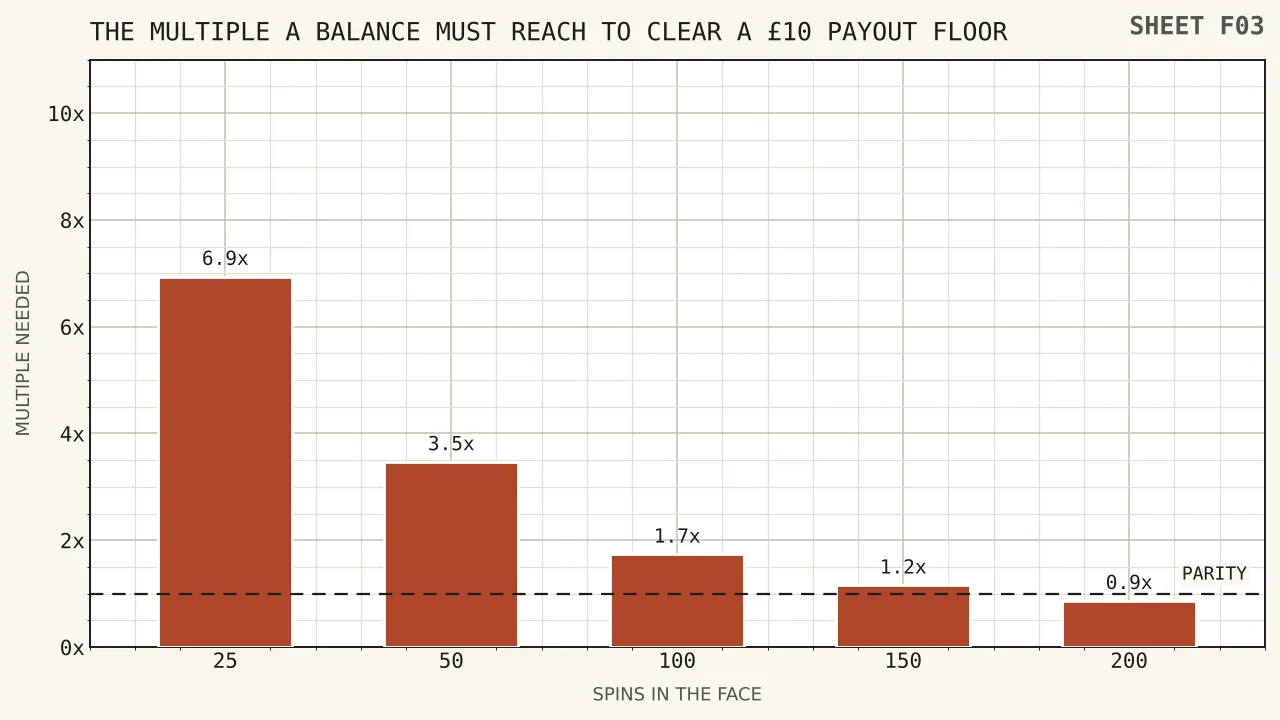
The multiple a balance must reach to get out
Here is the figure this page exists for, and it is no sum of money at all. A ratio, rather than a sum.
Denominations are fixed on a prepaid instrument, and £10.00 is the lowest rung of the ladder in use here. Put a cashier’s payout floor on that rung and a balance has to reach £10.00 before anything moves. Against £1.44 surviving a ten times rule, £10.00 is 6.94 times as much, and 6.94 rather than £1.44 is what a reader is playing for.
| Spins | Face | Averages | After ten times | Multiple needed |
|---|---|---|---|---|
| 25 | £2.50 | £2.40 | £1.44 | 6.94 |
| 50 | £5.00 | £4.80 | £2.88 | 3.47 |
| 100 | £10.00 | £9.60 | £5.76 | 1.74 |
| 150 | £15.00 | £14.40 | £8.64 | 1.16 |
| 200 | £20.00 | £19.20 | £11.52 | 0.87 |
Read the last column downwards and a 25-spin offer is structurally unlike a 200-spin one. At 200 spins the expectation already clears the floor, so the floor strands nothing and only the arithmetic stands in the way. At 25 spins the expectation is 14 per cent of the floor, so a perfect run through the wagering rule still ends in a balance that cannot be moved. Residue: the whole £1.44.
Playing on does not close a gap like that. Turnover of £1.00 costs 4p in expectation, so £1.44 once over costs 6p and £1.44 ten times over costs 58p. Stake size does not lift an expectation, since the edge keeps its sign throughout. Variance is the one road to £10.00, and the fare is 4p for each pound offered up.
£1.44 against a £10.00 floor: 6.94 times, or nothing
Adding money meets the same ladder from the other side. A reader £8.56 short cannot buy £8.56, £10.00 being the smallest denomination and nothing on the ladder smaller. So a £2.50 face occupies a structural position that no amount of care gets it out of: too small for a floor, and attached to an account whose smallest top-up is 4 times the face.
Three rules keep a British exit honest while a floor does the stranding. No offer to cancel a withdrawal once it is requested. No maximum on what leaves at any one time, with reasonableness governing size and frequency. And £50 a day against £500 a week as the example of a term that will not be allowed.
8
Registering where no British licence is held
Offers of this shape are advertised with no Great Britain licence behind them, and on a registration page the sharpest cost of that is not a wagering multiple. It is what opening an account means for somebody who has already decided to stop.
The national scheme’s reach is set by the British licence, which is the mechanism that puts a company into it. Its own account of what it does is brief. Accounts at gambling websites and apps are blocked, at no charge, from one registration instead of site by site. Its periods, its brakes and its limits are figures, so here they are as figures.
| Feature | Published position |
|---|---|
| Options at registration | 4 of them: 6 months, 1 year, 5 years, or 5 years renewing automatically |
| Turning renewal off | Only inside the last 6 months of a 5-year period |
| Ending early | Not available. The terms say so in capitals of their own |
| Lapsing | Does not happen. An exclusion is not removed automatically at the end of a period |
| Extending | By a further 6 months, 1 year or 5 years |
| Doing nothing | The exclusion runs on, for as much as 7 further years |
| Deactivating | Through the contact centre, with 24 hours of cooling off during which it stays live |
| Afterwards | Operators hear for 7 years that somebody was previously excluded, with no duty to bar access |
Those terms carry 20 May 2026 as their last update, and that date belongs with any quotation from them, because periods and the deactivation route are the most movable facts in the set. Capitals in the third row belong to the source, which puts the whole of it in upper case.
Where the scheme stops is stated just as plainly, and for anybody reading about offers made off the register that is the useful sentence. Participating operators are its reach. A service whose organisation stays outside it is past what the scheme can prevent.
Curaçao requires self-exclusion too, so the honest comparison is structural rather than a matter of presence and absence. What differs is reach. A player bars themselves from a single named operator there, which then excludes them right across its own domains. Encouragement is what the policy offers in place of a national register: a player should be encouraged to exclude from other gambling sites, one by one.
| Feature | Great Britain | Curaçao |
|---|---|---|
| Reach | Every licensed operator at once | One operator, across its own domains |
| Shortest period | 6 months | 1 year |
| Longest single period | 5 years, renewing | Lifetime |
| In between | 1 year, 5 years renewing | 3 years, 5 years, 10 years |
| Revoking it | Not before the minimum ends | Not before the period ends |
Neither column is simply better than the other. Curaçao’s floor is twice the British floor and its ceiling outlasts any British period. The row it has no equivalent of is the first, and the first row is the one that matters to somebody who wants to stop gambling rather than to stop gambling at one website.
Cooling off, as distinct from exclusion, is required there in a shape worth reporting. Four periods have to be on offer: 3 months, 1 month, 7 days, 24 hours. One click reaches them, with no email and no operator sign-off, effective at once and selectable by vertical. Discouragement is barred in 3 named ways: questioning the decision, offering reassurances so as to delay it, and handing over bonuses or promotions as an incentive to keep going. That third one is a bonus rule, and in shape it is stricter than anything the British codes say about an incentive offered at that particular moment.
Thinner is what that rulebook is at the entrance, which is this page’s own subject. No deposit and no wager until the operator is satisfied a player has reached 18. A birth date confirmed at registration. Then, where it can be managed, 3 more: open source verification, a tick box, a payment method confirmed. Government-issued identification waits on later anti-money-laundering milestones, coming forward only where age was doubted already. A face can be credited there and played before any document is seen.
Two absences from that rulebook move the figures on this page directly. No ceiling on a wagering multiple appears in it, so the 40 times row of the table in part 6 is available rather than prohibited. No minimum game cycle appears either, so the 240 cycles of a ten times rule need not occupy 600 seconds. Identical money, fewer minutes, which reads as an improvement and is its opposite.
Questions
- How much is 25 free spins on registration worth?
- Worked at a 10p spin and 96 per cent back, the face is £2.50 and the average £2.40. Ten times asks for £24.00 of turnover, costing 96p in expectation, which leaves £1.44. At forty times the turnover is £96.00, the expected cost is £3.84, and nothing at all survives.
- Do the spins arrive before identity is checked?
- Not at a British licensed cashier. Three items go in ahead of gambling under licence condition 17.1.1: a name, an address, a birth date. The age check reaches further than a customer’s own stake: a bonus, a free bet, and a free-to-play version of a game all sit inside it. Expectation therefore begins when checks clear, not when a form is submitted.
- Which documents will be asked for?
- No list is mandated, and the regulator says as much. Its player guidance offers 3 examples: a household bill, a driving licence, a passport. Which documents a business asks for is left unspecified. So a cashier may ask for something its neighbour does not, with neither of them wrong, and no published standard exists to compare them against.
- Can documents be demanded only at the withdrawal?
- Not where asking earlier was possible. A withdrawal request may not trigger a demand for anything obtainable at an earlier stage, and promptness is what money-laundering information requires rather than a wait until funds are wanted. A payout stalled because identity information is short may leave the operator in breach of condition 17.
- Why does a sign-up ask me to set a deposit limit?
- RTS requirement 12A asks for the prompt, and RTS 12E turns a limit into the default rather than an option, so declining takes a deliberate act and a confirmation has to arrive before a reader moves on. Three periods are the minimum on offer: 24 hours, 7 days, 1 month. On an account opened for £2.50 of spins, that limit is the most valuable thing in the transaction.
- What happens if two limits overlap?
- The tighter one wins. £10 a day against £100 a week is the worked example, and £10 a day with £70 a week is what the system then has to allow, 7 lots of £10 being the smaller figure. Reaching a limit halts further deposits until a period restarts or the customer acts, subject to 24 hours of cooling off.
- Why is £1.44 harder to take out than £11.52?
- The floor does that rather than the arithmetic. Denominations begin at £10.00 on the ladder used here, and a cashier with its payout floor on that rung will not move anything smaller. A surviving £1.44 stands 6.94 times short of £10.00, so the lot is stranded. At 200 spins the surviving £11.52 clears the floor and nothing is stranded by it.
- Can I play on until the floor is reached?
- Playing on lowers an expectation instead of raising it. Where 96 per cent comes back, £1.00 of turnover costs 4p, so £1.44 once over costs 6p and ten times over costs 58p. The edge keeps its sign at every stake size, so nothing lifts the expectation. Variance alone reaches £10.00, and the fare for asking is 4p a pound.
- Does an account with no British licence behind it touch a self-exclusion?
- The national scheme reaches operators that take part in it, and membership is set by the British licence. Its terms say a service whose organisation does not take part is past what it can prevent. Nothing on this site assists anybody in reaching a cashier they have excluded themselves from, and the help at the foot of this page is there so the tools can be used.
- How long does a self-exclusion run?
- Four options appear at registration: 6 months, 1 year, 5 years, or 5 years renewing automatically. Ending it before the minimum period finishes is not available, and it does not lapse by itself. Deactivation runs through the contact centre with 24 hours of cooling off, and operators hear for 7 years afterwards that somebody was previously excluded. Those terms carry 20 May 2026 as their last update.
- Is there self-exclusion offshore?
- Curaçao requires it, at operator level instead of nationally. A player bars themselves from one operator, which must then exclude them across all of its own domains, and the policy’s answer to other websites is encouragement to exclude from each in turn. Its shortest period is 1 year against 6 months in Great Britain, and a lifetime option is available there.