Note G10 Revision 1 Terms read 16 October 2026
Google Pay casino deposits: a rung that is a threshold, not a coin
This rail pays any sum to the penny, so every rung on the page belongs to the counter. Two of them stack: a smallest payment, and a line in the offer terms where the match rate steps up. Want £45.00 and both land on £50.00, so £5.00 goes in unchosen and buys £30.00 more credit, which is £300.00 more turnover. A pound the other side of a line costs £13.00 of credit that is never issued at all.
The face £50.00 threshold What draws it down £30.00 at ten times What is stranded £5.00 unchosen
What a face of this size is worth
Every destination on this rack is bought advertising. The site takes a fee if a reader goes on to register, and no figure printed below moves because of it.
Face and Residue
Strip No 01
Betportal
Ceiling as a multiple
Priced at this site's own 10p a spin
What is printed
What draws it down
What is stranded
No Great Britain licence
Licensed in Anjouan, Comoros, run by BetPortal Gaming Ltd, with Excite Ultra Media Ltd, reference ALSI-202601040-FI2.
Terms read 16 October 2026
Open the offer at Betportal, opens in a new tabFace and Residue
Strip No 02
WinBeast
Ceiling as a sum
Priced at this site's own 10p a spin
What is printed
What draws it down
What is stranded
No Great Britain licence
Licensed in Curaçao, operator not named on the site.
Terms read 16 October 2026
Open the offer at WinBeast, opens in a new tabFace and Residue
Strip No 03
EliteSpin
Longest spin window
Priced at this site's own 10p a spin
What is printed
What draws it down
What is stranded
No Great Britain licence
Licensed in Costa Rica, run by PrimeTier Limited.
Terms read 16 October 2026
Open the offer at EliteSpin, opens in a new tabFace and Residue
Strip No 04
Crown Jewelz
Multiple unpublished
No residue struck
What is printed
What draws it down
What is stranded
No Great Britain licence
Licensed in Curaçao, number not verified, operator not named on the site.
Terms read 16 October 2026
Open the offer at Crown Jewelz, opens in a new tabThe two figures in the second and third registers are this site's own arithmetic and nothing an operator has published: the face as printed, less the share a spin gives back at 96 per cent return to player, less what playing the wagering through costs at the same return, and then less whatever a published ceiling, a charge on the way out or a floor on the smallest withdrawal takes off what survives that. The residue is what is left of the face when all of it is accounted for. It describes the offer, not one reader's afternoon. Where the conditions price above the face the strip prints nothing coming off rather than a negative sum, and where a figure the sum needs is unpublished it prints the condition in the operator's words instead.
A face paid as spins has no unit of its own, so one is supplied. Where an operator publishes what a spin of its own is worth, that figure stands in the first register's own line and is labelled as theirs. Where it does not, this site's own 10p a spin stands there and says so, and every figure below moves in proportion: at half the price, half the money. The share of the face that does come off is also given as pence in the pound, which is the figure that compares a large face against a small one.
Money goes onto a prepaid voucher in fixed denominations, so a smallest deposit published in pounds is rounded up to the first rung of the ladder this site works in, £10, £20, £25, £50, £75 and £100, and the strip prints what that rounding strands. That is the reader's own money and it is never netted into a residue. A smallest deposit published in euros is printed as the operator publishes it, because the ladder here is a sterling one and rounding a euro sum to it would be an invented figure.
Three words stand in the amount column where no figure can. Noted is a published condition that takes value away without leaving the sum a figure to take. Unpriced is a condition whose figure nobody has published, or a credit that is not a sum until a deposit of your own sets it. Own money is money of yours, which is never part of a residue.
Not one of the operators printed above holds a Great Britain licence, so the duties that licence carries do not reach them. All online gambling companies licensed in Great Britain must be part of Gamstop Online, and a reader who has shut themselves out through the scheme is therefore not shut out here. The ceiling of ten times the bonus funds on a wagering requirement, in force since 19 January 2026 under Social Responsibility Code 5.1.1, is a condition of that licence and binds the companies that hold one. On an unlicensed site the Gambling Commission describes consumers as facing unfair gaming practices, financial loss and a lack of recourse if things go wrong, and it names blocked payouts and withdrawal limits set so high they are unattainable among what it has seen. Nobody under 18 may hold an account at any of them.
Every term printed on a strip is the operator's own, and each strip carries the day it was read. The oldest of those readings is 16 October 2026. What binds a reader is the operator's own full terms, and not a line printed here.
1
An exact rail and a counter that steps twice
Paying is the easy part of this rail. A wrapper of this sort passes a card payment through with a one-time number in place of the card number, and the amount can be anything the merchant asks for, down to the penny. Nothing about the instrument rounds.
Two lines beyond the glass do round, and they differ in kind. The first is the smallest payment a counter will process, which behaves like a coin: below it nothing works. The second is a line inside the offer terms where the match rate changes gear, which behaves like a tariff: either side of it the same pound is worth a different amount of credit.
When those two lines coincide, which they often do at the round numbers, a reader wanting £45.00 is pushed to £50.00 twice over. Once by the floor, and once by the fact that £5.00 more of payment attracts £30.00 more credit under the model used here. Both pushes are in the same direction, and neither was the reader’s idea.
Everything below uses the fixed workings of this site: a 10p stake, 96 pence back for each pound staked, and a multiple named where one is used. No primary source publishes a tier schedule, so the rates here are a model, declared as one. Offers of this sort are run by counters with no Great Britain licence, and part 9 sets the missing duties against the figures rather than asserting anything.
The modelled tariff: 50 per cent of the payment as credit up to twenty-five pounds, 100 per cent from twenty-five, 150 per cent from fifty. It is chosen so the gear changes sit on steps of the prepaid ladder, which is where they usually sit in practice. No operator is being described.
2
Where the match rate changes gear
Run the tariff across the ladder and the credit column moves in jumps rather than in a line. Each jump happens at a threshold, and between thresholds a pound of payment is worth a fixed amount of credit.
| Paid | Credit issued | Which gear it is in | Owed at ten times | Expected cost | Left standing |
|---|---|---|---|---|---|
| £10.00 | £5.00 | Bottom gear, half the payment | £50.00 | £2.00 | £3.00 |
| £20.00 | £10.00 | Bottom gear still | £100.00 | £4.00 | £6.00 |
| £24.00 | £12.00 | A pound short of the first line | £120.00 | £4.80 | £7.20 |
| £25.00 | £25.00 | Middle gear, pound for pound | £250.00 | £10.00 | £15.00 |
| £45.00 | £45.00 | Middle gear, five short of the next line | £450.00 | £18.00 | £27.00 |
| £50.00 | £75.00 | Top gear, half again on the payment | £750.00 | £30.00 | £45.00 |
| £75.00 | £112.50 | Top gear, one step along | £1,125.00 | £45.00 | £67.50 |
Two rows next to each other tell the story of a threshold. Pay twenty-four pounds and twelve pounds of credit arrives. Pay one pound more and twenty-five pounds of credit arrives. One pound of payment has bought thirteen pounds of credit, and a reader who stopped a pound short has £13.00 of advertised face that was never issued to them at all.
£24.00 paid: £13.00 of credit never issued, for want of one pound
That is a residue of an unusual kind, and it is worth being precise about it. Nothing was taken away. Nothing expired, and no ceiling cut anything down. The credit simply never existed, because a tariff is a step function and the payment landed on the lower tread. Compare two offers by headline percentage and none of this shows, because a headline quotes top gear while the payment picks the gear.
3
What the last pound buys, and when it stops
Crossing a threshold is obviously worth something. What is less obvious is that whether it is worth anything depends entirely on the play-through multiple, and that the sign flips at a figure this site uses everywhere.
Here is the arithmetic in one line. Take the credit, subtract four per cent of it for each unit of the multiple, and the expected survivor is what remains. So extra credit of £30.00 survives as £18.00 at ten times, as £0.00 at twenty-five times, and as a deficit of £18.00 at forty times. The threshold is worth crossing below twenty-five and worth avoiding above it.
| Step across | Extra paid | Extra credit | What happens to it | At ten times | At forty times |
|---|---|---|---|---|---|
| £24.00 to £25.00 | £1.00 | £13.00 | Bottom gear into middle | £7.80 | minus £7.80 |
| £45.00 to £50.00 | £5.00 | £30.00 | Middle gear into top | £18.00 | minus £18.00 |
| £49.00 to £50.00 | £1.00 | £26.00 | The same line, a pound below it | £15.60 | minus £15.60 |
Twenty-five is no arbitrary pivot. Four pence into a pound goes twenty-five times, and a game returning 96 pence per pound keeps four of them, so expected survival reaches nothing there for a credit of any size at all. Above twenty-five, more credit means more obligation and a deeper expected shortfall, so a bigger headline is a bigger hole. Below it, more credit genuinely means more expected money.
The practical consequence runs against intuition. A reader who finds a threshold and a light requirement should cross it. A reader who finds a threshold and the forty times this site assumes should pay the smaller sum, take the smaller credit, and accept the smaller obligation, because at that multiple the extra credit is a liability dressed as a gift. The same five pounds of payment is the right move and the wrong move depending on a number printed somewhere else in the terms.
One licence condition bears on the shape of all this. A licensee may not reduce an incentive’s value when the qualifying activity finishes early, before the offer period has run out. So a tariff may step on the size of a payment, and may not step on how quickly a reader got there.
4
Seventy-five pounds of credit, climbing
Take the threshold payment, £50.00, and the credit it attracts in top gear, £75.00. Required turnover is that credit times the multiple, expected cost is four pence from each pound of it, and the remainder is what a reader could in principle take away.
| Multiple | Turnover owed | Cycles needed | How the row reads | Expected cost | Remainder |
|---|---|---|---|---|---|
| 5 times | £375.00 | 3,750 | Light, and uncommon out here | £15.00 | £60.00 |
| 10 times | £750.00 | 7,500 | The British ceiling on bonus funds | £30.00 | £45.00 |
| 20 times | £1,500.00 | 15,000 | A fifth of the credit left | £60.00 | £15.00 |
| 25 times | £1,875.00 | 18,750 | The pivot, and nothing left | £75.00 | £0.00 |
| 40 times | £3,000.00 | 30,000 | Forty-five pounds past the pivot | £120.00 | £0.00 |
The ceiling of ten times is a British licence condition rather than a market habit. Social Responsibility Code 5.1.1 holds it at the third limb, first item; binding on licensees from 19 January 2026 onward; and two licence types are left out, the software one and the gaming machine technical one. One number is published for the position before it arrived, 60 times, and the number is the regulator’s own.
Time is the other currency. Seven and a half thousand cycles at a 10p stake, with a minimum of 2.5 seconds before a fresh cycle is available under a British licence, take 18,750 seconds at the very least. That is 5 hours 12 minutes 30 seconds. At the forty times assumed here, 30,000 cycles want 75,000 seconds, which is 20 hours 50 minutes.
7,500 cycles, 18,750 seconds, £45.00 expected: £8.64 an hour
Divide the remainder by the fastest possible sitting and the top gear pays £8.64 an hour at the ceiling. The same arithmetic at twenty times pays £1.44 an hour. At twenty-five it pays nothing for 5 hours 12 minutes 30 seconds, and at forty it pays nothing for 20 hours 50 minutes. A tariff that looks generous in the first column is paying a declining hourly rate in the last.
5
What may be bundled behind a line
A threshold offer meets a second licence condition, limiting what can ride behind the line. Four product types are named, and one incentive is allowed to span a single type and no more. Scope and commencement follow the wagering ceiling exactly: every licence bar the software and gaming machine technical ones, biting from 19 January 2026. The table sorts the arrangements, because the carve-outs are not where a reader would guess.
| The arrangement | Where it falls |
|---|---|
| The named types | Betting, casino, bingo, lottery, and no incentive spans two |
| A match plus bingo tickets | Two types at once, which the ban catches |
| A match plus free spins | One type, a slot being a casino product |
| A scratchcard beside a raffle | The same type twice, and allowed for that reason |
| Two offers, one email | Allowed where the reader opted in to both products |
| A credit spendable anywhere | Outside the ban entirely, by the regulator’s example |
| A tiered credit, spent at will | Outside it too, which is the row this page needs |
| Terms linked and shared | The narrow target the ban was written for |
The aim is stated narrowly by the regulator: products mixed within one incentive, where terms get linked together and shared. A drafting detail in the same response shows how little else shifted. From consultation draft to final wording, one definite article became an indefinite one ahead of the word incentive, and the record of change stops there.
For a tiered credit the useful row is the second from the bottom. A sum a reader may spend on whatever they choose is not a bundle of two products, so a tariff does not fall foul of this condition by being generous. It falls foul by chaining a casino requirement to a betting one inside the same set of terms.
6
A running total, shown as it happens
A rail that pays in one movement makes a running total harder to carry in the head, and two duties answer that directly. The table gives each with its date.
| The duty | What it requires, and from when |
|---|---|
| The running figures | Net spend, and time spent gambling, displayed live from 17 January 2025 |
| Several products at once | Functionality the operator provides for it was stopped on the same date |
| The published example | A roulette table running alongside a blackjack one |
| The affordability line | Five hundred pounds monthly from 30 August 2024, cut to a hundred and fifty on 28 February 2025 |
| The heavier version | Still a pilot, not live, with consumers unaffected while it runs |
| Credit records | Neither exercise touches a credit rating, says the regulator |
Put the first row against this page’s figures and it has something to show. A reader in top gear owes 7,500 cycles at the British ceiling. Each cycle is a decision and a 10p stake, and the running total climbs through £750.00 of turnover while the account balance moves far less. Net spend and turnover are different quantities, and a reader watching only the balance has no sense of the second.
The affordability line in the fourth row is worth converting into this page’s units. Three threshold payments of fifty pounds make up a monthly hundred and fifty, as do one top step and one bottom step together. Put that way, the check stops looking like an exotic threshold and starts looking like what it is, which is three ordinary deposits inside a calendar month.
£150.00 a month is three threshold payments of £50.00
7
Five pounds, three hundred of turnover
Now the residue this page is built on. A reader wanted £45.00. The floor and the tariff both pointed at £50.00, so £5.00 went in unchosen, which is 10.00 per cent of the face. What makes this rail different from a plain rounding is what those five pounds dragged behind them.
Extra credit of £30.00 arrived with them. At the British ceiling that credit carries £300.00 of extra required turnover, which at a 10p stake is 3,000 extra cycles. Under the 2.5 second floor, 3,000 cycles occupy 7,500 seconds, so the five pounds bought 2 hours 5 minutes of obligation along with the credit.
£5.00 unchosen, £300.00 of extra turnover, 2 hours 5 minutes of it
At the ceiling that trade is positive in expectation: £18.00 of extra expected survival for five pounds paid and two hours spent, which is about £8.64 an hour and the same rate as everything else at ten times. At forty times, the figure this site holds to, the same five pounds buys £1,200.00 of extra turnover, 12,000 extra cycles, 8 hours 20 minutes of extra obligation, and an expected deficit £18.00 deeper than if the reader had never crossed the line.
So the residue on a threshold rail is not only money. It is hours, and the hours are attached to a sum a reader did not choose to pay. That is the cleanest statement this section can make about why a fixed line costs more than it looks: the line does not bend to the sum, and what sits behind it scales with the multiple rather than with the payment.
The other residue on this page is the one in part 2, and it is the opposite shape. Stop a pound short of a gear change and £13.00 of credit is never issued. Nothing is forfeited, nothing expires, and no ceiling bites. The face simply does not come into existence, and a reader who reads only the headline percentage has no way of knowing which gear their payment landed in.
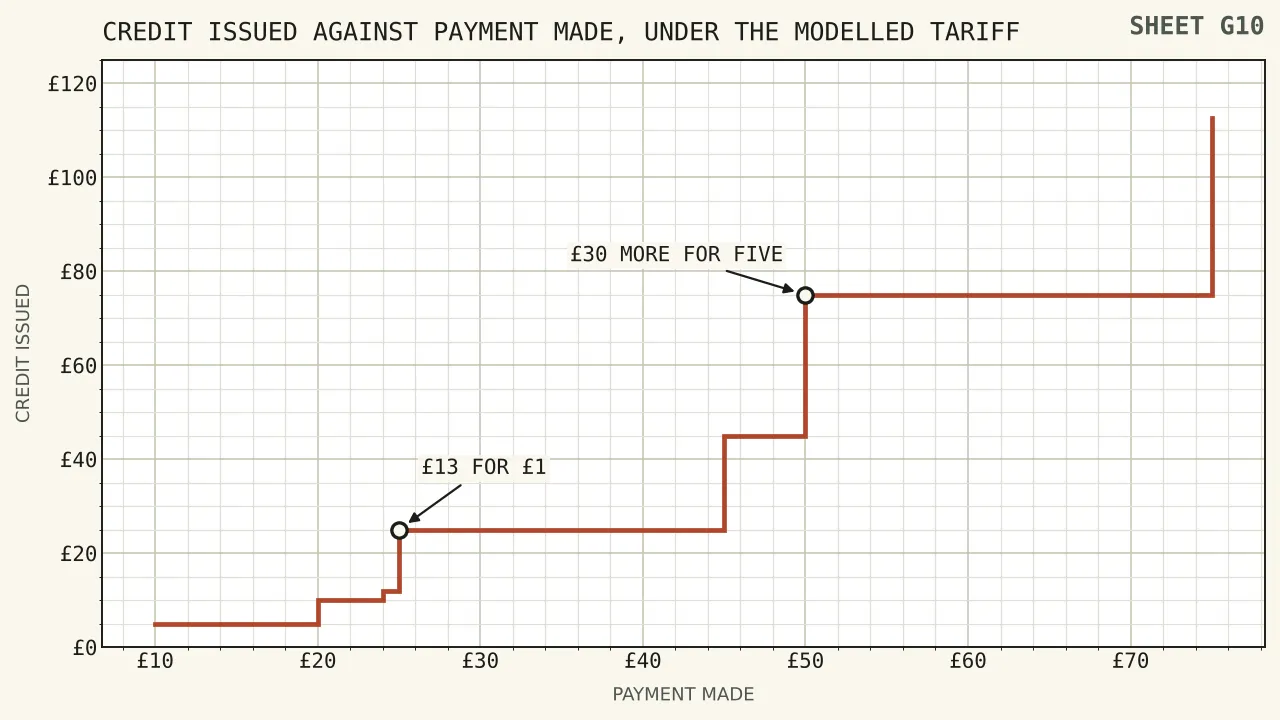
8
A blocked wallet is a decision kept
Payments on this rail fail for ordinary reasons, and a reader meeting one has usually met a protection rather than a malfunction. A bank bar on gambling payments, applied because the account holder asked for it. A block held in the wallet for the same reason. A funding route excluded from an offer by its terms.
None of those is a puzzle to be solved, and nothing published here helps anybody past one. A bar a person set up for themselves is doing the work they set it up to do, and helping somebody round it would be the same act as helping them round a self-exclusion. That principle holds for every rail this section prices, and a threshold does not bend it.
One offshore rule speaks to exactly this, and it runs in the player’s favour, so here it is in full.
| The feature | What the policy says |
|---|---|
| Lengths | Four of them, from a day up to three months |
| How it is reached | One click, and neither an email nor the operator’s say-so |
| When it starts | Immediately, and it can be chosen by product |
| Discouraging it | Not by querying the decision |
| Discouraging it again | Not by reassurance that delays the thing |
| And again | Not by bonuses held out to keep somebody playing |
The last row is the one a threshold page should sit with. A tariff is a promotion, and a promotion dangled at the moment somebody is trying to stop is named there and barred there.
The free British tools are worth naming plainly. Register once with the national online scheme and accounts across British licensed operators are shut off, free, from one place. Its own history gives the shape of that reach. The Remote Gambling Association founded it, June 2017 being the month, and the request came from the regulator together with the responsible department. March 2020 turned it into a licence condition wherever an operator takes business from residents of Britain. April 2020 brought the daily sweep: a licensee checks its entire customer list against the scheme at least once in every 24 hours. A counter outside the British licence stands outside all of it by construction.
9
The same threshold, no British licence
The payment is identical either way: a tap, a one-time number, fifty pounds moving because two lines pointed at the same figure. What changes is the rulebook around the tariff, and the table below groups the duties by what each one does to a threshold rather than by where it is written.
| What it constrains | The constraint | On the figures here |
|---|---|---|
| The obligation behind a tier | Ten times the credit, and no further | £45.00 left standing on £75.00 of credit |
| What may be bundled in | A single product type to one incentive | Spins may ride with a match; bingo tickets may not |
| Rewarding speed | No cutting an incentive’s value for finishing early | The tariff may step on size, never on pace |
| The running total | Net spend and time shown as they happen | £750.00 of turnover made visible while it accrues |
| Several products at once | No operator-led simultaneous play | 7,500 cycles cannot be run two tables at a time |
| Affordability | A light-touch check over a monthly net deposit line | £150.00 a month is three threshold payments |
| Stake inside a cycle | Five pounds in a slot cycle, two under 25 | A 10p stake is one fiftieth of the adult cap |
| Pace | At least 2.5 seconds from one cycle to the next | 30,000 cycles want 75,000 seconds at forty times |
| Stopping | A cooling-off route that promotions may not interrupt | A tariff offered to delay a decision is barred |
Two things keep that table honest. Read the Curaçao rulebook used for this site and nothing there caps a requirement, nothing caps a stake, no floor sits beneath a cycle time, and product mixing within an incentive goes unmentioned. Its bonus lines number two: terms put across openly, and nothing aggressive in the promotion of them. So the absence is real, and it is an absence of specifics rather than of every rule.
The second thing is that the cooling-off provisions quoted in part 8 are from that same rulebook, and on that narrow point it is more explicit than anything in the British standard, which addresses limits rather than naming a bonus as a thing that must not be dangled. Reporting only the absences would be a misreading, which is why both halves appear here.
One figure follows the player wherever a counter sits. Gaming duty tracks a customer’s usual residence rather than a licence address, so British duty catches a counter whatever register it is absent from. Remote gaming profits have carried a 40 per cent rate since 1 April 2026. The operator carries that charge, and nothing written here is tax advice.
Questions
- Does Google Pay change the minimum deposit at a casino?
- No. A wrapper of this kind passes a card payment through with a one-time number in place of the card number, and the amount can be anything the merchant asks for. Both rungs on this page belong to the counter: the smallest payment it will process, and the line in the offer terms where the match rate changes gear.
- Why is £45.00 a bad number to deposit?
- Because two separate lines both point at fifty pounds under the tariff modelled here. The floor rounds it up, and the gear change at fifty pounds means the extra £5.00 attracts £30.00 more credit. So £5.00 goes in unchosen, a tenth of the face, and £300.00 of extra required turnover comes with it at the British ceiling.
- What does stopping a pound short of a tier cost?
- Thirteen pounds of credit, on the modelled tariff. Pay twenty-four pounds and twelve pounds of credit arrives; pay twenty-five and twenty-five pounds arrives. Nothing was forfeited and nothing expired. The credit never came into existence, because a tariff is a step function and the payment landed on the lower tread.
- Is crossing a deposit threshold always worth it?
- No, and the pivot is twenty-five times. Subtract four per cent of a credit for each unit of the multiple and what is left is the expected survivor, so £30.00 of extra credit is worth £18.00 where the multiple is ten, nothing at twenty-five, and a deficit of £18.00 at forty. Below the pivot, crossing pays. Above it, extra credit is a liability wearing the clothes of a gift.
- Can a casino cut my bonus for finishing the wagering early?
- No, that one is prohibited outright. Changing what an incentive is worth because the qualifying activity was completed in less than the whole offer period is barred by the same code provision that caps the wagering multiple. A tariff may step on the size of a payment. It may not step on how fast a reader got there.
- Can one offer mix casino credit and betting credit?
- Not inside a single incentive. An incentive may hold a single named type and no more, the named types being betting, casino, bingo and lottery, with the rule in force since 19 January 2026. Three carve-outs apply: same-type pairs are allowed, two offers may share one email where the reader opted in to both, and a credit spendable wherever the customer chooses escapes the ban.
- How long does clearing £75.00 of credit take?
- At the ceiling the turnover owed is £750.00, which is 7,500 cycles at a 10p stake. A British licence puts 2.5 seconds at least in front of every fresh cycle, so those cycles occupy 18,750 seconds at the very least: 5 hours 12 minutes 30 seconds. At forty times, the figure this site holds to, 30,000 cycles want 75,000 seconds, giving 20 hours 50 minutes.
- What does a tiered offer pay per hour?
- At the ceiling, £45.00 of expected remainder across 5 hours 12 minutes 30 seconds works out at £8.64 hourly. Twenty times gives £1.44 on the same credit. Twenty-five gives nothing across 5 hours 12 minutes 30 seconds, and forty gives nothing across 20 hours 50 minutes. A tariff looks generous in its first column while its last column declines.
- Will a casino show me what I have actually spent?
- Under a British licence, yes, and while it happens. From 17 January 2025 a licensed counter has had to display what a customer has spent on net, and how long they have gambled, live rather than in a statement. The same changes stopped operators providing functionality for playing several products at once, with a roulette table alongside a blackjack one as the published example.
- At what point does a casino check whether I can afford this?
- Over a monthly net deposit line, with published dates. The light-touch check began at five hundred pounds monthly from 30 August 2024, then dropped to a hundred and fifty from 28 February 2025. The heavier version is still a pilot, not running live, and the regulator says neither exercise touches a credit rating. On this ladder, £150.00 is three threshold payments.
- Can a casino offer me a bonus while I am trying to stop?
- Not under the Curaçao policy, which names the practice and bars it. A cooling-off period there comes in four lengths, takes a single click, needs no email and nobody’s agreement, and starts immediately. Discouraging it is barred three ways: not by querying the decision, not by reassurance that delays it, and not by bonuses held out to keep somebody playing.
- What is stranded on a threshold deposit?
- Five pounds of payment and the hours behind it. The £5.00 that went in unchosen brought £30.00 of credit, £300.00 of extra required turnover at the ceiling, 3,000 extra cycles and 2 hours 5 minutes of obligation. At forty times the same five pounds buys £1,200.00 of turnover, 8 hours 20 minutes of it, and an expected deficit £18.00 deeper than not crossing the line.