Section K Revision 1 Terms read 16 October 2026
Off the register
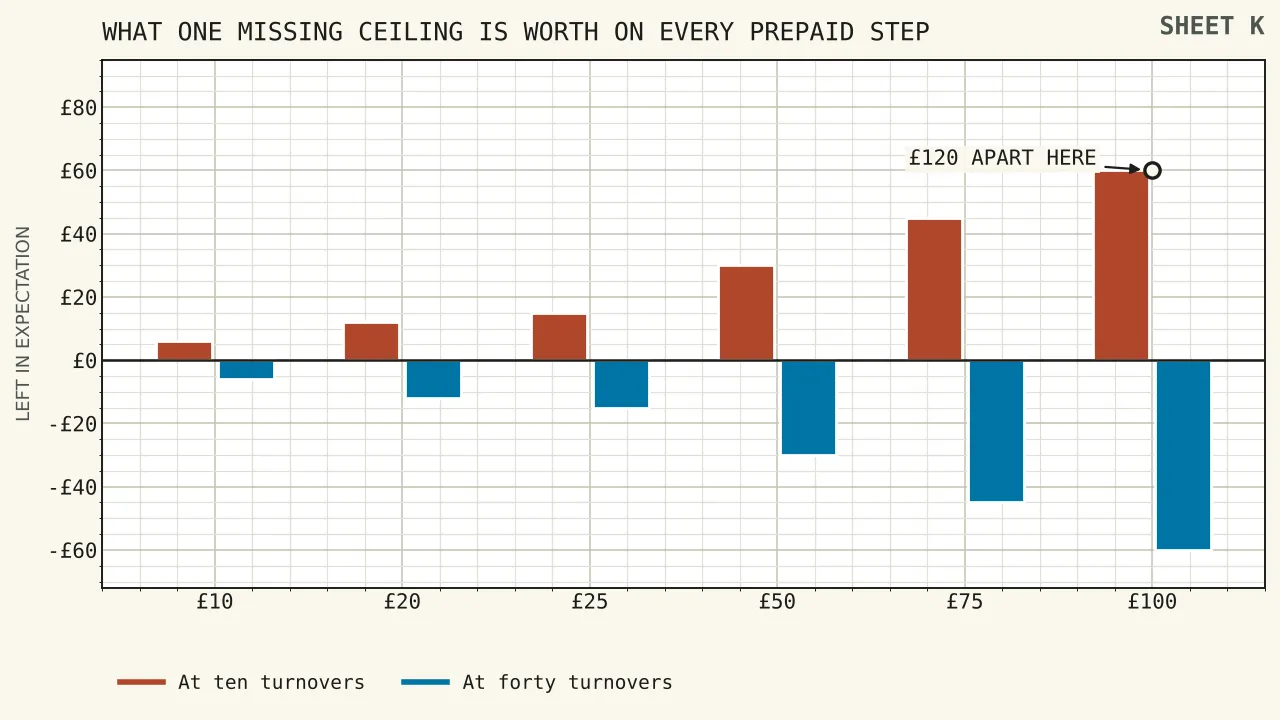
One missing number is worth £120.00 on the top step of this ladder. Where a play-through stops at ten turnovers, a £100.00 credit is expected to leave £60.00; where nothing stops it and forty turnovers are asked, the same credit runs an expected £60.00 past its own end. That swing is what the absence of one ceiling costs, and thirteen notes stand here pricing the rest of the absences the same way. One protection cannot be priced at all, and part 4 says what to do about it instead.
The face The top step, £100.00 What draws it down Ten turnovers cost £40.00 What is stranded £120.00 of swing
What a face of this size is worth
Every destination on this rack is bought advertising. The site takes a fee if a reader goes on to register, and no figure printed below moves because of it.
Face and Residue
Strip No 01
Betportal
Ceiling as a multiple
Priced at this site's own 10p a spin
What is printed
What draws it down
What is stranded
No Great Britain licence
Licensed in Anjouan, Comoros, run by BetPortal Gaming Ltd, with Excite Ultra Media Ltd, reference ALSI-202601040-FI2.
Terms read 16 October 2026
Open the offer at Betportal, opens in a new tabFace and Residue
Strip No 02
WinBeast
Ceiling as a sum
Priced at this site's own 10p a spin
What is printed
What draws it down
What is stranded
No Great Britain licence
Licensed in Curaçao, operator not named on the site.
Terms read 16 October 2026
Open the offer at WinBeast, opens in a new tabFace and Residue
Strip No 03
EliteSpin
Longest spin window
Priced at this site's own 10p a spin
What is printed
What draws it down
What is stranded
No Great Britain licence
Licensed in Costa Rica, run by PrimeTier Limited.
Terms read 16 October 2026
Open the offer at EliteSpin, opens in a new tabFace and Residue
Strip No 04
Crown Jewelz
Multiple unpublished
No residue struck
What is printed
What draws it down
What is stranded
No Great Britain licence
Licensed in Curaçao, number not verified, operator not named on the site.
Terms read 16 October 2026
Open the offer at Crown Jewelz, opens in a new tabThe two figures in the second and third registers are this site's own arithmetic and nothing an operator has published: the face as printed, less the share a spin gives back at 96 per cent return to player, less what playing the wagering through costs at the same return, and then less whatever a published ceiling, a charge on the way out or a floor on the smallest withdrawal takes off what survives that. The residue is what is left of the face when all of it is accounted for. It describes the offer, not one reader's afternoon. Where the conditions price above the face the strip prints nothing coming off rather than a negative sum, and where a figure the sum needs is unpublished it prints the condition in the operator's words instead.
A face paid as spins has no unit of its own, so one is supplied. Where an operator publishes what a spin of its own is worth, that figure stands in the first register's own line and is labelled as theirs. Where it does not, this site's own 10p a spin stands there and says so, and every figure below moves in proportion: at half the price, half the money. The share of the face that does come off is also given as pence in the pound, which is the figure that compares a large face against a small one.
Money goes onto a prepaid voucher in fixed denominations, so a smallest deposit published in pounds is rounded up to the first rung of the ladder this site works in, £10, £20, £25, £50, £75 and £100, and the strip prints what that rounding strands. That is the reader's own money and it is never netted into a residue. A smallest deposit published in euros is printed as the operator publishes it, because the ladder here is a sterling one and rounding a euro sum to it would be an invented figure.
Three words stand in the amount column where no figure can. Noted is a published condition that takes value away without leaving the sum a figure to take. Unpriced is a condition whose figure nobody has published, or a credit that is not a sum until a deposit of your own sets it. Own money is money of yours, which is never part of a residue.
Not one of the operators printed above holds a Great Britain licence, so the duties that licence carries do not reach them. All online gambling companies licensed in Great Britain must be part of Gamstop Online, and a reader who has shut themselves out through the scheme is therefore not shut out here. The ceiling of ten times the bonus funds on a wagering requirement, in force since 19 January 2026 under Social Responsibility Code 5.1.1, is a condition of that licence and binds the companies that hold one. On an unlicensed site the Gambling Commission describes consumers as facing unfair gaming practices, financial loss and a lack of recourse if things go wrong, and it names blocked payouts and withdrawal limits set so high they are unattainable among what it has seen. Nobody under 18 may hold an account at any of them.
Every term printed on a strip is the operator's own, and each strip carries the day it was read. The oldest of those readings is 16 October 2026. What binds a reader is the operator's own full terms, and not a line printed here.
1
The question under this heading
What is a missing licence worth? Not whether it matters, which is an opinion, but what it comes to in pounds on a face a reader can actually buy.
Asking it that way has a reason behind it. The word unregulated carries no information: it does not say which rule is absent, or what that rule was holding, or what a reader is exposed to without it. A list of duties with a figure beside each one says all three, and where no figure exists the blank itself is useful, because it marks the places where nothing can honestly be quantified.
So the method here is the same as everywhere on this site. Take the published duty. Name what it fixes. Work out what that is worth on this ladder. Where a duty fixes something no figure can reach, say so and leave the cell empty rather than filling it with an adjective.
Standing figures: 10p to a press, ninety-six pence coming back on each pound, a weighting of one, and six prepaid steps with £100.00 at the top. Ten turnovers is the ceiling on the licensed side, in force since 19 January 2026, and forty is used throughout as the comparison because it is the shape a reader meets where nothing caps anything.
One warning belongs at the front rather than at the back. A reader who has shut themselves out of gambling and is reading this section to find a way back in will find nothing here that helps, by design. Part 4 is written for that reader and part 8 states the limit in terms.
2
One ceiling, priced on every step
Begin with the duty that moves the most money, which is the one holding a play-through at ten turnovers. Its absence is worth the distance between what ten turnovers leave and what forty take, and that distance is six fifths of the credit on every step of the ladder.
| Credit | Expected at ten | Expected at forty | Distance between them | As a share of the credit |
|---|---|---|---|---|
| £10.00 | £6.00 | Minus £6.00 | Twelve pounds | 120 per cent |
| £20.00 | £12.00 | Minus £12.00 | Twenty-four pounds | 120 per cent |
| £25.00 | £15.00 | Minus £15.00 | Thirty pounds | 120 per cent |
| £50.00 | £30.00 | Minus £30.00 | Sixty pounds | 120 per cent |
| £75.00 | £45.00 | Minus £45.00 | Ninety pounds | 120 per cent |
| £100.00 | £60.00 | Minus £60.00 | A hundred and twenty | 120 per cent |
The last column is constant and that is the finding. On every denomination a missing ceiling comes to more than the credit carrying it, three fifths surviving and three fifths of deficit being six fifths apart. A reader buying the bottom step is exposed to £12.00 of swing on £10.00 of credit, and a reader buying the top step is exposed to £120.00 on a hundred.
The middle column is worth saying plainly, because it is where the word bonus stops describing what is happening. A negative expectation is not a credit that failed to pay. It is a reader’s own money, staked to serve an obligation, and expected to go. At forty turnovers the top step is expected to take £60.00 of it.
One line of arithmetic sits underneath. Scale a credit by one less four hundredths of its multiple and that is what it expects to leave, which puts ten turnovers at three fifths and forty at minus three fifths. Nothing at all sits between them, at twenty-five, and that is why the figure keeps recurring across this site.
Six fifths of the credit, on every step of the ladder
3
Duty by duty, with a figure or a blank
Each line below is a duty a British licence imposes. Not one of them reaches a counter which holds no Great Britain licence, and not one turns up in the offshore conduct policy this site reads most closely. The right-hand column is what each is worth on the figures used here, and three of the cells are deliberately empty.
| The duty | The thing it fixes | Worth, on this ladder |
|---|---|---|
| A ceiling on the multiple | Ten turnovers of the credit | Up to £120.00, from part 2 |
| A ceiling on the stake | £5.00 a cycle, or £2.00 under 25 | £288.00 an hour becomes the limit |
| A floor under the pace | Slot cycles kept 2.5 seconds apart | 1,440 presses an hour at most |
| A bar on automatic play | Each cycle committed to singly | No published figure attaches |
| A bar on hurrying a result | Turbo and slam stop refused | No published figure attaches |
| A bar on a near miss | No losing event swapped for one | No published figure attaches |
| A bar on a false celebration | Returns at or under the stake | Ten pence back off ten staked |
| A bar on cancelling a payout | No undoing a request | Four pence per pound, per turnover |
| A bar on capping a payout | A deposit balance comes out whole | A daily and a weekly ceiling, barred |
| Identity before any play | Three fields, bonus play included | Nothing sprung at the exit |
| One instrument refused | Credit, since 14 April 2020 | The whole face, where it was used |
| A complaint inside eight weeks | Then an approved adjudicator | £60.00 held at £1.07 a day |
Three cells carry no figure, which is honesty rather than idleness. What automatic play costs a player goes unpublished, and so does the cost of a hurried result or a near miss drawn falsely, because what each changes is how long somebody sits and what they believe while sitting. Neither of those is a published quantity. The reportable part is that one side of the register carries these rules and the other does not, which is a statement about documents instead of outcomes.
Two cells price protections pointing the other way. Forbidding the cancellation of a payout request guards a reader against themselves rather than against a counter, and without it a reinstated balance meets four pence in the pound for each turnover it then faces. Barring an upper limit on what a deposit balance hands back has the same shape, what it guards having been the reader’s money already.
The stake row earns its own sentence, a ceiling over a stake being nothing like a ceiling over a loss. Take the highest licensed stake at the licensed interval and an hour expects to cost £288.00, a rate sitting squarely within the rules. Rates above it go; rates beneath it stay exactly where they were.
4
The protection with no price on it
One duty from part 3 resists being put in pounds at all, and of everything here it matters most. Joining the national self-exclusion scheme comes as a condition attached to the British licence, so the licence and nothing else is what sets the scheme’s reach.
The scheme states the consequence itself, and this site repeats it as what it is, a limit on a protection. What it offers is exclusion from the operators who take part. Gambling services offered by organisations that stay outside are what it says it cannot prevent access to. That sentence is why this heading exists at all, and equally why nothing under it carries a route, a method or a comparison that would help anybody act on it.
What follows instead is the practical material, which is free and which works.
| What it is | What it covers | How to reach it |
|---|---|---|
| GamCare’s National Gambling Helpline | Every hour, every day, for a caller or for somebody they care about | Ring 0808 8020 133; chat and WhatsApp also answer |
| Gamban, which blocks | Many thousands of gambling websites and apps, across the major device platforms on a single licence | At no charge to a British reader through that helpline, under the name TalkBanStop |
| Gamstop Online | Every operator licensed in Great Britain, with customer bases checked at least daily | Registering with the scheme directly |
Two published cautions attach to the middle row. A date of 12 April 2021 sits on the article announcing that British route, with nothing said about how long access runs, so no duration appears here either. Meanwhile the software company’s own pages advertise a trial lasting seven days and name no British route at no charge. Both halves of that picture belong in the same paragraph.
Here are the scheme’s own figures, released 16 July 2026. People registered: 614,738. Growth over the first half of that year: 16 per cent. May 2026 set the record month, at 12,236 sign-ups. Over half took five years, the longest single period available. Among registrants under the age of 25, six months was taken by 38 per cent, and close to a third of everybody signing up belongs to that age group.
Registration offers four periods. The shortest is half a year. After that comes a single year, then a run of five, then five that renew without being asked, the renewal switchable off only within the final six months of such a run. Ending a registration early is not possible at all, a point the terms make in capitals, and nothing lapses by itself: leave it alone and it runs on for as much as another seven years. A contact centre handles deactivation, with a cooling-off period of 24 hours or more in which the exclusion holds, and operators then hear for seven years that this person excluded themselves before. Those terms carry a revision date of 20 May 2026.
One contrast is worth drawing, running as it does against expectation. In the offshore jurisdiction whose policy this site reads most closely, excluding yourself is an arrangement with one operator across that operator’s own domains, and the policy’s answer about other sites is to encourage a player to exclude from each of them in turn. A year is its shortest period against half a year here, and it carries a lifetime option against a longest single British period of five years. Longer at both ends, then, and far narrower in reach, and the narrowness is what counts.
5
Who the offence falls on, and where
A reader meeting this subject usually wants to know where the law sits, and the published answer has three parts that are easy to state and easy to get wrong.
First the offence. Providing gambling facilities when no operating licence is held makes the matter criminal, and what rides on it is 51 weeks of imprisonment at most, a fine at level 5 of the standard scale at most, or both at once, those 51 weeks reading as six months north of the border.
Second, whom it falls on. Throughout, the offence is drafted around whoever provides the facilities, and no matching offence covers taking part as a customer of a remote site. The statutory offence therefore belongs to the operator, and there it stops. Concluding from that alone that such a site is safe would ignore parts 2 to 4, each line of which concerns protection lost rather than liberty risked.
Third, how far it reaches. Provision from within the United Kingdom and provision from beyond it make no difference whatever. Remote gambling falls inside where a piece of remote gambling equipment is positioned in Great Britain, and falls inside again where no equipment is but the facilities get used in this country, the second of those routes carrying a knowledge test: the provider knows, or ought to know, of such use or of its likelihood. The subsections in question took effect on 1 November 2014.
| The point | What it says |
|---|---|
| The offence | Providing facilities without a licence |
| The penalty | Up to 51 weeks, or a level 5 fine, or both |
| Who commits it | The provider; no matching customer offence exists |
| Where it reaches | Provision from anywhere at all |
| The knowledge test | Knows, or should know, that it is used here |
| Advertising it | An offence of its own, with its own defences |
That last row gets left out most often. Advertising unlawful gambling is an offence in its own right, gambling counting as unlawful there where some licence or notice or permit or registration or exception would or might be needed and no arrangement for it exists. Three limits sit on the offence. Reasonable belief defends some conduct. A knowledge requirement governs other conduct. And somebody in the business of carrying communications, with no say over their content, is carved out. Display an advertisement or leave it reachable and the offence is committed on every day any part of that display happens.
One charge follows a player and not a licence, worth stating because it cuts against a common assumption. Where a customer usually lives is what gaming duty fastens to, never the address printed on a licence, which puts a counter holding British money inside a British tax regardless of which register has never heard of it. That charge is the operator’s to carry, not the player’s.
6
Thirteen notes, and the question each answers
These notes divide by what a reader is actually asking, which is rarely what the search phrase says.
Four are about the register itself. Best non Gamstop casinos prices a top-step face where no ceiling stands over it. Non UK casinos starts from the observation that the phrase describes a register rather than a country. Independent casinos not on Gamstop takes a word about ownership and asks what it protects, which is nothing. And Non Gamstop Curacao casino sites opens the one offshore rulebook that can be opened and reads it line by line.
Three are about a question at the door. No KYC casinos asks what an unverified balance is worth once the chance of collecting it is priced in. No verification casinos separates a promise about the entrance from the bill at the exit. Non Gamstop casinos no deposit bonus prices a face where nothing was paid in, so nothing rounds at the entrance at all.
Four are about a rail or a sum. Non Gamstop PayPal casinos makes the point that a payment brand writes no wagering ceiling and keeps no exclusion register. Non Gamstop paysafe casinos follows a denomination in and somebody else’s cashier out. Non Gamstop casinos UK £10 deposit is the one figure on this ladder that rounds away nothing at the door. Non Gamstop casinos with £5 deposit is the one that cannot be bought at all.
And two are about the reel and the bill. Non Gamstop pay by phone casinos deals with a bill that arrives after the play rather than before it. Slots not on Gamstop treats a reel as a machine with settings and prices the settings that are no longer fixed.
7
Seven headings, and this one’s job
A prepaid face gets seven questions put to it across this site. The sixth belongs to this heading, whose job is handing the other six a figure for whatever nobody has undertaken.
| Heading | Its question | What goes missing here |
|---|---|---|
| The face | The printed figure | The cap on the multiple |
| The rung | Fixed denominations | The duties at the entrance |
| The spend-down | What clearing costs | Ten turnovers as a limit |
| The stranded part | What never comes off | The bar on capping a payout |
| The way out | Leaving with the survivor | The bar on undoing a request |
| This one | What a licence is worth | Nothing; this is where it is counted |
| The room | The place of spending | Every design rule on the reel |
Read across the right-hand column and the picture is of a single licence doing many separate jobs, each of which turns up somewhere else on the site as a figure. That is the argument of this heading in one sentence: the licence is not one protection but a dozen, and a reader loses them individually rather than all at once.
8
What this section will not do
Thirteen notes sit under this heading, all of them about gambling away from the British register, and not one word of method appears in any of them. Getting back into a site somebody has closed to themselves is not described. Getting past a block a bank has placed is not described. No method is named as one more likely to be taken anywhere, going in or coming out, and none gets weighed against another at counters without a British licence, a comparison of that sort being useful chiefly to whoever wants to defeat a protection.
A line, then, not a hole in the research. Facts that would serve such a purpose do exist. They simply go unpublished here, and the sheet these pages are built from records that decision on purpose.
Three further things go unstated because nobody publishes them. Which licence any named offshore brand holds is unverified, and so is how many brands hold any particular one, so no count of counters appears here. No distribution of wagering multiples, withdrawal ceilings or payout charges away from the British register is published anywhere citable, which is why every such figure in these notes is a modelled parameter named as one. And no payout speed appears for anybody.
One published passage is worth carrying, bearing as it does on the reader part 4 was written for. An industry warning notice records websites without a licence frequently aiming at customers who are vulnerable, among them anybody who has excluded themselves, and running controls that may fall short, which leaves a customer open to fraud, to problems with their data, and to unfair practices. Elsewhere a blog post names two ways a payout fails at such places, one being payouts stopped outright and the other ceilings pitched past anybody’s reach. Recognising a game settles nothing in either direction, since titles built by suppliers who are licensed have been recorded at websites that hold no licence whatever.
If any of that describes where a reader has got to, the material in part 4 is free, it is published by organisations with nothing to sell, and it is the only thing on this page worth acting on today.
Questions
- What is a missing ceiling on the multiple worth?
- Six fifths of the credit, at every denomination. Three fifths stand after ten turnovers and forty turnovers run three fifths past where the credit ended, which puts £12.00 between them on the bottom step and £120.00 on the top. One absent number thus outweighs the credit it was attached to.
- What does a negative expectation actually mean?
- A reader’s own stake going, rather than a bonus that failed to pay. Forty turnovers expect to eat the top denomination’s credit whole and then take £60.00 besides, the obligation being served out of whatever the balance holds once that credit has gone.
- Is a stake ceiling the same as a limit on losses?
- No. Put the highest licensed stake against the licensed interval between cycles and an hour expects to cost £288.00, a rate squarely inside the rules rather than beyond them. Rates above that one are removed by the ceiling. Rates beneath it are left exactly as they were.
- Why do some duties have no figure beside them?
- Because what each protects is not a published quantity. Play running automatically, a result hurried along and a near miss drawn falsely all change how long a person sits and what they believe while sitting, and no price for either is published anywhere. An empty cell is the honest entry, alongside the observation that one side of the register carries the rule and the other does not.
- What does the exclusion scheme actually cover?
- Whoever takes part, which is every company licensed in Great Britain, taking part being a licence condition. Its own limit is stated plainly by the scheme: services run by organisations outside it are not something it can prevent access to. A limit on a protection, in other words, and this site reports it as exactly that.
- Can a registration be ended early?
- No, and the terms put that in capitals. The minimum period has to end before deactivation, which then runs through a contact centre and carries 24 hours or more of cooling off in which the exclusion holds. Operators hear for the next seven years that this person had excluded themselves.
- What periods does the scheme offer?
- The shortest is half a year, then a single year, then a run of five, then five that renew without being asked, the renewal switchable off only inside the closing six months of such a run. Left alone at the end, an exclusion keeps running for as long as seven further years.
- How many people are registered?
- The figure is 614,738, from the scheme’s release of 16 July 2026, with growth over the first half of that year running at 16 per cent and May 2026 setting a record month at 12,236 sign-ups. Over half took the longest single period available, while six months was the choice of 38 per cent of registrants under 25.
- Where can a reader get blocking software for nothing?
- Through that helpline, under the name TalkBanStop, which puts the helpline, the software and the exclusion scheme together. A date of 12 April 2021 sits on the article announcing it, with nothing said about how long access lasts, while the software company’s own pages advertise a trial of seven days and name no British route at no charge. Both halves belong together.
- Who commits an offence where no licence is held?
- Whoever provides the facilities. What rides on it is 51 weeks of imprisonment at most, a fine at level 5 of the standard scale at most, or both at once, the 51 weeks reading as six months north of the border. Nothing matching it covers taking part as a customer, and that is still no ground for treating such a site as safe.
- Does the law reach operators outside the United Kingdom?
- Yes. Provision inside the United Kingdom or outside it makes no difference, and remote gambling is caught where equipment is positioned in Great Britain, or where no equipment is but the facilities get used in this country. A test of knowledge rides on that second route, and both subsections took effect on 1 November 2014.
- Does this section explain how to reach a blocked site?
- No, and the refusal is a line rather than a hole. No route past an exclusion is printed here, no way round a block a bank has placed, and no weighing of payment methods at counters lacking a British licence. Facts serving such a purpose exist, and leaving them unpublished on this site is deliberate.