Note F11 Revision 1 Terms read 16 October 2026
Forty spins, forty times: one face where both numbers agree
Forty cycles at 10p make a face of £4.00. The edge removes £0.16 at once, a ten times rule removes £1.54 more, and the £2.30 that comes through sits £7.70 below the smallest rung the ladder can pay out. Every one of those figures is worked below.
The face £4.00 What draws it down £1.70 What is stranded £2.30
What a face of this size is worth
Every destination on this rack is bought advertising. The site takes a fee if a reader goes on to register, and no figure printed below moves because of it.
Face and Residue
Strip No 01
Betportal
Ceiling as a multiple
Priced at this site's own 10p a spin
What is printed
What draws it down
What is stranded
No Great Britain licence
Licensed in Anjouan, Comoros, run by BetPortal Gaming Ltd, with Excite Ultra Media Ltd, reference ALSI-202601040-FI2.
Terms read 16 October 2026
Open the offer at Betportal, opens in a new tabFace and Residue
Strip No 02
WinBeast
Ceiling as a sum
Priced at this site's own 10p a spin
What is printed
What draws it down
What is stranded
No Great Britain licence
Licensed in Curaçao, operator not named on the site.
Terms read 16 October 2026
Open the offer at WinBeast, opens in a new tabFace and Residue
Strip No 03
EliteSpin
Longest spin window
Priced at this site's own 10p a spin
What is printed
What draws it down
What is stranded
No Great Britain licence
Licensed in Costa Rica, run by PrimeTier Limited.
Terms read 16 October 2026
Open the offer at EliteSpin, opens in a new tabFace and Residue
Strip No 04
Crown Jewelz
Multiple unpublished
No residue struck
What is printed
What draws it down
What is stranded
No Great Britain licence
Licensed in Curaçao, number not verified, operator not named on the site.
Terms read 16 October 2026
Open the offer at Crown Jewelz, opens in a new tabThe two figures in the second and third registers are this site's own arithmetic and nothing an operator has published: the face as printed, less the share a spin gives back at 96 per cent return to player, less what playing the wagering through costs at the same return, and then less whatever a published ceiling, a charge on the way out or a floor on the smallest withdrawal takes off what survives that. The residue is what is left of the face when all of it is accounted for. It describes the offer, not one reader's afternoon. Where the conditions price above the face the strip prints nothing coming off rather than a negative sum, and where a figure the sum needs is unpublished it prints the condition in the operator's words instead.
A face paid as spins has no unit of its own, so one is supplied. Where an operator publishes what a spin of its own is worth, that figure stands in the first register's own line and is labelled as theirs. Where it does not, this site's own 10p a spin stands there and says so, and every figure below moves in proportion: at half the price, half the money. The share of the face that does come off is also given as pence in the pound, which is the figure that compares a large face against a small one.
Money goes onto a prepaid voucher in fixed denominations, so a smallest deposit published in pounds is rounded up to the first rung of the ladder this site works in, £10, £20, £25, £50, £75 and £100, and the strip prints what that rounding strands. That is the reader's own money and it is never netted into a residue. A smallest deposit published in euros is printed as the operator publishes it, because the ladder here is a sterling one and rounding a euro sum to it would be an invented figure.
Three words stand in the amount column where no figure can. Noted is a published condition that takes value away without leaving the sum a figure to take. Unpriced is a condition whose figure nobody has published, or a credit that is not a sum until a deposit of your own sets it. Own money is money of yours, which is never part of a residue.
Not one of the operators printed above holds a Great Britain licence, so the duties that licence carries do not reach them. All online gambling companies licensed in Great Britain must be part of Gamstop Online, and a reader who has shut themselves out through the scheme is therefore not shut out here. The ceiling of ten times the bonus funds on a wagering requirement, in force since 19 January 2026 under Social Responsibility Code 5.1.1, is a condition of that licence and binds the companies that hold one. On an unlicensed site the Gambling Commission describes consumers as facing unfair gaming practices, financial loss and a lack of recourse if things go wrong, and it names blocked payouts and withdrawal limits set so high they are unattainable among what it has seen. Nobody under 18 may hold an account at any of them.
Every term printed on a strip is the operator's own, and each strip carries the day it was read. The oldest of those readings is 16 October 2026. What binds a reader is the operator's own full terms, and not a line printed here.
1
Forty cycles become four pounds
Forty is a count. A count is not a sum of money until something prices each unit, and no published rule prices a free cycle. There is no regulated floor beneath its value, no regulated lid above it, and no duty to print the figure anywhere as a figure.
The figure is chosen by whichever desk drafts the promotion. Two sourced duties bear on it. One: a game’s chance information has to be reachable ahead of any commitment to gamble. Two: clear terms, transparent terms, fair terms, and terms within reach of whoever is offered the incentive.
So the price is declared here and used everywhere on this site. A cycle costs 10p. Forty of them is £4.00, which is the face. The return is pinned at 96 per cent, meaning 96p comes back per pound crossing a game. Multiply £4.00 by 0.96 and the count averages £3.84. Sixteen pence has already gone, and it went before the small print opened.
| Price a cycle | Face | Average |
|---|---|---|
| Five pence | £2.00 | £1.92 |
| Ten pence | £4.00 | £3.84 |
| Twenty-five pence | £10.00 | £9.60 |
Read those three rows and the headline is seen for what it is: a number waiting on a denomination. The same forty cycles are a £2.00 face or a £10.00 face according to a figure the reader has not been given. A promotion printing the count and withholding the price has printed the smaller half of what matters.
Nothing here assumes the 96 per cent arrives smoothly. The regulator’s own term for it is an average theoretical return, a phrase about how a game behaves over the long run. Across forty cycles the realised figure scatters hard, and most of that scatter falls below the average, because the large outcomes propping the mean up are rare. So £3.84 is an average pulled upward by rare large outcomes, not the result an ordinary run produces.
2
Sixteen pence, charged before any term
Four pence is the edge on each pound at a 96 per cent return. Where those 4p attach decides every figure further down. They come off each pound crossing a game, so a pound crossing ten times pays them ten times.
On the face by itself the charge is 16p and no more. Nobody would write a page about 16p. The reason to set it down is that 16p is the unit a play-through multiplies. Fasten a requirement to send the winnings round forty times and the same four pence is levied forty times over, which converts 16p into £6.14 on a face of £4.00. The face was never large. The obligation is.
Here is the whole mechanism on one line, with the figures already inside it, so no algebra is left over:
£3.84 x 0.04 x 40 = £6.14 of expected cost on a £3.84 credit
Twenty-five is the point where the cost of a requirement equals the credit carrying it. Nobody picked the number: 25 inverts 4p in the pound. Under 25, part of a credit survives in expectation. Over it, the credit is gone and the reader’s own money is next.
Change the return and that pivot moves with it. Raise the return to 98 per cent and the edge halves while the pivot doubles to 50. Drop it to 90 per cent and the edge becomes 10p with the pivot at 10, so a ten times rule leaves nothing there while the identical rule on a 96 per cent game leaves three fifths. The rule did not move. The game did.
3
When the count equals the multiple
Here the advertised count and the working multiple happen to be the same figure. Forty cycles are credited. Forty times is this site’s working multiple past the register. The coincidence is arithmetically idle and useful anyway, because it makes the distance between entitlement and obligation impossible to misread.
Forty cycles arrive. The requirement, worked at forty times against £3.84, asks £153.60 of turnover, which at 10p apiece comes to 1,536 cycles. Forty cycles of entitlement therefore carry 1,536 cycles of obligation. The entitlement is the advertisement; the obligation is the product.
| Multiple | Turnover | Cost | Comes through | Where that lands |
|---|---|---|---|---|
| Nothing attached | £0.00 | £0.00 | £3.84 | Cash as credited |
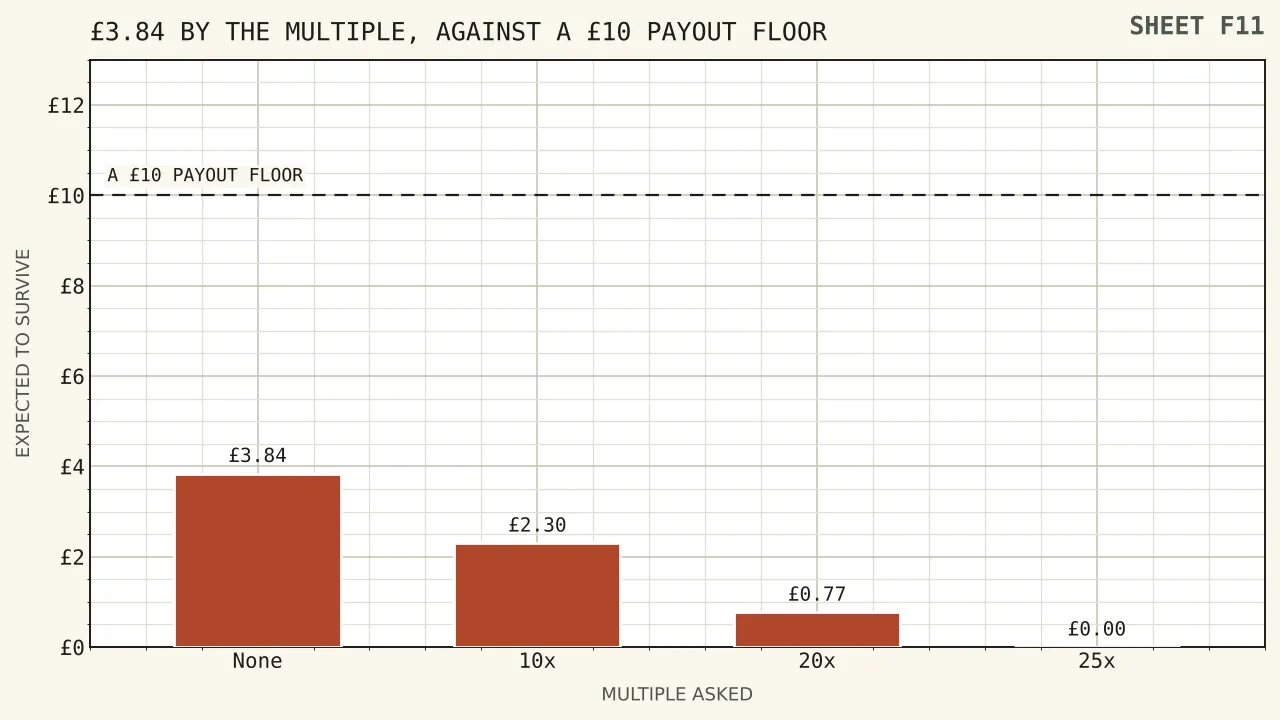
| Ten times | £38.40 | £1.54 | £2.30 | The British ceiling |
| Twenty times | £76.80 | £3.07 | £0.77 | A fifth remaining |
| Twenty-five times | £96.00 | £3.84 | £0.00 | Nothing, to the penny |
| Forty times | £153.60 | £6.14 | £0.00 | £2.30 past nothing |
| Sixty times | £230.40 | £9.22 | £0.00 | £5.38 past nothing |
Ten times is a condition and not a convention. The provision: social responsibility code 5.1.1, third limb, paragraph (a). The date it began to bite: 19 January 2026. The scope: all but two licence kinds, those for gambling software and those for gaming machine technical.
What gets capped is defined narrowly: wagers adding up to a stated value, due before funds become withdrawable. No judgement on the size of that value appears in the wording.
Up to 60 times was being asked by some licensees before the ceiling landed. The 60 is the Commission’s own published figure, and it is the single market multiple on this site’s sheet that the regulator supplies. On a £4.00 face, 60 times calls for £230.40 of turnover and expects to cost £9.22 against a credit of £3.84.
Is a free cycle bonus funds in its own right? No primary source answers that, either way, so this page does not answer it either. What is sourced runs narrower: a bonus balance holding the winnings off a free cycle is bound at ten times.
4
Nine point six obligations per cycle
An identity is hiding inside part 3, and once written out it prices any spin count in a second with no table at all. Required cycles divided by credited cycles come to the multiple times the return, and to nothing else.
Required cycles per credited cycle = multiple x return: at ten times, on a game of 96 per cent, 9.6
Test it against the figures above. At ten times, 384 cycles are required against 40 credited, and 384 over 40 is 9.6. At forty times, 1,536 over 40 is 38.4, being 40 multiplied by 0.96. The price of a cycle cancels out of the ratio altogether, which is why the identity survives whatever a cycle costs.
That makes the ratio the cleanest figure for setting one headline beside another. Ten credited cycles under a ten times rule carry 96 cycles of work. Forty carry 384. A thousand carry 9,600. The advertised count scales the work without altering its character, and the character is that each credited cycle brings 9.6 more along at the British ceiling, or 38.4 more at the figure used here past the register.
Time is where the ratio bites. A licensed slot cycle has a published floor beneath it. 2.5 seconds is the figure in RTS requirement 14D, timed from a game starting to the earliest moment another may begin, and it wants a start control released and pressed again, or an equivalent action, so holding something down cannot begin a cycle. That standard page states no date of commencement, and this page claims none for it.
| Multiple | Cycles required | Ratio to the forty credited | Seconds at the floor | Shortest sitting |
|---|---|---|---|---|
| The credit itself | 40 | One to one | 100 | 1 minute 40 seconds |
| Ten times | 384 | 9.6 to one | 960 | 16 minutes |
| Twenty times | 768 | 19.2 to one | 1,920 | 32 minutes |
| Twenty-five times | 960 | 24 to one | 2,400 | 40 minutes |
| Forty times | 1,536 | 38.4 to one | 3,840 | 1 hour 4 minutes |
Forty cycles of entitlement occupy a hundred seconds. The obligation fastened to them at forty times occupies 3,840, and the expectation at the end of those 64 minutes is nothing. A reader taking the headline at its word is being shown the hundred seconds and sold the hour.
None of that pacing survives past the British licence. Curacao’s own responsible gaming document carries no minimum game cycle in any of its eight mandatory areas. The version is 1.0; the date on it is 21 February 2025. The 1,536 cycles still have to happen, and they can happen as fast as the software will run, which sounds like an improvement and is its reverse, since the floor exists to put daylight between one decision and the next.
5
Two pounds thirty, seven pounds seventy short
Assume the best available run. Forty cycles credited, nothing forfeited, the multiple held at the British ceiling of ten times, and £2.30 arrives on the far side. That is a balance. It is not yet money anybody can hold.
Prepaid money moves in fixed denominations, and the ladder assumed throughout this site has six rungs: £10, £20, £25, £50, £75 and £100. Put a cashier’s smallest payout at the bottom rung and the floor is £10.00. A balance of £2.30 against a £10.00 floor falls £7.70 short, and the whole £2.30 is stranded. Not part of it. The lot.
Playing on is the first route across the gap and the arithmetic answers it flatly. Turning £2.30 over once expects to cost 9p; turning the same sum over ten times expects to cost 92p. Staking more lifts no expectation, since the charge keeps its sign at every size. Variance is the only thing that reaches £7.70, and 4p a pound is what asking costs.
Buying a rung is the second route, and the ladder bites twice. A £7.70 shortfall has to be covered by the £10.00 denomination, because nothing smaller exists on the ladder, so £2.30 of that purchase serves no purpose. The figure equals the surviving balance to the penny, and it will go on doing so for as long as the payout floor and the smallest rung are both £10.00.
£2.30 held under a £10.00 floor, and £10.00 the cheapest cover for a £7.70 gap
Four rules hold the exit open under a British licence. One: a deposit balance may not have its withdrawals capped by any term, and the barred wording the Commission illustrates runs £50 daily alongside £500 weekly. Two: limits on withdrawal size or count have to be reasonable. Three: a placed withdrawal request gets no reverse button. Four: documents may not be demanded at the exit where there was a chance to ask earlier.
No minimum payout is published anywhere, by anybody. That is why £10.00 appears here as the bottom rung of a declared ladder and not as a market figure. The real number sits in a cashier’s terms, and in no register or standard.
6
The box a licensed cashier must build
An offer that asks for no payment still has an entrance, and on the licensed side that entrance carries a duty specified down to the form control. It costs an operator real engineering, which is the reason its absence is worth pricing rather than lamenting.
| Element | What the standard requires |
|---|---|
| The control | A free text box, or the telephone counterpart, rather than a menu the operator picks |
| The level | Account level, at the very least |
| The kind | A lid on money going in, at prominence no lower than any other kind, and that name reserved for it alone |
| The durations | The menu must carry three spans: 24 hours, 7 days and 1 month |
| Overlaps | The tightest limit governs wherever two are running |
| The place | A direct link off the home page, reach from any deposit screen, and the fewest clicks the system can manage |
| The default | A limit is the pre-selected choice; refusing it needs an action and a confirmation first |
| Review | Existing customers without a limit prompted at least once a year |
Eight rows, and only one of them has any arithmetic in it. The overlap row is the one the Commission works through itself. Set £10 for a day and £100 for a week together and the system has to allow £10 daily and £70 weekly, because the tighter figure governs at every point. On a face of £4.00 that example is larger than the subject, which is the point of quoting it. A limit written before play is the one figure here that a reader picks.
A prompt every six months to read through one’s own account and transactions sits alongside, required wherever an account has seen activity in the past rolling year, with more frequent reminders on offer.
Two Commission pages word the prompt itself differently, and the gap is substantive. Registration is the first moment the live standard names. A customer’s first deposit or payment is the other. Either satisfies the prompt, the limit goes in as soon as practicable after a request, and the customer gets told when it begins to apply.
A summary page covering amendments in force from 31 October 2025 asks for the prompt as early as possible instead. No publication date appears on that page, and its lettering of the sub-requirements differs from the standard’s own. Quote the standard; name the summary where the looser phrasing is wanted; present neither as the single wording.
Where a face has no deposit behind it, one of those two moments may never arrive. No first payment means the registration limb is carrying the whole duty, so a looser phrasing weakens precisely the limb a headline of this shape relies on.
7
What a cooling-off period buys in cycles
Limits move at unequal speeds in both directions and in both regimes, and the asymmetry can be priced in cycles rather than described in adjectives. Downward is immediate in each, barring a technical failure. Upward waits.
Twenty-four hours is the British brake on an increase, and it comes with two further steps: a request first, then a fresh positive act by the customer once the wait has run. Seven days is the Curacao brake on the same movement, which is the longer of the two, and on this one point the offshore rulebook is the stricter document.
Convert both brakes into the only unit this page trusts. At the 2.5 second floor, 24 hours holds 34,560 cycles. Priced at 10p apiece, those are £3,456.00 of turnover. Seven days holds 241,920 cycles and £24,192.00. Between the two brakes lie 207,360 cycles of staking that cannot happen while the wait runs.
| Waiting period | Seconds | Cycles at the floor | Turnover at 10p | Where the figure comes from |
|---|---|---|---|---|
| None | 0 | 0 | £0.00 | No published brake at all |
| Twenty-four hours | 86,400 | 34,560 | £3,456.00 | The British minimum before a rise applies |
| Seven days | 604,800 | 241,920 | £24,192.00 | The Curacao waiting period on a rise |
| One month | 2,592,000 | 1,036,800 | £103,680.00 | A duration the limit menu must offer |
Those turnover figures are absurd beside a £4.00 face, and the absurdity is the finding. A brake measured in a day is worth £3,456.00 of theoretical staking, which is 864 faces of this page’s size. A reader whose £4.00 ran out in a hundred seconds is nowhere near that ceiling, which means the brake protects somebody else entirely and costs this reader nothing at all.
Read the other way round, the same figures show why a cycle floor counts for more out here than a deposit limit does. A limit binds money going in. On a face with nothing going in, the only binding figure is the clock, and the clock is 2.5 seconds per cycle where a British licence applies and whatever the software manages where one does not.
A 24-hour brake covers 34,560 cycles, which is 864 faces the size of this one
8
Duties priced on four pounds
A headline of this shape reaches a reader from a cashier holding no British licence, and the missing duties have a price in pence rather than a warning attached. A cashier holding no British licence is bound by nothing in the table below, and no row of it appears in the Curacao rulebook read for this site either.
| What binds a licensed cashier | What it is worth on £4.00 |
|---|---|
| Ten times at the very most | £2.30 comes through where otherwise nothing would |
| A 2.5 second minimum between cycles | Spreads 1,536 cycles over 64 minutes instead of over software speed |
| No autoplay on online gaming | Each cycle committed to on its own, 1,536 separate times |
| No turbo, quick spin or slam stop | The 64 minutes cannot be compressed by a setting |
| No win effects for a return the stake already covers | A 7p return on a 10p cycle stays a loss on screen |
| No several games at once | A single reel set running, so the hour cannot be halved |
| No near-miss substitution | Swapping a loss for a near-miss loss is prohibited by name |
| A free text box for limits, at account level | A lid the customer writes, before the face is played |
| Identity settled ahead of any play | Name, address and birth date, before a reel turns at all |
| No cap on withdrawals from a deposit balance | A reader’s own money leaves unlimited |
| Eight weeks to finish a complaint | A ceiling on how long £2.30 can be argued over |
| Membership of the national scheme | One registration reaching every licensed cashier at once |
Six of those twelve rows are about pacing, which is what a page built on 1,536 cycles ought to expect. Three are about the entrance. Two are about the exit. One has no price against it and is the heaviest of the twelve.
Take the entrance rows first. Identity is obtained and verified ahead of any gambling, the age check reaching bonus-funded play, free bets and free-to-play versions too. Credit cards cannot pay for gambling at all, including one made by credit card via a money service business, and 14 April 2020 is when that took effect. A monthly net deposit figure triggers light-touch financial checks: £500 to begin with, £150 from 28 February 2025.
Then the exit rows. Acknowledgement of a complaint is due in three working days, and in 24 hours at an operator whose facilities never close. Eight weeks from receipt covers the whole process, escalation and all. The shortest window a term may impose for bringing a complaint is six months, counted from the incident. Seven days without an answer to a reasonable information request can justify stopping the clock, which then picks up where it halted.
Then the row with no money against it. A British licence is what puts a company into Gamstop Online, and every online company holding one is in. A registrant picks from six months, from twelve, from sixty, or from sixty that renew themselves until switched off inside the final half year. Its own boundary is stated by the scheme: operators that take part are reached, and anybody who does not take part lies outside what it can stop. Scheme membership follows the licence and not the domain, which is why a familiar address proves nothing.
Three figures finish the page, and they are the three standing at its head. A face of £4.00. A drawdown of £1.70, being 16p of edge on the face plus £1.54 of expected cost at the British ceiling. And £2.30 of residue, which is not a part of the balance but the whole of it, held under a floor it is £7.70 short of reaching.
Questions
- What is 40 free spins actually worth?
- At the price held across this site, 10p a cycle, forty cycles are a face of £4.00 and average £3.84 on a 96 per cent game. Attach the British ceiling of ten times and £1.54 goes in expected cost, leaving £2.30. At forty times the expected cost is £6.14 and nothing survives.
- Why is the spin price an assumption rather than a fact?
- No published rule fixes it. There is no regulated minimum, no regulated maximum, and no duty to disclose the value as a figure, so the figure belongs to whichever desk drafts the promotion. Rather than invent a market average, this site declares one price and applies it everywhere, so that two headlines can be set on a single scale.
- How many spins does a ten times rule really ask for?
- Nine point six for every cycle credited. Required cycles divided by credited cycles come to the multiple times the return, and the price of a cycle cancels out of that ratio. So forty credited cycles carry 384 required ones at ten times, and 1,536 at forty times, which is 38.4 for each one advertised.
- How long does the obligation take?
- Turn turnover into cycles, then cycles into seconds. At ten times, 384 cycles occupy 960 seconds, or 16 minutes, measured at the 2.5 second minimum RTS requirement 14D puts under a licensed slot. At forty times, 1,536 cycles occupy 3,840 seconds, being 1 hour 4 minutes, at the end of which the expectation is nothing. Past the British licence no such minimum exists.
- What is stranded if nothing goes wrong?
- The whole £2.30. A clean run at the British ceiling leaves that much as a balance, and against a £10.00 payout floor, the bottom rung of the ladder assumed here, it falls £7.70 short. Playing on cannot close the gap: 4p leaves every pound staked in expectation, and that charge keeps its sign however large the stake.
- Is covering the shortfall cheaper than playing on?
- It is certain rather than cheap. A £7.70 gap must be covered by a £10.00 purchase, since nothing smaller exists on the ladder, and £2.30 of that purchase then serves no purpose. That residue equals the surviving balance here, and it does so whenever the payout floor and the smallest rung are the same figure.
- Where does the sixty times figure come from?
- The regulator rather than this site. Its consultation response records that some licensees were applying wagering requirements of up to 60 times before the ceiling landed, and it is the one market multiple the Commission itself supplies to this site’s fact sheet. On a £4.00 face, 60 times calls for £230.40 of turnover and expects to cost £9.22 against a credit of £3.84.
- What shape must a deposit limit take at a licensed cashier?
- A free text box, or the telephone counterpart, and it has to bind at account level or lower. A lid on money going in must be offered at prominence no lower than any other kind, and that name is reserved for it alone. The menu must reach across a day, a week and then a month, the facility must be linked directly off the home page, and the clicks needed to reach it must be kept down.
- What is a cooling-off period worth in cycles?
- At 2.5 seconds a cycle, a 24-hour wait covers 34,560 cycles. Priced at 10p apiece those come to £3,456.00 of turnover, or 864 faces the size of this page’s. A seven-day wait, the Curacao figure on a limit increase, covers 241,920 cycles and £24,192.00. Between the two brakes lie 207,360 cycles.
- What does the absent licence cost on this face?
- Part 8 prices twelve duties. The wagering ceiling is worth £2.30 on this face, the cycle minimum is worth 64 minutes of pacing on the obligation, and the limits regime is worth a lid the customer writes before play. The duty with no price against it is national scheme membership, which follows the licence rather than the address.