Note X04 Revision 1 Terms read 16 October 2026
USDT casino: a peg to one currency, held by a reader who spends another
A unit that holds to a dollar does not hold to a pound, so a British reader keeps the exposure the peg was supposed to remove. On the figures modelled here the peg costs one per cent in two conversions and leaves three per cent of sterling exposure standing, which puts its break-even at four per cent: worth having where an unpegged unit would move more than that, worth nothing where it would move less. What the peg does buy outright is a steadier floor. It narrows the band of balances that may or may not be payable from £2.50 wide to 30p wide.
The face A £20.00 credit What draws it down £8.00 of turnover cost What is stranded £9.23, or 46.15 per cent
What a face of this size is worth
Every destination on this rack is bought advertising. The site takes a fee if a reader goes on to register, and no figure printed below moves because of it.
Face and Residue
Strip No 01
Betportal
Ceiling as a multiple
Priced at this site's own 10p a spin
What is printed
What draws it down
What is stranded
No Great Britain licence
Licensed in Anjouan, Comoros, run by BetPortal Gaming Ltd, with Excite Ultra Media Ltd, reference ALSI-202601040-FI2.
Terms read 16 October 2026
Open the offer at Betportal, opens in a new tabFace and Residue
Strip No 02
WinBeast
Ceiling as a sum
Priced at this site's own 10p a spin
What is printed
What draws it down
What is stranded
No Great Britain licence
Licensed in Curaçao, operator not named on the site.
Terms read 16 October 2026
Open the offer at WinBeast, opens in a new tabFace and Residue
Strip No 03
EliteSpin
Longest spin window
Priced at this site's own 10p a spin
What is printed
What draws it down
What is stranded
No Great Britain licence
Licensed in Costa Rica, run by PrimeTier Limited.
Terms read 16 October 2026
Open the offer at EliteSpin, opens in a new tabFace and Residue
Strip No 04
Crown Jewelz
Multiple unpublished
No residue struck
What is printed
What draws it down
What is stranded
No Great Britain licence
Licensed in Curaçao, number not verified, operator not named on the site.
Terms read 16 October 2026
Open the offer at Crown Jewelz, opens in a new tabThe two figures in the second and third registers are this site's own arithmetic and nothing an operator has published: the face as printed, less the share a spin gives back at 96 per cent return to player, less what playing the wagering through costs at the same return, and then less whatever a published ceiling, a charge on the way out or a floor on the smallest withdrawal takes off what survives that. The residue is what is left of the face when all of it is accounted for. It describes the offer, not one reader's afternoon. Where the conditions price above the face the strip prints nothing coming off rather than a negative sum, and where a figure the sum needs is unpublished it prints the condition in the operator's words instead.
A face paid as spins has no unit of its own, so one is supplied. Where an operator publishes what a spin of its own is worth, that figure stands in the first register's own line and is labelled as theirs. Where it does not, this site's own 10p a spin stands there and says so, and every figure below moves in proportion: at half the price, half the money. The share of the face that does come off is also given as pence in the pound, which is the figure that compares a large face against a small one.
Money goes onto a prepaid voucher in fixed denominations, so a smallest deposit published in pounds is rounded up to the first rung of the ladder this site works in, £10, £20, £25, £50, £75 and £100, and the strip prints what that rounding strands. That is the reader's own money and it is never netted into a residue. A smallest deposit published in euros is printed as the operator publishes it, because the ladder here is a sterling one and rounding a euro sum to it would be an invented figure.
Three words stand in the amount column where no figure can. Noted is a published condition that takes value away without leaving the sum a figure to take. Unpriced is a condition whose figure nobody has published, or a credit that is not a sum until a deposit of your own sets it. Own money is money of yours, which is never part of a residue.
Not one of the operators printed above holds a Great Britain licence, so the duties that licence carries do not reach them. All online gambling companies licensed in Great Britain must be part of Gamstop Online, and a reader who has shut themselves out through the scheme is therefore not shut out here. The ceiling of ten times the bonus funds on a wagering requirement, in force since 19 January 2026 under Social Responsibility Code 5.1.1, is a condition of that licence and binds the companies that hold one. On an unlicensed site the Gambling Commission describes consumers as facing unfair gaming practices, financial loss and a lack of recourse if things go wrong, and it names blocked payouts and withdrawal limits set so high they are unattainable among what it has seen. Nobody under 18 may hold an account at any of them.
Every term printed on a strip is the operator's own, and each strip carries the day it was read. The oldest of those readings is 16 October 2026. What binds a reader is the operator's own full terms, and not a line printed here.
1
A peg names a currency, and it is not the pound
A unit designed to hold a fixed value holds it against something, and the something is named in the design. Where the something is a dollar, a reader whose rent is in pounds has not removed an exposure. They have swapped a large one for a smaller one and paid a toll for the swap.
Three separate deductions follow from that, and the page takes them in order. Converting into the unit costs a spread. Converting out costs another. And in between, the currency the unit is pegged to moves against the currency the reader lives in, which is a deduction with no sign on it and no fee attached.
Quantities fixed across this site hold on this page too: 10p to a press, 96 pence returning on the pound, a weighting of unity, and six denominations between £10.00 and £100.00. Modelled for this page, and said again where each is used: a payout charge of 75p, a conversion spread of half a per cent in each direction, a floor of £10.00, and a sterling exposure of three per cent against the currency behind the peg. The last of those is the figure doing the real work, and part 3 shows why.
Balances kept in units of this sort sit at counters that hold no Great Britain licence. Among much else that means the spread is unfixed, the charge is unfixed, the floor is unfixed, and no duty obliges anybody to print a figure for any of the three before a reader pays in. Parts 6 and 7 go further than listing that absence: they ask, jurisdiction by jurisdiction, whether a rulebook exists that a reader could open and read.
| The deduction | Shape | Known in advance? |
|---|---|---|
| Spread going in | A share of the sum | Yes, from the terms |
| Spread coming out | A share of the sum | Yes, from the terms |
| Payout charge | A fixed sum each time | Yes, from the terms |
| Sterling against the peg | A share, either direction | No, and no fee is charged for it |
| Floor under a payout | All or nothing | Yes, but it moves in pounds |
2
Two conversions where there used to be a movement
Put a number on the toll first, since it is the one part a reader can read off a page before paying. Half a per cent each way means one per cent of whatever passes through, and one per cent behaves nothing like the 75p charge beside it.
On £15.00 the spreads come to 15p and the charge to 75p, so the charge is five times the spreads. On £100.00 the spreads come to £1.00 and the charge is still 75p, so the spreads are now the larger of the two. They cross at £75.00, which is 75p divided by one hundredth, and that figure is a denomination on this site’s ladder.
| Sum moved | Charge | Charge as a share | Both spreads | Larger of the two |
|---|---|---|---|---|
| £12.00 | £0.75 | 6.25 per cent | £0.12 | The charge, six times over |
| £20.00 | £0.75 | 3.75 per cent | £0.20 | The charge, nearly four times |
| £30.00 | £0.75 | 2.50 per cent | £0.30 | The charge, two and a half times |
| £75.00 | £0.75 | One per cent | £0.75 | Level, to the penny |
| £100.00 | £0.75 | 0.75 per cent | £1.00 | The spreads, by 25p |
| £200.00 | £0.75 | 0.38 per cent | £2.00 | The spreads, by £1.25 |
So a reader moving a small residue is paying mostly for the privilege of a transaction, and a reader moving a large balance is paying mostly for the privilege of a currency. Two different bills with one total, and the proportions invert at £75.00.
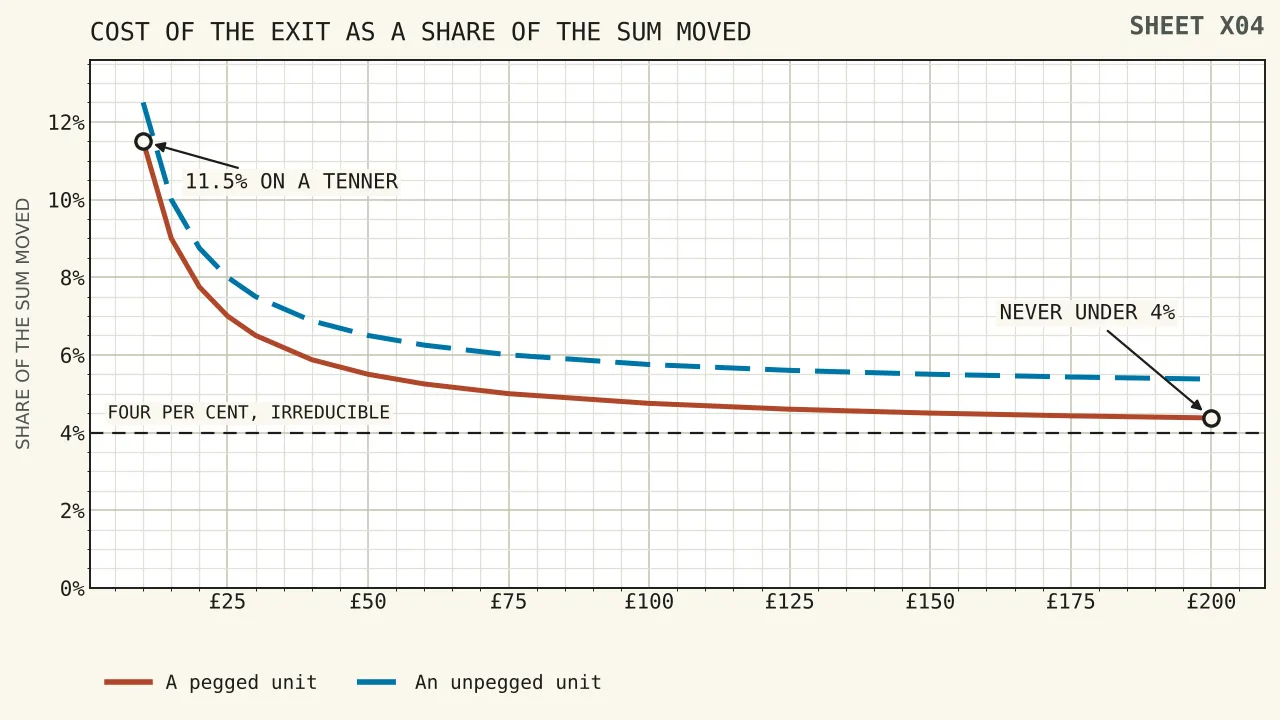
Worth noticing what the spreads do not do. They do not shrink as the sum grows, which means they put a floor under the total cost that no amount of patience removes. Add the one per cent of spread to the three per cent of sterling exposure modelled here and the total cost of getting money away cannot fall below four per cent, however large the balance and however small the charge. On £100.00 the whole bill is £4.75, of which £4.00 is that irreducible four per cent and 75p is the only part that would shrink further.
Four per cent is the floor under the cost of getting out
3
Four per cent, which is where the peg earns its keep
Now the comparison the page exists for. An unpegged unit carries no spread of its own in this model and one large unknown instead: the unit’s own movement against sterling between the request and the arrival. A pegged unit carries two spreads, one per cent in total, and a smaller unknown, which is sterling against the currency behind the peg.
So the peg is worth having exactly when one per cent plus the sterling exposure comes to less than the movement it replaced. With the exposure modelled at three per cent, the threshold is four per cent, and the rule reads in one line: a peg pays for itself where an unpegged unit would have moved more than four per cent, and costs money where it would have moved less.
| Sum moved | Pegged total | Of which irreducible | Unpegged total | What the peg saved |
|---|---|---|---|---|
| £10.00 | £1.15 | 40p of spread and exposure | £1.25 | Ten pence |
| £15.00 | £1.35 | 60p of spread and exposure | £1.50 | Fifteen pence |
| £20.00 | £1.55 | 80p of spread and exposure | £1.75 | Twenty pence |
| £30.00 | £1.95 | £1.20 of spread and exposure | £2.25 | Thirty pence |
| £60.00 | £3.15 | £2.40 of spread and exposure | £3.75 | Sixty pence |
| £100.00 | £4.75 | £4.00 of spread and exposure | £5.75 | One pound |
The last column is a straight one per cent of the sum, every row, which is the difference between the five per cent assumed for an unpegged unit and the four per cent the peg leaves behind. That is the whole value of the peg on these parameters: one penny in the pound. Not nothing, and nothing like the protection the word peg suggests.
Change the one assumption that matters and the conclusion turns over. Model the sterling exposure at five per cent instead of three and the pegged total becomes six per cent, which is dearer than the unpegged five. Model the unpegged unit as moving two per cent and the peg loses by two points in every pound. The threshold is the only durable statement here, and the threshold is four per cent, built out of two half-per-cent spreads and a three per cent exposure.
A reader can test the first half of that threshold and not the second. Spreads and charges are published in terms, so the one per cent is checkable before a penny moves. The exposure is not anybody’s to publish, and this site has no citable source for a distribution of currency movements, so three per cent is a parameter chosen to be moved rather than a figure asserted to be true.
4
The floor that stops jumping about
Here is the benefit a peg genuinely delivers, and cost is not what it is about. Give a smallest payout as so many units, let the unit wander, and the floor’s size in pounds wanders with it, so a reader budgeting in pounds cannot say beforehand whether a balance gets paid. Pin the unit and the uncertainty shrinks to whatever exposure is left over.
Put numbers on both. A floor of £10.00 in a unit that could move 25 per cent spans £10.00 to £12.50 in sterling, a band £2.50 wide. The same floor in a unit pegged to a currency three per cent away from sterling spans £10.00 to £10.30, a band 30p wide. Any balance inside the band may be paid or held, and a reader cannot tell which. Outside it, they can.
| The floor | Unpegged, a quarter of movement | Pegged, three per cent |
|---|---|---|
| £10.00 | A band £2.50 wide | A band 30p wide |
| £20.00 | A band £5.00 wide | A band 60p wide |
| £25.00 | A band £6.25 wide | A band 75p wide |
| £50.00 | A band £12.50 wide | A band £1.50 wide |
Divide one column by the other and the factor is constant: eight and a third. The peg makes the uncertain band eight times narrower, which is a real gain and a different gain from the penny in the pound in part 3. One is about how much a reader pays. The other is about whether a reader is paid at all, and the second matters more at the bottom of the ladder, where a residue is small and a floor is close.
Take a worked case. A balance of £10.15 against a £10.00 floor sits 15p above it. In an unpegged unit that balance is inside a £2.50 band, so whether it pays is unknowable in advance, and the residue is either 75p or £10.15. Pegged, the balance is still inside the 30p band, so it is still unknowable, but the band it is unknowable within is narrow enough that a reader clearing the floor by a pound is safe rather than merely hopeful. Clearing a floor by a pound is worth nothing in the first case and settles the question in the second.
A 30p band of doubt, against £2.50 of it
5
What each denomination puts in a bank
Four deductions in a row, applied in the order they happen. The credit is staked through ten turnovers, which costs four pence in every pound staked. The survivor meets the floor. The charge comes off what passes. The spreads and the exposure take their shares of the rest.
| Credit | Survivor at ten | Floor at £10.00 | Charge and shares | Into a bank | Residue as a share |
|---|---|---|---|---|---|
| £10.00 | £6.00 | Held, by £4.00 | None levied | Nil | The whole credit |
| £20.00 | £12.00 | Pays, by £2.00 | £1.23 | £10.77 | 46.15 per cent |
| £25.00 | £15.00 | Pays, by £5.00 | £1.35 | £13.65 | 45.40 per cent |
| £50.00 | £30.00 | Pays, by £20.00 | £1.95 | £28.05 | 43.90 per cent |
| £75.00 | £45.00 | Pays, by £35.00 | £2.55 | £42.45 | 43.40 per cent |
| £100.00 | £60.00 | Pays, by £50.00 | £3.15 | £56.85 | 43.15 per cent |
The residue share drifts down from 46.15 per cent to 43.15 per cent as the denomination rises, and the drift stays small because just one deduction out of the set is a fixed sum. Forty points of every row are the turnover cost. Four more points are the spread and the exposure, which do not move. What falls as the ladder climbs is just the charge, from 6.25 per cent of the survivor on the twenty pound step to 1.25 per cent on the hundred pound one.
The bottom row is the usual casualty. Six pounds of survivor against a ten pound floor is held in full, so the ten pound denomination strands 100 per cent and no part of parts 2 to 4 ever applies to it. Working backwards instead, the least credit expected to leave a payable balance under a £10.00 floor and a 75p charge is £17.92 at ten turnovers, £21.50 at twelve and a half, £26.88 at fifteen and £53.75 at twenty. The first three sit between denominations, so a reader is buying the step above each of them.
And one figure for the twenty pound step on its own, since it is the most common purchase on this ladder. Twelve pounds of survivor becomes £10.77 in a bank. A reader who began with a £20.00 face has received just over half of it, which is a better outcome than most rows on this site and still a long way from the headline.
6
Which rulebooks open, and which do not
A reader comparing counters away from the British register is really asking a prior question: is there a published rulebook at all, and can it be read? That question has five different answers, and the differences are larger than anything in parts 2 to 5.
| Where | A rulebook that opens | A route for a complaint | What is missing |
|---|---|---|---|
| Great Britain | Licence conditions and technical standards | Eight weeks, then an approved body | Nothing on payout charges |
| Curaçao | Two documents, one on conduct and one on complaints | Lodged inside six months, answered inside eight weeks | No cap on a multiple or a stake |
| Malta | A gaming act and directives, with a register | A formal form, in English or Maltese | No stated time limit or binding effect |
| Anjouan | No ordinance or regulation is named | Advertised, and the page would not load | Everything a page would want to quote |
| Costa Rica | Nothing governmental was located | None found | Any statement of what the law requires |
That table is the opposite of a ranking. It records what opened and what did not, and the rows at the bottom are blank for a reason rather than from neglect.
| A reader asks | The complaints page | What may be written here |
|---|---|---|
| How long have I got? | Silent | That no period is given |
| Am I eligible from here? | Asks the country, sets no rule | That residence is asked and not tested |
| What can the authority do? | Silent on its own powers | That the limits go unmentioned |
| Must an operator obey? | Silent | That no binding effect is claimed |
Each of those gaps is the finding, and this note fills in none of them. Alongside them sit a register and a form that do exist, reviewed in English or Maltese, with identification reserved for where it is needed, and advice to approach the operator’s own support and management before any of it.
Anjouan is a different problem. Its issuing body sits on a commercial web address rather than a governmental one, calls itself the regulatory authority for internet gaming beneath an offshore financial authority, and points at no ordinance, Act or regulation at all. A complaint process is advertised, and a list of adjudicators. Neither would load when read for this site, so nothing is reported here about what either holds: no period, no remedy, no question of whether a decision binds. Setting that against the Curaçao timetable would be a comparison nobody has made at source, and it is not made here.
Costa Rica is one line long. No governmental gaming authority’s own pages were found, so this note states nothing whatever about the requirements of Costa Rican law. Where a registration there is cited by a counter, what can honestly be reported is the search result: nothing turned up to set beside the British material, neither rulebook nor register nor complaints route.
A fifth body turns up on footers and earns a sentence rather than a row. In Mohawk Territory in Quebec, the Kahnawà:ke Gaming Commission says its own gaming law lets it make regulations, issues five sorts of interactive gaming licence, and keeps the receipt and review of complaints, queries and investigations in its own hands under those regulations.
One caution on dates, as an example of what reading a rulebook turns up. Curaçao’s authority gives two different years for the coming into force of its governing ordinance: its online gaming page says 24 December 2024, while a 2025 date appears in one passage of its about page beside the 2024 date in another. Two statements of the three land on 24 December 2024, so that is the date this site uses, and the disagreement is printed here rather than smoothed over.
7
Four steps, published, costing nothing
One instruction published for players costs nothing, takes about a minute, and is worth more than any figure on this page. Below are its steps in sequence, and the one at the end carries the weight.
| The check | What it settles |
|---|---|
| A licence claimed on the site | No more than the site’s own word for it |
| Clicking through to the register | Whether a real entry exists at all |
| Activities on the entry | Whether the licence covers this game |
| Domain names on the entry | Whether this address is the licensed one |
| A game you recognise | Nothing whatever |
Step four is skipped most and settles most. A web address appears against a licence holder, and a licence holder is a company rather than a brand, so a minute spent there establishes which company stands behind an address and whether its licence covers the game on offer. Two cautions go with it. The register’s own page is undated and offers no reading guide, so it defines neither an active status nor an inactive one, and anybody leaning on register data has to print the date they looked and must not credit the Commission with an interpretation it never published. And a game somebody recognises proves nothing: titles from licensed suppliers have been recorded on sites holding no British licence.
What a player should look for inside an offer is published too, and it is the figure a no-deposit headline buries: a limit put on an introductory offer, or a level of spending required before the bonus is paid over. Everything in parts 2 to 5 descends from that one line, because a minimum spend is a play-through, and a play-through is what turns a £20.00 face into £10.77.
8
Priced absences, and what is left out here
Four figures price the missing ceiling on the twenty pound step, which is the denomination this page has used throughout. Ten turnovers leave £12.00 standing and bank £10.77 of it. At twelve and a half it leaves £10.00, clears the floor by nothing and banks £8.85. At fifteen it leaves £8.00, held in full by the floor. Forty turnovers are expected to finish £12.00 beyond the end of the credit. Ten turnovers is the British ceiling, and the span from £10.77 banked to £12.00 lost is what the absence of that ceiling is worth on one £20.00 face.
Two shorter absences, both of them in the identity rules rather than the money rules, because they bear on whether a payout happens at all. Three fields want verifying before anybody gambles at all under a British licence: the name, the address, then the date of birth, and the rule reaches play on a bonus and play for nothing alike. Curaçao’s registration test is lighter, confirming a birth date and leaving government identity documents to later milestones, while still barring a deposit or a wager where the operator is not satisfied about the age of the person making it. Timing is the whole difference, and timing at the entrance decides whether documents appear at the exit.
The refusals on this page, in the order they matter. The sterling exposure of three per cent and the spread of half a per cent are parameters, not quotations, because no citable source publishes a distribution of either, and a threshold that moves with its inputs is the honest form of that arithmetic. No payout speed is named here for anybody and no promotion code appears. No payment method is named as one that any counter accepts, either direction, and methods are not compared for counters without a British licence. And nothing at all is said about reopening an account a reader has closed against themselves, or about getting past a block a bank has put on.
For completeness, the charge that attaches wherever a counter sits. Where a customer usually lives decides the gaming duty, and the address printed on a licence decides nothing, with the operator carrying the charge rather than the player. A player’s own position is reached in HMRC’s manuals by an absence, betting not being treated there as a trade of itself, which leaves no trading income to catch. None of that is tax advice.
Questions
- Does a peg to a dollar protect a British reader?
- Partly, and the part it misses is the point. A unit held to a dollar has not been held to a pound, so the exposure that remains is sterling against the dollar. On the figures modelled here that is three per cent, and it is not charged for, not published and not avoidable by waiting.
- What does the peg cost?
- One per cent, as two conversions of half a per cent each, plus whatever the remaining exposure turns out to be. Add the three per cent modelled here and four per cent is the floor under the cost of getting money away, which no size of balance and no patience reduces.
- When is the peg worth having?
- Where an unpegged unit would have moved more than four per cent, since four per cent is what the peg costs in spread and residual exposure together. Below that threshold the peg loses money. The threshold is the durable statement here; the five per cent assumed for an unpegged unit is a parameter and so is the three.
- When do the spreads overtake the charge?
- At £75.00, which is 75p divided by a hundredth and also a denomination on this ladder. Under that sum a reader is paying mostly for the transaction, since the charge is six times the spreads at £12.00. Over it they are paying mostly for the currency, the spreads reaching £2.00 against 75p at £200.00.
- What does a peg do to a payout floor?
- It narrows the band of balances whose fate is unknowable. A £10.00 floor in a unit free to move a quarter spans £10.00 to £12.50, a band £2.50 wide. The same floor behind a three per cent exposure spans £10.00 to £10.30, a band 30p wide. The factor is eight and a third at every floor.
- Is a balance just above a floor safe?
- Only if it is above the band rather than inside it. Fifteen pence above a £10.00 floor is inside both bands, so it is unknowable in each case. A pound above the floor settles the question where the band is 30p wide and settles nothing where the band is £2.50 wide, which is the practical difference the peg buys.
- What does a £20.00 credit put in a bank?
- Ten pounds seventy-seven, on these parameters. Ten turnovers leave £12.00, the £10.00 floor passes it by £2.00, and 75p of charge, 12p of spread and 36p of exposure come off what remains. The residue is £9.23, or 46.15 per cent of the face, and 40 of those points are the turnover cost alone.
- Which denominations cannot reach the floor?
- The ten pound step, at every multiple. Six pounds is three fifths of ten, a £10.00 floor holds all of it, and nothing in parts 2 to 4 ever gets as far as applying. Worked backwards, the least credit expected to leave a payable balance is £17.92 at ten turnovers, £26.88 at fifteen and £53.75 at twenty.
- Which offshore rulebooks can actually be read?
- Two of the five, and both only in part. Curaçao prints a responsible gaming document and a separate complaints one, allowing six months in which to lodge and eight weeks in which to answer. Malta prints a gaming act, directives, a register and a form. Anjouan points at no ordinance and its complaint page would not open. Costa Rica yielded no governmental gaming pages whatever.
- What does Malta’s complaints page not say?
- A period, an eligibility rule, the reach of its own powers, and whether a decision obliges an operator to do anything. Each of those is unstated, which is itself the fact, and the form asks which country a player lives in without attaching any test to the answer.
- What check does the regulator ask a player to make?
- Four steps in order. Is a Commission licence claimed; is licensed status displayed; does a click reach the public register; and do the activities and web addresses on that entry match the site being read. The register’s own page bears no date and no reading guide, so anybody relying on it has to print the day they looked.
- Does recognising a game prove anything?
- No. Titles from licensed suppliers have been recorded on sites holding no British licence, so recognising one says something about who built the game and nothing about who is running it. Only the four-step check in the previous answer settles that question.