Note K03 Revision 1 Terms read 16 October 2026
No KYC casinos: what an unverified balance is actually worth
A £50.00 rung, ten turnovers, and £30.00 comes through. Then the question nobody prices: what is a balance worth at a cashier that never asked who holds it? Multiply £30.00 by the chance of collecting it, notice that nobody publishes that chance, and the answer sits somewhere between £30.00 and nothing.
The face at the door £50.00 What draws it down £20.00 What is stranded £30.00
What a face of this size is worth
Every destination on this rack is bought advertising. The site takes a fee if a reader goes on to register, and no figure printed below moves because of it.
Face and Residue
Strip No 01
Betportal
Ceiling as a multiple
Priced at this site's own 10p a spin
What is printed
What draws it down
What is stranded
No Great Britain licence
Licensed in Anjouan, Comoros, run by BetPortal Gaming Ltd, with Excite Ultra Media Ltd, reference ALSI-202601040-FI2.
Terms read 16 October 2026
Open the offer at Betportal, opens in a new tabFace and Residue
Strip No 02
WinBeast
Ceiling as a sum
Priced at this site's own 10p a spin
What is printed
What draws it down
What is stranded
No Great Britain licence
Licensed in Curaçao, operator not named on the site.
Terms read 16 October 2026
Open the offer at WinBeast, opens in a new tabFace and Residue
Strip No 03
EliteSpin
Longest spin window
Priced at this site's own 10p a spin
What is printed
What draws it down
What is stranded
No Great Britain licence
Licensed in Costa Rica, run by PrimeTier Limited.
Terms read 16 October 2026
Open the offer at EliteSpin, opens in a new tabFace and Residue
Strip No 04
Crown Jewelz
Multiple unpublished
No residue struck
What is printed
What draws it down
What is stranded
No Great Britain licence
Licensed in Curaçao, number not verified, operator not named on the site.
Terms read 16 October 2026
Open the offer at Crown Jewelz, opens in a new tabThe two figures in the second and third registers are this site's own arithmetic and nothing an operator has published: the face as printed, less the share a spin gives back at 96 per cent return to player, less what playing the wagering through costs at the same return, and then less whatever a published ceiling, a charge on the way out or a floor on the smallest withdrawal takes off what survives that. The residue is what is left of the face when all of it is accounted for. It describes the offer, not one reader's afternoon. Where the conditions price above the face the strip prints nothing coming off rather than a negative sum, and where a figure the sum needs is unpublished it prints the condition in the operator's words instead.
A face paid as spins has no unit of its own, so one is supplied. Where an operator publishes what a spin of its own is worth, that figure stands in the first register's own line and is labelled as theirs. Where it does not, this site's own 10p a spin stands there and says so, and every figure below moves in proportion: at half the price, half the money. The share of the face that does come off is also given as pence in the pound, which is the figure that compares a large face against a small one.
Money goes onto a prepaid voucher in fixed denominations, so a smallest deposit published in pounds is rounded up to the first rung of the ladder this site works in, £10, £20, £25, £50, £75 and £100, and the strip prints what that rounding strands. That is the reader's own money and it is never netted into a residue. A smallest deposit published in euros is printed as the operator publishes it, because the ladder here is a sterling one and rounding a euro sum to it would be an invented figure.
Three words stand in the amount column where no figure can. Noted is a published condition that takes value away without leaving the sum a figure to take. Unpriced is a condition whose figure nobody has published, or a credit that is not a sum until a deposit of your own sets it. Own money is money of yours, which is never part of a residue.
Not one of the operators printed above holds a Great Britain licence, so the duties that licence carries do not reach them. All online gambling companies licensed in Great Britain must be part of Gamstop Online, and a reader who has shut themselves out through the scheme is therefore not shut out here. The ceiling of ten times the bonus funds on a wagering requirement, in force since 19 January 2026 under Social Responsibility Code 5.1.1, is a condition of that licence and binds the companies that hold one. On an unlicensed site the Gambling Commission describes consumers as facing unfair gaming practices, financial loss and a lack of recourse if things go wrong, and it names blocked payouts and withdrawal limits set so high they are unattainable among what it has seen. Nobody under 18 may hold an account at any of them.
Every term printed on a strip is the operator's own, and each strip carries the day it was read. The oldest of those readings is 16 October 2026. What binds a reader is the operator's own full terms, and not a line printed here.
1
What the phrase describes, and what it does not
Three letters do a lot of work in that heading. Know your customer is the banking phrase for establishing who an account holder is, and a cashier described as having none of it is one that puts no identity step between a visitor and a reel.
What the phrase never describes is a cashier that will not ask later. A step skipped at the start has not been abolished. It has been moved to whichever moment suits the business holding the money, and the moment that suits a business holding money is the moment somebody asks for it back.
So this note prices one thing: a balance that exists while its owner is unknown. Every figure below is arithmetic on an assumed £50.00 rung at the 10p spin, 96 per cent return and forty times play-through stated across this site, and every rule below is a duty on somebody holding a licence rather than a prediction about anybody who holds none.
At the door of a site holding no Great Britain licence there is no duty to check anything, and the check does not vanish: it moves to the exit, where the money is. That is the whole page in one line, and parts 6 and 7 put a figure on it.
What this note will not do, said once and meant. It names no cashier, no domain and no search string. It describes no way of opening an account anywhere without documents, no second account, and nothing about a network, a browser or a payment route. A reader who has registered with the national scheme is protected by that registration, and a page offering a way round it would be doing harm with arithmetic as cover. The telephone number in the block below costs nothing to ring and answers at any hour.
2
The British order of events, in one table
Great Britain fixes the order rather than the paperwork. Obtaining and verifying come before gambling, three items are named as a floor, and then something less obvious happens: a late demand gets shut out of the exit. Read the table as a timeline, top to bottom.
| Moment | What is required | Of whom |
|---|---|---|
| Before a deposit | Say what may be needed, when and how | A British licensee |
| Before any play | Three items verified: name, address, birth date | A British licensee |
| Through the account | Keep that information accurate | A British licensee |
| At the cash-out | No late demand the door could have made | A British licensee |
| At the cash-out | What another legal duty requires then | The one exception |
Row two reaches the subject of this site, because it reaches play that costs a visitor nothing. A bonus-funded spin sits inside the duty, as does a free bet, as does reaching a game in its free-to-play form, which the regulator explains by observing that such games are not technically gambling and that it sees no good reason for children to be in them.
Row four is worth the most money to a reader and gets advertised the least. The exit is not the place for a question the door could have asked. The player-facing version of that adds that money-laundering information ought to be requested early rather than when somebody wants their funds. That consumer guide predates most of the rules beside it, published on 23 September 2020 and last updated on 13 April 2022, so the live wording is the licence condition’s.
Row one is small print with real money in it. Before any deposit a licensee has to say which documents or other information might be asked for, at what point, and by what means. Price that against a prepaid ladder and the value is obvious: a reader told at the start can decide not to buy a rung. A reader told at the end has already bought one, played it down to £30.00, and is negotiating from inside the cashier rather than outside it.
Three reasons get given for asking at all, and the middle one is why this page exists: age, self-exclusion status, and confirming that somebody is who they say. A cashier that establishes nobody’s identity cannot consult a register of exclusions, because it has no name to look for. The protection and the identity step are one mechanism seen from two sides.
3
The same questions, asked in a different order
Offshore the questions are not absent. They are sequenced differently, and the sequence is the whole of the difference. The columns below are a timeline, not a scorecard.
| The question | Under a British licence | Under the Curacao policy |
|---|---|---|
| Is this an adult? | Verified first | The operator must be satisfied first |
| How, at sign-up? | Name, address, birth date | Birth date, plus more where possible |
| Government identification? | Part of verifying, before play | Tied to later money-laundering milestones |
| Bonus and demo play? | Inside the duty | Not addressed as such |
| A demand at the cash-out? | Barred where the door would have done | Nothing published on it |
The third row is where the money goes. A document step tied to a later milestone is one that happens after a balance exists, and a balance existing before its owner has been established is a balance somebody can be asked to prove a claim to. Nothing in the offshore policy forbids the asking. Nothing in it puts a clock on the asking either.
What that policy does carry, and a note of this kind has to say so, is an instruction that nothing may be deposited or wagered before the operator is satisfied about age. The gap is not between a rule and no rule. It sits between verifying first and being satisfied first, and those are different acts at different prices.
4
The rung, and what it strands before anybody plays
Prepaid money arrives in fixed sizes, so the first residue on any page here belongs to the ladder rather than to the reels. This site assumes rungs of £10, £20 and £25, with £50, £75 and £100 above them, and declares the ladder an assumption rather than a survey of what gets sold.
A sum that misses a rung is paid for at the next one up, which is a residue no headline mentions. The table prices four intentions against the ladder, and the right-hand column is money gone before a single press.
| What was wanted | What the ladder sells | Paid | Stranded at the door |
|---|---|---|---|
| £45.00 | One fifty | £50.00 | £5.00 |
| £50.00 | One fifty | £50.00 | £0.00 |
| £55.00 | A fifty and a ten | £60.00 | £5.00 |
| £65.00 | A fifty, a ten and a five | £60.00 | No five pound rung |
That last row is the useful one. There is no £5.00 step on this ladder, so a reader wanting £65.00 buys either £60.00 and falls short or £75.00 and strands £10.00. The ladder does not care which, and neither does the cashier: the money arrives in the sizes the instrument comes in.
The door residue has an expectation of its own, which is the part a reader can work out and nobody prints. £5.00 stranded on a rung would have been worth £3.00 at the ten turnover ceiling and nothing at all at forty, because the same three fifths applies to it as to every other pound of credit. So the rounding at the door is not a £5.00 loss and not a nothing: it is £3.00 of expectation thrown away before the first press, on the best terms available anywhere.
On an unverified account the door residue has a second life. Money stranded on a rung is money sitting in an account whose holder has never been established, which means the £5.00 from the first row shares the risk the rest of the balance carries. It was never played, it was never won, and it is in the same database.
5
The £50.00 face at five obligations
The margin is fourpence a pound with 96 per cent coming back, so the cost of clearing an obligation is fourpence times the staking that obligation asks for. On this rung the arithmetic runs as follows, and the row to read twice is the one marked as the ceiling.
| Obligation written | Staking it asks | Charge in expectation | Plain reading | Left standing | 10p presses |
|---|---|---|---|---|---|
| Nothing asked | £0.00 | £0.00 | Cash on crediting | £50.00 | 0 |
| Ten turnovers | £500.00 | £20.00 | The British ceiling | £30.00 | 5,000 |
| Twenty turnovers | £1,000.00 | £40.00 | A fifth left | £10.00 | 10,000 |
| Twenty-five | £1,250.00 | £50.00 | Nothing, exactly | £0.00 | 12,500 |
| Forty turnovers | £2,000.00 | £80.00 | Thirty pounds past zero | £0.00 | 20,000 |
Two figures from that table carry the rest of the page. £30.00 is what the ceiling leaves standing, and £30.00 is also how far past the end of the credit a forty times obligation runs. Three fifths of a credit is both of those at once, so a ceiling is worth that much twice over.
£30.00 left standing at ten turnovers, £30.00 of overshoot at forty
Weighting moves the second column without touching the written multiple. At the 30p contribution rate quoted in the regulator’s consultation papers, ten turnovers on this rung wants £1,666.67 of staking rather than £500.00, a charge of £66.67 in expectation, and 16,667 presses. Written as ten; staked as 33.33.
Hours follow from presses, and on the licensed side there is a floor under them: a reel there may not start a new cycle inside two and a half seconds. Apply that floor to the press counts above and the sitting appears, along with the only hourly rate this page can honestly quote.
| Obligation written | 10p presses | Seconds at the floor | Shortest sitting | Expectation per hour |
|---|---|---|---|---|
| Ten turnovers | 5,000 | 12,500 | 3 hours 28 minutes | £8.64 |
| Twenty turnovers | 10,000 | 25,000 | 6 hours 56 minutes | £1.44 |
| Twenty-five | 12,500 | 31,250 | 8 hours 40 minutes | £0.00 |
| Forty turnovers | 20,000 | 50,000 | 13 hours 53 minutes | £0.00 |
Take the floor away, as a cashier outside that licence is free to do, and the sittings shorten while the money stays put. Faster is not kinder. The gap between one press and the next is the only moment in which somebody stops, and a rule that puts two and a half seconds there is buying a reader 20,000 of those moments on the bottom row.
6
What a balance is worth when its owner is unknown
Now the arithmetic this page exists for. £30.00 survives the ceiling. Whether it can be collected turns on a document request that may or may not come and may or may not be answerable, and nobody publishes how often either happens.
So the honest treatment is a sensitivity rather than an estimate. Multiply the surviving balance by a chance of collection and read the column. Those percentages are not findings. They are the range the real figure has to sit inside, and the point of the table is that every row but the first is worth less than the credit appeared to be.
| Chance of collection | Worth of a £30.00 balance | Against the £50.00 face |
|---|---|---|
| Certain | £30.00 | Three fifths of the face |
| Three in four | £22.50 | Under half the face |
| Even | £15.00 | Three tenths of the face |
| One in four | £7.50 | Three twentieths of the face |
| None | £0.00 | The whole face stranded |
A reader who wants the middle row to be wrong should ask what would make it right, and the answer is a published refusal rate. None exists for any cashier this note may read from. Payout speeds, refusal rates and withdrawal caps across this market are all unpublished, and that absence is itself the finding.
The published part is the shape of the failure rather than its frequency. On its own account of what it has seen away from the register, the regulator lists payouts stopped and withdrawal limits pitched so high that nobody arrives at them. Neither of those needs a document request to strand a balance, and neither leaves a reader with anything to dispute.
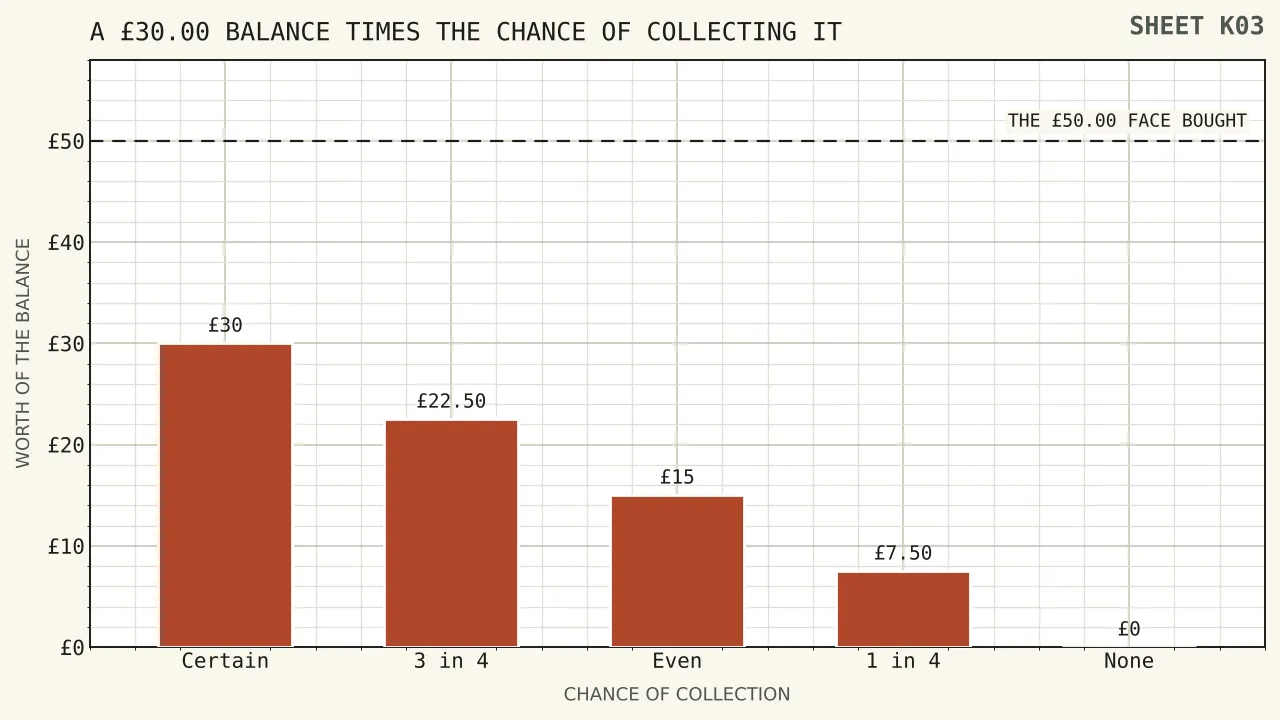
What would move that table is one number, and it is worth naming so that nobody mistakes the table for a survey. A published refusal rate, cashier by cashier, with a date on it, would turn five rows into one. Until something of that kind exists, a page that picked a row would be inventing the most important figure on it, which is exactly the thing a reader cannot check. The range is honest; a point inside it would not be.
There is a decision rule buried in that table and it is worth stating, because it is the only piece of advice this note gives. Where the chance of collection is unpublished, the arithmetic says to treat the credit as worth the bottom row until something published moves it. On this face the bottom row is £0.00, which means a reader comparing a face off the register against anything at all is comparing against zero, and zero is the figure to hold in mind when a headline is doing its work.
The British side of that comparison is no promise of payment either, and this note will not pretend it is. What a licence buys is narrower and worth stating exactly: the late demand barred, a prohibition on capping what leaves a deposit balance, a clock on complaints, and an adjudicator the regulator has approved. None of those pays anybody. All of them are things to point at when payment does not arrive.
7
Why anybody asks, and what a freeze costs
Money laundering is why the question exists and why the British rule carries an exception at all. A late demand is barred where the door would have done, except for what another legal duty requires at that moment. The exception is narrow; the duty behind it is real.
What an absent regime costs shows best through the largest published case about games reaching the unlicensed market. The findings sit in the table below, and the point of putting them there rather than in a sentence is that each one is a mechanism a reader’s balance depends on.
| What was found | What that mechanism decides |
|---|---|
| Risk assessment not done adequately | Whether a balance is suspected at all |
| Controls failed to keep games out | Whether a familiar reel means anything |
| Customer due diligence not met | Whether a balance belongs to its claimant |
| Settled at £4.75m, 23 July 2026 | What a licence costs when breached |
| Suspension considered | What a regulator can do and a reader cannot |
Read the second column from a reader’s side rather than a regulator’s. Due diligence is the mechanism deciding whether a balance belongs to whoever is asking for it. Where the mechanism is missing a decision still gets made, and it gets made by whoever holds the money, with no file, no clock and nobody to appeal to.
A held balance has a price and the price is all of it. £30.00 frozen is £30.00 stranded, and the ladder gives that figure a shape: three £10.00 rungs, or a £25.00 rung plus half of a £10.00 one. Real money, bought with real money, now a row in somebody else’s database.
A frozen £30.00 is 300 presses of a 10p reel that nobody will ever make
Price the freeze against the hours and the figure gets sharper still. £30.00 reached at the ten turnover ceiling took 5,000 presses and, at the licensed floor, 3 hours 28 minutes of pressing, which is £8.64 an hour of expectation. A freeze converts that rate to nothing while leaving the hours exactly where they were spent, and no part of the apparatus gives them back.
One instrument rule belongs on a page about identity, because it is about the thing rather than the person. April 2020 is when paying for gambling with a credit card stopped being permitted under a British licence, with money service business routes named in the condition as well. A prepaid voucher is not a credit card and never was, which is part of why it turns up on pages like this one.
8
The duties that come off with the licence
Every duty in this part attaches to a holder of a British operating licence, so a cashier holding none carries none of them: identity obtained and verified before play, a bar on demanding at the exit what the start should have settled, anti-money-laundering controls the regulator inspects, and credit barred as a funding route.
| The duty | What its absence changes | On this face |
|---|---|---|
| Identity before play | A balance can exist unowned | £30.00 exposed |
| No late demand | The asking can wait for the cash-out | £30.00 exposed |
| Inspected controls | A freeze has no file behind it | £30.00 exposed |
| Credit card ban | Borrowed money can reach a reel | Not priced here |
| Ten turnover ceiling | Any multiple may be written | £30.00 |
Three rows carry the same figure on purpose. An unverified balance meets all three failure modes at once and they do not add up, because any one of them can strand the same £30.00 by itself. A reader counting the exposure once has counted it correctly.
The last row carries a published ceiling behind it. The ceiling on bonus funds stands at ten turnovers under a British licence and is dated 19 January 2026, with two licence types outside it: technical for gaming machines, and software. The Curacao policy on responsible gaming, version 1.0, carrying 21 February 2025 on its face, offers no counterpart across any of its eight mandatory areas, and no primary source publishes what gets written instead.
One further duty belongs here and it decides who hears a complaint. Only an approved dispute resolution body may be used by a licensee, and the published description of the best known of them has it adjudicating between licensed gambling operators and their customers. Read that twice from a reader’s position. The adjudicator is there for licensed operators, so a dispute with a cashier outside the register has nowhere inside that machinery to go, whatever its merits.
So the figure in the fifth row is not an opinion about offshore cashiers. It is what the arithmetic gives when the single term a licence held down gets released, and it is the same £30.00 that the first three rows expose. One face, one figure, four ways to lose it.
9
A registration that cannot be undone early
No registration with the national scheme ends before its minimum period has run. The scheme states that in capitals, in terms of use carrying a 20 May 2026 revision date, and deactivation afterwards runs through a contact centre, with a 24-hour cooling-off period sitting in front of it and the exclusion live throughout. Expiry is not automatic either.
One further mechanism in the scheme’s terms deserves stating, because it runs on past the exclusion itself. A deactivation is followed by seven years in which operators get notified of the earlier exclusion, and through those years they are not obliged to bar access. So the protection has a long tail and a soft edge, and the soft edge is one more reason the cheapest thing on this page is a telephone call rather than a reel.
That belongs on a page about identity for an arithmetical reason rather than a moral one. A scheme that works by name needs a name to work with. A cashier that establishes nobody’s identity has, by that same act, made itself unable to honour an exclusion, which is why the phrase in this page’s title and the phrase in its heading describe one condition rather than two features.
Set the two sides of the trade out plainly. On one side, a £50.00 rung producing £30.00 of balance at the ceiling, worth £15.00 on an even chance of collection and nothing at all if the question of ownership is answered the wrong way. On the other, a protection that took one registration to put in place. Nothing in the part 6 table is worth that.
Three things cost nothing and need no identity step of their own: a call to the National Gambling Helpline, which GamCare answers around the clock; blocking software across the devices in a household; and the registration itself. GamCare is the publisher of the free British pairing of all three and TalkBanStop is the name on it, on a page from 12 April 2021 that attaches no period to it, so this note attaches none either.
A last word on what the figures here are and are not. Every pound in this note is arithmetic on assumptions that are stated rather than discovered: a press at 10p, 96 per cent coming back, forty turnovers where a page needs a multiple, and a ladder of six rungs. Change any of them and the hours move while the charge stays. What cannot be modelled at all is the chance of collection, and that is precisely the figure an unverified balance turns on.
One closing fairness. Offshore a complaints route exists. Six months from the incident in which to lodge one, four weeks for an answer with four more on written notice, and dispute resolution compulsory, the operator paying. What the same document also does is let the operator fix that process’s parameters, the binding effect on a player among them. A route whose terms are written by the party being complained about is still a route, and it is not an adjudicator picked off an approved list.
10
The price of a press, and why it moves only the hours
One assumption on this site does more work than any other, and it deserves testing rather than defending. A spin is priced at 10p everywhere here. Nothing published fixes that figure, so the fair question is what changes if it is wrong.
The answer is that the money does not move at all. A forty turnover obligation on a £50.00 rung asks £2,000.00 of staking whatever a single press costs, and fourpence in the pound of that is £80.00 of expected charge. What the press price moves is the number of presses, and through them the hours.
| Price of a press | Presses owed | Seconds at the floor | Shortest sitting | Charge in expectation |
|---|---|---|---|---|
| £0.05 | 40,000 | 100,000 | 27 hours 46 minutes | £80.00 |
| £0.10 | 20,000 | 50,000 | 13 hours 53 minutes | £80.00 |
| £0.25 | 8,000 | 20,000 | 5 hours 33 minutes | £80.00 |
| £1.00 | 2,000 | 5,000 | 1 hour 23 minutes | £80.00 |
| £5.00 | 400 | 1,000 | 16 minutes 40 seconds | £80.00 |
The last column never changes, which is the finding. A cheap press buys time and an expensive one buys none, and the charge arrives either way. So an argument about whether a spin is worth 5p or 25p is an argument about how long a reader sits there, not about what the sitting costs them.
The bottom row is the only one with a published lid on it, and the lid is a British one. the lid itself is £5.00 on a single slot cycle, falling to £2.00 for anybody under 25. One of those arrived on 9 April 2025 and the other on 21 May, both of them confined to online slots and neither to casino games generally. Away from that licence the bottom row has no bottom: the same £2,000.00 of staking can be discharged in however few presses a cashier allows.
£80.00 of expected charge, unchanged across every price a press can carry
The under-25 figure is worth its own line of arithmetic, since it is the tightest published lid of the two. At £2.00 a press the same obligation runs to 1,000 presses and 2,500 seconds at the floor, which is 41 minutes 40 seconds. A reader of 24 at a licensed cashier is therefore held to a sitting more than twice as long as the £5.00 row allows, and the lid is doing exactly what it was written to do. Neither lid exists off the register, and no figure replaces them.
Two more things hold that fourth column in place on the licensed side, and both concern the press rather than the money.
| Barred to a licensed system | What it does to the sitting |
|---|---|
| Autoplay for online gaming | Every press stays a separate decision |
| Shortening the wait before a result lands | Quick spin, turbo and slam stop barred |
So the sitting in that column is a floor and not an estimate. Neither row turns up in the offshore policy, which means the time a reader spends there is whatever the software can manage, and the £80.00 arrives either way.
One last figure for the ladder, because the press price touches it as well. A £50.00 rung buys 500 presses at 10p and 10 presses at £5.00, and the second of those is a face that can be gone inside a minute. The rung did not change. What changed is how quickly a prepaid instrument can be turned into a row in somebody’s ledger, and that is the one speed nobody advertises.
Which puts the identity question in its final shape. A reader at an unverified cashier can clear a £2,000.00 obligation in sixteen minutes if the presses are large enough, arrive at a balance of nothing in expectation, and still face the one question this page began with when there is anything left to collect. Speed and anonymity are the two things being sold. Neither of them is money.
Questions
- What does a no KYC casino actually mean?
- It means no identity step stands between a visitor and a reel at the start. It does not mean no step will ever happen. One skipped at the door has been moved to whichever moment suits the business holding the money, and the moment that suits a business holding money is the moment somebody asks for it back.
- What is an unverified balance worth?
- Multiply what survives by the chance of collecting it. On a £50.00 rung at the ten turnover ceiling, £30.00 survives: that is £22.50 on a three in four chance, £15.00 on an even one, and nothing if the balance is never released. No primary source publishes a refusal rate for any cashier, so the honest answer is the range rather than a point inside it.
- Can a licensed site ask for documents when I withdraw?
- Only in a narrow case. A question the start could have asked may not be held back for the cash-out, and the exception is what another legal duty requires at that moment. The player-facing wording adds that money-laundering information ought to be asked for early instead of when the funds are wanted.
- Does the British identity rule cover bonus play?
- Yes, which is what makes it bite on a subject like this one. Three items get obtained and verified before any gambling. Three items come first, being the name, then the address, then the birth date. A bonus-funded spin is inside that duty. A free bet is inside it too, as is reaching a game in its free-to-play form, which the regulator explains by noting that such games are not technically gambling.
- Is the offshore position simply that nobody checks?
- No, and any page flatly saying so is wrong. The Curacao policy requires that nothing be deposited or wagered before the operator is satisfied about age, and asks for a date of birth at registration with more where possible. What it ties to later money-laundering milestones is the government-issued identification, so the document step lands after a balance exists.
- Why would a cashier freeze a balance?
- Due diligence is the mechanism that decides whether a balance belongs to whoever is asking for it, and the duties around it exist because money laundering does. The largest published case about games reaching the unlicensed market turned on that point: risk assessment not done adequately and customer due diligence not met, settled at £4.75m with a decision dated 23 July 2026.
- What has the wagering ceiling to do with verification?
- Nothing directly, and everything to the figure. Ten turnovers is the most a British licence lets bonus funds carry, dated 19 January 2026, and it is what turns a £50.00 rung into £30.00 rather than into nothing. A cashier with no British licence sits outside that ceiling and outside the identity duty at once, so the same face carries a heavier obligation and a balance nobody has established the owner of.
- How long does a forty turnover obligation take on a £50.00 rung?
- 20,000 presses of a 10p reel, which is £2,000.00 of staking and £80.00 of expected charge against a £50.00 credit. A licensed reel keeps a 2.5 second floor beneath every new cycle, which puts 50,000 seconds behind those presses, near enough 13 hours 53 minutes. No such floor applies away from that licence.
- Can a self-exclusion be lifted to use a site like this?
- A registration does not end before its minimum period, which the scheme puts in capitals in terms of use carrying a 20 May 2026 revision date. Deactivation afterwards runs through a contact centre and keeps a day of cooling off ahead of it. This page offers no way round any of that, and the table in part 6 is why it would not be worth one.
- What is worth doing instead?
- A call to the National Gambling Helpline costs nothing and GamCare answers it around the clock, about the caller or about somebody else. Blocking software on a household’s devices reaches cashiers no register knows about. The registration can be left alone. GamCare publishes the free British pairing of all three under the name TalkBanStop.