Note G11 Revision 1 Terms read 16 October 2026
£1 deposit casino: a sum smaller than the smallest face
A pound is not a denomination. The smallest prepaid face on this site’s ladder is £10.00, so a reader who wants to put in £1.00 buys ten times what they wanted and strands £9.00 of it, which is 90.00 per cent of the purchase before anything has happened. A pound buys 10 cycles at a 10p stake, or 25 seconds of play. Matched at the British ceiling it leaves 60p, and a £10.00 payout floor holds every penny of that.
The face £10.00 smallest What draws it down £0.40 on the pound What is stranded £9.00 of it
What a face of this size is worth
Every destination on this rack is bought advertising. The site takes a fee if a reader goes on to register, and no figure printed below moves because of it.
Face and Residue
Strip No 01
Betportal
Ceiling as a multiple
Priced at this site's own 10p a spin
What is printed
What draws it down
What is stranded
No Great Britain licence
Licensed in Anjouan, Comoros, run by BetPortal Gaming Ltd, with Excite Ultra Media Ltd, reference ALSI-202601040-FI2.
Terms read 16 October 2026
Open the offer at Betportal, opens in a new tabFace and Residue
Strip No 02
WinBeast
Ceiling as a sum
Priced at this site's own 10p a spin
What is printed
What draws it down
What is stranded
No Great Britain licence
Licensed in Curaçao, operator not named on the site.
Terms read 16 October 2026
Open the offer at WinBeast, opens in a new tabFace and Residue
Strip No 03
EliteSpin
Longest spin window
Priced at this site's own 10p a spin
What is printed
What draws it down
What is stranded
No Great Britain licence
Licensed in Costa Rica, run by PrimeTier Limited.
Terms read 16 October 2026
Open the offer at EliteSpin, opens in a new tabFace and Residue
Strip No 04
Crown Jewelz
Multiple unpublished
No residue struck
What is printed
What draws it down
What is stranded
No Great Britain licence
Licensed in Curaçao, number not verified, operator not named on the site.
Terms read 16 October 2026
Open the offer at Crown Jewelz, opens in a new tabThe two figures in the second and third registers are this site's own arithmetic and nothing an operator has published: the face as printed, less the share a spin gives back at 96 per cent return to player, less what playing the wagering through costs at the same return, and then less whatever a published ceiling, a charge on the way out or a floor on the smallest withdrawal takes off what survives that. The residue is what is left of the face when all of it is accounted for. It describes the offer, not one reader's afternoon. Where the conditions price above the face the strip prints nothing coming off rather than a negative sum, and where a figure the sum needs is unpublished it prints the condition in the operator's words instead.
A face paid as spins has no unit of its own, so one is supplied. Where an operator publishes what a spin of its own is worth, that figure stands in the first register's own line and is labelled as theirs. Where it does not, this site's own 10p a spin stands there and says so, and every figure below moves in proportion: at half the price, half the money. The share of the face that does come off is also given as pence in the pound, which is the figure that compares a large face against a small one.
Money goes onto a prepaid voucher in fixed denominations, so a smallest deposit published in pounds is rounded up to the first rung of the ladder this site works in, £10, £20, £25, £50, £75 and £100, and the strip prints what that rounding strands. That is the reader's own money and it is never netted into a residue. A smallest deposit published in euros is printed as the operator publishes it, because the ladder here is a sterling one and rounding a euro sum to it would be an invented figure.
Three words stand in the amount column where no figure can. Noted is a published condition that takes value away without leaving the sum a figure to take. Unpriced is a condition whose figure nobody has published, or a credit that is not a sum until a deposit of your own sets it. Own money is money of yours, which is never part of a residue.
Not one of the operators printed above holds a Great Britain licence, so the duties that licence carries do not reach them. All online gambling companies licensed in Great Britain must be part of Gamstop Online, and a reader who has shut themselves out through the scheme is therefore not shut out here. The ceiling of ten times the bonus funds on a wagering requirement, in force since 19 January 2026 under Social Responsibility Code 5.1.1, is a condition of that licence and binds the companies that hold one. On an unlicensed site the Gambling Commission describes consumers as facing unfair gaming practices, financial loss and a lack of recourse if things go wrong, and it names blocked payouts and withdrawal limits set so high they are unattainable among what it has seen. Nobody under 18 may hold an account at any of them.
Every term printed on a strip is the operator's own, and each strip carries the day it was read. The oldest of those readings is 16 October 2026. What binds a reader is the operator's own full terms, and not a line printed here.
1
A pound is not a rung
Search the phrase that brought you here and the premise is a cashier that accepts a single pound. Plenty publish a floor at or near that figure, and the floor is real. What the floor cannot do is make a pound purchasable in the first place.
Prepaid faces come in denominations, and the ones this site prices against start at ten pounds and climb through twenty, twenty-five, fifty and seventy-five to a hundred. There is no step beneath the first. So a reader who has decided on £1.00 and who funds an account from a prepaid face has to buy £10.00, and £9.00 of that purchase sits somewhere it was never meant to sit.
Ninety per cent is the worst proportion on any page in this section, and it comes from division rather than from policy. The gap between nothing and the first step is the whole first step. Every other gap on the ladder is smaller than the face above it, which is why a pound is the most expensive thing to want.
Three things follow, and each gets its own part below. The residue is nine pounds. The entitlement a pound buys is 25 seconds. And every cost that does not scale with the sum, whether a charge, a floor or a rounding, takes its largest share here.
Fixed workings on everything below: a 10p stake, 96 pence coming back for each pound put through, and any multiple named in the sentence using it. Faces of this kind are reached at counters holding no British licence, and part 9 prices the gap duty by duty instead of asserting it.
A floor at a pound and a purchase at ten pounds are different facts and both can hold at once. A counter may well accept a single pound from a balance that already exists. The arithmetic here is about getting the pound into the balance when the instrument moves in denominations.
2
Twenty-five seconds of entitlement
Turn a pound into the unit it will actually be spent in. At a 10p stake it is ten cycles. Under a British licence 2.5 seconds must pass from a cycle starting before another may begin, so ten cycles occupy 25 seconds at the very least. That is the whole of what a pound entitles a reader to, measured in time.
Set it beside the stake ceiling and the picture sharpens. Inside one game cycle a licensed slot caps the total stake at five pounds, and the figure drops to two below the age of 25. A pound will not fund a single cycle at the adult ceiling, then: it is a fifth of one maximum spin, and half of one at the lower figure.
| Unit | How the conversion works | What £1.00 comes to |
|---|---|---|
| Cycles | At the 10p stake assumed throughout | 10 |
| Seconds | Those cycles at the licensed minimum pace | 25 |
| Maximum spins | Against the five pound ceiling on one cycle | 0.2 |
| Expected return | One circuit at 96 pence in the pound | £0.96 |
| Expected cost | The edge, taken once | £0.04 |
| Share of the smallest face | A pound against a ten pound purchase | 10.00 per cent |
Read the last row and the arithmetic of this page is already complete. A reader who wanted a pound of gambling has bought ten pounds of it, and the pound they wanted is a tenth of what they are holding. Twenty-five seconds is what the intention was worth. The other nine pounds, 225 seconds of cycles at the same stake, arrived as a condition of buying the first.
£1.00 wanted: 10 cycles, 25 seconds, and £9.00 bought alongside it
Those ceilings have a traceable origin, which matters because the figures get repeated without one. The table gives the instrument, its dates and its reach.
| The question | The answer as published |
|---|---|
| The instrument | Number 215 in the 2025 series of statutory instruments |
| Date of making | 25 February 2025 |
| What it limits | The total an individual may stake inside one game cycle |
| The adult ceiling | Five pounds |
| The younger ceiling | Two pounds, below the age of 25 |
| The transition | Six weeks of a flat five pounds for everybody |
| Commencement, in the instrument | A formula, and no calendar date printed at all |
| Commencement, in guidance | 9 April 2025, then 21 May 2025 for the lower figure |
| What it reaches | Reel-based casino games played online, and nothing besides |
| What it misses | Roulette and blackjack, which sit outside both figures |
The last two rows carry a warning for any page using the figures. Both ceilings are slots rules fastened to a remote casino licence. Neither reaches a wheel or a table, and a page that extends them is wrong on the face of the regulations.
3
Everything fixed is worst down here
Here is the finding this whole section keeps arriving at, and the bottom of the ladder is where it is easiest to see. A cost that does not move with the sum takes its largest share from the smallest sum. Three costs on this page behave that way: a fixed charge, a payout floor, and the rounding up to a face.
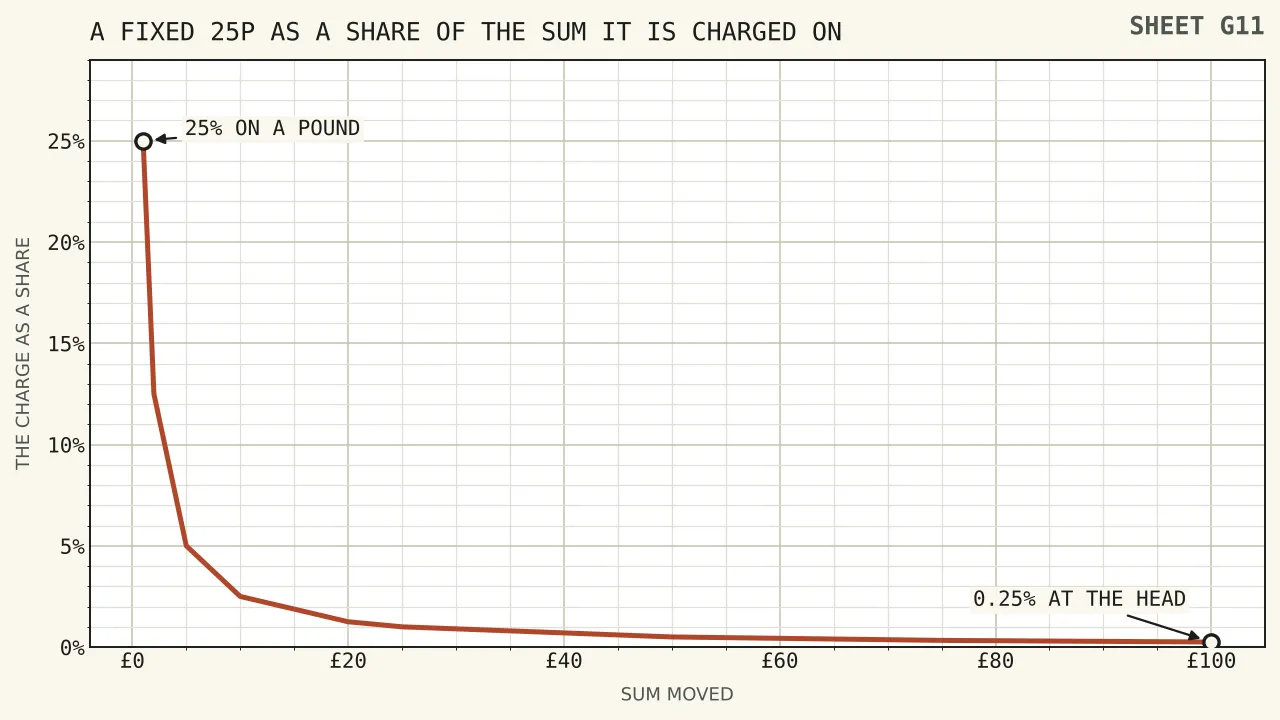
Take a charge of 25p, declared as a modelling assumption since no primary source publishes a schedule. Against a pound it is a quarter of the money. Against the top face it is a quarter of one per cent. The charge is identical in both cases and the burden differs by a factor of a hundred.
| Sum moved | Where it sits | 25p as a share | Cycles the charge costs |
|---|---|---|---|
| £1.00 | Below every step, so unbuyable | 25.00 per cent | 2.5 |
| £10.00 | The first step, and the smallest face | 2.50 per cent | 2.5 |
| £20.00 | The second step | 1.25 per cent | 2.5 |
| £25.00 | The third step | 1.00 per cent | 2.5 |
| £50.00 | The fourth step | 0.50 per cent | 2.5 |
| £75.00 | The fifth step | 0.33 per cent | 2.5 |
| £100.00 | The head of the ladder | 0.25 per cent | 2.5 |
The right-hand column is the one worth keeping. In cycles the charge never changes: two and a half spins, wherever it is levied. In proportion it swings by a hundredfold. Both statements are true, and which of them a reader notices decides whether a small deposit feels cheap.
The payout floor behaves the same way and bites harder, because it is not a cost but a threshold. A floor at the smallest face holds any balance beneath ten pounds in full, and a balance beneath ten pounds is the only sort a pound-sized deposit can produce. So the proportion held is 100 per cent until the balance clears the line, and then it is nothing. There is no middle.
The rounding is the third, and it is this page’s headline. Nine pounds of a ten pound purchase was surplus to a pound-sized intention. Expressed as the recurring finding of this section: a flat charge is blind to the sum, a step is blind to the sum, and the two together make the smallest deposits the worst value per pound that the ladder can produce.
4
One pound matched, and the sixty pence
Suppose a counter matches the pound, so £1.00 of bonus funds arrives beside it. Turnover due equals the credit multiplied out by the multiple. The expected cost is four pence per pound of that. What is left over is the credit once the cost has gone.
| Multiple | Turnover due | Cycles | Cost expected | Remainder | What the row says |
|---|---|---|---|---|---|
| 5 times | £5.00 | 50 | £0.20 | £0.80 | Two minutes five seconds of play |
| 10 times | £10.00 | 100 | £0.40 | £0.60 | The British ceiling, four minutes ten |
| 20 times | £20.00 | 200 | £0.80 | £0.20 | Eight minutes twenty, for a fifth |
| 25 times | £25.00 | 250 | £1.00 | £0.00 | Ten minutes twenty-five, for nothing |
| 40 times | £40.00 | 400 | £1.60 | £0.00 | Sixteen minutes forty, for less than nothing |
Twenty-five is where the remainder reaches nothing, and arithmetic rather than custom puts it there. Four pence is the edge where a pound returns 96 pence, and a pound divided by four pence gives twenty-five. Under it a credit keeps a fraction. Over it the expected cost of finishing exceeds the credit itself, and the shortfall comes out of money the reader already had.
Ten times is a British licence condition. The incentives provision numbered 5.1.1 carries it in its third limb; it has bitten from 19 January 2026; and it runs over all licences bar two, with gambling software and gaming machine technical work the exceptions. The published figure for the position beforehand is 60 times, applied by some licensees, and it belongs to the regulator.
What these rows mainly demonstrate is how little is at stake at this end of the ladder, in both directions. The whole spread from five times to forty times moves the outcome by 80p. The time moves from 2 minutes 5 seconds to 16 minutes 40 seconds. A reader comparing requirements on a pound-sized credit is optimising pennies, while the nine pounds of unwanted face in part 1 sits unexamined.
The whole range of multiples moves a matched pound by £0.80
5
Sixty pence under a ten pound floor
Follow the best case. A pound in, a pound matched, ten times cleared with nothing forfeited, and 60p standing at the far end. Then the exit. Put the smallest processable payout on the first step of the ladder and 60p is £9.40 short of payable, and the proportion held is the whole of it.
£0.60 beneath a £10.00 floor: £9.40 short, and nothing payable at all
Closing that gap is where the page turns from arithmetic into something worth saying plainly. Staking cannot do it in expectation. Put a pound through a game paying 96 pence and 96p is the expectation, so 60p sent round repeatedly shrinks on average instead of growing. Crossing £9.40 by variance needs a run of outcomes, and four pence a pound is what the attempt costs, however many times it is made.
Paying cannot do it either, in the sense that matters. The shortfall is £9.40. The smallest purchasable face is £10.00. So buying the balance into reach costs ten pounds to release sixty pence, and leaves 60p plus whatever survives the new ten pounds in the account afterwards. The ladder cannot be asked for £9.40, and it cannot be asked for a pound, which is the same fact stated twice.
Nothing in the licensed rulebook prohibits a floor of that sort, and no page here pretends otherwise. What is prohibited differs, and separating the two is worth doing cleanly. A term putting a maximum on what a deposit balance lets out is barred. A minimum payment size is not a maximum, with reasonableness the only test on a payment’s size or its frequency. So a floor at the smallest face can coexist with the prohibition, and both statements are true at once.
6
What a pound is taxed
A page about the smallest sums should be exact about tax, because the loose version of it circulates everywhere. Nothing published says winnings are untaxed. What exists is a published answer to a different question, and the table sets that answer out line by line.
| What was asked | What the manual gives |
|---|---|
| Is gambling a trade | Not as such, which leaves winnings outside trading income |
| What would be one | Organised activity aimed at profit from the gambling public, normally |
| The worked case | A spread bettor is not normally trading, so no tax on profits |
| And the losses | No relief for them either, by the same reasoning |
| The other side of it | The bookmaker organising the bet is taxable on profits |
| The authority | Graham v Green, 1925, reported at 9 TC 309 |
| The judge’s sentence | Six words, and the fourth of them is tax: no tax on a habit |
| A betting system | Not enough on its own to make a trade of it |
| A living from it | Not enough either |
| Studying form | Expertise and method are still not enough |
| Where a gambler can trade | Appearance money for television, depending on the facts |
| The page dates | Published 22 November 2013, last updated 4 August 2026 |
So the formulation worth using is narrow. The published view is that gambling is not of itself a trade, which is why winnings do not arrive as trading income. A declaration that winnings are free of tax would be a different sentence, and no page here writes it. Nothing in this part is tax advice, since nothing on the sheet behind it addresses anybody’s circumstances.
Where money is actually charged is the counter, and the charge tracks the player instead of the licence.
| The question | The published answer |
|---|---|
| Who pays | The operator, and the guidance addresses operators throughout |
| What triggers it | Remote gambling offered where a customer’s usual residence is British |
| The rate now | Forty per cent of gaming profits, on or after 1 April 2026 |
| The rate before | Twenty-one per cent from 2019, and fifteen per cent earlier |
| What profits means | Stakes taken in, less winnings handed back |
| An operator abroad | Must usually appoint a representative the revenue approves |
| The exempt list | Members of the European Union, Norway, Gibraltar among them |
A pound staked: 4p to the edge in expectation, with the duty falling on the counter
One consequence belongs on a page about faces reached offshore. Being absent from the register does not put a counter outside British duty, because the trigger is where the customer lives. That is precise and sourced, and it is more use to a reader than a vague claim about legality.
7
A pound against the market’s own figures
Official statistics give a scale that a pound-sized deposit cannot, and the right-hand column below is this site’s own arithmetic on the regulator’s published numbers. Two things travel with any figure taken from the first release: the period is April 2025 to March 2026, and the release date is 17 September 2026.
| What is published | The figure | Converted here |
|---|---|---|
| Gross gambling yield, Great Britain | £17.5 billion | Up 4.4 per cent against the year before |
| Remote casino, betting and bingo | £8.3 billion | Up 6.9 per cent, and the sector this page sits inside |
| Online casino games | £5.7 billion | Rather more than two thirds of that remote figure |
| Slots games | £4.8 billion | At a 10p stake, 48 billion cycles of yield |
| Active accounts | 25.7 million | About £680.93 of yield for each account across the year |
| Licensed operators | 2,154 | Between them 3,097 licensed activities, at March 2026 |
| Any gambling inside four weeks | 47 per cent | Among participants of 18 and above, released 16 July 2026 |
| The same, lottery-only players out | 27 per cent | Which is the figure to use where draws are not the subject |
| Severity index at 8 or above | 2.4 per cent | Of the population in 2025, called stable across three waves |
| Interviews behind that | 20,000 | Approximately, each year, among adults aged 18 and over |
Three cautions belong with the table. Yield for each account is division and nothing else: an account is not a person, one person may hold several, and no average stake or average loss is published. The headline figure carries two labels on the regulator’s own pages, the statistics hub calling it the market’s value and the news release calling it total gross gambling yield, so where precision is needed the release’s wording is the one to take. And comparing this survey against one built on another method is not appropriate; successive waves of the same survey are the comparison that works.
Now put the pound back. Against £17.5 billion of yield a single pound is a vanishing share of a market and an entirely ordinary share of somebody’s month. That asymmetry is why this site prices faces instead of markets: the figure that decides anything is the one inside the account.
8
A small sum is not a small decision
The smallest deposits get described as a way of keeping things contained, and the arithmetic above offers two reasons to handle that framing carefully. A pound-sized intention produces a ten pound purchase. And a payout floor at the first step means whatever is won on that scale cannot leave.
Free tools exist and they are specific. Register with the national online scheme once and accounts close down, free of charge. Its paperwork carries a different name from the one a reader searches for, so the table prints both the identity and the published figures.
| What is published | The detail |
|---|---|
| Registered number | 10504973 |
| The company named in the footer | The National Online Self Exclusion Scheme Limited, as it writes itself |
| Where it sits | An address in Harrogate, given in the scheme’s own footer |
| What sets its reach | The British licence, since a licensee here must belong |
| People registered | 614,738 of them, per figures of 16 July 2026 |
| Growth, first half of 2026 | Sixteen per cent |
| The record month | May 2026, with 12,236 joining |
| Registrations under 25 | Twenty-six per cent higher year on year |
| Share of exclusions under 25 | Close to a third of them |
| The longest option | Five years, chosen by more than half of registrants |
| The shortest option | Six months, chosen by a quarter overall and by 38 per cent of under-25s |
| Men among new registrations | Over seven in ten of them |
The last pair of rows carries the most for a page about small sums. The shortest option is picked most often by the youngest registrants, and no exclusion ends before its minimum period has run. Choosing six months is choosing six months, not six months of reconsidering it.
Deposit limits are the other tool and they cost nothing to use. A licensed counter must offer periods of a day, of a week and of a month; must present setting a limit as the default; must apply a reduction straight away; and must hold any increase for a day before a separate confirmation. A reader who has arrived at the point of pricing a single pound is precisely the reader those facilities were drafted for.
Nothing on this page helps anybody past a block, a bar or an exclusion. A refusal a reader arranged for themselves is working, and no figure here depends on getting round one.
9
A pound, holding no British licence
Take the licence out and the ladder is unchanged. A pound is still unbuyable, the smallest face is still ten pounds, and nine pounds is still surplus. Everything standing behind the face changes, and the table prices each duty in the units of this page rather than listing it flat.
| The duty | The figure | What a pound comes to |
|---|---|---|
| Ceiling on a requirement | Ten times the credit | 60p survives a matched pound, rather than nothing |
| Stake inside one cycle | Five pounds, two under 25 | A pound is a fifth of one maximum adult spin |
| Pace between cycles | At least 2.5 seconds | Ten cycles cannot be run inside 25 seconds |
| Autoplay and hurrying | Neither available | Ten separate commitments for a pound of stake |
| Small returns | No win display at or below the stake | No fanfare where 10p comes back off a 10p cycle |
| Periods for a limit | A day, a week, a month | A pound a day is a limit a counter must accept |
| Drawing on a balance | No maximum permitted | 60p can be floored, and cannot be rationed |
| Identity before play | Three items | Name, address and birth date, for a pound as for a hundred |
| Duty on the counter | Forty per cent of gaming profits | Charged wherever it sits, since 1 April 2026 |
Two qualifications keep that honest, and both come from the sources. Nothing in the Curaçao document behind these comparisons sets a requirement ceiling, sets a stake ceiling, fixes a minimum cycle time, bars autoplay, or says anything about win displays where the money handed back equals the money staked. The first five rows are genuinely missing there, and that absence is what a British player actually gives up, stated from documents rather than asserted.
Against it, the same rulebook is longer than the British scheme at the bottom end of exclusion, and the table gives both.
| Which regime | What the lengths are |
|---|---|
| Curaçao, at the shortest | A year of long-term self-exclusion, which operators must offer |
| Curaçao, beyond that | Three years, five, ten, and a lifetime option |
| Curaçao, reversing it | A confirmed exclusion stands until its period ends |
| Britain, at the shortest | Six months, offered at registration |
| Britain, at the longest | Five years, with renewal available on the same term |
| Britain, reversing it | Nothing ends before the minimum period has run |
A year against six months makes the offshore rule the stricter one here, and reporting absences alone misreads the document being quoted.
Candour about its own limits runs through the regulator’s pages as well, and at this end of the ladder that lands harder than anywhere. No ombudsman powers sit with it. No complaint gets settled by it. No money comes back through it. A problem with a payout, or a fault inside a game, falls outside what it can decide. For 60p held beneath a floor that is the whole position: nobody is coming to retrieve it, and the only published lever a reader holds is the one in part 8.
Questions
- Can I really deposit £1 at a casino?
- A floor at or near a pound is published by plenty of counters and the floor is real. What a floor cannot do is make a pound purchasable from a prepaid face, because those come in denominations and the smallest on this site’s ladder is £10.00. Where the deposit is funded that way, a pound-sized intention buys ten pounds and strands £9.00 of it, which is 90.00 per cent of the purchase.
- What does a pound actually buy?
- Ten cycles at the 10p stake assumed here, which is 25 seconds of play, since 2.5 seconds must pass from one cycle starting before another may begin. It will not fund a single spin at the licensed adult ceiling of five pounds in a cycle: a pound is a fifth of one maximum spin, and half of one against the two pound figure for players under 25.
- Why are small deposits worse value?
- Because the costs that matter most do not shrink with the sum. A fixed 25p charge is 25.00 per cent of a pound and 0.25 per cent of a hundred pounds, while costing two and a half cycles in both cases. A payout floor holds the whole of any balance beneath it. And a step rounds a pound up to ten. A flat charge ignores the sum, a step ignores the sum, and together they make the smallest deposits the worst value per pound on the ladder.
- What is a matched pound worth after wagering?
- Sixty pence at the British ceiling of ten times, out of £10.00 of required turnover, 100 cycles and four minutes ten seconds of play. Twenty times leaves 20p. Twenty-five leaves nothing exactly, four pence being the edge where a pound returns 96 pence, and a pound divided by four pence giving twenty-five. The whole span from five times to forty moves the outcome by 80p.
- Can I withdraw 60p?
- Not with the smallest processable payout sitting on the first step of the ladder. A balance of 60p is £9.40 short of £10.00, and the whole of it is held. Staking will not close that in expectation, because a pound put through a game paying 96 pence is expected back as 96p. Buying it into reach costs £10.00 to release 60p, since the ladder can no more be asked for £9.40 than for a pound.
- Is a minimum withdrawal allowed at all?
- Yes, and it differs from the thing that is barred. Putting a maximum on what a deposit balance lets out is prohibited under a British licence. A minimum payment size is not a maximum, and reasonableness is the only test on how big or how frequent a payment may be. A floor at the smallest face and that prohibition therefore hold together.
- Are gambling winnings taxed in the United Kingdom?
- No published source says in terms that they are untaxed, and nothing here is tax advice. The manual answers a narrower question: gambling is not of itself a trade, which is what keeps winnings out of trading income. The authority is Graham v Green, from 1925, and the taxpayer there lived on starting-price bets alone and was held not to be trading. Six words carried it, the fourth being tax: no tax on a habit.
- Does an offshore casino pay British tax?
- The duty follows the player rather than the licence. Where a customer’s usual residence is British, an operator offering them remote gambling owes the relevant duty wherever it sits, and gaming profits have carried forty per cent since April 2026 began. Absence from the register is therefore not absence from the British tax net, and the charge lands on the counter and not on the player.
- How big is the online casino market?
- Covering April 2025 to March 2026 and released on 17 September 2026: gross gambling yield for Great Britain of £17.5 billion, remote casino, betting and bingo accounting for £8.3 billion, online casino games for £5.7 billion, slots for £4.8 billion. Set against 25.7 million active accounts, that is roughly £680.93 for each account across the year. It is division, not an average loss, since one person may hold several.
- Which exclusion period do people choose?
- From figures of 16 July 2026: more than half took five years, the longest option available at sign-up. Six months was taken by a quarter of all ages together, and by 38 per cent of those under 25. Growth over the first half of 2026 ran at sixteen per cent, the record month was May 2026 with 12,236 joining, and under-25 registrations were up twenty-six per cent year on year.
- Is an offshore self-exclusion shorter than the British one?
- Longer at the bottom end, which runs against expectation. Operators there must put a long-term self-exclusion of twelve months on offer, with three, five and ten years beyond it and a lifetime option as well, and once confirmed it stands until its period ends. Six months is the shortest the British scheme offers. What that rulebook has no equivalent of is a wagering ceiling, a stake cap or a minimum cycle time.
- What is stranded on a pound-sized deposit?
- Nine pounds at the door and sixty pence at the exit. The £9.00 is the part of a ten pound purchase that a pound-sized intention never wanted, which is 225 seconds of cycles arriving as a condition of buying the first 25. The 60p is what a matched pound leaves at the British ceiling, held in full beneath a £10.00 floor.