Note M09 Revision 1 Terms read 16 October 2026
Pragmatic slots: what a studio’s name does not settle
A studio builds a reel. A cashier writes the band, the multiple and the payout floor, and holds the licence or does not. On a £10.00 credit at ten times, a room counting thirty pence in the pound turns the real multiple into 33.33 and the expected cost into £13.33. The reel is identical in both cases. The rung stranded £4.00 beforehand.
The face £10.00 in spins What draws it down £13.33 asked What is stranded £4.00 on the rung
What a face of this size is worth
Every destination on this rack is bought advertising. The site takes a fee if a reader goes on to register, and no figure printed below moves because of it.
Face and Residue
Strip No 01
Betportal
Ceiling as a multiple
Priced at this site's own 10p a spin
What is printed
What draws it down
What is stranded
No Great Britain licence
Licensed in Anjouan, Comoros, run by BetPortal Gaming Ltd, with Excite Ultra Media Ltd, reference ALSI-202601040-FI2.
Terms read 16 October 2026
Open the offer at Betportal, opens in a new tabFace and Residue
Strip No 02
WinBeast
Ceiling as a sum
Priced at this site's own 10p a spin
What is printed
What draws it down
What is stranded
No Great Britain licence
Licensed in Curaçao, operator not named on the site.
Terms read 16 October 2026
Open the offer at WinBeast, opens in a new tabFace and Residue
Strip No 03
EliteSpin
Longest spin window
Priced at this site's own 10p a spin
What is printed
What draws it down
What is stranded
No Great Britain licence
Licensed in Costa Rica, run by PrimeTier Limited.
Terms read 16 October 2026
Open the offer at EliteSpin, opens in a new tabFace and Residue
Strip No 04
Crown Jewelz
Multiple unpublished
No residue struck
What is printed
What draws it down
What is stranded
No Great Britain licence
Licensed in Curaçao, number not verified, operator not named on the site.
Terms read 16 October 2026
Open the offer at Crown Jewelz, opens in a new tabThe two figures in the second and third registers are this site's own arithmetic and nothing an operator has published: the face as printed, less the share a spin gives back at 96 per cent return to player, less what playing the wagering through costs at the same return, and then less whatever a published ceiling, a charge on the way out or a floor on the smallest withdrawal takes off what survives that. The residue is what is left of the face when all of it is accounted for. It describes the offer, not one reader's afternoon. Where the conditions price above the face the strip prints nothing coming off rather than a negative sum, and where a figure the sum needs is unpublished it prints the condition in the operator's words instead.
A face paid as spins has no unit of its own, so one is supplied. Where an operator publishes what a spin of its own is worth, that figure stands in the first register's own line and is labelled as theirs. Where it does not, this site's own 10p a spin stands there and says so, and every figure below moves in proportion: at half the price, half the money. The share of the face that does come off is also given as pence in the pound, which is the figure that compares a large face against a small one.
Money goes onto a prepaid voucher in fixed denominations, so a smallest deposit published in pounds is rounded up to the first rung of the ladder this site works in, £10, £20, £25, £50, £75 and £100, and the strip prints what that rounding strands. That is the reader's own money and it is never netted into a residue. A smallest deposit published in euros is printed as the operator publishes it, because the ladder here is a sterling one and rounding a euro sum to it would be an invented figure.
Three words stand in the amount column where no figure can. Noted is a published condition that takes value away without leaving the sum a figure to take. Unpriced is a condition whose figure nobody has published, or a credit that is not a sum until a deposit of your own sets it. Own money is money of yours, which is never part of a residue.
Not one of the operators printed above holds a Great Britain licence, so the duties that licence carries do not reach them. All online gambling companies licensed in Great Britain must be part of Gamstop Online, and a reader who has shut themselves out through the scheme is therefore not shut out here. The ceiling of ten times the bonus funds on a wagering requirement, in force since 19 January 2026 under Social Responsibility Code 5.1.1, is a condition of that licence and binds the companies that hold one. On an unlicensed site the Gambling Commission describes consumers as facing unfair gaming practices, financial loss and a lack of recourse if things go wrong, and it names blocked payouts and withdrawal limits set so high they are unattainable among what it has seen. Nobody under 18 may hold an account at any of them.
Every term printed on a strip is the operator's own, and each strip carries the day it was read. The oldest of those readings is 16 October 2026. What binds a reader is the operator's own full terms, and not a line printed here.
1
What a studio’s name does not settle
A reader searching by studio is asking a reasonable question in a form that cannot answer it. What a studio supplies is a game. What decides whether a credit survives is a set of figures the studio does not write.
Four quantities settle a credit, and three of them belong to the cashier rather than to whoever built the reel.
| Quantity | Set by | Published where |
|---|---|---|
| The credit | The cashier | On the banner |
| The multiple | The cashier | In the small print |
| The band | The cashier | In the bonus terms, if anywhere |
| The return | The game’s design | Nowhere, by obligation |
| The payout floor | The cashier | In the cashier’s own pages |
| The licence | A regulator, or nobody | On a public register |
Row four is the studio’s own, and it is the row nobody is obliged to publish. The chance-information duty takes any of four items, or standing between them, so a margin will serve, a probability of winning will serve, and no percentage need ever appear.
| Held still here | The figure |
|---|---|
| Stake per spin | Ten pence |
| Returned per pound | Ninety-six pence |
| House multiple | Forty times |
| Weighting, undisturbed | One point nought |
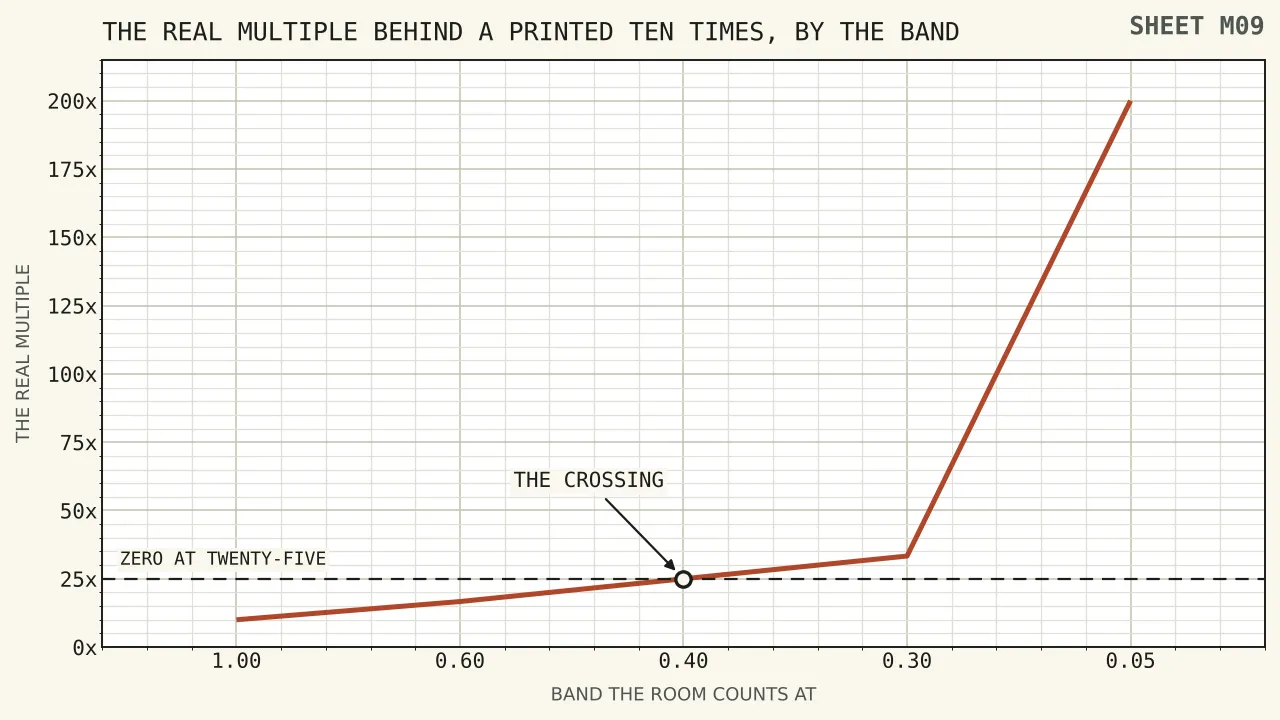
A band has to clear the multiple over twenty-five before anything survives, on a 96 per cent return. Ten times puts that bar at 0.40.
A band of 0.30 against a bar of 0.40: nothing survives, whoever built the reel
That is the whole of this page in one line. A reel from any studio, counted at thirty pence in the pound, cannot carry a ten times requirement, because thirty pence is below the forty the requirement demands. Search by studio and the figure deciding the outcome is still the cashier’s.
One fact gives the thirty pence its provenance. A consultation response carries that rate, taken there from a respondent whose example counted a game at thirty per cent, so each staked pound contributes thirty pence. Arithmetic worked from it below belongs to this site. Contribution schedules are published by no regulator, their market spread by no primary source, so nothing here is advanced as a finding about the market.
In this bracket the rooms carrying a studio’s games have no Great Britain licence whatever, and part eight prices that. The studio-specific half arrives earlier, in part four, since a supplier’s authorisation and a room’s are separate things with a published figure between them.
2
The £10.00 rung and the £4.00 above a line
Say the offer wants £6.00 before it credits a hundred spins. Prepaid money buys in steps and none sits at £6.00, so £10.00 is bought and £4.00 of the purchase earns no eligibility.
| What is bought | Against the £6.00 | Over the line |
|---|---|---|
| £10.00 | Covers the line | £4.00 over |
| £20.00 | Covers the line | £14.00 over |
| £25.00 | Covers the line | £19.00 over |
| £50.00 | Covers the line | £44.00 over |
There is no cheaper step than the first, which is the point of printing it. A £6.00 line and a £10.00 bottom rung mean nobody can pay £6.00, so the room’s stated minimum is £6.00 and its real one, for a reader with a voucher, is £10.00. Forty per cent of that purchase went nowhere.
Forty spins at 10p is what the £4.00 amounts to. Against the £10.00 payout floor assumed here it falls £6.00 short, so it cannot leave, and circuits price the attempt: 16p of expected cost each time round, £1.60 across ten circuits, and the whole £4.00 gone across twenty-five.
£4.00 under a £10.00 floor, £6.00 short, at 16p of expected cost a circuit
Prohibited outright: a term setting any ceiling over a deposit balance’s exit. Illustration printed by the regulator: £50 in a day, £500 in a week, which annualises to £26,000 of the player’s own money. Nothing about a bonus conversion falls inside that rule, and nothing about a payout floor does either.
3
Thirty pence in the pound, and the real multiple
A requirement has a printed multiple and a real one, and the gap between them is the band. Divide the printed multiple by the band and the real figure appears.
| Band in play | The real multiple | Staking wanted | Cycles | Outcome | Cost expected |
|---|---|---|---|---|---|
| 1.00 | Ten, as printed | £100.00 staked | 1,000 spins | £6.00 comes out | £4.00 |
| 0.60 | Sixteen and two thirds | £166.67 staked | 1,667 spins | £3.33 comes out | £6.67 |
| 0.40 | Twenty-five exactly | £250.00 staked | 2,500 spins | nothing comes out | £10.00 |
| 0.30 | Thirty-three and a third | £333.33 staked | 3,333 spins | £3.33 under zero | £13.33 |
| 0.05 | Two hundred | £2,000.00 staked | 20,000 spins | £70.00 under zero | £80.00 |
Row four is this page’s own case, and the head of it takes that sum. Printed at ten times, counted at thirty pence, real at 33.33. Cost expected £13.33 on a credit of £10.00, which makes the requirement a third larger than whatever it hangs on.
Third row down is the crossing. Two fifths counted turns ten times into twenty-five exactly, which is where a 96 per cent return leaves nothing. Everything above that row survives and everything below it does not, and the studio’s name appears in none of the five rows.
One further conversion is worth printing, because it is the figure a reader can carry away. At a band of 0.30, every pound of credit costs £1.33 in expectation to clear at ten times. At 0.40 it costs exactly £1.00, which is the crossing. At 0.60 it costs 66.7p, and at full weight 40p. Multiply by the credit and the whole table reappears without any of the intermediate steps, and the only quantity a reader needs from the room is the band.
Two further readings make the table usable. The real multiple is the printed one divided by the band, which is why thirty pence produces 33.33 and five pence produces two hundred. And staking is the credit multiplied by that real figure, which is why the last column holds four per cent of the one before it.
A licensee’s limit: ten times bonus funds. Dated 19 January 2026. Found at prohibition three of provision 5.1.1. That limit binds the printed multiple and says nothing whatever about the band, which is why a licensed room can still produce the fourth row of that table without breaching anything.
Two unpublished points, left unfilled. Whether a requirement reaching the deposit falls under a ceiling whose subject is bonus funds. And whether a spin given away is bonus funds at all.
4
A supplier’s licence is not a room’s licence
One fact turns a studio search from unhelpful into misleading. Rooms with no licence have been found running games that licensed suppliers built, and both the observation and a penalty are published.
| What was recorded | The detail |
|---|---|
| A warning notice | Dated 20 January 2025 |
| What it observed | Licensed suppliers’ games on unlicensed sites |
| What such sites may lack | Social responsibility and money-laundering controls |
| What customers may meet | Fraud, data privacy problems, unfair practices |
| Who they often go after | Those registered with the national scheme |
| A supplier’s settlement | £4.75m, dated 23 July 2026 |
| How many sites | Six, reachable by British consumers |
| The visit volumes | Large, December 2023 to November 2024 |
| What was found wanting | Risk assessment, market controls, customer checks |
Read rows one and two together and a studio search collapses as a safety check. Recognising a game evidences a supply arrangement. Beyond that it evidences nothing whatever, which the regulator has set out in a published notice.
The settlement rows matter for a different reason. They show that the licensed side has an enforcement route against a supplier whose games end up in unlicensed rooms, and that the route has a figure on it. What they do not show is any remedy for a reader whose balance is stranded in such a room, because the money in that case went to the regulator rather than to a player.
One more point belongs here and it cuts the other way, in fairness. Nothing on these sheets says which licence any named offshore room holds, and no primary source gives a count of rooms holding any given offshore licence. So a page may describe what a licence requires and must not count the rooms that hold one. This note describes requirements and counts nothing.
The arithmetic consequence is simple and worth stating as a figure. On a £10.00 credit at ten times and a band of 0.30, the expected cost is £13.33 whether the reel came from a licensed supplier or an unlicensed one. A supplier’s authorisation changes no number in part three. What it changes is whether anybody can be fined when the games turn up in the wrong place.
5
What the register records about a name
A studio name is usually absent from a public register. Present instead: a licensee, an account number, activities carrying start dates, and domains carrying statuses. Reading them correctly is the cheapest check a reader has, and no guide to reading them is published anywhere on the register.
| The entry | Its meaning | What it is silent on |
|---|---|---|
| The licensee named | Who was authorised | Who operates the brand |
| The account number | A handle for the record | Any term being offered |
| A domain marked Active | Listed on that account | Which games sit on it |
| A domain marked White Label | Licensed, on another party’s licence | Nothing: it is licensed |
| A domain marked Inactive | Listed, unused on that account | Whether the site still trades |
| An activity’s start date | When authorisation began | What was added afterwards |
The white label row is the one most often misread, and the misreading runs in the direction of alarm rather than reassurance. A domain carrying that status is a licensed domain sitting on somebody else’s licence. So a brand a reader has never heard of can be perfectly licensed while the licence holder’s name is one the reader has also never heard of.
A second point about names bears on a studio search directly. Where one domain appears on two accounts, with different statuses, the brand has moved licence holder. Reading only the older account puts the brand outside the licensed sector; reading only the newer one misses that it used to sit elsewhere. Both readings are wrong, and only the pair of them together is right.
A short procedure follows, and it is one the regulator recommends. Find the licensed status somewhere on the room’s pages. Take the link under it. Set the recorded activities and domains against whatever the page claims. Then note the date of looking, since nothing on the register is dated for a reader’s benefit.
One figure puts the register in proportion. Operators recorded at the end of March 2026: 2,154 of them, holding 3,097 activities. That is the sole operator count these sheets carry, and it counts licence holders rather than brands, which is precisely why a studio name will not be found in it.
6
The rules that make a percentage mean anything
Part three’s figures all rest on one thing: a 96 per cent return describing a design’s long-run behaviour rather than labelling it. Three published requirements make that difference, and they are this page’s strongest argument for minding a room’s licence instead of a reel’s maker.
| Requirement | What it demands | What it forbids |
|---|---|---|
| 7A | Outcomes acceptably random | A compensated game |
| 7A guidance | Distribution per theoretical probabilities | Interventions moving the odds |
| 7B | Random numbers used in order | Discarding them for adaptive behaviour |
| 7C | Designs that do not mislead | A near miss falsely displayed |
| 7E | The result clearly shown | A display too brief to read |
| 14F | Silence under the stake | A fanfare where nothing was won |
One more arithmetic point belongs to a studio page, because it is the one figure a studio does influence and it is not the one readers look for. Volatility, meaning how widely results scatter about the mean, is a design property like the return. It changes nothing about expectation. On a £10.00 credit at ten times and full weight, the expected cost is £4.00 whether the reel pays in many small amounts or in a few large ones. What volatility changes is the chance of reaching the £10.00 payout floor at all, and in opposite directions: a wide scatter makes the floor more reachable and the usual outcome worse, while a narrow one makes the usual outcome better and the floor harder to clear. No published figure for either sits on these sheets, so no page here puts a number on it. The honest statement is that volatility moves the shape of the distribution and leaves its mean alone.
Row two carries the arithmetic. Where outcomes have to come out distributed as the theoretical probabilities say, a percentage predicts something about the long run and part three’s figures hold. Strip the requirement away and a percentage becomes a claim, with £13.33 of expected cost resting on nothing at all.
Row three shuts a subtler route to the same destination. Arrival order governs the use of numbers, and discarding any on account of adaptive behaviour is barred, which removes a system that draws repeatedly until an answer pleases it.
Two advertising rules bear on names specifically, and they sit here rather than in part eight because promotion rather than behaviour is their subject. First: marketing may not be likely to appeal strongly to children, nor to young persons, nor carry a person or character whose example anyone under 18 would be likely to follow. Second: gambling, or a significant role, is shut to anybody who is or appears under 25.
One carve-out attaches to the second rule and deserves precision, being narrow. A significant role is open to people between 18 and 24 in one place only: advertising sited where a bet may be struck directly, meaning an operator’s own site, and then only with the person as the bet’s subject rather than placed in a gambling scene. Anywhere else, and that includes social media, they stay out.
Taken together, those six requirements and two rules are what a licensed room brings to a reel that a studio cannot. The reel is the same object either way. What differs is whether its published behaviour has anything holding it in place.
7
The exit, and the £4.00 beneath a floor
Take the top row of part three: full weight, ten times, nothing forfeited, and £6.00 of a £10.00 credit expected out. A £10.00 payout floor is not cleared by £6.00, so even the best row on this page leaves a balance that cannot move, and the £4.00 from part two sits beneath it.
Added together they make £10.00 exactly, clearing the floor by nothing whatever. That is this page’s sharpest arithmetic: best outcome plus stranded rung landing precisely on the floor, so one penny of bad luck across a thousand spins leaves all £10.00 immovable.
£6.00 expected plus £4.00 stranded lands on a £10.00 floor, with nothing to spare
Two and a half seconds under each licensed cycle. The count runs start to earliest next start. The control comes up, then goes down. The standard shows no commencement date. So the best row’s thousand spins fill 2,500 seconds at the least, which comes to 41 minutes 40 seconds, while this page’s own 3,333 spins fill 8,333 seconds, or 2 hours 18 minutes 53 seconds.
Below sit the conditions that hold an exit open under a British licence. Not one of them turns on who built the reel.
| The condition | What it does |
|---|---|
| A lodged request | Stands; no cancelling |
| Money requested already | Cannot be put back in |
| The process end to end | Friction held down |
| A deposit balance ceiling | Never permitted |
| Size and frequency limits | Reasonableness required |
| Documents asked for late | No condition, if sooner was possible |
On the record from 21 October 2025, two mechanisms. A pay-out that does not arrive. A withdrawal threshold nobody attains. Pitch a threshold above £6.00 and the best row on this page strands whole, which on these figures takes no pitching at all: a £10.00 floor does it by itself.
8
Priced where no British licence covers the room
A studio’s name on a reel is not a Great Britain licence, and none is held here. Below, every line names such a licence’s condition, every line disappears with the licence, and every line is costed against the £10.00 credit and the 3,333 spins above.
| The missing condition | Its value on these figures |
|---|---|
| Randomness held acceptable | Ninety-six per cent describes something |
| Numbers taken in order | No redrawing for a better answer |
| No near miss shown falsely | A loss stays a loss on screen |
| Results shown readably | Legible even at 2.5 seconds each |
| Quiet beneath the stake | Thirteen pounds of cost reads as cost |
| An interval per cycle | Two hours and nineteen minutes of it |
| A cap per cycle on a reel | Five pounds; two for the under-25s |
| A ceiling over the multiple | Ten as printed, not as pleased |
| Under-25s kept out of adverts | Save for one narrow carve-out |
| A place in the scheme | Registering once covers the licensed |
Rows one to five are the studio-relevant group and reward being read together. None concerns money. Each concerns whether the numbers put in front of a reader describe the game they are looking at. A reel standing behind none of those requirements may be honest enough; checkable is the thing it cannot be.
On those questions the Curaçao rulebook is tabled below rather than paraphrased. Paraphrase is where pages of this sort come apart.
| The question | Offshore, in that policy | Here, under a licence |
|---|---|---|
| Are outcomes held random | The policy is silent | Acceptably so, uncompensated |
| May a near miss be faked | The policy is silent | Named, and prohibited |
| Is a multiple capped | Not in that document | At ten times bonus funds |
| Is a stake capped | Not in that document | At five pounds, or two |
| Is a cycle floored | Not in that document | At two and a half seconds |
| Who answers for affiliates | The operator, by contract | Nothing is published |
| How near is cooling-off | A click, at four lengths | Clicks minimised |
| How slow is a limit rise | Seven days | Twenty-four hours |
| Must a footer link to help | Yes, British bodies cited | Framed differently |
| How wide is an exclusion | One operator’s domains | All licence holders |
Four of those rows favour the offshore document, and an honest page prints them. Seven days brakes a rising limit harder than twenty-four hours. Cooling-off a click away, at four lengths, needing no email and no approval from anybody, is a control a reader can genuinely work. Affiliates are the operator’s to answer for. And support links are required in a footer, with British bodies among the policy’s own examples.
Rows one to five are what a studio search ought to mind, and the offshore column is empty across all five. So the honest summary runs: identical reel, figures nobody is required to publish, and the requirements that would give those figures meaning present only where a British licence is.
The scheme closes it, as it closes every note here. Participation tracks the licence, so a room without one stands outside as a matter of construction. Registration comes at four lengths, the shortest half a year and the longest five with renewal, and nothing ends ahead of its minimum. Figures published on 16 July 2026: 614,738 registered, with 12,236 in that May setting a record.
Questions
- Does the studio behind a slot affect what a bonus is worth?
- Hardly at all. The credit, the multiple, the band and the payout floor are the cashier’s, and the band is what decides survival. A reel counted at thirty pence in the pound cannot carry a ten times requirement, because the bar at ten times is forty pence, and that is true whoever built the reel.
- What is the real multiple behind a printed ten times?
- The printed figure divided by the band. At full weight it stays ten. At two fifths it becomes twenty-five, which is exactly where a 96 per cent return leaves nothing. At thirty pence in the pound it becomes 33.33. At a twentieth it becomes two hundred, which needs £2,000.00 of staking on a £10.00 credit.
- What does ten times cost on a £10.00 credit at thirty pence?
- £13.33 in expectation, against a credit of £10.00. The staking required is £333.33, which is 3,333 spins at 10p, and four per cent of that staking goes to the edge. So the requirement is a third larger than the credit it hangs on, and cannot be finished out of it.
- Does a familiar game mean a room is licensed?
- No, and both halves of that are published. A notice of 20 January 2025 records games built under licence running where no licence exists. One supplier settled at £4.75m on a decision dated 23 July 2026, its games having turned up on six unlicensed sites open to consumers here, visit volumes being called large over the stretch from December 2023 to November 2024.
- Can I look a studio up on the public register?
- Not usefully. What the register records is a licensee, an account number, activities with start dates and domains with statuses, and the only operator count on these sheets is 2,154 licensees holding 3,097 activities at the end of March 2026. It is a count of licence holders rather than of brands or of game makers.
- What does White Label mean against a domain?
- A licensed domain sitting on somebody else’s licence. It is the status most often misread, and the misreading runs towards alarm. A brand a reader has never heard of can be properly licensed while the licence holder’s name is also unfamiliar, and absence of the brand name from the licensee column proves nothing by itself.
- Does a licensed slot have to publish a return percentage?
- No. The chance-information duty accepts any of four, with or between: how a game runs alongside the settling of prizes and winners; a margin, or else a house edge; a figure covering the return; or a winning event’s likelihood. One serves, so a studio’s reel may show a margin and no percentage at all.
- What makes a published percentage mean anything?
- Three requirements, and money is the subject of none of them. Randomness has to be acceptable, compensated games being out and interventions that move the odds being barred. Numbers have to be taken as they arrive, in order, with none thrown away for adaptive behaviour. And outcomes have to come out distributed as the theoretical probabilities say.
- Are there rules about how a game may be advertised?
- Yes, and two touch names and faces. Marketing that would likely appeal strongly to children or to young persons is out, and so is a person or character whose example the under-18s would likely copy. Gambling, or a significant role, is shut to anyone who is or appears under 25, with one narrow carve-out for people between 18 and 24 on an operator’s own pages.
- How long do 3,333 spins take?
- 2 hours 18 minutes 53 seconds, at one cycle per 2.5 seconds. Part three’s best row runs a thousand spins, which fill 41 minutes 40 seconds. Beyond that licence no published floor exists, so an identical expected cost can land in a fraction of the time.
- What is stranded on this page?
- £4.00 from the rung, and in an unusually tight way. A £6.00 line meets a ladder whose cheapest step is £10.00, so £4.00 bought nothing. Add it to the £6.00 the best row expects and the account holds exactly £10.00 against a £10.00 floor, so one penny of bad luck across a thousand spins strands the lot.
- What goes missing in a room without a British licence?
- Mostly whatever lets a figure be checked at all. Randomness, faked near misses, a multiple’s ceiling, a stake cap, an interval per cycle: the Curaçao rulebook addresses none of the five. Four points there run the other way, among them seven days of brake on a rising deposit limit and cooling-off a single click away.