Note M07 Revision 1 Terms read 16 October 2026
Online slots UK: the one band where a multiple still works
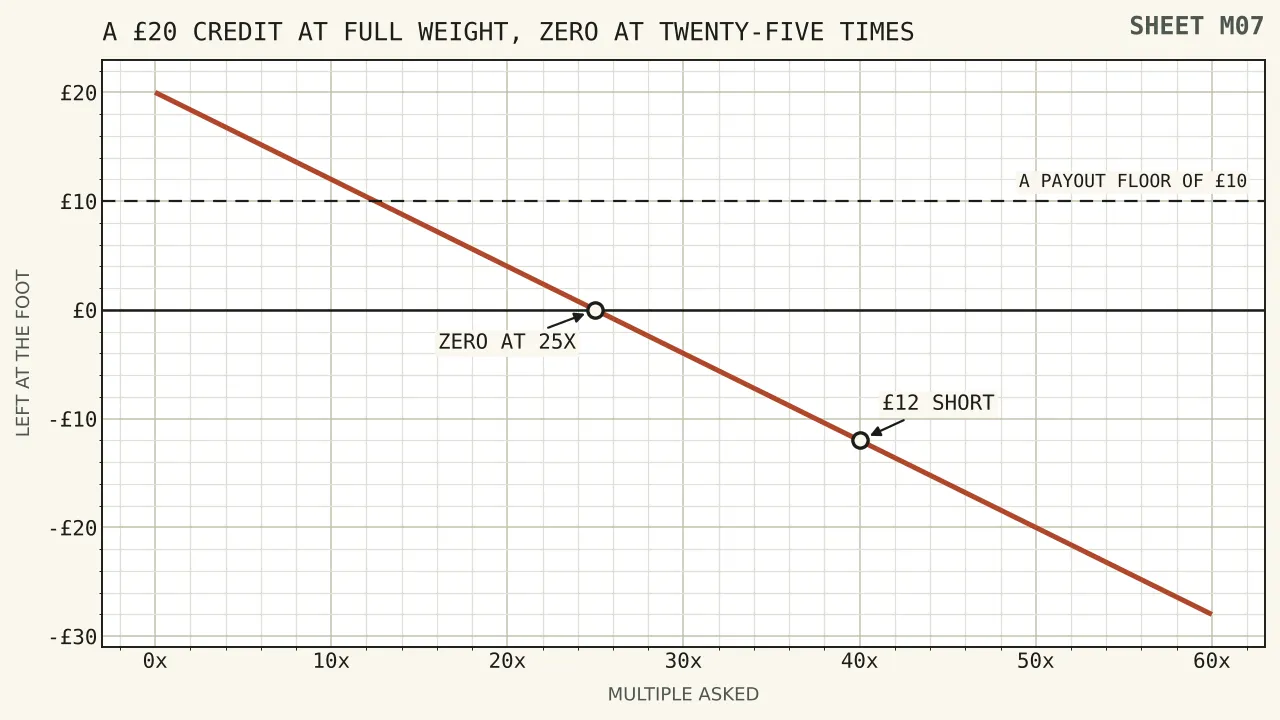
Reels count whole, which makes them the only part of a floor where a published requirement survives. A £20.00 credit at ten times keeps £12.00 in expectation. At forty times it finishes £12.00 under zero, and the band wanted there is 1.60, which nothing reaches. Terms reading only slots count put the band at nought elsewhere. The rung stranded £7.00 at the outset.
The face £20.00 of credit What draws it down £32.00 at forty What is stranded £7.00 and the rest
What a face of this size is worth
Every destination on this rack is bought advertising. The site takes a fee if a reader goes on to register, and no figure printed below moves because of it.
Face and Residue
Strip No 01
Betportal
Ceiling as a multiple
Priced at this site's own 10p a spin
What is printed
What draws it down
What is stranded
No Great Britain licence
Licensed in Anjouan, Comoros, run by BetPortal Gaming Ltd, with Excite Ultra Media Ltd, reference ALSI-202601040-FI2.
Terms read 16 October 2026
Open the offer at Betportal, opens in a new tabFace and Residue
Strip No 02
WinBeast
Ceiling as a sum
Priced at this site's own 10p a spin
What is printed
What draws it down
What is stranded
No Great Britain licence
Licensed in Curaçao, operator not named on the site.
Terms read 16 October 2026
Open the offer at WinBeast, opens in a new tabFace and Residue
Strip No 03
EliteSpin
Longest spin window
Priced at this site's own 10p a spin
What is printed
What draws it down
What is stranded
No Great Britain licence
Licensed in Costa Rica, run by PrimeTier Limited.
Terms read 16 October 2026
Open the offer at EliteSpin, opens in a new tabFace and Residue
Strip No 04
Crown Jewelz
Multiple unpublished
No residue struck
What is printed
What draws it down
What is stranded
No Great Britain licence
Licensed in Curaçao, number not verified, operator not named on the site.
Terms read 16 October 2026
Open the offer at Crown Jewelz, opens in a new tabThe two figures in the second and third registers are this site's own arithmetic and nothing an operator has published: the face as printed, less the share a spin gives back at 96 per cent return to player, less what playing the wagering through costs at the same return, and then less whatever a published ceiling, a charge on the way out or a floor on the smallest withdrawal takes off what survives that. The residue is what is left of the face when all of it is accounted for. It describes the offer, not one reader's afternoon. Where the conditions price above the face the strip prints nothing coming off rather than a negative sum, and where a figure the sum needs is unpublished it prints the condition in the operator's words instead.
A face paid as spins has no unit of its own, so one is supplied. Where an operator publishes what a spin of its own is worth, that figure stands in the first register's own line and is labelled as theirs. Where it does not, this site's own 10p a spin stands there and says so, and every figure below moves in proportion: at half the price, half the money. The share of the face that does come off is also given as pence in the pound, which is the figure that compares a large face against a small one.
Money goes onto a prepaid voucher in fixed denominations, so a smallest deposit published in pounds is rounded up to the first rung of the ladder this site works in, £10, £20, £25, £50, £75 and £100, and the strip prints what that rounding strands. That is the reader's own money and it is never netted into a residue. A smallest deposit published in euros is printed as the operator publishes it, because the ladder here is a sterling one and rounding a euro sum to it would be an invented figure.
Three words stand in the amount column where no figure can. Noted is a published condition that takes value away without leaving the sum a figure to take. Unpriced is a condition whose figure nobody has published, or a credit that is not a sum until a deposit of your own sets it. Own money is money of yours, which is never part of a residue.
Not one of the operators printed above holds a Great Britain licence, so the duties that licence carries do not reach them. All online gambling companies licensed in Great Britain must be part of Gamstop Online, and a reader who has shut themselves out through the scheme is therefore not shut out here. The ceiling of ten times the bonus funds on a wagering requirement, in force since 19 January 2026 under Social Responsibility Code 5.1.1, is a condition of that licence and binds the companies that hold one. On an unlicensed site the Gambling Commission describes consumers as facing unfair gaming practices, financial loss and a lack of recourse if things go wrong, and it names blocked payouts and withdrawal limits set so high they are unattainable among what it has seen. Nobody under 18 may hold an account at any of them.
Every term printed on a strip is the operator's own, and each strip carries the day it was read. The oldest of those readings is 16 October 2026. What binds a reader is the operator's own full terms, and not a line printed here.
1
Full weight, and why it matters most here
Reels are the part of a casino floor that counts in full. A pound staked on one usually advances a play-through by a pound, which this site writes as g of 1.00. That property is why a slots note reaches a different conclusion from the rest of this section.
g of 1.00 survives every multiple under 25 and no multiple above
A 96 per cent return leaves fourpence of edge per pound, and 0.04 goes into one exactly twenty-five times. The widest survivable range anywhere on a floor belongs, then, to the band reels occupy, and it stops dead at twenty-five.
Two things follow. A requirement no table could clear is often clearable on a reel, which is why bonus terms keep narrowing themselves to reels. And the house multiple of forty times is beyond even this band, since forty wants 1.60 of weighting and a staked pound gives at most a pound.
Worked on £20.00 of credit at full weight. Ten times: £200.00 of staking, £8.00 of cost, £12.00 through. Forty times: £800.00 of staking, £32.00 of cost, £12.00 under zero. One credit, one reel, one return, and only the multiple moving.
Reels hold most of the money too. Of the £8.3 billion the remote sector produced in the twelve months to March 2026, slots games accounted for £4.8 billion. The band that survives is therefore the band most credits are spent in, and the arithmetic turns in the smaller bands rather than in the larger money.
Nothing on this page claims a licensed reel owes a reader a percentage. Four items satisfy the chance-information duty and the word joining them is or, so a margin will do and a percentage is one option of four. The 96 per cent used throughout is this site’s own assumption, held across every note so one can be set beside another.
Reels of the kind priced here are run where no Great Britain licence is held. Two published rules exist for reels and for nothing else on a floor: a cap on a cycle’s stake, and an interval between cycles. Part eight puts a figure on both.
Constant across this site: 10p a cycle, 96 per cent back, forty times as the house multiple, g at 1.00 wherever a sentence leaves it alone. Here g stays at 1.00 for most of the way, reels being where it does, and part four is where it falls to nought.
2
The £20.00 rung and the £7.00 above a line
Prepaid money buys in steps. Say a reel offer wants £13.00 before crediting anything. Nothing on the ladder sits at £13.00, so £20.00 is bought and £7.00 of the purchase opens nothing.
| Step | Against the line | Left over |
|---|---|---|
| £10.00 | Falls short | No credit opens |
| £20.00 | Covers it | £7.00 spare |
| £25.00 | Covers it | £12.00 spare |
| £50.00 | Covers it | £37.00 spare |
Seventy cycles at 10p: that is what £7.00 amounts to, or close to three minutes of play at the licensed pace. The payout floor assumed here is £10.00, so the £7.00 falls £3.00 short of leaving, and no correct play closes a gap of that kind.
Circuits price it. Sending £7.00 round once, at 96 per cent, costs 28p expected. Ten times round costs £2.80. Twenty-five times round takes all of it. An expectation is not improved by repetition, since the edge keeps its sign, so the £7.00 sits where it is or leaks off a few pence at a time.
One rule guards the deposited part and admits no conditions: a maximum on a deposit-balance withdrawal is beyond any term a licensee here may write. Fifty in a day beside five hundred in a week is the offending example the regulator prints, which annualises to twenty-six thousand on money already the player’s. Nothing outside the deposit balance is within its reach.
Scaling that residue is instructive, because it shows where the ladder hurts. A line of £11.00 against the £20.00 step wastes £9.00, which is 45 per cent of the purchase. A line of £13.00 wastes £7.00, or 35 per cent. A line of £19.00 wastes £1.00, or 5 per cent. Worst case on each gap sits immediately above the step below it, so the reader who needed barely more than the last step pays the most.
3
Five multiples on one reel
Hold the band at 1.00 and move the multiple. Credit £20.00, return 96 per cent, unit 10p.
| Multiple | What it is | Staking wanted | Cycles | Outcome | Cost expected |
|---|---|---|---|---|---|
| 10 times | A licensee’s ceiling | £200.00 staked | 2,000 spins | £12.00 gets through | £8.00 |
| 20 times | Twice that ceiling | £400.00 staked | 4,000 spins | £4.00 gets through | £16.00 |
| 25 times | Where zero sits | £500.00 staked | 5,000 spins | nothing gets through | £20.00 |
| 40 times | This site’s house figure | £800.00 staked | 8,000 spins | £12.00 beneath zero | £32.00 |
| 60 times | What the ceiling replaced | £1,200.00 staked | 12,000 spins | £28.00 beneath zero | £48.00 |
Twenty-five divides that table, a figure owed to the return and to no market convention. Clearing a requirement costs exactly the credit at that point, given a 96 per cent return. Lower down, something comes out. Higher up, the requirement has outgrown what it was fastened to.
One more figure belongs in this part, and of all the figures here it is the only one not a multiple of something else. Expected cost per spin is fixed at four tenths of a penny, because a 10p stake at a 96 per cent return loses 0.4p on average. Multiply by the spin count and every row of that table falls out: 2,000 spins cost £8.00, 4,000 cost £16.00, 5,000 cost £20.00, 8,000 cost £32.00 and 12,000 cost £48.00. A reader who remembers four tenths of a penny can rebuild the whole table without the credit, the multiple or the band.
Two rows want careful reading. A £12.00 shortfall at forty times does not leave a reader £12.00 poorer than they started. It says the credit cannot complete the requirement: either play stops with it unmet, or money of the reader’s own continues it at the same fourpence per pound. At sixty times the shortfall is £28.00 on a £20.00 credit, which is the clearest case on this page of a requirement outgrowing its credit.
Four of those five rows are unavailable from a licensee. Ten times bonus funds is the ceiling, dated 19 January 2026, at the third prohibition in provision 5.1.1, with two licence classes outside it. Sixty is what the regulator records as having been in use beforehand, and it is the one market multiple on these sheets written by the regulator itself.
Two gaps stay open. Bonus funds are the ceiling’s subject, and nothing published deals with a requirement reaching the deposit too. A spin’s own status against that subject is unpublished as well.
4
A band of nought, where the terms say so
Weighting is this section’s subject, and reels present a version the other notes do not: not a small band but no band whatever. Welcome terms read on 15 October 2026 put the point in a bracket after a wagering requirement, saying that only slots count.
Three kinds of band therefore exist, and the third is the one that catches readers.
| What the terms do | Effect on a staked pound |
|---|---|
| Count everything whole | A pound of contribution |
| Count some games lower | Part of a pound, per a schedule |
| Count only slots | Nothing whatever, elsewhere |
A stake placed outside the named games is not refunded or redirected. It is spent, the 4p in the pound is charged as normal, and the requirement stands exactly where it stood. On £20.00 of credit at ten times, a reader who put £50.00 through a table believing it counted has spent £2.00 in expectation and taken nothing off the outstanding requirement.
£50.00 staked outside the named games: £2.00 of expected cost, nothing off the requirement
That same published set carries three further figures, and all three are operator terms read on a date rather than rules.
| The term, as published | On a £20.00 credit |
|---|---|
| Ten times the bonus | £200.00 of staking wanted |
| Ten times free-spin winnings | A second requirement, counted apart |
| Only slots counting | A band of nought elsewhere |
| A tenth of the credit, maximum bet | £2.00 a spin, so 100 spins |
| A 10p floor under that | Binding only on credits under £1.00 |
| A £5 lid over it | Binding only above £50.00 of credit |
The fourth row is the one with real arithmetic in it. A tenth of £20.00 is £2.00, and £2.00 is under £5.00, so £2.00 governs. Two hundred pounds of required staking then arrives in 100 spins rather than 2,000, and the expected cost stays at £8.00 the whole way. A maximum bet moves the count of decisions by a factor of twenty and leaves the money untouched.
One further published policy belongs here, because it is the only one on these sheets addressing a withdrawal while a bonus runs. A player holding an active bonus and wishing to withdraw has to cancel the entire bonus balance, winnings accrued with the bonus included. One operator’s published policy, read on that same date, so it is a shape to look for in terms rather than a figure to lean on.
5
What a stake cap buys, in decisions
Two caps cover reels and nothing else on a floor. They arrive in an instrument of 25 February 2025, and decisions rather than pounds are the units of their effect.
| Cap | Who it covers | Date in the guidance | Presses for £800.00 |
|---|---|---|---|
| £5 a cycle | Players aged 25 and above | From 9 April 2025 | 160 of them |
| £2 a cycle | Anybody under 25 | From 21 May 2025 | 400 of them |
| 10p, this site’s unit | An assumption, not a rule | No date applies | 8,000 of them |
The right-hand column is the finding. Every row costs £32.00 in expectation on £800.00 of turnover, four per cent of staking being the cost and the staking being unchanged. Presses are what differ: 160 of them, or 400, or 8,000, against one identical cost.
So a cap is not a protection against losing money. What it provides is a floor under the decisions a given turnover demands, and a floor under the minutes it occupies. The scope of both caps is tabled below rather than described, because scope is where the misreadings happen.
| Point of scope | What is published |
|---|---|
| Games covered | Online slots, and nothing else |
| Games outside | Roulette and blackjack, named in guidance |
| The definition used | Reel-based, and played online |
| Reel-based, in turn | Images or text moving or changing |
| What the arrangement does | Settles a prize or other advantage |
| Dates in the instrument | None, only six weeks from making |
| The transitional period | A flat five pounds, for six weeks |
| Licences it attaches to | Each remote casino one, earlier ones too |
One last conversion puts the caps in minutes instead of presses. Each press carries 2.5 seconds beneath it, so 160 of them occupy 6 minutes 40 seconds, 400 presses occupy 16 minutes 40 seconds, and 8,000 presses occupy 5 hours 33 minutes 20 seconds. So the same £32.00 of expected cost can be delivered inside a tea break or across most of a working day, and which of those happens is settled by a stake size rather than by any term in the offer.
The last row is worth a sentence. The condition attaches to remote casino operating licences including those issued before the regulations took effect, so it is not a rule that arrived only for new entrants. And the transitional row explains why the two dates are six weeks apart rather than simultaneous.
6
The interval, and three routes it closes
Cycles become minutes once a floor exists to multiply by, and a licensed reel has one. Requirement 14D fixes it at 2.5 seconds, timed from a game’s start to the soonest another may begin. Between them the start control comes up and goes down again, so nothing begins while a button or a screen is merely held. No commencement date is printed on that standard and none is asserted here.
| Multiple | Cycles | Time, at the least | Seconds | Expected hourly |
|---|---|---|---|---|
| 10 times | 2,000 spins | 1 hour 23 minutes | 5,000 | £8.64 an hour |
| 20 times | 4,000 spins | 2 hours 46 minutes | 10,000 | £1.44 an hour |
| 25 times | 5,000 spins | 3 hours 28 minutes | 12,500 | Nothing an hour |
| 40 times | 8,000 spins | 5 hours 33 minutes | 20,000 | Nothing an hour |
| 60 times | 12,000 spins | 8 hours 20 minutes | 30,000 | Nothing an hour |
Three rules close the three obvious routes to going faster.
| Route | What closes it |
|---|---|
| Letting a reel run itself | Every cycle a separate commitment |
| Shortening a wait | Turbo, quick spin, slam stop |
| Running several together | Split screens, multi-screen layouts |
| Scoring a loss as a win | No fanfare at or under the stake |
| Dressing a loss as a near thing | No false near miss, by name |
Four things the same guidance leaves alone are worth listing, since implying otherwise would overstate it. Features that scratch everything or reveal everything. Bonus and feature games carrying no further stake. Games whose stake goes unless a customer acts to finish them. And familiar mechanics of the blackjack split sort, which the rule on chasing expressly does not aim at.
The fourth row of that table does more work across 8,000 spins than any of the others. Most results on a long requirement hand back less than the 10p staked. Where a room may score each of those as a win, £32.00 of expected cost can be made to read as a run of small successes, which is a cost paid in information rather than in money.
One figure closes this part. At 2.5 seconds a cycle, a reader clearing forty times on £20.00 makes 8,000 decisions across 5 hours 33 minutes 20 seconds, and the expected value of the whole exercise is minus £12.00. That is 2.5 seconds per decision and about a fifth of a penny of expected loss per decision, which is the most honest way to state what a long requirement costs.
7
The exit, and the £7.00 beneath a floor
Take part three’s top row: ten times, full weight, nothing forfeited, £12.00 expected out of a £20.00 credit. Two pounds clears the £10.00 floor. Part two’s £7.00 sits elsewhere and stays put.
Seven pounds against a £10.00 floor is £3.00 short. Topping up costs £10.00, since that is the cheapest step, and produces £17.00 against the floor: £10.00 departs and £7.00 remains, so the residue is reproduced rather than removed. Playing it costs 28p a circuit in expectation and improves nothing.
£7.00 under a £10.00 floor, £3.00 short, at 28p of expected cost per circuit
Whatever keeps an exit open under a British licence appears beneath, and none of it is particular to reels.
| Requirement | Effect |
|---|---|
| A request once placed | Cancelling is not offered |
| Funds already requested | Not offered back as a deposit |
| The process itself | Friction as low as achievable |
| Deposit balance maxima | Barred, with no exception |
| Limits on size or frequency | Only the reasonable sort |
| Documents at the exit | No condition there, where asking came earlier |
Beyond that licence two failures have been named. The regulator’s enforcement and intelligence director set them out on 21 October 2025: a pay-out stopped, and a withdrawal threshold pitched past reach. Pitch one above £12.00 and this page’s best outcome strands whole, with no refusal issued anywhere in the process.
8
Priced where no British licence covers a reel
Reels at this end of the market run with no Great Britain licence over them. Two items below exist for reels alone, which makes the slots case the sharpest in this section, and each line is costed against the £20.00 credit and the 8,000 spins above.
| Condition | What it is worth here |
|---|---|
| A £5 cap on a cycle | 160 presses at least, not 8,000 |
| A £2 cap under 25 | 400 presses at least instead |
| An interval of 2.5 seconds | 5 hours 33 minutes, not 33 |
| No reel running itself | Eight thousand separate choices |
| No turbo and no slam stop | No buying the interval off |
| No fanfare under a stake | A cost cannot read as a win |
| No false near miss | A loss cannot look like a near thing |
| A ceiling of ten | £12.00 out rather than £12.00 short |
| Identity settled first | Three items, and bonus play too |
| A place in the scheme | One sign-up, all licensed accounts |
The first two rows deserve their figures. No stake cap appears anywhere in the Curaçao rulebook, so a reel there may take whatever its own table of stakes permits. Eight hundred pounds of required staking then arrives in 8,000 presses at 10p, or in sixteen at £50.00, with an expected cost of £32.00 either way. Sixteen decisions is the gap between a session and a reflex.
The third row is the other reel-only item. That rulebook contains no interval between cycles either, so the 8,000 spins need not fill 5 hours 33 minutes. Four cycles a second delivers them in 33 minutes 20 seconds for the same £32.00 of expected cost.
What that document does require is tabled here rather than summarised, because the easy version of this part would be wrong in both directions.
| Question | Curaçao’s policy | A British licence |
|---|---|---|
| A cap on a stake | None anywhere | Five pounds, two under 25 |
| An interval per cycle | None anywhere | Two and a half seconds |
| A ceiling on a multiple | None anywhere | Bonus funds times ten |
| Auto-play | Unaddressed | Not offered for gaming |
| Cooling-off | Four lengths, one click | Fewest clicks possible |
| A deposit limit rise | Held for a week | Held for a day |
| Identity at the start | A date of birth taken | Name, address and date verified |
| Photographic identification | Held for later milestones | Ahead of any play whatever |
| Affiliates | Contracts, audits, penalties | Nothing published about them |
| How far exclusion reaches | A single operator and its domains | Every holder of a licence |
Three rows there run in the offshore direction and an honest page prints them. Against a day, a week is the heavier brake on a limit going up. Four lengths of cooling-off, one click away and needing neither email nor approval, is a control a reader can genuinely use. And responsibility for affiliate compliance rests on the operator there, through contracts, audits and penalties, with no published British counterpart to set beside it.
The bottom row decides most. Scheme participation tracks the licence, so a reel lacking one is outside as a matter of construction. The boundary is in the scheme’s own terms: its reach is the operators taking part, and a service outside that group cannot be blocked by it. Half a year is the shortest sign-up available, and no sign-up ends ahead of its minimum period.
One figure closes the note, slots being where the money and the exclusions meet. Of the registrations published on 16 July 2026, over half took the longest option of five years. A quarter across every age took the shortest. Among the under-25s that share climbed to 38 per cent. For that group the £2 cap exists, and it is a British licence condition and nothing besides.
Questions
- Why do bonus terms narrow themselves to slots so often?
- Reels count whole, and full weight is the only band a published multiple survives in. What a band must beat is the multiple over twenty-five, on a return of 96 per cent, so 1.00 takes in everything beneath twenty-five and nothing beyond it. Weaker bands cannot finish the same requirement out of the credit at all.
- What does ten times cost on £20.00?
- £8.00 expected, leaving £12.00. Staking wanted is £200.00, or 2,000 spins at 10p, with fourpence of each pound going to the edge. Twenty times doubles the cost to £16.00 and leaves £4.00. Twenty-five times costs £20.00, which is the credit, and leaves nothing.
- Why does forty times fail even on a reel?
- The band it demands is 1.60, and nothing above 1.00 exists, a staked pound giving at most a pound. On £20.00 of credit, forty times calls for £800.00 through the reel, whose expected cost is £32.00, leaving the requirement £12.00 larger than the credit carrying it.
- What happens when terms say only slots count?
- The band is nought everywhere else, so a pound staked away from the named games moves the requirement by nothing at all. That is no route rather than a slow route. Fifty pounds through a table under such a term costs £2.00 in expectation and takes nothing off what is outstanding.
- Does the £5 cap stop me losing money?
- No. Turnover of £800.00 costs £32.00 expected whether 160 presses at £5.00 deliver it or 8,000 at 10p. What a cap gives is a floor beneath the decisions any turnover demands, and beneath the minutes it fills. The figure for a player under 25 is £2.00, which lifts that floor to 400 presses.
- Which games do the caps actually cover?
- Online slots and nothing else. The definition runs to three words: casino, reel-based, online. As for reel-based, it takes in a game displaying images or text that move or change, done with representations of reels or otherwise, provided the arrangement arrived at settles a prize or an advantage. Guidance leaves other casino games out, roulette and blackjack among the names given.
- When did the two caps start?
- Two dates sit in the guidance: 9 April 2025 brought five pounds, and 21 May brought two. Nothing resembling a calendar date appears in the instrument itself, made as it was on 25 February 2025, only a formula of six weeks past the day of making. A flat five covered everybody across that stretch, so the lower figure arrived behind it.
- How many hours does a long requirement take?
- At one cycle per 2.5 seconds: 2,000 spins fill 1 hour 23 minutes 20 seconds; 8,000 fill 5 hours 33 minutes 20 seconds; 12,000 fill 8 hours 20 minutes. Dividing survival by that time gives £8.64 hourly at ten times, £1.44 at twenty, and nothing at all from twenty-five up.
- Must a licensed reel publish its return figure?
- No. Four items answer the duty, joined by or: the way a game works together with the settlement of winners and prizes; a margin or a house edge; a figure for the return; or the chance of a winning event. Where a percentage does appear, guidance asks for the average theoretical return, a description of a design across the long run which predicts nothing about one sitting.
- What is stranded here on the best outcome?
- £7.00. An offer wanting £13.00 before it credits anything meets a ladder with £20.00 as the cheapest adequate step, so £7.00 opened nothing. Against a £10.00 payout floor it falls £3.00 short. A circuit costs 28p expected; twenty-five circuits finish it off; and buying a £10.00 step to free it leaves £7.00 sitting there again.
- What changes on a reel with no British licence?
- The two reel-only rules go first. Without a stake cap, sixteen presses at £50.00 can deliver £800.00 of required staking rather than 8,000 at 10p, at the identical £32.00 of cost. Without an interval, 8,000 spins need not occupy 5 hours 33 minutes. The multiple’s ceiling goes too, and that is what makes forty times writable in the first place.
- Can I take money out while a bonus is running?
- One published policy on these sheets answers it, and the answer there is no without a cost: a player with an active bonus who wants to withdraw must cancel the whole bonus balance, winnings accrued with the bonus included. That is one operator’s published policy read on 15 October 2026 rather than a rule, so treat it as a shape to look for in terms.