Section N Revision 1 Terms read 16 October 2026
The spend-down
Clearing a credit costs four pence for every pound staked, so the bill is four hundredths of the multiple times the credit and nothing else. On a £25.00 credit that is £10.00 at ten turnovers and £25.00 at twenty-five, where the whole thing has gone. One line in the terms moves the break-even from twenty-five turnovers to twelve and a half: whether the multiple is applied to the credit alone or to the credit plus the payment behind it. Thirteen notes stand here.
The face A credit of £25.00 What draws it down £250.00 of staking What is stranded £10.00 of expected cost
What a face of this size is worth
Every destination on this rack is bought advertising. The site takes a fee if a reader goes on to register, and no figure printed below moves because of it.
Face and Residue
Strip No 01
Betportal
Ceiling as a multiple
Priced at this site's own 10p a spin
What is printed
What draws it down
What is stranded
No Great Britain licence
Licensed in Anjouan, Comoros, run by BetPortal Gaming Ltd, with Excite Ultra Media Ltd, reference ALSI-202601040-FI2.
Terms read 16 October 2026
Open the offer at Betportal, opens in a new tabFace and Residue
Strip No 02
WinBeast
Ceiling as a sum
Priced at this site's own 10p a spin
What is printed
What draws it down
What is stranded
No Great Britain licence
Licensed in Curaçao, operator not named on the site.
Terms read 16 October 2026
Open the offer at WinBeast, opens in a new tabFace and Residue
Strip No 03
EliteSpin
Longest spin window
Priced at this site's own 10p a spin
What is printed
What draws it down
What is stranded
No Great Britain licence
Licensed in Costa Rica, run by PrimeTier Limited.
Terms read 16 October 2026
Open the offer at EliteSpin, opens in a new tabFace and Residue
Strip No 04
Crown Jewelz
Multiple unpublished
No residue struck
What is printed
What draws it down
What is stranded
No Great Britain licence
Licensed in Curaçao, number not verified, operator not named on the site.
Terms read 16 October 2026
Open the offer at Crown Jewelz, opens in a new tabThe two figures in the second and third registers are this site's own arithmetic and nothing an operator has published: the face as printed, less the share a spin gives back at 96 per cent return to player, less what playing the wagering through costs at the same return, and then less whatever a published ceiling, a charge on the way out or a floor on the smallest withdrawal takes off what survives that. The residue is what is left of the face when all of it is accounted for. It describes the offer, not one reader's afternoon. Where the conditions price above the face the strip prints nothing coming off rather than a negative sum, and where a figure the sum needs is unpublished it prints the condition in the operator's words instead.
A face paid as spins has no unit of its own, so one is supplied. Where an operator publishes what a spin of its own is worth, that figure stands in the first register's own line and is labelled as theirs. Where it does not, this site's own 10p a spin stands there and says so, and every figure below moves in proportion: at half the price, half the money. The share of the face that does come off is also given as pence in the pound, which is the figure that compares a large face against a small one.
Money goes onto a prepaid voucher in fixed denominations, so a smallest deposit published in pounds is rounded up to the first rung of the ladder this site works in, £10, £20, £25, £50, £75 and £100, and the strip prints what that rounding strands. That is the reader's own money and it is never netted into a residue. A smallest deposit published in euros is printed as the operator publishes it, because the ladder here is a sterling one and rounding a euro sum to it would be an invented figure.
Three words stand in the amount column where no figure can. Noted is a published condition that takes value away without leaving the sum a figure to take. Unpriced is a condition whose figure nobody has published, or a credit that is not a sum until a deposit of your own sets it. Own money is money of yours, which is never part of a residue.
Not one of the operators printed above holds a Great Britain licence, so the duties that licence carries do not reach them. All online gambling companies licensed in Great Britain must be part of Gamstop Online, and a reader who has shut themselves out through the scheme is therefore not shut out here. The ceiling of ten times the bonus funds on a wagering requirement, in force since 19 January 2026 under Social Responsibility Code 5.1.1, is a condition of that licence and binds the companies that hold one. On an unlicensed site the Gambling Commission describes consumers as facing unfair gaming practices, financial loss and a lack of recourse if things go wrong, and it names blocked payouts and withdrawal limits set so high they are unattainable among what it has seen. Nobody under 18 may hold an account at any of them.
Every term printed on a strip is the operator's own, and each strip carries the day it was read. The oldest of those readings is 16 October 2026. What binds a reader is the operator's own full terms, and not a line printed here.
1
The question this section answers
A credit is granted and then has to be kept. Between those two moments it has to be staked, and staking costs money. How much, and what decides it, is the whole of this section.
The answer is a single multiplication and it is worth learning. Expect four pence to go from each pound staked at a game handing 96 back, with the pounds staked coming to the multiple times the credit, which makes the bill four hundredths of the multiple times the credit. Nothing else enters it. Not the number of presses, not the length of the sitting, not the size of a win along the way.
That makes this section the most predictable on the site and also the easiest to misread, because the bill grows with two things at once. Double the credit and the cost doubles. Double the multiple and the cost doubles again. A reader looking at a bigger headline attached to the same multiple is looking at a proportionally bigger obligation, which is the subject of part 3.
Assumptions standing across the site: 10p to a press, a return of 96 pence per pound, unity for the weighting, and prepaid steps from £10.00 up to £100.00. Where a note needs a weighting below one it says so, and the section on where a credit must be spent exists because that single assumption carries a great deal of the arithmetic.
One figure separates the two sides of the register, and it belongs under this heading rather than any other. A play-through meets its ceiling at ten turnovers on the licensed side, while offers out here, which hold no Great Britain licence, meet no ceiling whatever. Take a £25.00 credit from ten turnovers to forty and £15.00 surviving becomes £15.00 lost, a swing of £30.00 across a credit of twenty-five pounds.
2
One multiplication, four figures
Four credits against five multiples. Four hundredths of the multiple times the credit fills every cell, and the row beneath each one holds what the credit is then expected to leave.
| Credit | Ten turnovers | Fifteen | Twenty | Twenty-five | Forty |
|---|---|---|---|---|---|
| £10.00, cost | £4.00 | £6.00 | £8.00 | £10.00 | £16.00 |
| £10.00, left | £6.00 | £4.00 | £2.00 | Nil | Minus £6.00 |
| £25.00, cost | £10.00 | £15.00 | £20.00 | £25.00 | £40.00 |
| £25.00, left | £15.00 | £10.00 | £5.00 | Nil | Minus £15.00 |
| £50.00, cost | £20.00 | £30.00 | £40.00 | £50.00 | £80.00 |
| £50.00, left | £30.00 | £20.00 | £10.00 | Nil | Minus £30.00 |
| £100.00, cost | £40.00 | £60.00 | £80.00 | £100.00 | £160.00 |
| £100.00, left | £60.00 | £40.00 | £20.00 | Nil | Minus £60.00 |
Read down the twenty-five column and the point of this whole site appears in one place. Whatever the credit, twenty-five turnovers are expected to consume the entire thing. The reason is that the bill is proportional to the credit and the credit is the only thing standing against it, so the ratio between them is a property of the multiple alone. Twenty-five is where that ratio reaches one, since four hundredths fits into one exactly twenty-five times.
Read along the bottom pair of rows and a second point appears. At forty turnovers a hundred pound credit is expected to finish £60.00 beyond the end of itself, which means the credit is gone and £60.00 of a reader’s own money has gone after it. A multiple above twenty-five does not merely fail to pay. It charges.
Four hundredths of the multiple, times the credit, every time
3
Why the percentage is not the multiple
Headlines in this section usually name a percentage, and the percentage is the part that does not matter to the ratio. The published cap bears on the multiple and on nothing else, so raising a match raises the credit and raises the obligation in the same proportion, leaving the pounds of staking per pound of credit exactly where they were.
| Match | Credit issued | Staking at ten turnovers | Expected cost | Staking per pound of credit |
|---|---|---|---|---|
| Fifty per cent | £5.00 | £50.00 | £2.00 | Ten pounds |
| One hundred | £10.00 | £100.00 | £4.00 | Ten pounds |
| Two hundred | £20.00 | £200.00 | £8.00 | Ten pounds |
| Three hundred | £30.00 | £300.00 | £12.00 | Ten pounds |
| Four hundred | £40.00 | £400.00 | £16.00 | Ten pounds |
The last column never moves. Ten pounds of staking buys one pound of credit through its obligation at every match rate on the list, so a reader comparing a hundred per cent against four hundred is comparing two sizes of the same deal rather than two deals. The larger headline issues four times the credit, demands four times the staking and costs four times as much to clear.
What does change is the sum at stake and the time it takes, and both of those are in part 5. Four hundred per cent on a ten pound payment puts £400.00 of staking in front of a reader, which at 10p a press is four thousand presses. A reader who would have declined four thousand presses at the hundred per cent offer has not been offered anything different in kind.
One further published limb belongs here, bearing as it does on what a headline may hold. Product types may not be mixed inside an incentive, so free presses beside a match stay within casino while bingo tickets beside a match reach into a second product, which the licensed side does not permit. Three carve-outs sit beneath that and each one runs against a reader’s guess. Pairing two products of a single type is permitted. Two offers covering different products may travel together in one email where marketing has been opted into for each. And a credit a customer may put on whichever product they fancy falls outside the ban entirely.
4
Which base the multiple attaches to
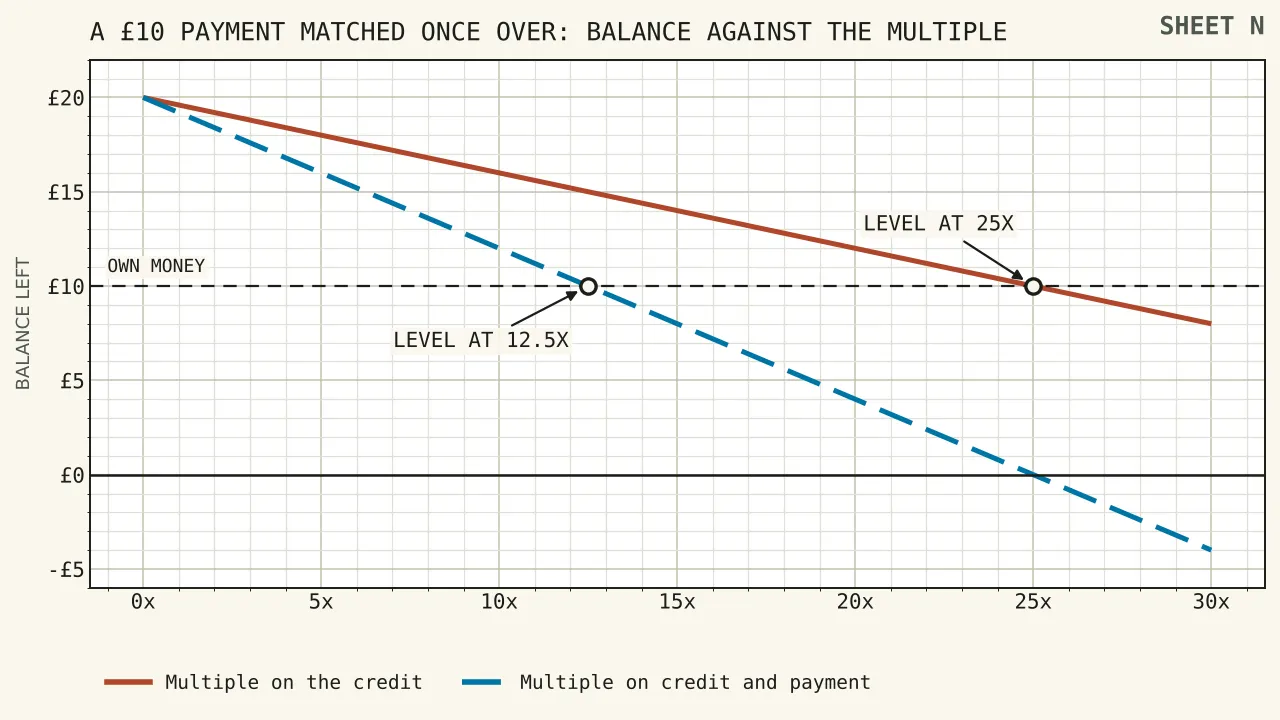
Here is the line in a set of terms that moves more money than the percentage does, and it is usually one clause long. A multiple can be applied to the credit, or to the credit plus the payment that earned it. The first is the common form. The second doubles the staking on a one-to-one match, and it moves the break-even.
Work it on a £10.00 payment matched once over, so the credit is £10.00 and the balance is £20.00. Set the multiple on the credit by itself and ten turnovers want £100.00 staked, costing £4.00. Set it on the pair and the same ten turnovers want £200.00, costing £8.00. Nothing in the headline changed.
| Turnovers | Staking asked | Expected cost | Balance left | Against the payment itself |
|---|---|---|---|---|
| Five | £100.00 | £4.00 | £16.00 | Six pounds ahead |
| Ten | £200.00 | £8.00 | £12.00 | Two pounds ahead |
| Twelve and a half | £250.00 | £10.00 | £10.00 | Exactly level |
| Fifteen | £300.00 | £12.00 | £8.00 | Two pounds behind |
| Twenty | £400.00 | £16.00 | £4.00 | Six pounds behind |
| Twenty-five | £500.00 | £20.00 | Nil | Ten pounds behind |
The third row is the crossing point of this section. On a one-to-one match with the requirement on the pair, twelve and a half turnovers leave a reader exactly where they started: the balance has fallen to the size of the payment they made, and the credit has been consumed entirely. Below that they are ahead. Above it they are paying for the privilege of having been given something.
The general form is worth having, because the crossing moves with the match rate. Where a requirement sits on the pair, the highest multiple that leaves a reader whole is twenty-five times the match rate divided by one plus the match rate. At fifty per cent that is 8.33 turnovers. At a hundred per cent, twelve and a half. At two hundred, 16.67. At three hundred, 18.75. At four hundred, twenty. Put the requirement on the credit alone and the answer is twenty-five in every case, whatever the match.
So the two clauses are not variants of one term. They are different offers, and the one that looks identical in a headline can halve the multiple a reader can afford. A reader who checks the percentage and skips the base has checked the number that does not change the ratio and skipped the one that does.
One honest limit on all of that. Bonus funds are what the published ceiling of ten turnovers is written about, and the regulator has put out no example dealing with a requirement that reaches the payment too. So the shape gets priced here, which is arithmetic, and whether the ceiling catches it goes unsaid, that being a claim about a rule nobody has made.
5
The staking, measured in presses and minutes
Pounds of staking are the obligation; presses and minutes are what serving it feels like. Both conversions are fixed by the assumptions at the top of this page, so they can be stated once and reused.
| Staking asked | Presses at 10p | Time at the licensed interval |
|---|---|---|
| £50.00 | Five hundred | Twenty minutes fifty seconds |
| £100.00 | One thousand | Forty-one minutes forty seconds |
| £200.00 | Two thousand | One hour twenty-three minutes |
| £300.00 | Three thousand | Two hours five minutes |
| £400.00 | Four thousand | Two hours forty-seven minutes |
| £500.00 | Five thousand | Three hours twenty-eight minutes |
That interval belongs to the licensed side, where a slot waits 2.5 seconds before permitting the next cycle, putting a thousand presses at 2,500 seconds or more. No rule fixes that interval once a British licence has gone, so an identical obligation can be served quicker at precisely the same cost. Duration is what speed moves. The bill it leaves alone.
Those times matter for one reason beyond patience, which is that a clock sits on most of these offers. Where a credit has to be cleared inside a window, the window has to be long enough for the presses, and a window shorter than the obligation forfeits whatever is left. That is not a cost in the sense parts 2 and 4 use. It is the whole credit, and it is why several notes under this heading end on a clock rather than on a figure.
One published duty helps a reader keep track while it happens. Since 17 January 2025 the licensed side has had to put net spend and time spent gambling in front of a customer as it accrues. A running total is what that offers, not a limit on one, and among the duties collected across this site very few hand over a figure during a spend-down rather than before it or after it.
6
Thirteen notes, sorted by their headline
These notes divide by what the headline names, because that decides which of the figures above a reader has to supply for themselves.
Five name a percentage, and part 3 is the arithmetic they share. 100% deposit bonus is the match that doubles a balance and prices its own clearing. 200% deposit bonus is the page that asks ten times of what, exactly, which is part 4’s question. 300% deposit bonus turns three pounds of credit into thirty of turnover. 400% deposit bonus is really a timetable, since £800.00 of staking is eight thousand presses. And Casino welcome bonus takes an upper bound dressed as a quantity and prices it at each rung in turn.
Six name a payment and a count of presses together, which fixes both ends of the arithmetic. Deposit five pounds, take a hundred free spins, no wagering runs into the bottom denomination, a five pound minimum being unbuyable. Deposit £5, take 200 free spins carries the heaviest face per pound asked anywhere under this heading, and the ladder halves it. Deposit ten pounds, take a hundred free spins is the one shape where a press costs a reader exactly what a press is worth. Deposit ten pounds, take two hundred free spins, no wagering strikes the play-through out and finds three draws still on the face. Deposit £10, get 300 free spins puts 2 hours 5 minutes behind a thirty pound face. And 120 free spins for real money turns on which ledger the winnings land in.
Two name a product rather than a figure, and the product decides which rules apply. Bingo sign up bonus counts in tickets, so a two hundred pound requirement is two thousand tickets. Slots sign up bonus is the one product where every design rule on the licensed side bites at once.
| The group | Given in the headline | To be found in the terms |
|---|---|---|
| A percentage | The ratio of credit to payment | The multiple, and its base |
| A payment and a count | Both ends of the face | The price of one press |
| No wagering stated | That the multiple is nought | The clock, and the payout floor |
| A product | Which rules reach it | The unit it is counted in |
7
Seven headings, and this one’s place
Seven questions get asked of a prepaid face across this site, and this heading holds the third. The table below places the others, with what each one contributes to the bill above.
| Heading | Asks about | Supplies to this bill |
|---|---|---|
| The face | The printed figure | The credit the multiple applies to |
| The rung | Fixed denominations | The payment that earns a match |
| This one | Clearing the credit | Four hundredths of the multiple |
| The stranded part | Caps and forfeitures | A ceiling over what survives |
| The way out | Leaving with it | A floor under what survives |
| Off the register | A missing licence | Whether the multiple is capped |
| The room | Where it is spent | The weighting, which divides the staking |
The room is the one that can overturn everything on this page. Every figure in parts 2 to 5 assumes each pound staked counts a full pound towards the requirement. Where it counts less, the staking rises by the reciprocal of the weighting while the credit stays where it was, and the expected cost rises with it. That is the single assumption most worth checking before using any figure here.
8
What is published, and what is not
Three things under this heading rest on published rule. First the ceiling of ten turnovers, live on the licensed side from 19 January 2026, whose object is defined for it: wagers a customer must make to a stated total before funds turn withdrawable. Second the ban on mixing products, with its three carve-outs. Third the duty, from 17 January 2025, to put net spend and elapsed time in front of a customer as they accrue.
Four things go unpublished and no note here supplies them. A free press has no stated value, so the 10p throughout is an assumption for moving rather than a figure for asserting. No contribution table is published, which is why a weighting is a parameter here. Nobody states whether the ceiling treats a free press as bonus funds, so these notes go only this far: a requirement on winnings from one, once they reach a bonus balance, is capped at ten times. And a requirement reaching the payment as well has no published example against it, which part 4 states outright.
One regulator’s figure is worth carrying, since it shows what the ceiling displaced. Some licensees were running multiples as high as sixty times, on its own record. Feed sixty into part 2 and a £25.00 credit is expected to end £35.00 beyond itself, which is a reader’s own funds going rather than a bonus failing.
And the usual refusals. No counter gets a payout speed here, no promotion code appears, and nothing here concerns an account somebody has closed against their own future self. Taking part in the national exclusion scheme is one condition attached to a British licence, and the scheme reports of itself that whoever stands outside it is past its reach. One helpline costs nothing and answers at every hour, with its number in the care note under this page.
Questions
- What does clearing a credit cost?
- Four hundredths of the multiple times the credit, and nothing besides. Against £25.00 that reads £10.00 at ten turnovers, £15.00 at fifteen, £20.00 at twenty, and the entire £25.00 by twenty-five. Press counts, sitting lengths and the size of any win along the way all drop out of the arithmetic.
- Why does twenty-five consume the whole credit?
- Because the bill is proportional to the credit and the credit is the only thing standing against it, so the ratio depends on the multiple alone. Four hundredths fits into one exactly twenty-five times, which is where the bill reaches the size of the thing it is charged on, whatever that thing was.
- Does a larger percentage match improve anything?
- Not the ratio. Ten pounds of staking buys one pound of credit at fifty per cent, at a hundred, at two hundred, at three hundred and at four hundred. The bigger headline issues more credit, demands proportionally more staking and costs proportionally more to clear, so it is a larger version of the same deal.
- Which clause matters more than the percentage?
- The one naming what the multiple applies to. Put it on the credit alone and the break-even stays at twenty-five turnovers whatever the match. Put it on the credit plus the payment and the break-even becomes twenty-five times the match rate over one plus the match rate: 8.33 at fifty per cent, twelve and a half at a hundred, twenty at four hundred.
- What happens at twelve and a half turnovers on a one-to-one match?
- Where the requirement sits on the pair, a reader ends exactly where they started. The balance has fallen to the size of their own payment, the credit has been consumed entirely, and £250.00 of staking has been served to get there. Below that multiple they are ahead; above it they are paying to have been given something.
- Is a requirement on the payment plus the credit capped?
- Unpublished, and no guess will be made here. The ceiling’s written subject is bonus funds, and no published example deals with a requirement reaching the payment too. The shape therefore gets priced, that being arithmetic, while whether the ceiling reaches it goes unclaimed, that being a statement about a rule nobody has made.
- How long does the staking take?
- At 10p a press, with 2.5 seconds between cycles on a licensed slot, £100.00 of staking is a thousand presses and 41 minutes 40 seconds. Two hundred pounds is an hour and twenty-three minutes. Five hundred is three hours twenty-eight. That interval is fixed by no rule once a British licence has gone, so the obligation can be served quicker at exactly the same cost.
- What does a clock on an offer actually forfeit?
- Whatever is left when it runs out, which is the whole credit where the window is shorter than the obligation. That is not a cost in the sense the tables above use, because nothing was staked to produce it, and it is why several of these notes end on a clock instead of a figure.
- Can an offer mix products?
- Not on the licensed side, where free presses beside a match stay within casino and bingo tickets beside a match reach into a second product. Three carve-outs are published all the same. Pairing two products of a single type is permitted. Two offers may share an email where marketing was opted into for each. And a credit a customer may put on whichever product they fancy is untouched.
- How high were multiples before the ceiling?
- Sixty times, at the furthest, on the regulator’s own record. Sixty turnovers carry a £25.00 credit £35.00 beyond itself and a £100.00 credit £140.00 beyond itself, each of those being a reader’s own money expected to go rather than a bonus failing to pay.
- What can a reader see while it is happening?
- Net spend and elapsed time, as they accrue, on the licensed side since 17 January 2025. A running total is shown rather than capped, and among the published duties collected here very few hand a reader a figure during a spend-down instead of before one or after one.
- Which assumption here is the riskiest?
- The weighting. Every figure in parts 2 to 5 assumes each pound staked counts a full pound towards the requirement. Where it counts less, the staking rises by the reciprocal of the weighting while the credit stays put, and the expected cost rises with it. The section on where a credit must be spent exists for exactly that reason.