Note X06 Revision 1 Terms read 16 October 2026
Bitcoin slots: two bills, one of them charged by the hour
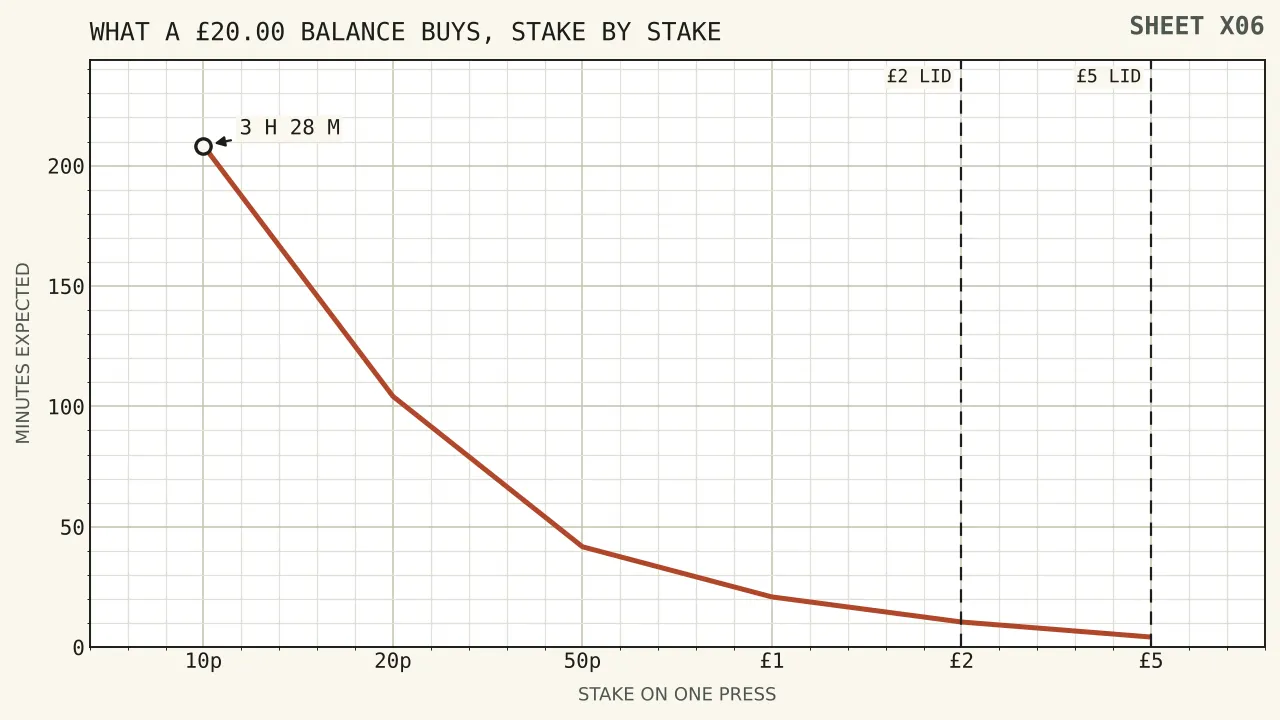
A balance of £20.00 is expected to last 3 hours 28 minutes 20 seconds at 10p a press and 4 minutes 10 seconds at £5.00 a press, a difference of fifty times, with the pace and the game identical in both. That is the first bill, and it arrives by the hour. The second is the payout charge, £1.25 here, which buys thirteen minutes of play at the small stake and 15.6 seconds at the large one. Raise a payout floor from £10.00 to £15.00 and the twenty pound denomination moves across into the group handing back nothing.
The face £25.00 of credit What draws it down 2,500 presses, £10.00 What is stranded £11.25, or 45 per cent
What a face of this size is worth
Every destination on this rack is bought advertising. The site takes a fee if a reader goes on to register, and no figure printed below moves because of it.
Face and Residue
Strip No 01
Betportal
Ceiling as a multiple
Priced at this site's own 10p a spin
What is printed
What draws it down
What is stranded
No Great Britain licence
Licensed in Anjouan, Comoros, run by BetPortal Gaming Ltd, with Excite Ultra Media Ltd, reference ALSI-202601040-FI2.
Terms read 16 October 2026
Open the offer at Betportal, opens in a new tabFace and Residue
Strip No 02
WinBeast
Ceiling as a sum
Priced at this site's own 10p a spin
What is printed
What draws it down
What is stranded
No Great Britain licence
Licensed in Curaçao, operator not named on the site.
Terms read 16 October 2026
Open the offer at WinBeast, opens in a new tabFace and Residue
Strip No 03
EliteSpin
Longest spin window
Priced at this site's own 10p a spin
What is printed
What draws it down
What is stranded
No Great Britain licence
Licensed in Costa Rica, run by PrimeTier Limited.
Terms read 16 October 2026
Open the offer at EliteSpin, opens in a new tabFace and Residue
Strip No 04
Crown Jewelz
Multiple unpublished
No residue struck
What is printed
What draws it down
What is stranded
No Great Britain licence
Licensed in Curaçao, number not verified, operator not named on the site.
Terms read 16 October 2026
Open the offer at Crown Jewelz, opens in a new tabThe two figures in the second and third registers are this site's own arithmetic and nothing an operator has published: the face as printed, less the share a spin gives back at 96 per cent return to player, less what playing the wagering through costs at the same return, and then less whatever a published ceiling, a charge on the way out or a floor on the smallest withdrawal takes off what survives that. The residue is what is left of the face when all of it is accounted for. It describes the offer, not one reader's afternoon. Where the conditions price above the face the strip prints nothing coming off rather than a negative sum, and where a figure the sum needs is unpublished it prints the condition in the operator's words instead.
A face paid as spins has no unit of its own, so one is supplied. Where an operator publishes what a spin of its own is worth, that figure stands in the first register's own line and is labelled as theirs. Where it does not, this site's own 10p a spin stands there and says so, and every figure below moves in proportion: at half the price, half the money. The share of the face that does come off is also given as pence in the pound, which is the figure that compares a large face against a small one.
Money goes onto a prepaid voucher in fixed denominations, so a smallest deposit published in pounds is rounded up to the first rung of the ladder this site works in, £10, £20, £25, £50, £75 and £100, and the strip prints what that rounding strands. That is the reader's own money and it is never netted into a residue. A smallest deposit published in euros is printed as the operator publishes it, because the ladder here is a sterling one and rounding a euro sum to it would be an invented figure.
Three words stand in the amount column where no figure can. Noted is a published condition that takes value away without leaving the sum a figure to take. Unpriced is a condition whose figure nobody has published, or a credit that is not a sum until a deposit of your own sets it. Own money is money of yours, which is never part of a residue.
Not one of the operators printed above holds a Great Britain licence, so the duties that licence carries do not reach them. All online gambling companies licensed in Great Britain must be part of Gamstop Online, and a reader who has shut themselves out through the scheme is therefore not shut out here. The ceiling of ten times the bonus funds on a wagering requirement, in force since 19 January 2026 under Social Responsibility Code 5.1.1, is a condition of that licence and binds the companies that hold one. On an unlicensed site the Gambling Commission describes consumers as facing unfair gaming practices, financial loss and a lack of recourse if things go wrong, and it names blocked payouts and withdrawal limits set so high they are unattainable among what it has seen. Nobody under 18 may hold an account at any of them.
Every term printed on a strip is the operator's own, and each strip carries the day it was read. The oldest of those readings is 16 October 2026. What binds a reader is the operator's own full terms, and not a line printed here.
1
One reel, two separate bills
Two bills arrive on a page like this and readers tend to notice only the smaller one. The reel bills by the hour, and the rate is set by the stake. The exit bills by the event, and the rate is set by the terms. Of the two, the hourly one is larger by a wide margin at every stake above a few pence, and it is the one nobody advertises.
The arithmetic behind the hourly bill is four pence in every pound staked, which is what a game returning 96 pence keeps. Multiply that by the stake and by the number of presses in an hour and the rate appears. At 10p a press and 1,440 presses in an hour, it is £5.76. At £5.00 a press, the same 1,440 presses cost £288.00. Nothing about the game has changed between those two figures.
Standing quantities, used here as everywhere on this site: a press of 10p where no other stake is named, a game handing back 96 pence in the pound, weighting at unity, and a ladder of six denominations topping out at £100.00 and starting at £10.00. Modelled for this page and flagged at each appearance: £1.25 a payout and a floor of £15.00. Parameters, not quotations, for the reason part 8 gives.
Price a reel in a unit instead of in pounds and it is standing at a counter holding no Great Britain licence, where what goes missing is mostly about the reel rather than about the payment. The stake runs uncapped. So does the interval from one press to the next. Automatic play is unaddressed, so is any device for cutting short the wait before a result, and so is the dressing up of a return that fails to exceed the stake. Parts 3 and 6 set a figure against each.
| The bill | What sets the rate | What a reader controls |
|---|---|---|
| The reel, by the hour | The stake, and the gap between presses | The stake, and how long they sit |
| The exit, by the event | A figure in the terms | How often they take money out |
| The floor, once | A figure in the terms | Whether a balance ever reaches it |
| The play-through, once | A multiple in the terms | Nothing, once the credit is taken |
2
How long £20.00 lasts, stake by stake
Take a balance of £20.00 and ask how many presses it is expected to survive. Each press is expected to cost four hundredths of the stake, so the answer is the balance divided by that, and the time is the press count multiplied by the gap between presses. Licensed slots keep a 2.5 second interval between cycles, and against that interval the figures come out as follows.
| Stake a press | Expected cost a press | Presses expected | Time at the licensed gap | Cost an hour |
|---|---|---|---|---|
| Ten pence | Four tenths of a penny | 5,000 | Three hours twenty-eight minutes | £5.76 |
| Twenty pence | Eight tenths of a penny | 2,500 | One hour forty-four minutes | £11.52 |
| Fifty pence | Two pence | 1,000 | Forty-one minutes forty seconds | £28.80 |
| One pound | Four pence | 500 | Twenty minutes fifty seconds | £57.60 |
| Two pounds | Eight pence | 250 | Ten minutes twenty-five seconds | £115.20 |
| Five pounds | Twenty pence | 100 | Four minutes ten seconds | £288.00 |
From the top row to the bottom one the stake climbs fifty times over and the expected life of the balance shortens fifty times over, 5,000 presses becoming 100. No coincidence and no quirk of one game lies behind that. The expected cost of a press is proportional to the stake, so the number of presses a fixed sum buys is inversely proportional to it, and every one of those rows is the same arithmetic with one number changed.
The fourth column is the one worth sitting with. Three and a half hours and four minutes are both descriptions of what £20.00 buys. The difference between them is a decision made before the first press, and it is a decision most readers will describe as how much they are betting rather than as how long they are buying.
One more figure from the same table. Staking a £20.00 balance once over takes 200 presses at 10p and 4 presses at £5.00, which is 500 seconds against 10 seconds at the licensed gap. A play-through of ten turnovers on a £20.00 credit therefore means 2,000 presses and 83 minutes at the small stake, and 40 presses and 100 seconds at the large one. The obligation is identical in pounds. The experience of serving it is not remotely similar.
5,000 presses or 100, on the same £20.00 balance
3
What the stake caps are caps on
British stake caps exist, they are narrower than most readers assume, and their effect is best understood through part 2’s table. They cap the bottom row off entirely.
They arrive in a statutory instrument, the 215th of 2025, made on 25 February that year, which hangs a condition on each remote casino operating licence and reaches back to licences granted before it. The table below is what it says, with the calendar beside it.
| Per game cycle | Whose stake | Live from | Where the date comes from |
|---|---|---|---|
| £5.00 | An individual of 25 or more | 9 April 2025 | The regulator’s guidance |
| £2.00 | An individual under 25 | 21 May 2025 | The same guidance |
| £5.00 flat | Everybody, for six weeks | The gap between the two | A transitional regulation |
Six weeks separate the two dates because a transitional regulation held a flat £5.00 over everybody in between. The instrument prints no calendar date of its own, giving a formula instead, so both dates above come from guidance rather than from the statute.
| The cap | Who it covers | Hourly cost it rules out | Shortest life it allows a £20.00 balance |
|---|---|---|---|
| Five pounds a cycle | Twenty-five and over | Above £288.00 | Four minutes ten seconds |
| Two pounds a cycle | Eighteen to twenty-four | Above £115.20 | Ten minutes twenty-five seconds |
| No cap | Where no British licence is held | Nothing ruled out | As short as the stake allows |
Two points of scope get misreported and both matter here. First, these figures reach online slots and no other game. The instrument’s own definition makes an online slots game a casino game both reel-based and played online, and reel-based in turn means a game putting up text or pictures which shift or alter, through drawings of reels or by some other route, the arrangement reached deciding whether a prize or any other advantage falls to the player. Guidance from the regulator says as much directly: online slots only, with a wheel and a card table given as instances of what lies outside.
The second is that a cap on the stake is not a cap on the loss. At £5.00 a cycle and the licensed 2.5 second gap, an hour of play is expected to cost £288.00, and that figure sits inside the rules rather than outside them. The cap removes the rows beneath four minutes ten seconds from part 2’s table and leaves everything above them in place. A reader who reads a stake cap as a spending limit has read it as something it is not.
Away from the British licence neither figure applies, and the table’s bottom row is where the arithmetic goes. There is no published distribution of stakes offered off that register, so this note gives none; what it can say is that the ceiling in the first two rows is a British rule and the third row is what its absence permits.
4
A payout charge, in minutes of reel
Now the second bill, converted into the units of the first. A payout charge of £1.25 is worth whatever length of play has the same expected cost, and that length depends entirely on the stake.
| Stake a press | Presses it equals | Time it equals |
|---|---|---|
| Ten pence | Three hundred and thirteen | Thirteen minutes |
| Twenty pence | One hundred and fifty-six | Six and a half minutes |
| Fifty pence | Sixty-three | Two minutes thirty-six seconds |
| One pound | Thirty-one | Seventy-eight seconds |
| Two pounds | Sixteen | Thirty-nine seconds |
| Five pounds | Six | Fifteen point six seconds |
So the payout charge is a substantial sum to a reader at 10p and a rounding error to a reader at £5.00. Thirteen minutes of reel is a real session at the small stake. Fifteen and a half seconds is six presses. The same £1.25, read against the two bills, is 3.9 per cent of what the hour costs at the top stake and 21.7 per cent of what it costs at the bottom.
Which inverts the usual advice about exit charges. A fixed charge is dearest, as a share of the money moved, to the reader moving the smallest sums. It is also dearest, as a share of the money being lost, to the reader staking the smallest amounts. Both readers are the same person, and the charge hits them twice from different directions.
Expressed as credit rather than as cash, the same £1.25 costs £2.08 at ten turnovers, £2.50 at twelve and a half, £3.12 at fifteen, £6.25 at twenty and £31.25 at twenty-four, because covering it means earning it through the play-through first. At twenty-five turnovers no amount of credit covers it, the share surviving having closed to nothing.
And the count of exits is a reader’s own decision, which makes it the one figure on this page that answers to a habit rather than to a rule. Twelve payouts a year at £1.25 is £15.00, which is exactly the floor modelled on this page and one and a half times the bottom denomination. Fifty-two of them is £65.00. How much money moved has no bearing on either figure, and both shrink if the same money moves in fewer pieces.
5
Fifteen pounds of floor, and who fails it
Run the six denominations through a £15.00 floor and a £1.25 charge. The survivor is the credit multiplied by the share surviving, the floor test runs first, and the charge comes off whatever passes.
| Credit | Turnovers | Survivor | Against the floor | Banked | Residue as a share |
|---|---|---|---|---|---|
| £10.00 | ×10 | £6.00 | Under by £9.00 | Nil | All of the credit |
| £20.00 | ×10 | £12.00 | Under by £3.00 | Nil | All of the credit |
| £25.00 | ×10 | £15.00 | Equal to it | £13.75 | 45.00 per cent |
| £50.00 | ×10 | £30.00 | Clear by £15.00 | £28.75 | 42.50 per cent |
| £75.00 | ×10 | £45.00 | Clear by £30.00 | £43.75 | 41.67 per cent |
| £100.00 | ×10 | £60.00 | Clear by £45.00 | £58.75 | 41.25 per cent |
| £25.00 | ×15 | £10.00 | Under by £5.00 | Nil | All of the credit |
| £50.00 | ×15 | £20.00 | Clear by £5.00 | £18.75 | 62.50 per cent |
| £75.00 | ×15 | £30.00 | Clear by £15.00 | £28.75 | 61.67 per cent |
Of the six denominations, a pair hands back nothing at ten turnovers, and the second of that pair is the interesting one. Twelve pounds of expected survivor against a £15.00 floor is a miss of £3.00, a fifth of that floor, and three fifths of one press at the highest licensed stake. Lower the floor to £10.00 and that same denomination pays. So the £5.00 by which the floor moved cost a reader £10.75 of banked money on the twenty pound step, and nothing at all on the three steps above it.
That is the general shape of a floor and it bears repeating because it is counter-intuitive. A floor does not cost everybody a little. It costs a few readers everything and the rest nothing, and which group a reader lands in is decided by a denomination chosen before any of the arithmetic began.
Reversed, the smallest credit that can be expected to produce a payable balance beneath this floor is £18.75 at five turnovers, £25.00 at ten, £30.00 at twelve and a half, £37.50 at fifteen and £75.00 at twenty. Two of those are denominations exactly: the twenty-five pound step answers ten turnovers to the penny and the seventy-five pound step answers twenty. Both of them then lose £1.25 to the charge and arrive under the floor they just matched, which is the order of operations doing its usual work.
£3.00 short, and the whole £20.00 denomination is stranded
6
Rules about honesty rather than cost
A separate set of British rules governs how a reel may behave, and none of them is about money. They are about whether what a player sees matches what is happening, and they are the part of a licence hardest to replace with arithmetic, because a reader cannot test any of them from the outside.
| The subject | The rule | Why it matters to a figure |
|---|---|---|
| Outcomes | Acceptably random, and no compensated game | The 96 pence assumption means nothing otherwise |
| Random numbers | Used in the order received, none discarded | Same again, from the other direction |
| A near miss | No substituting one for a loss | Changes a belief rather than the odds |
| A simulated device | Must simulate the real probabilities | A wheel on a screen has to behave like a wheel |
| Rules in play | Not changed mid-game, and changes flagged | A term letting rules change at any time fails |
| The result | Shown clearly, and for long enough | An unseen result is an uncheckable one |
| A return no bigger than the stake | No celebrating it | Ten pence back off ten pence staked is not a win |
| Two games at once | Functionality for it is not permitted | Doubles the hourly rate without doubling the stake |
Three of those rows carry figures this page already has. The bottom one doubles the hourly bill from part 1, since two reels turning at once at 10p a press cost £11.52 an hour where one costs £5.76, and what prevents it on the licensed side is a bar on the operator providing functionality for several products at once, live from 17 January 2025. The celebration row names the case this site keeps running into: ten pence handed back off ten pence staked, a gain of nothing, which may not be dressed as a win. And the near-miss row is the one rule on the list aimed at a belief rather than a balance, which is exactly why somebody wrote it down.
Anybody using the figures on this site should look hardest at the random-outcome rules, because every calculation here stands on them. Four pence in the pound is the expected cost of a press at a game handing back 96 pence on average and making no adjustments to itself along the way. A compensated game, one shifting its probabilities according to what has already happened, does not tilt that arithmetic but destroys it, and the British standard shuts out intervention of that sort whether it is automatic or done by hand. The same standard asks that outcomes fall out in accordance with the theoretical probabilities, and that requirement is what makes a published return something a figure can be built on at all.
Off that licence the rules above are not softened. They are missing. Read the responsible gaming document of the offshore jurisdiction this site goes through most closely and there is no interval required between cycles in it, no bar on play running automatically, nothing against a hurried result and nothing on the presenting of a small one. Pulling those absences out of a document anybody can open beats any adjective, and it is the one honest way to report what is not there.
7
What a game has to tell a player
One duty on the licensed side gets misdescribed more than any other on this subject, and getting it right matters because every figure on this page depends on a return percentage.
Information good enough to let a customer judge their own chances has to be easy to reach before they commit to gamble. Satisfying it can be done in any single way out of the four set out below, the connector between them being the word or rather than the word and. Guidance beside the standard adds that a percentage given there should be the average theoretical return.
| What is published | Can this site build a figure on it? |
|---|---|
| A return percentage | Yes, directly |
| A house edge or margin | Yes, as one minus the return |
| Probabilities of winning events | Only with the prize sizes alongside |
| The workings, and how prizes get handed out | No, not as a number |
A licensed game can therefore meet the duty with no percentage printed anywhere, and a page insisting that a licensed site must print one has misread the standard. Where players play one another, an account of the workings plus how a winner is settled is recorded as enough; bingo and certain lottery games need only an account of the route by which prizes reach people. One practical consequence runs through this site, which is that 96 pence in the pound is an assumption stated out loud rather than a figure reported from anywhere, and a page about one particular game takes the figure that game publishes and names the version it read.
Two neighbouring duties finish the picture. Rules have to be explained somewhere easy to reach before a commitment to gamble, accurately, completely enough to cover all of them, and in terms a reader can follow. Potential prizes and payouts have to be described on the same footing, or else the method that arrives at them. Nothing further follows in that group, which is worth knowing because it is occasionally cited as though it ran on past the fourth item.
None of those duties reaches a counter without a British licence, which is why the honest form of every figure on this page is the one used throughout: a stated assumption, moved to show what depends on it. Four pence in the pound is an assumption. The £1.25 charge is an assumption. The £15.00 floor is an assumption. The ladder of denominations is fixed by the instrument in the domain, and the turnover arithmetic is fixed by arithmetic.
8
The absence, priced, and the omissions
Price the missing ceiling on the twenty-five pound denomination, which is the one this page’s title block uses. At ten turnovers it is expected to leave £15.00, meet the floor exactly and bank £13.75. At fifteen the survivor is £10.00, and the floor holds all of it. At twenty the survivor is £5.00, held again. Forty turnovers are expected to run £15.00 clear past where the credit ends. Ten turnovers is where a British licence sets its ceiling, so across one twenty-five pound credit the distance from the capped case to the uncapped one is £13.75 banked at one end and £15.00 gone at the other.
Four official statistics give the scale of the licensed market this all stands beside, each carrying a period and a release date. April 2025 to March 2026 is the period covered, and the release carries a date of 17 September 2026. Remote casino with betting and bingo together returned £8.3bn of gross gambling yield; online casino games accounted for £5.7bn of it; slots by themselves accounted for £4.8bn; and the market as a whole came to £17.5bn. Each of those describes the licensed market, and because the sector is reported in one block no count of remote casino operators can be lifted out of them.
Now the omissions, all deliberate. How stakes are distributed away from the British register is unpublished by anybody citable here, which is why the last row of part 3 carries no figure of its own. Both the payout charge and the floor are parameters, named as such at every use, since no published distribution stands behind either. No payout speed appears for any counter and no promotion code. This note identifies no method that a counter will take, going in or coming out, and runs no comparison between methods at counters lacking a British licence.
And nothing on this page helps anybody reach a reel they have shut themselves out of. The national exclusion scheme covers every company holding a British licence, that being a condition of the licence, and the scheme states plainly that it cannot prevent access to companies which do not take part. Where a reader wants the blocking software, the free British route to it, and the registration periods, those sit in the section of this site about faces priced outside the register, and the helpline number is in the care note under this page.
One last figure, because it closes the loop between the two bills in part 1. A reader at 10p a press who takes one payout a month pays £15.00 a year in charges, which is 2 hours 36 minutes of reel at that stake. A reader at £5.00 a press who does the same pays the identical £15.00, which is 3 minutes 7 seconds of reel. The charge did not change. The reader’s own rate of spending did, by a factor of fifty, and that factor is the whole of what the stake decides.
Questions
- How long does £20.00 last on a reel?
- It depends entirely on the stake, and by a factor of fifty across the range. At 10p a press the expectation is 5,000 presses, which is 3 hours 28 minutes 20 seconds at the licensed gap between cycles. At £5.00 a press it is 100 presses and 4 minutes 10 seconds. The game and the pace are identical in both.
- What does an hour at a reel cost?
- Four pence in every pound staked, which at 1,440 presses an hour comes to £5.76 at 10p a press, £57.60 at a pound, £115.20 at two pounds and £288.00 at five. The expected cost per press is four hundredths of the stake, so the hourly rate is simply the stake multiplied by 57.6.
- Do British stake caps limit what a player can lose?
- No, and the distinction is sharp. They cap the stake inside one game cycle at £5.00 for somebody of 25 or over and £2.00 for somebody under that age. At £5.00 and the licensed gap, an hour of play is still expected to cost £288.00, which is inside the rules rather than outside them.
- Which games do the caps cover?
- Online slots alone. The instrument’s definition wants a casino game both reel-based and played online, and reel-based means text or pictures shifting and altering, drawn as reels or not, whose settled arrangement decides any prize. Guidance states directly that other casino games lie outside, a wheel and a card table being its instances.
- When did those caps start?
- The 215th statutory instrument of 2025, made on 25 February that year, gives a formula where a reader wants a date. Guidance supplies the calendar instead: 9 April 2025 for the £5.00 figure, then 21 May 2025 for the £2.00 one, the six weeks between them being a transitional period during which a flat £5.00 applied to everybody.
- What is a payout charge worth in play?
- Thirteen minutes of reel at 10p a press, and 15.6 seconds at £5.00 a press, for the same £1.25. So the charge is a real sum to a small-stake reader and a rounding error to a large-stake one, which is the opposite of how a fixed charge is usually described.
- How much credit does £1.25 of charge cost?
- More than £1.25, the play-through having to be served before it can be covered: £2.08 at ten turnovers, £2.50 at twelve and a half, £3.12 at fifteen, £6.25 at twenty and £31.25 at twenty-four. At twenty-five turnovers no credit covers it at all, the surviving share having closed to nothing.
- Which denominations fail a £15.00 floor?
- Two of the six, at ten turnovers. Six pounds is what the ten pound step leaves and twelve is what the twenty pound step leaves, and a floor of £15.00 holds both in full rather than trimming either. The twenty-five pound step matches the floor exactly and banks £13.75 once the charge comes off, which is under the floor it just matched.
- What did raising the floor by £5.00 cost?
- Ten pounds seventy-five on the twenty pound step and nothing on the three steps above it. That is how a floor behaves: it takes everything from a few readers and nothing from the rest, and which group a reader is in was settled by the denomination they bought before any of the arithmetic started.
- Does a licensed slot have to print its return percentage?
- No, and the point is misreported constantly. Chance information has to be easy to reach ahead of any commitment to gamble, and the standard lists four routes to that, connected by or rather than and. An account of the workings is one. A margin is another. A percentage handed back is a third. Fourth comes the chance of a winning event turning up. Any one of them will do.
- Can a win equal to the stake be celebrated?
- Not on a licensed system, where celebrating a return which does not beat the total staked is out, and so are the sounds and the animations that go with a win. Ten pence back off a 10p press is what the rule was drafted against: nothing gained, nothing lost, nothing to announce.
- Why are the floor and the charge on this page assumptions?
- Because payout floors and charges away from the British register lack a published distribution anywhere citable, the places carrying such figures being out of bounds here. So each is named as a parameter and moved, which is what parts 4 and 5 do. The sourced contrast is structural: a British licence caps a play-through at ten turnovers and the offshore document read for this site caps nothing.