Note G02 Revision 1 Terms read 16 October 2026
PayPal casino deposits: a rail with no rungs of its own
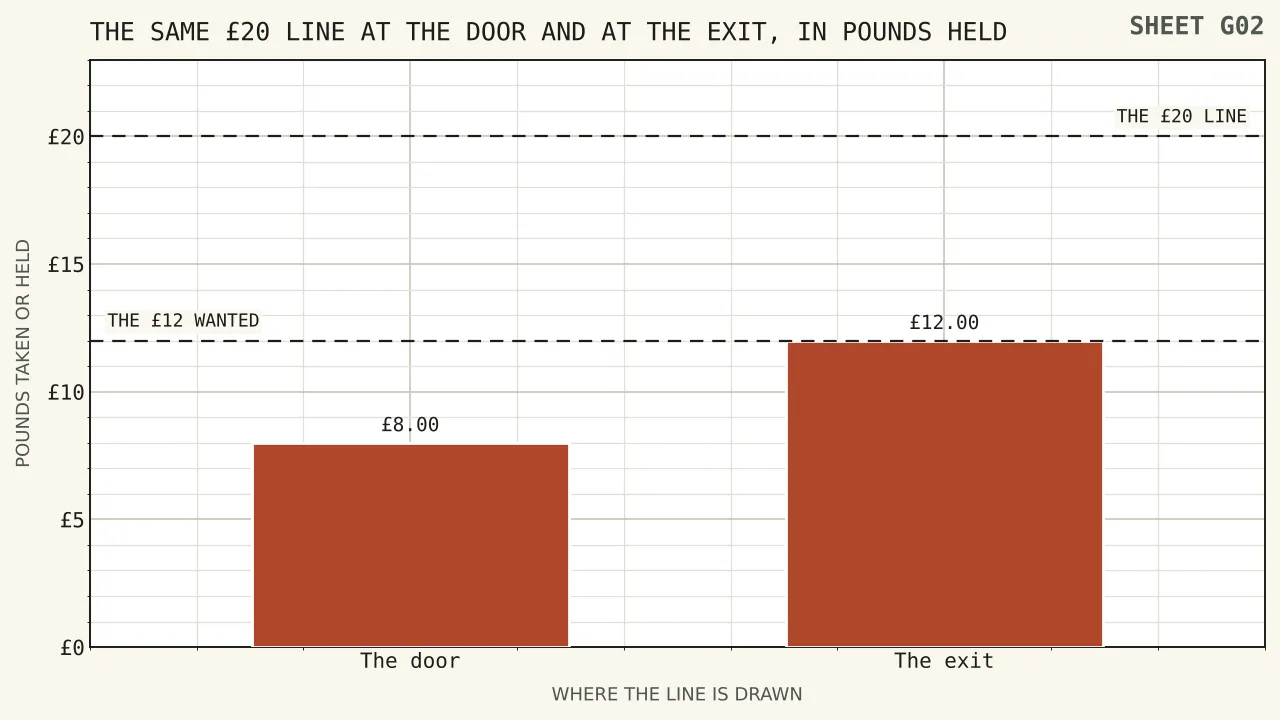
A wallet can send £12.00 to the penny. What it cannot do is make a counter accept £12.00 where that counter’s own floor is £20.00. On this rail the denominations belong to the counter rather than to the instrument, so £8.00 goes in unasked at the door, and the same £20.00 line drawn at the exit can hold £12.00 back in full.
The face £20.00 deposit What draws it down £8.00 in play What is stranded £12.00
Faces costed against a twenty pound counter floor
Every destination on this rack is bought advertising. The site takes a fee if a reader goes on to register, and no figure printed below moves because of it.
Face and Residue
Strip No 01
Betportal
Ceiling as a multiple
Priced at this site's own 10p a spin
What is printed
What draws it down
What is stranded
No Great Britain licence
Licensed in Anjouan, Comoros, run by BetPortal Gaming Ltd, with Excite Ultra Media Ltd, reference ALSI-202601040-FI2.
Terms read 16 October 2026
Open the offer at Betportal, opens in a new tabFace and Residue
Strip No 02
WinBeast
Ceiling as a sum
Priced at this site's own 10p a spin
What is printed
What draws it down
What is stranded
No Great Britain licence
Licensed in Curaçao, operator not named on the site.
Terms read 16 October 2026
Open the offer at WinBeast, opens in a new tabFace and Residue
Strip No 03
EliteSpin
Longest spin window
Priced at this site's own 10p a spin
What is printed
What draws it down
What is stranded
No Great Britain licence
Licensed in Costa Rica, run by PrimeTier Limited.
Terms read 16 October 2026
Open the offer at EliteSpin, opens in a new tabFace and Residue
Strip No 04
Crown Jewelz
Multiple unpublished
No residue struck
What is printed
What draws it down
What is stranded
No Great Britain licence
Licensed in Curaçao, number not verified, operator not named on the site.
Terms read 16 October 2026
Open the offer at Crown Jewelz, opens in a new tabThe two figures in the second and third registers are this site's own arithmetic and nothing an operator has published: the face as printed, less the share a spin gives back at 96 per cent return to player, less what playing the wagering through costs at the same return, and then less whatever a published ceiling, a charge on the way out or a floor on the smallest withdrawal takes off what survives that. The residue is what is left of the face when all of it is accounted for. It describes the offer, not one reader's afternoon. Where the conditions price above the face the strip prints nothing coming off rather than a negative sum, and where a figure the sum needs is unpublished it prints the condition in the operator's words instead.
A face paid as spins has no unit of its own, so one is supplied. Where an operator publishes what a spin of its own is worth, that figure stands in the first register's own line and is labelled as theirs. Where it does not, this site's own 10p a spin stands there and says so, and every figure below moves in proportion: at half the price, half the money. The share of the face that does come off is also given as pence in the pound, which is the figure that compares a large face against a small one.
Money goes onto a prepaid voucher in fixed denominations, so a smallest deposit published in pounds is rounded up to the first rung of the ladder this site works in, £10, £20, £25, £50, £75 and £100, and the strip prints what that rounding strands. That is the reader's own money and it is never netted into a residue. A smallest deposit published in euros is printed as the operator publishes it, because the ladder here is a sterling one and rounding a euro sum to it would be an invented figure.
Three words stand in the amount column where no figure can. Noted is a published condition that takes value away without leaving the sum a figure to take. Unpriced is a condition whose figure nobody has published, or a credit that is not a sum until a deposit of your own sets it. Own money is money of yours, which is never part of a residue.
Not one of the operators printed above holds a Great Britain licence, so the duties that licence carries do not reach them. All online gambling companies licensed in Great Britain must be part of Gamstop Online, and a reader who has shut themselves out through the scheme is therefore not shut out here. The ceiling of ten times the bonus funds on a wagering requirement, in force since 19 January 2026 under Social Responsibility Code 5.1.1, is a condition of that licence and binds the companies that hold one. On an unlicensed site the Gambling Commission describes consumers as facing unfair gaming practices, financial loss and a lack of recourse if things go wrong, and it names blocked payouts and withdrawal limits set so high they are unattainable among what it has seen. Nobody under 18 may hold an account at any of them.
Every term printed on a strip is the operator's own, and each strip carries the day it was read. The oldest of those readings is 16 October 2026. What binds a reader is the operator's own full terms, and not a line printed here.
1
An instrument that can pay any sum at all
Every other note in this section is about an instrument sold at fixed amounts. This one is the exception that proves what the rest are about, because a wallet holding a balance can pay out £3.47 or £11.08 as readily as it pays out £20.00. There is no denomination anywhere in it. The arithmetic of rounding ought therefore to vanish, and it does not vanish, and the reason is the whole subject of this page.
What an instrument sold at fixed amounts does is keep the problem outside the counter. A code bought at a set figure leaves its remainder on the code. A wallet has no remainder, so the one place a rounding loss can appear is the counter itself: in the smallest sum it agrees to receive, and in the smallest sum it agrees to pay back. Those two figures are the rungs on this rail, and nothing about the payment instrument touches either.
The sum worked throughout is a wanted deposit of £12.00 against a counter floor of £20.00. Both are modelling figures rather than facts about a business: no regulator publishes a minimum deposit, a minimum payout or a wallet charge anywhere in this site’s fact sheet, so each is declared here and then used consistently. £20.00 is the second step of the six denominations held across this site, which climb from £10.00 to £100.00 by way of £25.00, £50.00 and £75.00.
Two assumptions do the rest of the work, and both hold across every note here. A spin costs 10p. A game hands 96 pence back for each pound put through it, which leaves 4p behind per circuit, and 25 circuits of 4p exhaust the pound.
Hold on to the shape of what follows. At the door, £8.00 arrives beyond what was wanted, which is two fifths of the face. In the middle, a ten times requirement on a matched £20.00 has an expected cost of £8.00. At the exit, a floor of £20.00 holds a balance of £12.00 in its entirety. The sum the reader meant to put in and the sum that cannot come out are the same £12.00. That is a coincidence of these particular figures, and a very good way to remember what a floor does.
2
So the rung belongs to the counter
A floor on what a counter will receive behaves exactly like a denomination, with one difference that favours the reader and one that does not. In its favour: anything above the floor is payable to the penny, so the rounding bites once rather than at every step. Against it: the floor is set by the business taking the money, and it can sit anywhere at all.
Here is one wanted sum against six floors. The surplus column is money inside the account the reader had not meant to commit, and the share column says what proportion of the face that surplus is.
| Counter floor | Can it take £12.00 | Surplus committed | Reading | Share of the face |
|---|---|---|---|---|
| £3.00 | Yes, to the penny | £0.00 | No rung in the way | 0 per cent |
| £5.00 | Yes, to the penny | £0.00 | No rung in the way | 0 per cent |
| £10.00 | Yes, to the penny | £0.00 | No rung in the way | 0 per cent |
| £20.00 | No, it rounds up | £8.00 | The figure worked here | 40 per cent |
| £25.00 | No, it rounds up | £13.00 | Past half the face | 52 per cent |
| £50.00 | No, it rounds up | £38.00 | Above three times the intention | 76 per cent |
The top three rows are the point of the rail. Where a counter floor sits at or under the sum a reader wanted, a wallet strands nothing whatever, because it can pay the exact figure and no denomination intervenes. That is a real advantage over an instrument sold at fixed amounts, and it is worth stating plainly before the rest of this page takes it apart.
The bottom three rows are what happens when the floor rises above the intention. At £20.00 the reader commits two fifths more than planned. At £50.00 the commitment is more than three times the plan and 76 per cent of the money in the account was never meant to be there. No charge has been levied at any point in that table. The cost is purely a matter of where a line was drawn.
£12.00 wanted, £20.00 received, £8.00 committed by the floor alone
One further comparison belongs here, because it shows the rail’s real character. On a ladder of set amounts, a reader wanting £12.00 buys £20.00 and the remainder waits on a part-used code, outside the counter, needing a fresh decision before it can be gambled. On this rail that identical £8.00 is already a balance. The sum is the same; the distance between it and a reel is not.
3
The name on the wallet is the real price
What this rail charges is not money. It is identity, and a reader who has stored credentials once tends to forget that the stored name is now a term of the contract. Here is what the published rules ask for, in the order a reader meets them, with the figure each one carries.
| The requirement | Where it bites | The figure in it |
|---|---|---|
| Identity obtained and verified | A name, an address, a birth date, before a first spin | Three items |
| Bonus and demo play | Inside the same rule, not outside it | No carve-out |
| Why the check is made | Age, then exclusion status, then who the customer is | Three reasons |
| Papers at the payout | Not as the price of a withdrawal, where asking earlier was open | One exception |
| Which documents count | Passport, licence or household bill, among others | No fixed list |
| A payout held for want of papers | The identity condition may be breached by the hold | Condition 17 |
| Material for money-laundering checks | Asked for early, not saved up for the exit | Timing, not content |
| Away from the British licence | A birth date at sign-up, papers at a later milestone | Curaçao version 1.0 |
Row two is the one readers miss, and it governs this site’s whole subject. A credit that costs nothing to receive is still gambling, so the check runs ahead of it. Nothing is credited, nothing turns, and no expectation of £12.00 exists, until the documents clear.
Row three explains why a wallet in somebody else’s name is not a slow route but a closed one. If the check exists partly to find out whether the person in front of the counter has excluded themselves, then a stored credential belonging to a different person defeats the purpose of the check, and the business that accepted it has a problem rather than a customer.
Price that failure and the stake is obvious. On the clean run below, £12.00 survives a ten times requirement. Where the registered name on the wallet is not the account holder’s, that £12.00 is not paid late. It is unpayable to that wallet, and the residue is the entire balance rather than a percentage of it.
Two dates belong beside the table. That consumer guide dates from 23 September 2020, with one revision on 13 April 2022, so the live obligation is the condition and not the guide. The extension to bonus and free-to-play games was announced on 7 February 2019 for commencement on 7 May, with no year printed, and its own date makes 7 May 2019 the single available year. Before that announcement, 72 hours was the allowance for finishing an age check.
Row eight is the offshore comparison, and it runs one way only. Under that policy an operator need only be satisfied the player has turned 18: a birth date at sign-up, plus a tick box, a payment method and open source checking where those can be managed. Identification issued by a government waits for a later money-laundering milestone, and comes forward only where age is doubted already. So money can be credited and spun there with nothing seen, and the document check waits at the exit, which is the single place the British rules will not let it wait.
4
Twenty pounds through four multiples
Suppose the floor has done its work and £20.00 sits in the account against an intention of £12.00. A percentage match at 100 per cent now places a second £20.00 beside it, and from that moment the two sums are governed by different rules.
The deposited £20.00 remains the reader’s and a licensed counter cannot ration what comes off it. The matched £20.00 is bonus funds, and ten times those funds is the British ceiling on a play-through, binding since 19 January 2026. Ten times £20.00 is £200.00 to be staked. Four pence of each pound staked is the edge, which prices that obligation at £8.00 and leaves £12.00 expected to come through it.
| Multiple | Staking asked | Where the figure comes from | Expected cost | What survives | Cycles at 10p |
|---|---|---|---|---|---|
| Ten times | £200.00 | The British ceiling | £8.00 | Three fifths | 2,000 |
| Twenty times | £400.00 | Twice the ceiling | £16.00 | One fifth | 4,000 |
| Twenty-five times | £500.00 | The reciprocal of the edge | £20.00 | Nothing at all | 5,000 |
| Forty times | £800.00 | This site’s own assumption | £32.00 | Nothing, and £12.00 past it | 8,000 |
Sixty times was the figure some licensees were applying before that ceiling arrived, and it is the regulator’s own number rather than this site’s. What the ceiling did not touch is weighting, which survived it. Where a game counts 30 pence of each pound staked towards a requirement, ten times becomes 33.33 times in effect, which is past the point at which anything is expected to survive. A ceiling can hold at ten while the arithmetic goes elsewhere.
The time behind the first row is the figure nobody prices. Two thousand cycles, taken at the 2.5 seconds a licensed slot must leave between game cycles, occupy 5,000 seconds. That is 1 hour 23 minutes 20 seconds of unbroken play to clear a requirement whose expected yield is £12.00, or £8.64 an hour. At forty times the expected yield is nothing an hour, sustained across 5 hours 33 minutes 20 seconds.
2,000 cycles, 5,000 seconds, £12.00 expected: £8.64 an hour
5
Two floors standing in series
A wallet rail puts two floors between a reader and their money, and the two are routinely confused. The first is the counter’s minimum payout. The second is whatever the wallet itself will accept or move on. A balance has to clear both, and clearing the lower of them is no use at all.
Take the clean run: £20.00 deposited, £20.00 matched, the ceiling of ten times applied, £12.00 of bonus surviving in expectation. Set a minimum payout of £20.00 against that £12.00 and the whole figure is held. Not rationed and not delayed: held, with £8.00 still to find before a request can even be made.
£12.00 under a £20.00 payout floor: 100 per cent held, £8.00 short
The deposited money changes that picture, and it matters to say how. Withdrawals from a deposit balance cannot be capped by a licensed business, so the reader’s own £20.00 stays reachable, and £20.00 beside £12.00 clears a £20.00 floor comfortably. The stranding bites where the deposit has been put through the requirement as well, which on a deposit-plus-bonus term it has. Whether such a term falls inside the ten times ceiling is not published anywhere this site can cite, so the gap is stated and left open.
Then the question of closing a gap by playing on, where the arithmetic is blunt. At 96 per cent the expected cost per pound staked is 4p. £12.00 staked once costs 48p in expectation, and ten circuits of it cost £4.80. The expected balance falls with every circuit while the £8.00 gap stays where it is. Variance alone crosses that gap, and four pence in the pound is the price of asking.
Or the reader deposits again, at which point the counter floor works in reverse. The gap is £8.00. The floor is £20.00. Topping up to release £12.00 therefore costs £20.00, which is more than the sum it releases, and leaves a fresh £12.00 of surplus inside the account behind it. Two lines at £20.00, one at the door and one at the exit, can between them make a £12.00 balance cost £20.00 to collect.
| The duty | What it stops |
|---|---|
| A request once made | Cannot be offered back for cancelling |
| Funds under request | Not to be offered for depositing again |
| A ceiling on a deposit balance | Not to be imposed, used or relied on at all |
| A limit on size or frequency | Has to be reasonable to stand |
A counter without a British licence is bound by no part of that, and the regulator’s prohibited specimen shows what row three is aimed at: £50 daily beside £500 weekly, a lid of £26,000 across a year on money that is already the player’s.
6
Free at both ends and not free
Suppose a rail charges nothing in either direction, which is the claim most often made for a wallet. Three costs are left standing, and every one of them is larger than any charge this page could have modelled.
| The cost | How it is charged | What it comes to here |
|---|---|---|
| The edge | Four pence a pound, on every circuit | £8.00 |
| The clock, at seven days | 2,000 cycles spread across a week | 11 min 54 s a day |
| The clock, at 24 hours | The same cycles in one sitting | 1 hr 23 min 20 s |
| Forfeiture | A discretion to close an account or take winnings back | £170,000 penalty |
Read the first row against a fee and the trick becomes visible. A charge of £8.00 on a £20.00 deposit would be 40 per cent of it and nobody would pay it. The same £8.00, levied as four pence per pound across 2,000 cycles, passes without comment, because it arrives in slices smaller than a penny.
The two clock rows carry identical money and different reachability. Nothing in the obligation changed between them. The window decided whether the requirement could be met at all, which is why a time limit is a term about money rather than a term about convenience.
Row four carries a published penalty, which the other rows do not. The sum was £170,000. Taichi Tech Limited drew it, under the Fafabet trading name, on a decision dated 3 July 2025. The wording sat among the rules for its casino promotions and kept a discretion for the operator to close an account or recover winnings. The findings were the fair and open condition breached, transparency absent, unfair outcomes possible, and a requirement to buy in an outside audit of those controls. A penalty is not the same thing as a term struck down, so void is not a word this page uses.
One ruling bears straight on a payment page. The date is 31 July 2024, the operator WHG (International) Ltd, which trades as William Hill Online, and the finding was that an excluded payment method, set in small type among full terms, had not been given enough prominence. Take that one personally: on an offer page, the term that shuts a wallet out is the term most likely to be the least visible thing printed.
Conditions of that weight are meant to be shown rather than buried, which is what rule 8.17 of the advertising code is for: significant conditions, clearly and prominently, wherever an omission would mislead. Four kinds sit on the worked list: an eligibility restriction, a minimum odds or a bet type, a claiming deadline, and a requirement to deposit or to wager. Online, the terms sit one click from an advertisement rather than in a footer.
7
A block set on a wallet stays set
Some readers arrive after a payment was refused, and the refusal was the point. A gambling block set on a wallet, a card or an account is a protection its holder asked for, and it belongs with a self-exclusion rather than with a technical fault. This page carries nothing about getting past one: no technique, no workaround, and no list of rails that behave differently, because that list would be the workaround.
The reasoning is the reasoning that makes a deposit ceiling work. Tightening is immediate. Loosening needs a request, a wait of at least 24 hours, and then a fresh confirmation at the end of the wait. The delay is not friction to be engineered away. The delay is the mechanism.
Gamstop Online works the same way, and its reach is set by something other than goodwill. A British operating licence carries membership with it, so the scheme covers what the licence covers and nothing else. Its own terms say the exclusion reaches participating operators and stops there. Where a counter holds no Great Britain licence, the scheme is not weak against it. The scheme simply does not reach that far.
Nor can a registration be unwound on impulse. Deactivation is not automatic at the end of a period, the shortest period on offer is six months, and ending one early is not available at all. Where a person does nothing at the end of a term, the exclusion carries on, and the scheme keeps telling operators about it for a further seven years after any deactivation. The terms carrying those figures were last revised on 20 May 2026.
Two things stand beside the scheme, and neither one is a gambling account. Blocking software runs on every major device platform on one licence; its own pages offer seven days free, and publish no British free route. GamCare publishes that free route as TalkBanStop, bringing together a helpline, the blocking software and self-exclusion. Its article carries the date 12 April 2021 and no duration at all, so this note gives none.
Where the aim is to stop instead, the box at the end of this note carries the helpline and the scheme, and that helpline answers by telephone, by live chat and by WhatsApp.
8
What the missing licence costs on £20.00
Counters reached from this end of the market are licensed somewhere other than Great Britain. A reader buying a face there is not short of protection in the abstract: the shortfall is specific, and it can be listed. Each row sets out one duty a British operating licence imposes, set against the £20.00 this page works with.
| What the licence fixes | What it settles on this page | The figure in it |
|---|---|---|
| Identity ahead of a first spin | Three items cleared before anything is credited | No bonus carve-out |
| No fresh demand at the exit | A payout is not priced in documents that could have been sought earlier | One exception |
| Ceiling on a play-through | £12.00 of a matched £20.00 survives instead of nothing | Ten times |
| Ceiling on a deposit balance | The reader’s own £20.00 cannot be rationed on the way out | Barred outright |
| Cancelling a withdrawal | A request cannot be handed back to be reversed | Not offered |
| Gap between game cycles | 2,000 cycles cannot be run inside 83 minutes | 2.5 seconds |
| Stake inside one cycle | A 10p spin sits far under either cap | £5, or £2 under 25 |
| Autoplay and quick spin | A cycle is committed to singly, with no shortcut to the result | Neither permitted |
| Credit card at the counter | A wallet funded that way is the question the rule leaves open | Barred from 14 April 2020 |
| Complaint answered | A clock the reader can hold the business to | 3 working days |
| Complaint finished | Internal escalation sits inside the same window | 8 weeks |
| Route past the operator | An approved adjudicator, unreachable without the licence | Eight entities |
| National self-exclusion | Membership follows the licence rather than a preference | 614,738 people |
The credit-card row needs a sentence of its own, because a wallet is where the question gets interesting and the published answer stops short. No licensed business may take a credit card for gambling, and the same wording reaches a card presented by way of a money service business. The date it began to apply is 14 April 2020, across remote licences, with three licence types outside it: host, gambling software, gaming machine technical. A wallet funded from a credit line is addressed nowhere on this site’s sheet, so nothing is claimed about one.
Two corrections to the lazy version of all this, both sourced. A counter outside the British licence is not necessarily one with no complaints route. Curaçao’s policy gives six months from the incident to lodge, free to the player, with an answer due inside four weeks, one extension of four weeks given in writing, and compulsory adjudication the operator pays for. Authorship is where the two regimes part, since that policy lets the operator set parameters, and names a binding outcome and a minimum claim value among them.
Nor is a British licence a route to a refund. The regulator says it is no ombudsman, cannot resolve a gambling complaint, cannot recover a consumer’s money, and names a withdrawal problem and a game fault as things beyond its reach. What a licence buys is the table above, enforced with published penalties, and not a person who will hand £12.00 back.
One figure outside the licensing system reaches an offshore counter anyway. Gaming duty attaches to a customer’s usual residence rather than to the place a licence was granted, which puts a business taking British money inside the charge wherever it sits. The rate from 1 April 2026 is 40 per cent of remote gaming profits, against 21 per cent over the seven years before. It is the operator who pays, and tax advice is not something this page gives.
Questions
- If a wallet can pay any amount, why is anything stranded?
- Because the denomination is not on the instrument. A wallet will send £12.00 to the penny, and a counter with a £20.00 minimum deposit will not receive it, so £8.00 goes in beyond the intention. On this rail the rung belongs to the business taking the money rather than to the thing paying it.
- What is the worst case in that table?
- A £50.00 minimum against a £12.00 intention, where £38.00 is committed that was never meant to be, and 76 per cent of the money in the account arrived by rounding. At a £20.00 minimum the surplus is £8.00, two fifths of the face, and at any floor of £10.00 or less nothing is stranded at all.
- Does the wallet have to be in my own name?
- Before any gambling a licensed counter settles three items, and the three reasons it gives for doing so are age, exclusion status and establishing who the customer is. A stored credential belonging to somebody else defeats that middle reason outright, so a payout is not slow but unavailable, and the residue in that case is the whole balance.
- Can a counter ask for documents once I ask to withdraw?
- Not where there was a reasonable earlier opportunity to ask, which is the rule that counts most on a rail whose credentials were stored long before. One exception survives, for information another legal duty requires at that moment. Where a payout is held back for missing identity material, the condition on identity may itself be breached.
- How much of a matched £20.00 survives a ten times requirement?
- £12.00 in expectation. Ten times £20.00 asks £200.00 of staking, which is 2,000 cycles at 10p, and four pence a pound prices those cycles at £8.00. At twenty times £4.00 survives; twenty-five times leaves nothing exactly; forty times costs £32.00 against a bonus of £20.00.
- What does a £20.00 payout floor do to a £12.00 balance?
- It holds every penny. The balance is not rationed or delayed, it is £8.00 short of being requestable, and playing on will not close that gap, because 4p of every pound staked is the expected cost at 96 per cent. Depositing £20.00 to release £12.00 costs more than the sum released and leaves £12.00 of fresh surplus behind it.
- Is a rail that charges nothing actually free?
- The charge can be nothing while three costs remain. The edge comes to £8.00 across a ten times requirement on £20.00, levied four pence at a time rather than as a fee. The clock decides whether that is 11 minutes 54 seconds a day for a week or one sitting of 1 hour 23 minutes. Forfeiture is the third, and a clause of that shape drew £170,000 on 3 July 2025.
- Why is an excluded payment method such a common complaint?
- Because it is a significant condition that tends to be printed where significant conditions are least visible. On 31 July 2024 the advertising regulator found exactly that, treating an excluded payment method printed in small type among full terms as short of the prominence it needed, in a case against WHG (International) Ltd, which trades as William Hill Online.
- My wallet has a gambling block on it. Can it be moved?
- Nothing on this page will help with that, by design. A block is a protection its holder asked for, and it works because reversing it is slow, exactly as a deposit ceiling does: immediate to tighten, then a wait of at least 24 hours and a second confirmation to loosen. If the aim is to stop, the box at the end of this note carries the helpline and the scheme.
- Does an offshore counter have any complaints route at all?
- Yes. Saying otherwise would be inaccurate. The Curaçao policy allows six months from the incident, costing nothing, with an answer due inside four weeks, one extension of four weeks given in writing, and compulsory adjudication the operator pays for. The difference is that the operator may set the parameters, a binding outcome among them.