Note N08 Revision 1 Terms read 16 October 2026
200% deposit bonus: ten times of what, exactly
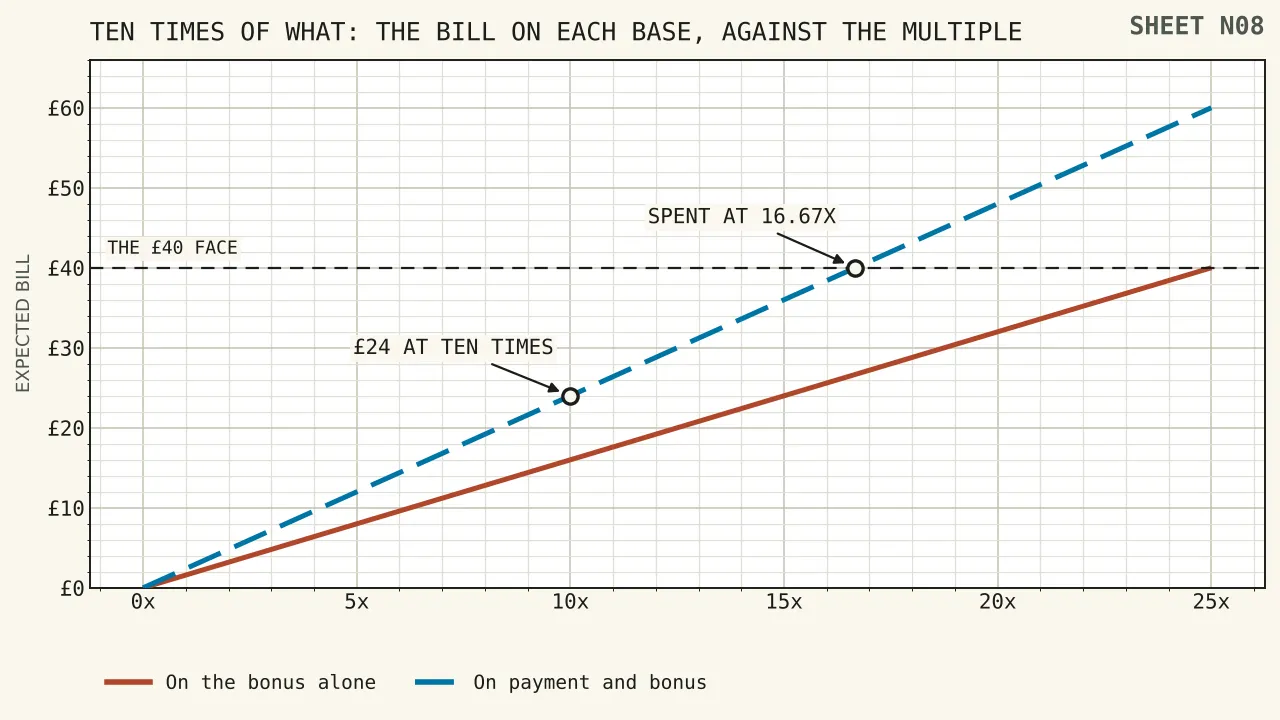
Two hundred per cent on the £20.00 rung issues £40.00 and leaves a balance of £60.00. Ten times the bonus is £400.00 of turnover and a bill of £16.00. Ten times the pair of them, payment and bonus, is £600.00 and a bill of £24.00, which is fifteen times the bonus wearing a ten on the label.
The face £40.00 issued What draws it down £24.00 on the wider base What is stranded £16.00 of the face
What a face of this size is worth
Every destination on this rack is bought advertising. The site takes a fee if a reader goes on to register, and no figure printed below moves because of it.
Face and Residue
Strip No 01
Betportal
Ceiling as a multiple
Priced at this site's own 10p a spin
What is printed
What draws it down
What is stranded
No Great Britain licence
Licensed in Anjouan, Comoros, run by BetPortal Gaming Ltd, with Excite Ultra Media Ltd, reference ALSI-202601040-FI2.
Terms read 16 October 2026
Open the offer at Betportal, opens in a new tabFace and Residue
Strip No 02
WinBeast
Ceiling as a sum
Priced at this site's own 10p a spin
What is printed
What draws it down
What is stranded
No Great Britain licence
Licensed in Curaçao, operator not named on the site.
Terms read 16 October 2026
Open the offer at WinBeast, opens in a new tabFace and Residue
Strip No 03
EliteSpin
Longest spin window
Priced at this site's own 10p a spin
What is printed
What draws it down
What is stranded
No Great Britain licence
Licensed in Costa Rica, run by PrimeTier Limited.
Terms read 16 October 2026
Open the offer at EliteSpin, opens in a new tabFace and Residue
Strip No 04
Crown Jewelz
Multiple unpublished
No residue struck
What is printed
What draws it down
What is stranded
No Great Britain licence
Licensed in Curaçao, number not verified, operator not named on the site.
Terms read 16 October 2026
Open the offer at Crown Jewelz, opens in a new tabThe two figures in the second and third registers are this site's own arithmetic and nothing an operator has published: the face as printed, less the share a spin gives back at 96 per cent return to player, less what playing the wagering through costs at the same return, and then less whatever a published ceiling, a charge on the way out or a floor on the smallest withdrawal takes off what survives that. The residue is what is left of the face when all of it is accounted for. It describes the offer, not one reader's afternoon. Where the conditions price above the face the strip prints nothing coming off rather than a negative sum, and where a figure the sum needs is unpublished it prints the condition in the operator's words instead.
A face paid as spins has no unit of its own, so one is supplied. Where an operator publishes what a spin of its own is worth, that figure stands in the first register's own line and is labelled as theirs. Where it does not, this site's own 10p a spin stands there and says so, and every figure below moves in proportion: at half the price, half the money. The share of the face that does come off is also given as pence in the pound, which is the figure that compares a large face against a small one.
Money goes onto a prepaid voucher in fixed denominations, so a smallest deposit published in pounds is rounded up to the first rung of the ladder this site works in, £10, £20, £25, £50, £75 and £100, and the strip prints what that rounding strands. That is the reader's own money and it is never netted into a residue. A smallest deposit published in euros is printed as the operator publishes it, because the ladder here is a sterling one and rounding a euro sum to it would be an invented figure.
Three words stand in the amount column where no figure can. Noted is a published condition that takes value away without leaving the sum a figure to take. Unpriced is a condition whose figure nobody has published, or a credit that is not a sum until a deposit of your own sets it. Own money is money of yours, which is never part of a residue.
Not one of the operators printed above holds a Great Britain licence, so the duties that licence carries do not reach them. All online gambling companies licensed in Great Britain must be part of Gamstop Online, and a reader who has shut themselves out through the scheme is therefore not shut out here. The ceiling of ten times the bonus funds on a wagering requirement, in force since 19 January 2026 under Social Responsibility Code 5.1.1, is a condition of that licence and binds the companies that hold one. On an unlicensed site the Gambling Commission describes consumers as facing unfair gaming practices, financial loss and a lack of recourse if things go wrong, and it names blocked payouts and withdrawal limits set so high they are unattainable among what it has seen. Nobody under 18 may hold an account at any of them.
Every term printed on a strip is the operator's own, and each strip carries the day it was read. The oldest of those readings is 16 October 2026. What binds a reader is the operator's own full terms, and not a line printed here.
1
Forty pounds of bonus, two possible bases
Two hundred per cent means two pounds of credit for each pound paid. On the £20.00 rung, which is a denomination that exists and therefore strands nothing in the purchase, that is £40.00 of bonus and £60.00 sitting in the account.
Every other figure on this page depends on one phrase in the terms, and it is a phrase most readers skim. A wagering requirement is a multiple of something. If that something is the bonus, the obligation is £400.00. If it is the bonus plus the money that triggered it, the obligation is £600.00. Same percentage, same payment, same printed multiple of ten, and £200.00 of difference in what has to go round a game.
The difference in money is smaller and sharper: £16.00 of expected cost against £24.00, which is half the bonus again. Stated as a multiple of the bonus alone, a ten times requirement on the wider base is a fifteen times requirement, because £600.00 divided by £40.00 is fifteen.
Offers at this percentage are issued by cashiers outside the British licensing system, and part 8 sets out what that removes. One item there matters more than the rest for this key: the ceiling on a multiple exists only inside that system, and even inside it the question of which base the multiple attaches to has no published answer.
Figures throughout are this site’s own assumptions, stated rather than implied: a 10p cycle, 96 per cent of each staked pound returned, and no weighting on a game unless a sentence brings one in. The regulated ceiling of ten times is sourced. The forty times used for comparison is an assumption about a market nobody publishes figures for.
2
What the ceiling is ten times of
The published ceiling is ten times, and what it is ten times of is the point of this page. Code provision 5.1.1 writes the cap against bonus funds, nothing else, and the date it took effect was 19 January 2026.
Whether a term that also requires the deposit to be turned over falls inside that cap has not been published. The regulator has issued no example covering a deposit-plus-bonus requirement, so the chain of published wording is all this page will offer, and the gap stays where it is.
What can be stated is the arithmetic of each reading, which is what parts 3 and 4 do. A reader cannot resolve the legal question and does not need to: the terms in front of them will say which base applies, and the two readings differ by £8.00 of expected cost on this key.
One companion rule arrived with the ceiling on the same January date. A single incentive may not mix the product types, and the rule’s own list runs betting, then casino, then bingo, then lottery. What that means here is narrow. Put spins with a match and one product type is in play. Put bingo tickets with a match and two are, bingo having its own place on that list. Scope matches the ceiling: all licences bar the technical one for gaming machines and the software one.
The practical effect of that rule on a reader is small, and the practical effect of its absence is not. A cashier beyond the ceiling may bundle a match with tickets, with spins, with a sportsbook credit, and run one requirement across the lot, so that clearing becomes a matter of several games with several contribution rates against a single figure.
3
The narrow base, priced
Take the reading most favourable to the reader: the multiple attaches to the bonus and to nothing else. Ten times £40.00 is £400.00 of turnover, which carries a four per cent charge of £16.00, so £24.00 of the bonus is expected to survive and the account is expected to hold £44.00.
In cycles that is 4,000 at 10p, and with 2.5 seconds beneath each licensed cycle it is 10,000 seconds, which is 166 minutes and 40 seconds of continuous play. Measured per hour the surviving £24.00 comes to £8.64, and that rate is identical for any face at ten times on this return, which is itself worth noticing.
| If the term says | Turnover | Cycles at 10p | Bill | Bonus surviving | Account holds |
|---|---|---|---|---|---|
| Five times | £200.00 | 2,000 cycles | £8.00 | £32.00 of it | £52.00 |
| Ten times | £400.00 | 4,000 cycles | £16.00 | £24.00 of it | £44.00 |
| Fifteen times | £600.00 | 6,000 cycles | £24.00 | £16.00 of it | £36.00 |
| Twenty-five times | £1,000.00 | 10,000 cycles | £40.00 | None of it | £20.00 |
| Forty times | £1,600.00 | 16,000 cycles | £64.00 | None of it | Nothing |
Two rows there deserve a sentence. At twenty-five times the account holds £20.00, which is the payment and nothing more: a bonus of any size is expected to be consumed exactly by a requirement of twenty-five times itself. At forty times the expected bill of £64.00 is larger than the £60.00 in the account, which means the obligation cannot be completed out of what is there. Either the attempt stops part way, with the bonus forfeit under the terms, or it continues on money added afterwards.
£400.00 of turnover, 4,000 cycles, 166 minutes, £16.00 of bill
4
The wide base, priced
Now the other reading, with the multiple attached to payment and bonus as one sum. The base is £60.00, ten times it is £600.00, and four per cent of that is £24.00. The bonus is £40.00, so £16.00 of it is expected to survive and the account is expected to hold £36.00.
Expressed against the bonus, the one comparison that puts two offers on the same footing, the printed ten has become fifteen. £600.00 of turnover divided by a £40.00 bonus is a multiple of fifteen, and the row for fifteen times in the table above gives exactly the same £24.00 and the same £36.00. The two readings are the same arithmetic under different labels.
| Reading of the term | Turnover asked | Expected bill |
|---|---|---|
| Ten times the bonus | £400.00, or 4,000 cycles | £16.00 |
| Ten times deposit and bonus | £600.00, or 6,000 cycles | £24.00 |
| The gap between them | £200.00, or 2,000 cycles | £8.00 |
| The wide base as a bonus multiple | Fifteen times the £40.00 | £24.00 |
The ratio between the two bases is fixed by the percentage and nothing else. At 200 per cent the base of deposit plus bonus is one and a half times the bonus, so a wide-base requirement is always half again as heavy as a narrow-base one with the same printed figure. At 100 per cent it would be twice as heavy. At 400 per cent it would be a quarter as heavy again, which is the single respect in which a larger headline treats a reader better.
In time the wide base costs 6,000 cycles rather than 4,000, which is 15,000 seconds at the licensed floor, or 250 minutes. Two thousand extra cycles is 83 minutes and 20 seconds of additional play for £8.00 of additional expected cost, and nothing in the headline percentage tells a reader that it is coming.
£600.00 of turnover is fifteen times a £40.00 bonus, not ten
5
Where break-even moves when the payment is in
This site uses twenty-five as the multiple at which an expected face reaches nothing, because 1 divided by 0.04 gives 25, and 0.04 is the proportion a 96 per cent game withholds. That figure holds when the requirement is measured against the bonus. Put the deposit into the base and it moves, and the movement can be calculated exactly.
The bill on a wide base is four per cent of the multiple times the deposit and bonus together. Set that equal to the bonus and the multiple that empties the face is 25 multiplied by the bonus and divided by the base. At 200 per cent the base is one and a half bonuses, so the answer is 16.67 rather than 25.
| The percentage | Base as bonuses | Break-even multiple |
|---|---|---|
| One hundred per cent | Two of them | 12.5 times |
| Two hundred per cent | One and a half | 16.67 times |
| Three hundred per cent | One and a third | 18.75 times |
| Four hundred per cent | One and a quarter | 20 times |
| Bonus alone | One | 25 times |
Read that bottom to top. The narrow base gives the familiar 25. Every percentage above zero pulls the figure downwards, and the smaller the percentage the harder it pulls, because a small bonus carries a large deposit in proportion. A one-to-one match on a wide base is finished at twelve and a half times, which is to say a term of fifteen times on deposit plus bonus has already passed the point where nothing is expected to survive.
On this key the regulated ten is comfortably inside 16.67, so something survives either way. The useful warning is for the offshore figure. Forty times on a wide base at this percentage is two and a half times past break-even: the expected bill is £96.00 against £60.00 in the account, so the requirement cannot be finished from the balance at all, and that conclusion needs no estimate of anybody’s terms beyond the multiple itself.
Game weighting pulls in the same direction and compounds with the base. Contribution at 30 per cent means a staked pound registers as 30p, so £600.00 of required contribution needs £2,000.00 of staking. The bill is then £80.00 against a £40.00 bonus, the effective multiple against the bonus is fifty, and the printed term still reads ten.
6
Six thousand cycles and the stake while clearing
A licensed slot has 2.5 seconds at the least between one cycle and the next, which turns any turnover obligation into a floor measured in minutes. Six thousand cycles is 250 minutes. Four thousand is 166 minutes and 40 seconds. Sixteen thousand, which is what forty times on the narrow base would ask, is 666 minutes and 40 seconds, or more than eleven hours.
A maximum stake while a requirement runs is the term that decides how many cycles there have to be. No primary source publishes a distribution of such terms, so what follows is a declared assumption: a ceiling of one tenth of the bonus, never below 10p. On £40.00 of bonus that is £4.00 a cycle.
| Stake a cycle | Cycles for £600.00 | Shortest sitting | What it means |
|---|---|---|---|
| 10p | 6,000 of them | 250 minutes | The site’s standard cycle |
| 50p | 1,200 of them | 50 minutes | Five times the standard |
| £4.00 | 150 of them | 6 minutes 15 seconds | A tenth of the bonus, assumed |
| £5.00 | 120 of them | 5 minutes | The licensed slots ceiling |
| £2.00 | 300 of them | 12 minutes 30 seconds | The ceiling under the age of 25 |
The expected cost does not change down that column. It is £24.00 at every stake size, because four per cent of £600.00 is £24.00 however the turnover is cut up. What changes is how many decisions get made, and how wide the spread around the expectation is. A hundred and fifty cycles of £4.00 and six thousand cycles of 10p have the same mean and nothing else in common.
The British stake ceilings sit on the same column and belong in any honest version of this arithmetic: £5 for one cycle on a licensed online slot, £2 where the player is under 25, dated by the Commission to 9 April 2025 and 21 May 2025. They are slots figures, so a roulette table is outside them, and a 10p player meets neither.
Since 17 January 2025 the display of net spend and time spent has had to be live, which is the one rule in this part that tells a reader mid-sitting where they are. Against a £600.00 obligation, that display is the difference between watching £24.00 leave and finding out afterwards.
7
What leaves the account at the end
Suppose the wide-base requirement is met at the printed ten and the account holds the expected £36.00. Two questions remain: whether the floor at the exit lets it out, and which part of it was ever at risk of being capped.
| The minimum payout | Outcome | Held |
|---|---|---|
| Lowest rung, £10.00 | Out, with £26.00 to spare | £0.00 |
| Second rung, £20.00 | Out, with £16.00 to spare | £0.00 |
| Third rung, £25.00 | Out, with £11.00 to spare | £0.00 |
| The fourth rung at £50.00 | £14.00 away from it | £36.00 |
A match at this percentage usually beats the floor, because £60.00 went in and the bill is a fraction of it. The exception is a minimum payout above the balance, and the fourth row shows what that looks like: £36.00 held for want of £14.00, with no refusal issued and no term breached.
The second question matters more. Capping the exit from a deposit balance is forbidden, and the example clause printed by the regulator holds a player to £50 for a day and £500 for a week. The same guidance entitles a player to take money out of that balance whenever they like, winnings and all, and asks that any cap on withdrawal size or count be a reasonable one.
Bonus money is not in that balance. No source publishes a usual ceiling over converting bonus winnings, so this page prices none, and the prohibition above does not stretch that far. On this key the £36.00 breaks into £20.00 traceable to the payment and £16.00 traceable to the bonus, and only the second part can meet a conversion ceiling.
Under a British licence two rules keep the exit passable. Offering to cancel a withdrawal request is not permitted, and the money behind one is not to be recycled as a deposit. Identity may not be made the price of payment where an earlier request was realistic, and an anti-money-laundering request is to come promptly rather than at the moment somebody wants paying.
£36.00 expected on the wide base, of which £16.00 is bonus money
8
The same headline with no British licence
A 200 per cent headline is a bigger number than a British licensee is likely to print, and the reason is not modesty. It is that the ceiling on the multiple makes a large percentage expensive to honour. Away from that licence the percentage is free and the multiple is free, which is the commercial logic of the whole offshore side.
What a reader loses is a list, and the list below is the subset that bears on a match of this shape. No Great Britain licence means none of it binds, and none of it is in the Curaçao rulebook this site read.
| The duty | Its source | Its price on this key |
|---|---|---|
| Ten times at the most | Code provision 5.1.1 | £400.00 of turnover, not £1,600.00 |
| The base left unsettled | No published example | £8.00 of cost rides on one phrase |
| One product type per incentive | In force from January 2026 | A match and spins, not a match and tickets |
| £5 a cycle, £2 under 25 | Regulations of 2025 | Slots only, roulette untouched |
| A cycle of 2.5 seconds at the quickest | RTS 14D | 250 minutes behind 6,000 cycles |
| Net spend shown live | Since 17 January 2025 | The £24.00 visible as it goes |
| Identity settled first | Condition 17.1.1 of the licence | Bonus play falls inside it |
| A withdrawal that cannot be recalled | RTS 14B | What is asked for stays asked for |
| A complaint finished in eight weeks | Social responsibility code | Six months to raise one at all |
| The self-exclusion scheme | A licence condition | Participation follows the licence |
Sixty times is the figure the regulator gave for the heaviest requirements in use before its ceiling arrived. On a £40.00 bonus that is £2,400.00 of turnover, £96.00 of expected cost, 24,000 cycles and 1,000 minutes at the licensed floor. Set against a £60.00 account it is not a hard offer but an impossible one, and that is what the ceiling was written to stop.
Two things cut the other way and belong here for honesty. A complaints route can exist offshore: the Curaçao policy publishes a six-month window, a four-week answer with one written extension, and dispute resolution the operator pays for. The British regulator recovers nothing either: it disclaims the ombudsman role and declines disputes over withdrawals or faults inside a game.
The difference lies in who sets the parameters and who can be made to answer. In Great Britain the arbitrator must be one the Commission has approved, and the Commission publishes a register a reader can check before paying anything. The national self-exclusion scheme takes its members from the British licence, so a cashier that holds none is outside it, and its own terms are explicit that services from non-participating organisations lie beyond its reach.
Questions
- What does 200% give me on a £20 deposit?
- £40.00 of bonus and a balance of £60.00. The £20.00 lands on the second rung of the ladder this site uses, so the purchase itself strands nothing, and everything after that turns on which sum the wagering requirement is a multiple of.
- Ten times what, though?
- That is the question this page exists for. Ten times the bonus is £400.00 of turnover and £16.00 of expected cost. Ten times the deposit and bonus together is £600.00 and £24.00. Expressed against the bonus alone, the second reading is a fifteen times requirement, because £600.00 divided by £40.00 is fifteen.
- Does the cap cover a deposit-plus-bonus term?
- Not published. Bonus funds are what the cap is written against, and no regulator example covers a requirement reaching the deposit too, so this page states the wording and stops there. What it can do is price both readings, and the difference on this key runs to £200.00 of turnover, or £8.00 of cost.
- Where is break-even if my deposit is in the base?
- At 16.67 times rather than 25. The bill on a wide base is four per cent of the multiple times deposit plus bonus, so the multiple that consumes the bonus is 25 multiplied by the bonus and divided by the base. At 200 per cent the base is one and a half bonuses, which gives 16.67. At 100 per cent it gives 12.5.
- How long does £600 of turnover take?
- Two hundred and fifty minutes at 10p a cycle, because 6,000 cycles with a 2.5-second floor beneath each come to 15,000 seconds. Raise the stake and the clock shortens without the expected cost moving: at £4.00 a cycle the same obligation is 150 cycles and 6 minutes 15 seconds, and the bill is still £24.00.
- Does a bigger percentage make the wide base worse?
- It makes it relatively better, which is counterintuitive. The base of deposit plus bonus is one and a half bonuses at 200 per cent but two bonuses at 100 per cent, so the smaller headline carries the heavier penalty for a wide base. At 400 per cent the base is only a quarter larger than the bonus.
- Where does a 30 per cent weighting land?
- It turns the wide base into a fifty times requirement against the bonus. At 30 per cent each pound staked counts as 30p, so £600.00 of required contribution needs £2,000.00 of staking and the bill becomes £80.00 against a £40.00 bonus. The printed term still says ten.
- Can the bonus be capped when my deposit cannot?
- Yes. Capping the exit from a deposit balance is prohibited, the regulator’s printed example stopping a player at £50 one day and £500 one week, and the same guidance says winnings may be withdrawn from that balance at any time. A ceiling over bonus winnings is a different term, no standard figure for one is published, and the prohibition does not stretch to it.
- What ends up stranded here?
- £16.00 of the £40.00 printed, on the wide base at the regulated ten. The account is expected to hold £36.00, which clears every minimum payout up to £25.00, so the stranded part is the share of the face that the turnover consumed rather than a balance stuck behind a floor.
- What is the worst case at forty times?
- On the wide base, an obligation that cannot be completed. Forty times £60.00 is £2,400.00 of turnover and £96.00 of expected cost against £60.00 in the account. Either the attempt stops part way, with the bonus forfeit under the terms, or it carries on over money added later, which is where the four per cent finds the reader’s own funds.