Note M02 Revision 1 Terms read 16 October 2026
Online bingo: a room that owes you no return figure
A bingo room satisfies its chance-information duty by describing how prizes get allocated. No percentage is required, so the usual arithmetic has a hole in the middle of it. A face of £20.00 buys 200 tickets at 10p, and what a ten times requirement costs depends on a figure nobody has to print. This page prices the band of answers instead, and names the £2.50 the rung stranded before any of it began.
The face £20.00 of tickets What draws it down £8.00 at the least What is stranded £2.50 on the rung
What a face of this size is worth
Every destination on this rack is bought advertising. The site takes a fee if a reader goes on to register, and no figure printed below moves because of it.
Face and Residue
Strip No 01
Betportal
Ceiling as a multiple
Priced at this site's own 10p a spin
What is printed
What draws it down
What is stranded
No Great Britain licence
Licensed in Anjouan, Comoros, run by BetPortal Gaming Ltd, with Excite Ultra Media Ltd, reference ALSI-202601040-FI2.
Terms read 16 October 2026
Open the offer at Betportal, opens in a new tabFace and Residue
Strip No 02
WinBeast
Ceiling as a sum
Priced at this site's own 10p a spin
What is printed
What draws it down
What is stranded
No Great Britain licence
Licensed in Curaçao, operator not named on the site.
Terms read 16 October 2026
Open the offer at WinBeast, opens in a new tabFace and Residue
Strip No 03
EliteSpin
Longest spin window
Priced at this site's own 10p a spin
What is printed
What draws it down
What is stranded
No Great Britain licence
Licensed in Costa Rica, run by PrimeTier Limited.
Terms read 16 October 2026
Open the offer at EliteSpin, opens in a new tabFace and Residue
Strip No 04
Crown Jewelz
Multiple unpublished
No residue struck
What is printed
What draws it down
What is stranded
No Great Britain licence
Licensed in Curaçao, number not verified, operator not named on the site.
Terms read 16 October 2026
Open the offer at Crown Jewelz, opens in a new tabThe two figures in the second and third registers are this site's own arithmetic and nothing an operator has published: the face as printed, less the share a spin gives back at 96 per cent return to player, less what playing the wagering through costs at the same return, and then less whatever a published ceiling, a charge on the way out or a floor on the smallest withdrawal takes off what survives that. The residue is what is left of the face when all of it is accounted for. It describes the offer, not one reader's afternoon. Where the conditions price above the face the strip prints nothing coming off rather than a negative sum, and where a figure the sum needs is unpublished it prints the condition in the operator's words instead.
A face paid as spins has no unit of its own, so one is supplied. Where an operator publishes what a spin of its own is worth, that figure stands in the first register's own line and is labelled as theirs. Where it does not, this site's own 10p a spin stands there and says so, and every figure below moves in proportion: at half the price, half the money. The share of the face that does come off is also given as pence in the pound, which is the figure that compares a large face against a small one.
Money goes onto a prepaid voucher in fixed denominations, so a smallest deposit published in pounds is rounded up to the first rung of the ladder this site works in, £10, £20, £25, £50, £75 and £100, and the strip prints what that rounding strands. That is the reader's own money and it is never netted into a residue. A smallest deposit published in euros is printed as the operator publishes it, because the ladder here is a sterling one and rounding a euro sum to it would be an invented figure.
Three words stand in the amount column where no figure can. Noted is a published condition that takes value away without leaving the sum a figure to take. Unpriced is a condition whose figure nobody has published, or a credit that is not a sum until a deposit of your own sets it. Own money is money of yours, which is never part of a residue.
Not one of the operators printed above holds a Great Britain licence, so the duties that licence carries do not reach them. All online gambling companies licensed in Great Britain must be part of Gamstop Online, and a reader who has shut themselves out through the scheme is therefore not shut out here. The ceiling of ten times the bonus funds on a wagering requirement, in force since 19 January 2026 under Social Responsibility Code 5.1.1, is a condition of that licence and binds the companies that hold one. On an unlicensed site the Gambling Commission describes consumers as facing unfair gaming practices, financial loss and a lack of recourse if things go wrong, and it names blocked payouts and withdrawal limits set so high they are unattainable among what it has seen. Nobody under 18 may hold an account at any of them.
Every term printed on a strip is the operator's own, and each strip carries the day it was read. The oldest of those readings is 16 October 2026. What binds a reader is the operator's own full terms, and not a line printed here.
1
The missing figure, and why it is lawfully missing
Pricing a face takes three inputs. The credit, the multiple attached to it, and the share of each pound the game gives back. Reel-based pages on this site put that third input at 96 per cent and get on with the sum. A bingo room is where that shortcut breaks, and the break is not an oversight by the room.
A bingo room satisfies the chance-information duty by describing how prizes get allocated, which the guidance to 3C records as sufficient, so no percentage need ever appear. That is the whole of the position, and it changes what an honest page can say. Where a return figure is not published, the expected cost of a requirement cannot be stated as a number. It can only be stated as a range, with the range named and the reason for it named too.
So this page does something the others do not. It prints the crossing value rather than the cost, and it prints the cost as a band of possibilities with the assumption beside each one. Nothing here claims a bingo return. The sheets behind this site carry no bingo percentage, no primary source publishes one, and inventing one would be the simplest false statement available here, and the least defensible.
What is statable exactly is the shape of the obligation. A play-through asks for wagers adding up to a set value before money becomes withdrawable, and the definition passes no judgment on the value chosen. The multiple is capped on the licensed side: a British licence has held a play-through to ten times bonus funds since 19 January 2026, the provision being 5.1.1 and the limb 3(a). Two licence classes stand outside, gaming machine technical and gambling software; every remote bingo licence is therefore in.
What can also be stated exactly is the unit. This site prices a bingo ticket at 10p, held constant so one note can be set beside another. A face of £20.00 is therefore 200 tickets, and a requirement expressed in money converts into a count of tickets by dividing by a tenth of a pound. Those conversions are arithmetic and carry no uncertainty at all.
Bingo faces of this sort are offered from rooms holding no Great Britain licence. Part eight itemises the removal, and bingo makes a sharp case of it, because several restraints a reader might assume cover bingo do not cover bingo even where a licence is held. Knowing which is which is most of the value here.
Constants on this site, so notes can be compared: 10p buys one unit of play, forty times is the house multiple, and g, the share of a stake a room counts towards a requirement, stands at 1.00 until a sentence moves it and names the move. The single assumption this note will not carry is a return, because the room owes nobody one.
2
A £20.00 rung against a £17.50 line
Prepaid money arrives in steps, and the steps this site uses appear in the table below. Suppose a room asks £17.50 to open its sign-up credit. No step sits on £17.50. The smallest one that clears it costs £20.00, and £2.50 of that purchase went towards no eligibility at all.
Two pounds fifty is the residue this page prints, and it exists before a single number has been called. Nobody seized it. Its position on the account is above the qualifying line and under the payout floor, and that is the one position from which a sum cannot be moved at either end.
| Step bought | Clears the line | Left over |
|---|---|---|
| £10.00 | No | Nothing opened |
| £20.00 | Yes | £2.50 |
| £25.00 | Yes | £7.50 |
| £50.00 | Yes | £32.50 |
| £75.00 | Yes | £57.50 |
| £100.00 | Yes | £82.50 |
In tickets rather than pounds, the £2.50 is 25 tickets at 10p. That is the clearest way to read it, because 25 tickets is a quantity a bingo player can picture and £2.50 under a payout floor is not. Twenty-five tickets will be played, or they will sit. There is no third outcome available to a sum that size.
A single rule guards the exit for the deposited part, and its unconditional form is worth isolating. No British licensee may run a term that sets a maximum on a consumer’s withdrawal from a deposit balance. What the regulator prints as forbidden wording allows £50 across one day, £500 across one week, and over a year that lids money the player owns at £26,000. Reach stops at the deposit balance. Any lid on what a bonus becomes lives in a different box and is untouched.
So the £2.50 is not held by a term at all. It is held by two shapes meeting: a ladder with no step under £10.00, and a cashier with no payout under £10.00. Neither shape breaks a rule and neither is going to change. The instrument produces the residue, and of every figure here it is the only one needing no percentage at all.
3
Where the crossing goes when the return is unknown
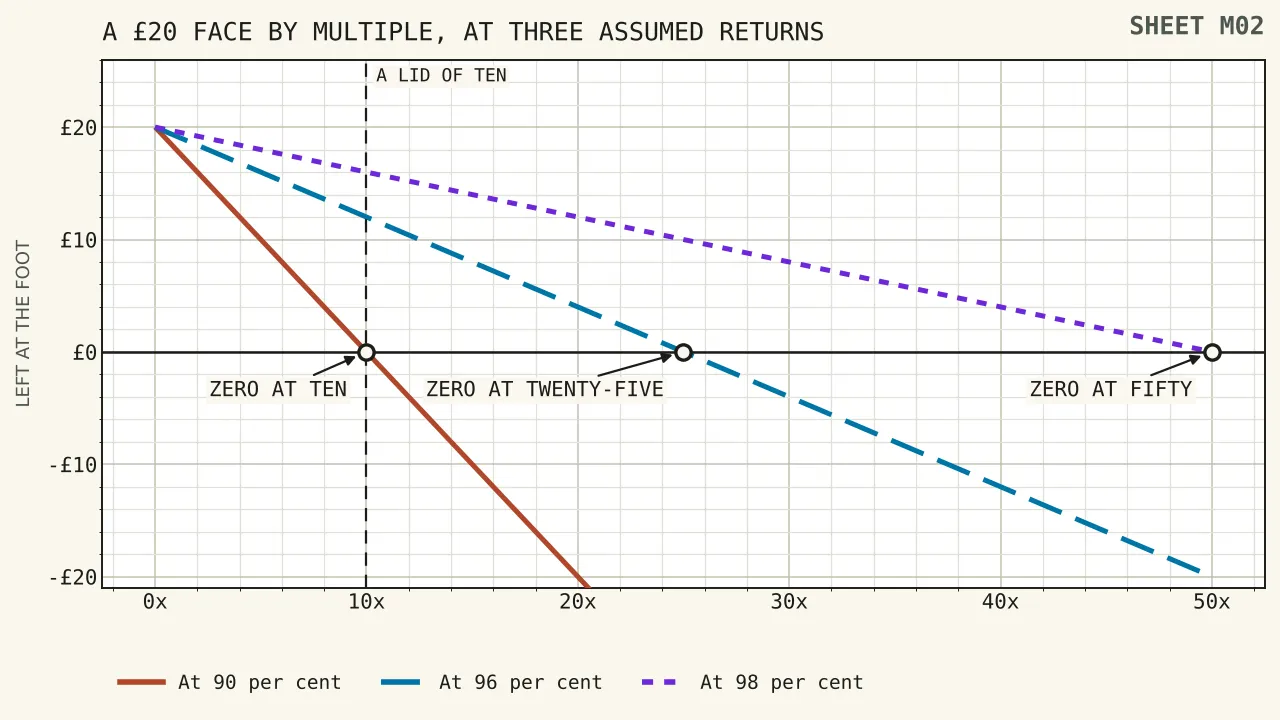
Elsewhere on this site the crossing is a fixed number. Twenty-five, because 0.04 goes into one that many times, and 0.04 is the edge left by a 96 per cent return. The general form is less comfortable and more honest.
g > W × (1 − RTP) is the condition for any expected survival
Read that and the problem is plain. Two of the three letters are unpublished in a bingo room. The weighting is in the bonus terms if anywhere, and the return is not required to be anywhere. Only W, the multiple, is reliably printed, and W on its own settles nothing.
The useful move is to invert it. Instead of asking what a requirement costs, ask what the room would have to be paying for the requirement to leave anything. That question has an exact answer for every multiple, and the answer is a return, not a guess.
| If the return were | Edge per pound | Multiple that reaches zero | Band needed at ten times | Cost of £200.00 staked | Left of £20.00 |
|---|---|---|---|---|---|
| 90 per cent | 10p | 10 times | Full weight, and zero | £20.00 | Nothing |
| 92 per cent | 8p | 12.5 times | Above 0.80 | £16.00 | £4.00 |
| 94 per cent | 6p | 16.67 times | Above 0.60 | £12.00 | £8.00 |
| 96 per cent | 4p | 25 times | Above 0.40 | £8.00 | £12.00 |
| 98 per cent | 2p | 50 times | Above 0.20 | £4.00 | £16.00 |
Every figure in that table is this site’s own working from the assumption in its first column, and the first column is a set of assumptions rather than a set of findings. What the table is for is the spread it shows. On the same £20.00 face, at the same ten times requirement, at full weight throughout, the expected cost runs from £4.00 to £20.00 depending on a number the room need not print. That is a fivefold range, and a reader comparing two bingo rooms on their headlines is comparing neither end of it.
Sit with the top row for a moment. A return of 90 per cent puts the zero-crossing multiple at ten, which is exactly the British ceiling. So a room paying 90 per cent and asking the maximum a British licence permits is a room where a credit’s expected survival is £0.00 at full weight, with no term broken and no deadline missed. Whether the lid and the arithmetic meet turns on a number no bingo room is required to print.
Weighting pushes it further in a direction the reader cannot see. Suppose the room counts bingo stakes at full weight but counts side games at a fifth. Half the staking at 0.20 and half at 1.00 blends to 0.60 of contribution per pound. At a 96 per cent return that clears ten times, because 0.60 sits above 0.40. At 92 per cent it does not, because the band wanted there is 0.80. One sentence changes meaning on a figure the reader does not have, which is this room’s difficulty in a single example.
Two gaps stay open here. The lid’s subject is bonus funds, and nothing published addresses a requirement reaching the deposit as well. The status of a free ticket against that subject is unpublished too. Neither is closed in either direction.
4
Tickets, not spins: what the unit does to the count
Bingo meters a face differently from a reel. A reel takes a stake per cycle and the cycle is the unit. A bingo room sells a ticket into a game that is called once, however many tickets a player holds, so the count of tickets and the count of games come apart. That has one arithmetic consequence worth printing.
Required staking converts to tickets at a fixed rate: ten tickets to the pound at 10p each. On a £20.00 face at ten times, contribution required is £200.00. At full weight that is 2,000 tickets. At a band of 0.40 it is £500.00 of staking, which is 5,000 tickets. At a band of 0.05 it is £4,000.00, which is 40,000 tickets.
| Band | Staking asked | Tickets at 10p | Games at six tickets each | Reading |
|---|---|---|---|---|
| 1.00 | £200.00 | 2,000 of them | 334 | A ticket counts whole |
| 0.60 | £333.33 | 3,334 of them | 556 | A blended floor |
| 0.40 | £500.00 | 5,000 of them | 834 | Two fifths counted |
| 0.20 | £1,000.00 | 10,000 of them | 1,667 | A fifth counted |
| 0.05 | £4,000.00 | 40,000 of them | 6,667 | A twentieth counted |
The games column assumes six tickets to a game, which is this page’s own modelling choice and not a market finding. It is there because the game, not the ticket, is the thing that takes time. Six tickets at a time turns 2,000 tickets into 334 games, and 40,000 tickets into 6,667 games. Nothing in the published standards sets a minimum length for a bingo game, which is the subject of part six, so no hour figure can honestly be attached to those counts.
The 0.60 row carries a figure worth noticing, because it comes from the regulator’s own page rather than from this site. A contribution rate of 30 per cent is quoted there from a respondent, where each pound staked moves a requirement on by 30 pence, and the Commission’s page records that £100 of required contribution then needs about £333.33 of staking. The same proportion appears in that row: £200.00 of required contribution at 0.60 needs £333.33 of staking. The arithmetic is this site’s, worked against a rate the regulator printed.
One more effect of the ticket unit deserves its own line. Where a requirement is expressed in money and a room sells tickets six at a time, the last purchase overshoots. A reader needing £3.40 of further contribution at full weight buys six tickets for 60p, and one such purchase carries them past the line. Overshoot is small, repeated, and always in the same direction.
Scaling the face changes nothing about the proportions, which is worth one line of proof. A £10.00 face at ten times wants £100.00 of contribution, or 1,000 tickets at full weight. A £50.00 face wants £500.00 and 5,000 tickets. A £100.00 face wants £1,000.00 and 10,000 tickets. Ten tickets per pound of face per unit of multiple is the whole rule, and the band divides into it. So a reader can carry one figure and derive the rest: at 0.40, multiply the ticket count by two and a half.
2,000 tickets at 10p, bought six at a time, overshoots a £200.00 line by 40p at worst
5
Tickets and a match may no longer travel together
Of every rule here, this one lands on bingo credits hardest, and it is recent. Two product types may no longer sit inside a single incentive. Betting, bingo, casino and lottery are the four named, and the rule took effect on the lid’s own date.
Tickets bolted to a match cross a product boundary, because bingo and casino are both on the rule’s list, while spins bolted to a match stay within casino. That reading comes off the list itself, which is short enough to check: a match with spins is one product, a match with tickets is two.
Three carve-outs sit beneath the rule, and each cuts against assumption.
| Permitted despite the ban | The regulator’s illustration |
|---|---|
| Two products of one type | A scratchcard and a raffle |
| Two offers inside one email | Casino and betting, consent held for each |
| A credit the customer allocates | £10 across betting and casino, as they like |
The third carve-out is the one with arithmetic in it. A credit spendable anywhere is a credit whose weighting the reader chooses, which sounds like a gift and is the opposite on the numbers. Take £10.00 spendable across a room at ten times. Spend it on tickets counted whole and £100.00 of staking clears the requirement. Spend it on a side game counted at a twentieth and £2,000.00 of staking is wanted instead. The offer did not change. The reader chose a denominator.
The stated aim is narrow: no product combined with another inside a single incentive where the terms are shared and linked between them. Reading further than that would be reading what the page does not say. What it means for a bingo reader is concrete. A single welcome credit covering a bingo room and a slots room together, on one linked set of terms, is no longer available from a British licensee, while a room holding no such licence is bound by none of this.
Alongside that sits the incentive provision itself, 5.1.1, which bites whenever a licensee offers any customer or potential customer an incentive, reward or arrangement giving them money, goods, services or another advantage. Its second limb wants an incentive’s terms clear, transparent and fair, and reachable without difficulty by anyone to whom it is offered. A contribution table in the bonus terms meets that limb, found or unfound.
6
Which standards name bingo and which do not
A reader who has read about slot rules may assume they carry across. Several do, by their own scope lines. Several do not, and the ones that do not are the ones that would have governed pace.
Pace is written product by product, and bingo is not a product either provision names. Slots get an interval of 2.5 seconds. Casino games that are not slots get five, poker between players excepted, and the updates page carries 17 January 2025 for that one. Bingo appears in neither scope line, so a ticket count cannot honestly be turned into a minimum span of minutes.
| Provision | What it does | Whose scope line names bingo |
|---|---|---|
| 8A | Removes auto-play | Gaming, bingo included |
| 7A to 7E | Random outcomes, no near miss | Gaming, bingo included |
| 3A to 3D | Rules and chance information | Gaming, bingo included |
| 12A to 12E | Financial limits | All gambling, bar subscription lotteries |
| 14A | No chasing, no silent top-ups | All gambling |
| 14B | No cancelling a withdrawal | All gambling |
| 14D | Interval of 2.5 seconds | Slots alone |
| 14G | Interval of five seconds | Casino games other than slots |
| Stake lids of £5 and £2 | Caps a cycle’s stake | Online slots alone |
Take the bottom three rows together and a precise point falls out. Reel-based games played online are what the stake lids cover, and the guidance places other casino games outside them, roulette and blackjack being the examples given. From that direction nothing sets a maximum on what a bingo ticket may cost. What limits a bingo stake is the room’s own pricing and the player’s own deposit limit, and only the second of those is a regulated thing.
The rows that do name bingo matter in a different way. Auto-play is out, so buying a ticket is a commitment the player makes. The random-outcome standard applies, bringing a bar on a loss displayed as a near miss, and a demand that outcomes follow their expected probabilities. And the chance-information standard applies as well, which is where this page started: it applies to bingo, and for bingo it is satisfied by a description of how prizes get allocated.
One scope line closes a loop. Financial limits reach all gambling other than subscription lotteries, so a bingo player gets the same limit furniture as a reel player wherever a British licence governs. The standard’s own details are set out below.
| What the standard fixes | The specification |
|---|---|
| Shape of the control | A free text box, never a menu |
| Granularity | The account, as a floor |
| Gross deposit limits | No less prominent than other sorts |
| Durations offered | A day, a week, a month |
| Where two overlap | Whichever binds harder |
| A cut to a limit | Immediate, technical failure aside |
| A rise in a limit | A day, then a positive act |
| Review prompt | Half-yearly, where an account is active |
Those directions move at unequal speeds, and the inequality is the detail with the most in it. A cut lands at once unless a technical failure stops it. A rise takes three steps and at least a day. So a limit is easy to tighten and slow to loosen, which is the whole design.
7
The exit, and the floor under £2.50
Take the friendliest row of part three. A return of 98 per cent, a ten times requirement, full weight, nothing forfeited, and £16.00 of the £20.00 face expected through. That clears a £10.00 payout floor comfortably. Now take the £2.50 from part two, which never entered the requirement at all, and the floor does not move for it.
Two pounds fifty against a £10.00 floor is £7.50 short. The arithmetic of closing that gap by playing cannot even be stated on this page, because stating it needs the return figure the room does not publish. What can be said is the direction. Every circuit of £2.50 through a room with any house edge at all costs something in expectation, the cost rises with the number of circuits, and no quantity of circuits lifts an expectation. At the 96 per cent assumption used elsewhere on this site the cost would be 10p a circuit. At 90 per cent it would be 25p. The sign is the same in every case.
£2.50 under a £10.00 floor, £7.50 short, with the cost per circuit unpublished
The other route out is to put money in, and the ladder bites again. Reaching the floor wants £7.50. The smallest step costs £10.00. Buying it leaves £2.50 on the far side of the line, which is precisely the sum that caused the problem, now reproduced. A ladder with nothing beneath £10.00 cannot be asked for £7.50 by anyone.
Rules keeping the exit open under a British licence appear below, because part eight leans on them.
| What the rule covers | What it means in practice |
|---|---|
| A withdrawal already asked for | Cancelling is not to be offered |
| Money already requested | Not to be offered back as a deposit |
| The withdrawal process | Friction kept as low as the operator can |
| A maximum on the deposit balance | Barred outright |
| Limits on size or number | Only where reasonable |
| Documents demanded at the exit | Barred as a condition if there was an earlier opportunity |
On the other side the failure modes have been described by the regulator. Its enforcement and intelligence director named two on 21 October 2025: pay-outs stopped, and withdrawal thresholds pitched where nobody arrives. A threshold above any balance a £20.00 face can plausibly produce strands the face with no refusal issued at all. Nothing is confiscated. The money stays where it is, which is a quieter outcome and the same one.
The licensed side runs a clock on complaints, which is what a stranded balance eventually meets. Three working days is the outer limit for acknowledging one, cut to a day where the gambling never closes, and as soon as reasonably possible is the standard above it. Fifty-six days from receipt is the ceiling on the process as a whole, escalation included. No term may shut a complaint out within six months of an incident. The closing letter carries the decision, records that the operator’s stage has ended, and names the next step.
8
What the licence would have added
A bingo room with no Great Britain licence is not a room with no rules. It is a room whose rules are shorter, written by a different hand, and missing the particular items below. Each one is a condition on a British operating licence. None appears in the rulebook Curaçao publishes for its own licensees.
Start with what bears on this page’s own arithmetic. The lid of ten on the multiple, which in part three decided whether a £20.00 face survived at all. The incentive provision’s demand for clear, transparent and fair terms, which is the only published hook under a contribution table. The mixing ban, which stopped tickets and a match sharing one set of linked terms. And the chance-information standard, which even at its weakest obliges a licensed room to describe how its prizes get allocated before a player commits.
That last item is the one most worth weighing. A reader might reasonably say that a duty satisfied by a prize description is barely a duty. The answer is that the alternative is nothing whatever. Bonuses occupy two lines of the Curaçao policy. Terms communicated transparently is the first. The second bars promotion aggressive enough to encourage excessive play. No lid of ten appears, no mixing rule, and no schedule of conditions a promotion must display.
Then the duties bearing on the account rather than the game. Verification before any gambling at all, with three items as the floor beneath it: name, then address, then date of birth, with bonus-funded play included. Credit cards ceased to be a payment route for gambling from 14 April 2020, and interposing a money service business changes nothing. Limits are prompted, set as the default, and slow to loosen. Light-touch financial checks sit above a monthly net deposit line of £500 from 30 August 2024, then £150 from 28 February 2025.
Adjudication comes next, and bingo throws up a detail there worth knowing. Only an entity the Commission has approved may be used by a licensee, and eight are published with their sectors beside them. Of those eight, Pegasus ADR Service carries no remote casino listing at all, and the sectors beside its name are land-based ones, bingo away from the internet among them. A remote bingo player is therefore looking at a shorter list than the headline count suggests. Remote across all sectors covers five of the eight: IBAS, eCOGRA, ADR Group, the Centre for Effective Dispute Resolution and Blexr Limited.
Participation in the national exclusion scheme follows the licence and not the website, so a room outside the licence is outside the scheme. The scheme’s own terms carry the limit: it cannot keep a registrant from a service an organisation outside it runs. Registrations published on 16 July 2026 stood at 614,738, with half-year growth of 16 per cent, and May 2026 at 12,236 was a record month.
Two balancing points, since the easy version errs both ways. A route for complaints does exist offshore. Six months from the incident, at no cost. Four weeks to answer, with four more available where notice is given in writing. Adjudication obligatory, the player paying nothing. Drafting is where the two part company, since parameters there may be the operator’s, the binding effect of an outcome among them.
Nor does the British regulator settle anything. Its own phrase for itself is not an ombudsman, and it states that resolving a gambling complaint and recovering a consumer’s money are both beyond its powers, a withdrawal problem named among the examples.
One further point sits oddly and belongs in the honest column. Curaçao’s own policy requires an operator’s footer to carry links to gambling support resources, and the examples it gives include British bodies by name. A reader on a Curaçao-licensed bingo site may therefore find a route to help written into the offshore rulebook, while finding no lid on a multiple anywhere in the same document.
A check the regulator recommends, costing nothing: the table below is the whole of it.
| What to look for | Where to look |
|---|---|
| A licensed status | On the room’s own pages |
| The licence behind it | Through that link, at the register |
| Activities recorded | Against the account number |
| Domain names recorded | Against the same account |
| The day of checking | On whatever gets written down |
No guide to reading the register is published anywhere on it. A domain sitting against a licensee therefore arrives with no explanation, which is why a date of checking matters as much as a result does.
Questions
- Why will this page not tell me a bingo return to player?
- Because none is published and inventing one would be the easiest false fact here to write. The chance-information standard applies to bingo, and for bingo it is satisfied by a description of how prizes get allocated. No percentage is required, no primary source gives a market figure, so this page prices a band of assumptions instead and labels each one as an assumption.
- What does ten times cost on a £20.00 bingo credit?
- Somewhere between £4.00 and £20.00 at full weight, depending on a figure the room need not print. At an assumed 98 per cent the £200.00 of staking costs £4.00; at 96 per cent, £8.00; at 92 per cent, £16.00; at 90 per cent it takes the whole £20.00, because a tenpenny edge sets the zero-crossing multiple at ten exactly.
- Is there a general version of the break-even rule?
- Yes, and it is the one this page uses. Expected survival requires the weighting to exceed the multiple times the edge per pound. Where the return is 96 per cent the edge is 0.04 and the crossing multiple is 25. Where the return is unpublished, both the edge and the crossing are unpublished with it, and only the multiple is reliably printed.
- How many tickets sit behind the requirement?
- At 10p a ticket, £200.00 of required contribution means 2,000 tickets where a ticket counts whole. Drop to 0.40 and staking rises to £500.00 with 5,000 tickets. Drop to 0.05 and it is £4,000.00 across 40,000 tickets. Bought six at a time, those 2,000 overshoot a £200.00 line by 40p at most.
- Can a welcome offer still combine bingo tickets with a slots match?
- Not from a British licensee on one linked set of terms. Betting, bingo, casino and lottery are the named types, and no single incentive may now carry two of them. Bingo and casino are two. A match with spins stays inside casino, so that pairing is untouched. A credit usable on any product the customer picks is still allowed, the regulator’s illustration being £10 across betting and casino.
- Does the 2.5 second rule slow a bingo game down?
- No. Slots are what that interval is written for, and the five second one is written for casino games which are not slots, poker between players excepted. Bingo is in neither scope line, so no published floor exists to turn a ticket count into minutes. This note gives ticket counts and game counts and stops.
- Do the £5 and £2 stake limits cap a bingo ticket?
- No. Online slots are what those limits attach to. A reel-based game, played online, is the definition used, and other casino games sit outside it by the guidance’s own words. Nothing there touches what a bingo ticket costs. A bingo stake meets the room’s own pricing and the player’s own deposit limit, and only the second of those is regulated.
- Which rules do apply to bingo on a British licence?
- The ones whose scope lines name gaming including bingo, or all gambling. Auto-play is out, so each purchase of a ticket is a separate commitment. The random-outcome standard applies, bringing the bar on presenting a loss as a near miss. Chance information applies as well. Financial limits reach all gambling bar subscription lotteries, and the rules on withdrawals and on chasing losses reach all gambling too.
- What is actually stranded on this page?
- £2.50, which is 25 tickets at 10p. A room asking £17.50 meets a ladder whose smallest step above that line costs £20.00. The £2.50 left over sits above the qualifying line and £7.50 below a £10.00 payout floor, which is the one position from which a sum cannot move in either direction.
- Is there anyone to complain to at an unlicensed bingo room?
- Possibly, and claiming otherwise would be wrong. The Curaçao policy allows a complaint at no cost for six months from the incident. Four weeks is the answer window, with four more on written notice. Adjudication is obligatory and free to the player. Authorship differs, because parameters there may be the operator’s. A British licensee may use only an approved entity, and five of the eight published carry remote in all sectors.
- Does the national exclusion scheme cover a bingo site?
- Participation follows a British licence, so a licensed bingo room is in and a room without one is out, as a matter of construction. The scheme itself states the limit: it cannot stop a registrant reaching a service run by an organisation that is not a participant.
- Why does a credit I can spend anywhere make things worse?
- Because the reader then chooses the denominator. Take £10.00 at ten times. Spent on tickets counted whole, £100.00 of staking clears the requirement. Spent on a side game counted at a twentieth, the staking wanted is £2,000.00. Nothing in the offer changed. The flexibility that looks generous is the freedom to pick a weighting, and most of the available weightings are worse than the one the credit was advertised against.