Note G04 Revision 1 Terms read 16 October 2026
Paysafecard casino: the code keeps what the counter did not need
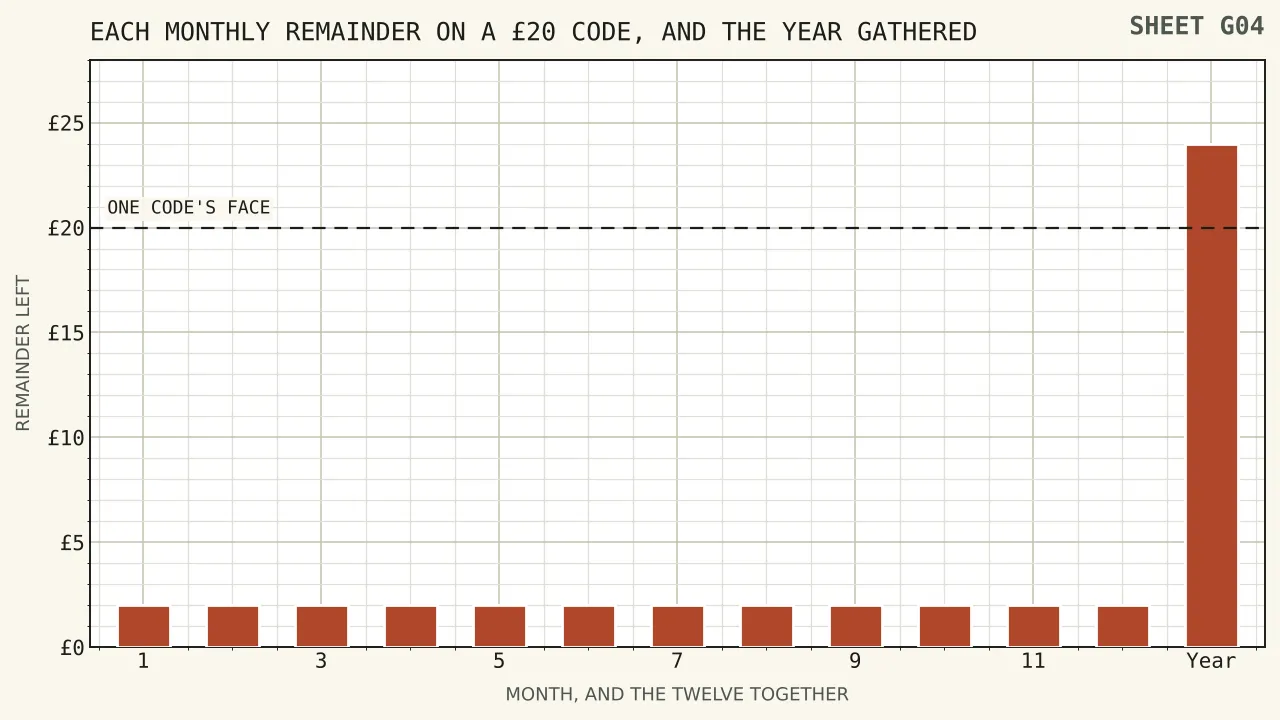
A counter asking £18.00 and a denomination of £20.00 leave £2.00 on the code, which is a tenth of the face and the purest residue on this site. Repeat that purchase monthly and the year ends with £24.00 spread across twelve part-used codes. Meanwhile a matched £18.00 cleared at the ten times ceiling is expected to cost £7.20 of itself.
The face £20.00 code What draws it down £7.20 What is stranded £2.00
Faces measured against a printed denomination
Every destination on this rack is bought advertising. The site takes a fee if a reader goes on to register, and no figure printed below moves because of it.
Face and Residue
Strip No 01
Betportal
Ceiling as a multiple
Priced at this site's own 10p a spin
What is printed
What draws it down
What is stranded
No Great Britain licence
Licensed in Anjouan, Comoros, run by BetPortal Gaming Ltd, with Excite Ultra Media Ltd, reference ALSI-202601040-FI2.
Terms read 16 October 2026
Open the offer at Betportal, opens in a new tabFace and Residue
Strip No 02
WinBeast
Ceiling as a sum
Priced at this site's own 10p a spin
What is printed
What draws it down
What is stranded
No Great Britain licence
Licensed in Curaçao, operator not named on the site.
Terms read 16 October 2026
Open the offer at WinBeast, opens in a new tabFace and Residue
Strip No 03
EliteSpin
Longest spin window
Priced at this site's own 10p a spin
What is printed
What draws it down
What is stranded
No Great Britain licence
Licensed in Costa Rica, run by PrimeTier Limited.
Terms read 16 October 2026
Open the offer at EliteSpin, opens in a new tabFace and Residue
Strip No 04
Crown Jewelz
Multiple unpublished
No residue struck
What is printed
What draws it down
What is stranded
No Great Britain licence
Licensed in Curaçao, number not verified, operator not named on the site.
Terms read 16 October 2026
Open the offer at Crown Jewelz, opens in a new tabThe two figures in the second and third registers are this site's own arithmetic and nothing an operator has published: the face as printed, less the share a spin gives back at 96 per cent return to player, less what playing the wagering through costs at the same return, and then less whatever a published ceiling, a charge on the way out or a floor on the smallest withdrawal takes off what survives that. The residue is what is left of the face when all of it is accounted for. It describes the offer, not one reader's afternoon. Where the conditions price above the face the strip prints nothing coming off rather than a negative sum, and where a figure the sum needs is unpublished it prints the condition in the operator's words instead.
A face paid as spins has no unit of its own, so one is supplied. Where an operator publishes what a spin of its own is worth, that figure stands in the first register's own line and is labelled as theirs. Where it does not, this site's own 10p a spin stands there and says so, and every figure below moves in proportion: at half the price, half the money. The share of the face that does come off is also given as pence in the pound, which is the figure that compares a large face against a small one.
Money goes onto a prepaid voucher in fixed denominations, so a smallest deposit published in pounds is rounded up to the first rung of the ladder this site works in, £10, £20, £25, £50, £75 and £100, and the strip prints what that rounding strands. That is the reader's own money and it is never netted into a residue. A smallest deposit published in euros is printed as the operator publishes it, because the ladder here is a sterling one and rounding a euro sum to it would be an invented figure.
Three words stand in the amount column where no figure can. Noted is a published condition that takes value away without leaving the sum a figure to take. Unpriced is a condition whose figure nobody has published, or a credit that is not a sum until a deposit of your own sets it. Own money is money of yours, which is never part of a residue.
Not one of the operators printed above holds a Great Britain licence, so the duties that licence carries do not reach them. All online gambling companies licensed in Great Britain must be part of Gamstop Online, and a reader who has shut themselves out through the scheme is therefore not shut out here. The ceiling of ten times the bonus funds on a wagering requirement, in force since 19 January 2026 under Social Responsibility Code 5.1.1, is a condition of that licence and binds the companies that hold one. On an unlicensed site the Gambling Commission describes consumers as facing unfair gaming practices, financial loss and a lack of recourse if things go wrong, and it names blocked payouts and withdrawal limits set so high they are unattainable among what it has seen. Nobody under 18 may hold an account at any of them.
Every term printed on a strip is the operator's own, and each strip carries the day it was read. The oldest of those readings is 16 October 2026. What binds a reader is the operator's own full terms, and not a line printed here.
1
A face printed on a code
A prepaid code is the instrument this whole site is named after, so this note is the one where the three questions come out cleanest. What is printed on it. What draws that down. What is left when the drawing down has stopped.
The first question has an exact answer, which is unusual. A code carries a denomination, and six of them are used across this site: £10.00 at the bottom, £100.00 at the top, with £20.00 and £25.00 and £50.00 and £75.00 standing between them. Nothing is sold under the first figure and nothing is sold between any two of them. That ladder is a modelling assumption fixed by this site, because no regulator publishes a denomination table anywhere on the fact sheet behind these pages.
The second question is where a reader gets caught, and it is caught at the door rather than in the game. Suppose a counter asks £18.00. No code is sold at £18.00. The reader buys £20.00, spends £18.00 of it, and holds a code with £2.00 still on it.
That £2.00 is the residue, and its position is the thing worth understanding. It has not gone anywhere. It is not a fee and nobody has taken it. It sits on an instrument, outside the counter, where no wagering requirement can reach it and no game can charge it four pence in the pound. The two things that can happen to it are that it is spent, which needs a second purchase to top it up, or that it is forgotten, which is what usually happens to £2.00.
Against the printed face, £2.00 is 10 per cent. That proportion is the figure this page is built on, and it is small enough to be ignored once and large enough to matter twelve times.
Outside the counter is better than inside it, and the comparison is worth making precisely. Where a rail credits the whole increment to a gambling balance, that surplus is immediately reachable by a play-through and immediately exposed to the edge. A remainder on a code is exposed to neither. It is inert. The cost of a code’s remainder is an opportunity cost, not an expected loss, and this site prices the difference rather than treating them as the same thing.
2
Twelve purchases and what they leave behind
One remainder of £2.00 is a rounding error. Twelve of them are a line in a budget, and the arithmetic is worth doing because nobody does it: the loss is spread across twelve instruments and never appears as a single figure anywhere.
Take the same purchase once a month for a year. Twelve codes at £20.00 is £240.00 of face bought. Twelve deposits of £18.00 is £216.00 of intention. The difference is £24.00, sitting as £2.00 on each of twelve codes, and the share of the year’s face that never reached a counter is 10 per cent.
| Asked each month | Code bought | Face across the year | Reading | Residue across the year |
|---|---|---|---|---|
| £3.00 | £10.00 | £120.00 | Seven tenths never spent | £84.00 |
| £5.00 | £10.00 | £120.00 | Half of it never spent | £60.00 |
| £8.00 | £10.00 | £120.00 | A fifth never spent | £24.00 |
| £10.00 | £10.00 | £120.00 | Nothing left on any code | £0.00 |
| £15.00 | £20.00 | £240.00 | A quarter never spent | £60.00 |
| £18.00 | £20.00 | £240.00 | The figure worked here | £24.00 |
| £22.00 | £25.00 | £300.00 | Three pounds a time | £36.00 |
| £45.00 | £50.00 | £600.00 | Five pounds a time | £60.00 |
The first row is the one a reader should look at twice. A counter asking £3.00, met twelve times from the smallest denomination available, buys £120.00 of face to spend £36.00 of it. £84.00 is left distributed across twelve codes in units of £7.00, and £7.00 is a sum too small to buy anything on the ladder and too large to be comfortable about losing.
£120.00 of face bought to spend £36.00: £84.00 left on twelve codes
Row four is the only clean line in the table. Where the sum asked for and the denomination sold agree exactly, nothing is stranded at all, and the whole of this page’s subject disappears. That is the practical lesson of the section: a reader who can find out what a counter asks for before choosing a denomination can usually arrange to strand nothing, and the figure that makes it possible is printed somewhere small.
Two caveats keep the table honest. It assumes one code per deposit, which is how a reader without a stored balance buys. And it assumes the remainder goes unspent, which is the assumption the next part examines, because whether £2.00 is truly stranded depends on what a counter will accept.
3
What two pounds on a code can do
A remainder is only a residue if it cannot be used. So the question for this part is narrow: what sums can £2.00 reach, and what has to be true for it to reach them.
On its own, nothing on the ladder. The smallest denomination is five times the remainder, so topping the code up is not possible; a code is bought at a denomination rather than loaded with an arbitrary figure. That leaves two routes, and both depend on a counter’s own rules rather than on the instrument.
| What the counter permits | What the £2.00 becomes |
|---|---|
| A deposit at or under £2.00 | Money, in full, with nothing stranded |
| Several codes in one deposit | Money, once nine more remainders join it |
| A minimum deposit above £2.00, one code at a time | A residue, and the whole of it |
The middle row carries the arithmetic worth keeping. Ten remainders of £2.00 make £20.00, which clears any minimum this page has modelled. On the monthly purchase above, that is ten months of accumulation before the remainder of the first month becomes spendable, and the reader has to have kept ten codes and the sums left on them.
The bottom row is the default this page prices, because it is the arrangement that strands money, and the share is 100 per cent of the remainder rather than a part of it. A £2.00 balance under a £10.00 minimum is £8.00 short and entirely held. That is the same shape as a payout floor above a balance, which is the shape this site keeps finding at both ends of every rail.
One honest note on what cannot be sourced here. The fact sheet behind this page carries no claim about what a prepaid instrument’s issuer does with an unspent balance, about expiry, about an inactivity charge, or about combining codes at a counter. Nothing in those areas is stated as fact anywhere on this site, and a reader who needs to know should read the terms attached to the instrument itself. What this page can do is price the arithmetic once a rule is known, and that is what the tables above are for.
4
The four prohibitions inside every incentive
A prepaid deposit usually arrives at a counter because an offer is attached to it, and the code provision governing every incentive on the licensed side carries four prohibitions. They are worth setting out as a list rather than as prose, because most of them are invisible in any headline.
| What a licensee must not do | What it prevents in practice | The figure in it |
|---|---|---|
| Ask more than ten times the bonus funds | A requirement larger than the credit can pay for | Ten times |
| Put more than one gambling product in one incentive | A casino credit chained to a betting condition | Four product types |
| Change an incentive’s value for finishing early | A reward quietly cut for completing inside the window | The full offer period |
| Tie travel or accommodation to expected gambling | A trip priced against how much a customer will stake | Premises attendance |
Three carve-outs sit under row two, and each one runs against assumption. Pairing two of the same type is allowed: a scratchcard with a raffle, in the published example. A single email may hold both a betting and a casino offer where both were opted in to. And £10 of credit to spend on whichever product the customer likes falls outside the prohibition.
The rule’s own list has four entries: betting, casino, bingo, lottery. Slots belong to casino, so free spins alongside a match stay inside one entry, while bingo tickets alongside a match take two. Both the ceiling and this prohibition began on 19 January 2026, and the scope leaves out two licence types, software and gaming machine technical.
Beneath those prohibitions sits a duty about the terms themselves. Clear, transparent, fair, and easy for anyone offered them to reach: that is the standard. The regulator also tells players what to hunt for, naming a minimum spend standing between a customer and a bonus being paid.
Price that against the figures on this page and the shape is plain. A £20.00 code buys an £18.00 deposit. If the bonus needs £25.00 of spend before it is paid at all, the code was the wrong denomination, the £2.00 remainder is irrelevant, and the residue is the entire incentive.
5
Eighteen pounds matched, then played through
Now the middle question of the three. A deposit of £18.00 arrives, a 100 per cent match puts £18.00 of bonus funds beside it, and a requirement is attached to the bonus.
The ceiling of ten times asks £180.00 of staking. The edge keeps 4p from each of those pounds, so £7.20 is the expected cost and £10.80 the expected survivor. At 10p a spin that staking is 1,800 game cycles, and the licensed floor of 2.5 seconds puts 4,500 seconds behind them, which is 1 hour 15 minutes exactly.
| Multiple | Reading | Staking asked | Expected cost | What comes through | Shortest sitting |
|---|---|---|---|---|---|
| Five times | Half the ceiling | £90.00 | £3.60 | Four fifths of the bonus | 38 minutes |
| Ten times | The ceiling itself | £180.00 | £7.20 | Three fifths of the bonus | 75 minutes |
| Twenty times | Twice over it | £360.00 | £14.40 | One fifth of the bonus | 150 minutes |
| Twenty-five times | Where the edge exhausts it | £450.00 | £18.00 | Nothing, precisely | 188 minutes |
| Forty times | The site’s own assumption | £720.00 | £28.80 | Nothing, with £10.80 beyond that | 300 minutes |
Twenty-five is not a market convention and it is worth saying why it keeps appearing. Four pence is a twenty-fifth of a pound, so twenty-five circuits of a sum have an expected cost equal to the sum itself. Below that multiple something survives in expectation; at it, nothing; above it, the bonus cannot pay for its own clearance and the staking runs on into the reader’s money.
Set the surviving expectation against the hours and the hourly rate collapses in the familiar way. Five times returns £14.40 of expectation for 38 minutes, which is £22.74 an hour. The ceiling returns £10.80 for 75 minutes, which is £8.64. Twenty times returns £3.60 for 150 minutes, which is £1.44. The bottom two rows return nothing an hour, for 188 and 300 minutes respectively.
Weighting is the thing that moves those figures without moving the ceiling, and the only rate this site will quote for it comes from a respondent on the regulator’s own consultation page: a game counting 30 pence of each pound staked. Apply it and ten times becomes an effective 33.33 times, which is past the point where anything survives. The ceiling has not moved. The requirement has.
6
A win ceiling and a balance are different boxes
Two rules get mixed up here routinely, and the confusion costs readers money because it makes them expect a protection that is not there and miss one that is.
The protection that exists covers a deposit balance. No term may cap what a customer takes out of money they put in, whether imposed, used or leaned on. The prohibited specimen the regulator prints is a daily £50 and a weekly £500, which comes to £26,000 of annual lid on money already theirs. A player takes that balance whenever they choose, winnings included, with any limit on size or frequency needing to be reasonable to stand.
The protection that does not exist covers a ceiling on bonus winnings. No figure for one appears in any source this site may use, so none appears here as a market fact. Both things can hold at once: a capped bonus win and a deposit balance nobody may ration. They govern different boxes, and a page that merges them has misled its reader.
Model a ceiling of £50.00 on what the matched £18.00 can win, and the expectation does not move, because £10.80 sits nowhere near it. A ceiling of that size removes the far tail, and the far tail is the only part that ever repays 75 minutes. The mean is untouched and the point of playing has gone, which is a residue no expectation calculation will show.
A £50.00 win ceiling against a £10.80 expectation: nothing in the mean, everything in the tail
The deposit balance on this page is £18.00, so a reader who stops before any requirement is cleared has £18.00 that cannot be rationed on the way out, less whatever the play has already cost. That is the strongest single position a reader of this site can be in, and it exists only on the licensed side of the market.
7
Why a stopped payment is not a problem to solve
A prepaid instrument is bought at a till or online and spent at a counter, which makes it the rail readers ask about when a card has stopped working. This note treats that question as closed. A gambling block set on a card or on an account belongs with a scheme registration: the person asked for it, and nothing here explains how to get round one.
The reason is structural rather than moral. Every protection here works by being slow to reverse. A deposit ceiling tightens at once; loosening it needs a request, then 24 hours at minimum, then a second confirmation. A scheme registration runs its minimum period out before it can end, six months being the shortest on offer, and nothing lapses by itself. Remove the delay and nothing of the protection is left.
Reach is a question of licensing rather than of will. Membership is a condition carried by a British operating licence, so the scheme covers the operators inside that licence and nobody else, which it states in its own terms. That is not a weakness in the scheme, and it is where the scheme’s boundary was drawn.
The published scale tells a reader how ordinary the decision is. Registered users numbered 614,738 in figures dated 16 July 2026. The first half of that year added 16 per cent, and 12,236 people signed up during May 2026 alone. Over half of all registrants chose the longest period available.
The other half of the same answer is blocking software, sold under one licence across the major device platforms. Seven days is the trial its own site advertises, and no free British route appears there. GamCare publishes one under the name TalkBanStop, in an article dated 12 April 2021 with no duration in it. Both halves of that picture belong together, which is why both are here.
The care box below this note gives the helpline and the scheme, and a call costs nothing at whatever hour.
8
The face costed with no British licence
The counters behind faces like these hold no Great Britain licence, and a prepaid code reaches them exactly as it reaches a licensed one, because the instrument neither knows nor cares. What changes is every rule below, each of which hangs on the licence and not on the payment.
| The question a reader has | Under a British licence | Away from it |
|---|---|---|
| How big can a requirement be | Ten times the bonus funds, and no more | Unlimited |
| Can products be chained together | One gambling product inside one incentive | No equivalent rule |
| What can one spin cost | £5 of stake a cycle, £2 under the age of 25 | No cap published |
| How fast can a slot run | 2.5 seconds before a fresh cycle may start | No floor at all |
| Is autoplay available | Each cycle committed to on its own | Nothing in the rulebook |
| Can a small win be celebrated | Not where the return is at or under the stake | Nothing in the rulebook |
| Can a deposit balance be rationed | No cap may be imposed, used or relied on | £18.00 at risk |
| Who checks identity, and when | Three items settled before any play | A later milestone |
| How long does a complaint take | Eight weeks from receipt, escalation included | Four plus four |
| Who hears it after that | An adjudicator the regulator has approved | Terms set by the operator |
| Is there a national exclusion | Membership rides on the licence | Operator by operator |
Three of those right-hand cells need their source. The complaints line is Curaçao’s policy: four weeks for an answer there, with one further four weeks where notice is written, so the total matches the British maximum while the authorship of the adjudication does not. The identity line is the same policy tying government identification to a later money-laundering milestone, where the British position settles it before a first spin. The exclusion line is that policy defining self-exclusion as a bar on one operator’s own domains, with the player encouraged to exclude elsewhere themselves, which is the precise difference from a single national register.
Curaçao’s shortest exclusion runs twelve months against six months here, and that cuts the other way. Three years, five, ten and a lifetime are the longer terms offered, and a player cannot revoke one before it expires. Saying only the unflattering half of a comparison is the easy version of a page like this, and the easy version is wrong.
Two figures from outside the licensing system close the account. Duty follows a customer’s usual home rather than a licence’s address, so a counter taking British money is inside the charge wherever it sits, and 40 per cent is the rate on remote gaming profits from 1 April 2026. The regulator recovers nothing either: no ombudsman powers, no resolution of a gambling complaint, and a payout problem named as outside what it settles. The left-hand column is what a licence buys. Nothing here is tax advice.
Questions
- Why is anything left on the code at all?
- Because the denomination and the deposit are set by different people. A counter asking £18.00 cannot be paid £18.00 from a ladder whose steps are £10.00 and £20.00, so the reader buys £20.00 and £2.00 stays on the code. That is a tenth of the face, decided before any game is opened.
- Is that £2.00 actually lost?
- Not lost, and not safe either. It sits outside the counter, where no wagering requirement can reach it and no game charges it four pence in the pound, so it is inert rather than exposed. It becomes a residue only if it cannot be spent, which depends on whether a counter will take a deposit at or under £2.00, or will take several codes at once.
- How much does that add up to over a year?
- £24.00 on the figures here, as £2.00 on each of twelve codes, against £240.00 of face bought and £216.00 of deposits intended. At a £3.00 deposit met from a £10.00 code the same exercise buys £120.00 of face to spend £36.00, leaving £84.00 across twelve codes in units of £7.00.
- Can several part-used codes be put together?
- That depends on the counter rather than on the instrument, and no claim about it appears on the fact sheet behind these pages. The arithmetic is simple once the rule is known: ten remainders of £2.00 make £20.00, which clears every minimum modelled on this page, but it takes ten months of the monthly purchase above to accumulate them.
- What are the four things an incentive may not do?
- Ask more than ten times the bonus funds. Put more than one gambling product inside one incentive. Cut the value of an incentive because the qualifying activity finished early. Tie free or subsidised travel or accommodation to the gambling a customer is expected to do. The first two began binding on 19 January 2026.
- Does a free spins offer count as two products?
- No. The rule names four product types, which are betting, casino, bingo and lottery, and slots sit inside casino, so a match plus free spins stays within one of them. Bingo tickets beside a match take two. And £10 of credit to spend on whichever product the customer likes is outside the prohibition entirely.
- What does a ten times requirement cost on £18.00?
- £7.20 in expectation, leaving £10.80. The staking asked is £180.00, which at 10p a spin is 1,800 game cycles, and the licensed floor of 2.5 seconds between them gives 4,500 seconds, or 1 hour 15 minutes exactly. The expectation works out at £8.64 an hour.
- Why does twenty-five keep appearing in these tables?
- Because four pence is a twenty-fifth of a pound. Twenty-five circuits of a sum therefore have an expected cost equal to the sum, so a requirement at that multiple exhausts the credit exactly. Below it something survives in expectation, and above it the requirement runs on into the reader’s own money.
- Can a counter ration what I take out?
- A deposit balance cannot be rationed at all, since a cap there is barred whether imposed, used or leaned on, and the term the regulator prints as its prohibited specimen rations £50 daily, £500 weekly. A ceiling on what a bonus can win is a separate box, no standard figure for one is published anywhere on this site’s sheet, and both things can be true at the same time.
- What does the missing licence change about a prepaid deposit?
- Nothing about the code and everything about the counter. Ten times as a ceiling, 2.5 seconds as a floor, £5 and £2 as stake ceilings, no rationing of a deposit balance, identity before a first spin, and the national scheme’s membership: all of it rides on the licence. A prepaid code reaches a counter without one exactly as it reaches a licensed counter, because the instrument does not know the difference.