Note N13 Revision 1 Terms read 16 October 2026
Slots sign up bonus: the one product where every rule bites
A match on the £50.00 rung issues £50.00 and makes the balance £100.00. Ten times the credit asks £500.00 of turnover, which is 5,000 cycles and 208 minutes at the licensed pace, and bills £20.00. What survives is £30.00, and a payout floor set at the rung the money arrived on holds every penny of it.
The face £50.00 matched What draws it down £20.00 over 5,000 cycles What is stranded £30.00 under a £50.00 floor
What a face of this size is worth
Every destination on this rack is bought advertising. The site takes a fee if a reader goes on to register, and no figure printed below moves because of it.
Face and Residue
Strip No 01
Betportal
Ceiling as a multiple
Priced at this site's own 10p a spin
What is printed
What draws it down
What is stranded
No Great Britain licence
Licensed in Anjouan, Comoros, run by BetPortal Gaming Ltd, with Excite Ultra Media Ltd, reference ALSI-202601040-FI2.
Terms read 16 October 2026
Open the offer at Betportal, opens in a new tabFace and Residue
Strip No 02
WinBeast
Ceiling as a sum
Priced at this site's own 10p a spin
What is printed
What draws it down
What is stranded
No Great Britain licence
Licensed in Curaçao, operator not named on the site.
Terms read 16 October 2026
Open the offer at WinBeast, opens in a new tabFace and Residue
Strip No 03
EliteSpin
Longest spin window
Priced at this site's own 10p a spin
What is printed
What draws it down
What is stranded
No Great Britain licence
Licensed in Costa Rica, run by PrimeTier Limited.
Terms read 16 October 2026
Open the offer at EliteSpin, opens in a new tabFace and Residue
Strip No 04
Crown Jewelz
Multiple unpublished
No residue struck
What is printed
What draws it down
What is stranded
No Great Britain licence
Licensed in Curaçao, number not verified, operator not named on the site.
Terms read 16 October 2026
Open the offer at Crown Jewelz, opens in a new tabThe two figures in the second and third registers are this site's own arithmetic and nothing an operator has published: the face as printed, less the share a spin gives back at 96 per cent return to player, less what playing the wagering through costs at the same return, and then less whatever a published ceiling, a charge on the way out or a floor on the smallest withdrawal takes off what survives that. The residue is what is left of the face when all of it is accounted for. It describes the offer, not one reader's afternoon. Where the conditions price above the face the strip prints nothing coming off rather than a negative sum, and where a figure the sum needs is unpublished it prints the condition in the operator's words instead.
A face paid as spins has no unit of its own, so one is supplied. Where an operator publishes what a spin of its own is worth, that figure stands in the first register's own line and is labelled as theirs. Where it does not, this site's own 10p a spin stands there and says so, and every figure below moves in proportion: at half the price, half the money. The share of the face that does come off is also given as pence in the pound, which is the figure that compares a large face against a small one.
Money goes onto a prepaid voucher in fixed denominations, so a smallest deposit published in pounds is rounded up to the first rung of the ladder this site works in, £10, £20, £25, £50, £75 and £100, and the strip prints what that rounding strands. That is the reader's own money and it is never netted into a residue. A smallest deposit published in euros is printed as the operator publishes it, because the ladder here is a sterling one and rounding a euro sum to it would be an invented figure.
Three words stand in the amount column where no figure can. Noted is a published condition that takes value away without leaving the sum a figure to take. Unpriced is a condition whose figure nobody has published, or a credit that is not a sum until a deposit of your own sets it. Own money is money of yours, which is never part of a residue.
Not one of the operators printed above holds a Great Britain licence, so the duties that licence carries do not reach them. All online gambling companies licensed in Great Britain must be part of Gamstop Online, and a reader who has shut themselves out through the scheme is therefore not shut out here. The ceiling of ten times the bonus funds on a wagering requirement, in force since 19 January 2026 under Social Responsibility Code 5.1.1, is a condition of that licence and binds the companies that hold one. On an unlicensed site the Gambling Commission describes consumers as facing unfair gaming practices, financial loss and a lack of recourse if things go wrong, and it names blocked payouts and withdrawal limits set so high they are unattainable among what it has seen. Nobody under 18 may hold an account at any of them.
Every term printed on a strip is the operator's own, and each strip carries the day it was read. The oldest of those readings is 16 October 2026. What binds a reader is the operator's own full terms, and not a line printed here.
1
Fifty pounds matched on the fourth rung
Slots are the largest thing in British online gambling by a wide margin. The Commission’s annual report for April 2025 to March 2026 puts the remote casino, betting and bingo sector at £8.3 billion of gross gambling yield, with online casino games accounting for £5.7 billion of that and slots games for £4.8 billion.
That scale is why a slots sign-up is the most regulated offer on this site, and why the rules on it can be listed rather than guessed at. Every technical standard a British licence carries reaches a slot. Several of them reach nothing else.
Take the arithmetic first. A payment of £50.00 sits on the fourth rung of the denomination ladder in use here, so the purchase strands nothing. A one-to-one match adds £50.00, bringing the balance to £100.00, half of it the reader’s and half of it the offer’s face.
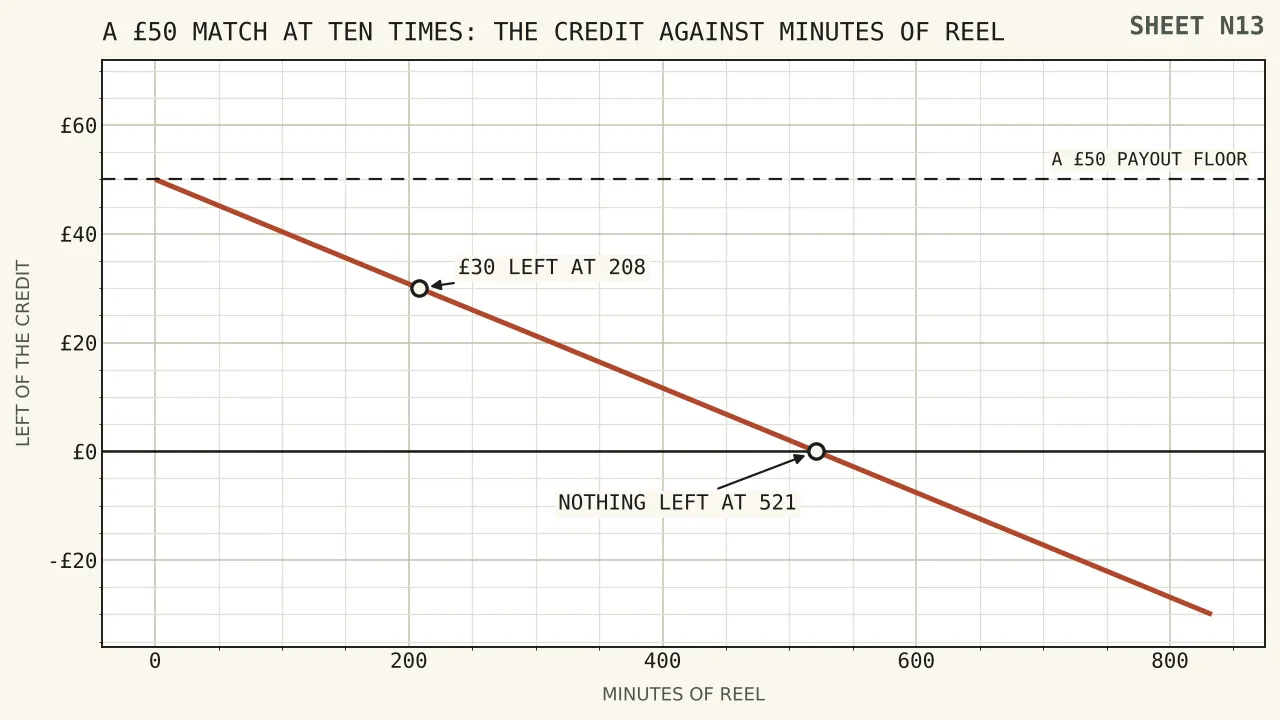
Ten times the credit is £500.00 of required turnover. Four per cent of that figure is £20.00 of expected cost in the clearing, so £30.00 of the credit should come through. In cycles the obligation is 5,000 at 10p, and with the licensed minimum of 2.5 seconds apiece that is 12,500 seconds, or 208 minutes and 20 seconds.
Cashiers with no Great Britain licence sell this shape of offer too, and part 9 prices the absence. The list runs longer here than on any other page of this site, the slots rulebook being the thickest one there is.
Assumptions, stated plainly: a cycle priced at 10p, 96 pence returning out of each staked pound, no weighting until part 5 introduces one, and a denomination ladder running from £10.00 to £100.00. The ceiling of ten times, the stake caps and the pace floor are all sourced, and each is attributed where it appears.
2
Five hundred pounds and two hundred minutes
What a British requirement may ask stops at ten times the bonus funds. The provision sits in code 5.1.1, third limb, with 19 January 2026 as its start, and two licence kinds stand outside it, covering gaming machine technical work and software.
Applied here it gives £500.00 of turnover, and turnover resolves into two quantities a reader notices, money and time.
| If the term says | Cycles at 10p | Turnover | Shortest sitting | Bill | Credit left |
|---|---|---|---|---|---|
| Five times | 2,500 cycles | £250.00 | 104 minutes 10 seconds | £10.00 | £40.00 of it |
| Ten times | 5,000 cycles | £500.00 | 208 minutes 20 seconds | £20.00 | £30.00 of it |
| Fifteen times | 7,500 cycles | £750.00 | 312 minutes 30 seconds | £30.00 | £20.00 of it |
| Twenty times | 10,000 cycles | £1,000.00 | 416 minutes 40 seconds | £40.00 | £10.00 of it |
| Twenty-five times | 12,500 cycles | £1,250.00 | 520 minutes 50 seconds | £50.00 | Nothing left |
| Forty times | 20,000 cycles | £2,000.00 | 833 minutes 20 seconds | £80.00 | A deficit of £30.00 |
The minutes column is the one nobody advertises. At the regulated ceiling the obligation is three and a half hours of unbroken reel. At the figure this site assumes for an unlicensed cashier it is nearly fourteen hours, and the expected bill of £80.00 exceeds the entire £100.00 balance once the reader’s own stake is in the account alongside it.
By the hour the regulated case pays £8.64 in expectation, being £30.00 spread over three and a half hours. That rate is the same on every match at ten times on a 96 per cent game, whatever the size of the payment, because survival and time both move with the credit.
5,000 cycles, 208 minutes, £20.00 of bill, £30.00 surviving
3
A stake ceiling written in law
A stake ceiling on a licensed online slot is statutory rather than contractual. The instrument is the 2025 amendment regulations, made on 25 February 2025, and the new condition caps the total an individual may stake in any game cycle at £5, or at £2 for an individual under 25.
Commencement arrived as a formula and not a date: the regulations took effect six weeks after the day of their making, and a transitional stretch of six further weeks applied a flat £5 to everybody. Calendar dates come from the Commission’s guidance: the higher ceiling from 9 April 2025, the lower one from 21 May that year. Both figures are confined there to online slots, which leaves roulette and blackjack outside them.
The definition has two limbs. A casino game, reel-based, that gets played online. Reel-based itself covers images that move or change, shown by way of reels or by any equivalent means. The condition fastens to each remote casino operating licence, those issued before the regulations included.
What that ceiling does to this key is set the shortest honest sitting. The obligation is £500.00 of turnover however it is staked, so the stake decides the number of cycles and therefore the number of minutes.
| Stake a cycle | Cycles for £500.00 | Shortest sitting | Expected bill | Who may use it |
|---|---|---|---|---|
| 10p | 5,000 cycles | 208 minutes 20 seconds | £20.00 | Anybody, and this site’s standard |
| 50p | 1,000 cycles | 41 minutes 40 seconds | £20.00 | Anybody |
| £2.00 | 250 cycles | 10 minutes 25 seconds | £20.00 | The ceiling below the age of 25 |
| £5.00 | 100 cycles | 4 minutes 10 seconds | £20.00 | The ceiling at 25 and over |
| £10.00 | 50 cycles | 2 minutes 5 seconds | £20.00 | Not on a licensed slot |
The bill does not move down that column, because four per cent of £500.00 is £20.00 whatever size the pieces are. What moves is the number of decisions, from 5,000 down to 100, and the spread of outcomes around the expectation, which widens as the stake grows.
The bottom row is there to show what the ceiling prevents. Without it, a requirement of this size could be cleared in a hundred and twenty seconds at £10.00 a cycle, and the balance would be likelier to have gone before the hundred and twenty seconds were up.
4
The maximum bet the promotion adds
A second ceiling usually sits in the promotion itself, and it works the other way round from the statutory one: it exists to stop a reader clearing a requirement quickly rather than to stop them staking heavily.
Nobody publishes a survey of maximum-bet terms, so the figure used is declared rather than found: one tenth of the credit, bounded below at 10p. On £50.00 that gives £5.00 a cycle, which on this key lands exactly on the statutory ceiling for a player of 25 or over.
For a player under 25 the two ceilings part company. The promotion would allow £5.00 and the law allows £2.00, so the lower one governs and the obligation takes 250 cycles rather than 100. The expected bill is the same £20.00, and the sitting is 10 minutes 25 seconds rather than 4 minutes 10 seconds.
| The ceiling | Where it comes from | What it does here |
|---|---|---|
| £5.00 a cycle | The 2025 regulations | Binds a player of 25 or over |
| £2.00 a cycle | The same regulations | Binds a player under 25 |
| A tenth of the credit | This site’s stated assumption | £5.00 on a £50.00 credit |
| Whichever is lower | Both apply at once | £2.00 under 25, £5.00 above it |
Breaking a maximum-bet term is the quiet way a credit gets forfeited, because the breach is usually a single cycle and the consequence is usually the whole balance. That is a term to read before the first spin rather than after, and it is also the term least likely to appear beside a headline.
Where a British licence applies, a term of that kind sits inside the fairness and transparency duties: terms may not be unfair under the consumer statute, have to be transparent, have to be reachable without difficulty, and a material change needs telling to the customer first.
5
Why a slot is the cheapest place to clear
Where a sign-up credit is restricted to slots, the weighting question changes shape. Slots are the product a requirement is cheapest to clear on, because other casino games are the ones a contribution rate typically discounts.
Thirty per cent is the only contribution rate quotable here, and a respondent in the regulator’s consultation supplied it rather than the regulator itself. At that rate a staked pound counts as 30p towards a requirement, so a £500.00 obligation needs £1,666.67 of staking.
| What it costs | At a full count | At 30 per cent |
|---|---|---|
| Staking needed | £500.00 | £1,666.67 |
| Cycles at 10p | 5,000 cycles | 16,667 cycles |
| Shortest sitting | 208 minutes 20 seconds | 694 minutes 27 seconds |
| Expected bill | £20.00 | £66.67 |
| Credit surviving | £30.00 | Nothing, by £16.67 |
Eleven and a half hours against three and a half is the whole argument for a slots-only credit, and it is also the warning about a credit that may be spent anywhere. A requirement of ten times is affordable on a product counting in full and unpayable on a product counting at under half.
The restriction has a cost of its own, which belongs in the same paragraph for balance. A credit locked to slots is a credit locked to the product with the thickest rulebook and the fastest cycle, and a reader who would rather play something slower is being paid to play something quicker.
One rule removes the obvious workaround. Functionality that lets a customer run several products at the same time is banned on a licensed site, with roulette and blackjack tables named as the example in the release that introduced it, so two requirements cannot be cleared in parallel on one screen.
6
Nine design rules on one reel
A slot under a British licence is built to a specification, and the specification is public. The table below is the part of it that changes what 5,000 cycles feel like and what they cost.
| The rule | Its reference | What it rules out |
|---|---|---|
| A cycle lasting 2.5 seconds at least | RTS 14D | 5,000 cycles cannot take under 12,500 seconds |
| A start control released and pressed | The same requirement | Holding a button down to spin |
| One commitment for each cycle | RTS 8A | Autoplay on a licensed slot |
| No shortening of a result | Guidance to RTS 14E | Quick spin, slam stop and turbo |
| No celebration under the stake | RTS 14F | A 5p win on a 10p cycle made to look like one |
| No near-miss substitution | RTS 7C | A loss dressed up as a near thing |
| Acceptably random outcomes | RTS 7A | A game that adapts its own odds |
| No change to rules in play | RTS 7D | Payouts moving mid-game |
| Chance information before committing | RTS 3C | Playing blind, on one of four measures |
Two of those rows deserve expanding, because they are the ones most often misdescribed. The first is the information duty. Four items appear in it, separated by or, and publishing any single one satisfies the duty: the workings of the game and the settling of prizes; the edge, or the margin; the percentage that comes back; or the odds of a winning event. A reader may therefore clear 5,000 cycles without seeing a percentage, and a page claiming a duty to publish one has misread the standard.
The second is the near-miss rule, the sharpest design prohibition in the set. Designs likely to mislead about the chance of a result are barred, and two are named in terms: putting a near-miss loss where a plain loss fell, and simulating a real device on probabilities the device itself lacks.
The pace rules have a companion for games that are not slots: five seconds between cycles on other casino games, excluding poker between players, a figure dated 17 January 2025 on the Commission’s own updates page. No part of that requirement carries a commencement date in the standard, which is why the date is taken from the updates page, and why it belongs to the five-second figure alone.
Taken together the nine rows are what a British licence buys on a slots key, and they are the reason the arithmetic above can be done at all. Without a pace floor the minutes are unknown. Without the randomness rules the 96 per cent is unknown. Without the information duty a reader has no route to either.
7
Twenty-five, and what forty does
Twenty-five is the multiple that spends an expected credit to the penny, and one division explains why. A game returning 96 per cent withholds four pence in the pound, and 1 over 0.04 gives 25, so a requirement at that multiple costs precisely the credit it is fastened to.
On this key that means £1,250.00 of turnover, 12,500 cycles, 520 minutes of reel and an expected bill of exactly £50.00. The account would then hold the £50.00 that was paid in, and the match would have bought eight and a half hours of play and nothing else.
Below twenty-five a share survives, and the share needs no table: take four per cent of the multiple away from one. Ten times leaves 60 per cent of the credit. Fifteen times leaves 40 per cent. Twenty times leaves a fifth.
Above twenty-five the bill exceeds the credit and the difference comes from the reader. At the forty times assumed here for a cashier past the British ceiling, the bill is £80.00 against a credit of £50.00, so £30.00 of the payment is expected to go as well. The whole £100.00 balance covers it, barely, and the sitting is 833 minutes.
Sixty times is the figure the Commission gave for the heaviest requirements then in use, before it capped the multiple. On this credit it would mean turnover of £3,000.00, some 30,000 cycles, an expected £120.00 of cost and 1,250 minutes, which is an obligation larger than the balance and longer than a working week of evenings.
Per hour the same table reads £23.04 at five times, £8.64 at ten, £3.84 at fifteen, £1.44 at twenty and nothing at twenty-five. That rate falls faster than the multiple climbs, because survival shrinks while the clock lengthens, and the two of them move in opposite directions off one printed figure.
£50.00 of credit eaten exactly by twenty-five times, across 520 minutes
8
Eighty pounds or thirty at the exit
Suppose the requirement is met at the regulated ceiling. The credit has left £30.00. Whether the account holds £80.00 or £30.00 depends on a single question: did the payment stay as cash, or did it go round the game alongside the credit?
A qualifying payment is a deposit, which makes the first reading the default: £50.00 of the reader’s own money in a deposit balance, and no term may cap what leaves one. The second reading is what happens in practice on a slot account, where the balance is pooled and the four per cent finds whatever is staked.
| The minimum payout | Payment kept, £80.00 | Payment staked, £30.00 |
|---|---|---|
| £10.00, the lowest rung | Released, £70.00 over | Released, £20.00 over |
| £25.00, the third rung | Released, £55.00 over | Released, £5.00 over |
| £50.00, the payment’s rung | Released, £30.00 over | Held, £20.00 short |
| £75.00, the fifth rung | Released, £5.00 over | Held, £45.00 short |
The third row is this page’s residue. A cashier whose minimum payout matches the rung the payment arrived on will release a kept payment and hold a staked one, and the difference between those two outcomes is £30.00 of real money on a £50.00 bet with itself.
Crossing a £20.00 gap by playing on is bought at four pence in each staked pound, so variance has to do it. Crossing it by paying again runs into the ladder: the rungs available are £20.00 and £25.00, and the first covers the gap exactly, which is the one tidy result on this page.
Four protections sit over that exit under a British licence. Once a withdrawal has been requested, no offer to cancel it may be made, and the money behind the request is not to be returned to a deposit. Friction is to be kept out of the process. A deposit balance may not have its exit capped, and the regulator’s barred specimen is a daily £50 with a weekly £500. Identity may not become the price of payment where asking sooner was reasonably possible.
£30.00 surviving, £20.00 beneath the rung the payment arrived on
9
The same reel with no British licence
A slots sign-up outside the British licence loses more than any other offer on this site, because more of the rulebook was written for slots in the first place. The cashier in question holds no Great Britain licence, so the table below costs the absence item by item, with a figure wherever one can be attached.
| The duty | Its reference | What it is worth here |
|---|---|---|
| A multiple capped at ten | Limb 3(a) of the code | £500.00 of turnover, not £2,000.00 |
| A £5 cycle, £2 beneath 25 | Regulations made in 2025 | A floor under the number of cycles |
| 2.5 seconds a cycle | RTS 14D | 208 minutes rather than any figure |
| No autoplay | RTS 8A | 5,000 separate commitments |
| No turbo or slam stop | Guidance to RTS 14E | The sitting cannot be compressed |
| No near-miss display | RTS 7C | A loss is shown as what it is |
| Outcomes acceptably random | RTS 7A | No adaptive behaviour behind the reel |
| One product running at once | Required from 17 January 2025 | No parallel clearing on one screen |
| Net spend shown live | The same date | The £20.00 visible as it goes |
| Identity settled before a first cycle | Condition 17.1.1 | Verification comes ahead of the reel |
| No cap on a deposit balance | Withdrawal-limits guidance | The £50.00 payment stays reachable |
| A place in the exclusion scheme | A licence condition | Membership is not the room’s choice |
Active accounts in the same annual report number 25.7 million as the last reporting quarter closed, and on 31 March 2026 the register held 2,154 operators with 3,097 licensed activities between them. Every one of those activities is inside the table above. A cashier absent from that register is inside none of it.
Curaçao’s policy for its own licensees, version 1.0 and 21 February 2025, makes eight areas compulsory. Age verification. Information. Self-assessment by a player. Tracking of behaviour. Cooling-off, and exclusion. Deposit limits. Training, for staff and for affiliates. Principles for marketing. Absent from it: any ceiling over wagering, any cap over a stake, any minimum cycle, any autoplay ban, any restriction on how a sub-stake return gets presented. Set that absence against the twelve rows above and it is the sourced part of what a British player hands over.
Two items in it run the other way, and a fair page records both. Deposit limits fall at once and rise only after seven days, where a British licensee may raise one in a single day. And its complaints policy allows six months for lodging, four weeks before a first answer, one extension given in writing, and arbitration funded by the operator, which is a route and not an absence.
Where the two regimes genuinely part is authorship and enforcement. The parameters, under that policy, may be set by the operator, down to whether its outcome has any binding force. In Great Britain the arbitrating entities need the regulator’s approval, a register and a penalty list are both published, and the regulator states in its own words that the ombudsman role is not its and that recovering money is beyond it.
The exclusion row is last and cannot be bought. A place in Gamstop Online comes with the British licence, so a cashier lacking one is simply not in it, and the scheme’s terms record that services from organisations outside it cannot be blocked by it. For a reader who has excluded themselves, that sentence is the whole reason to check the register before paying anything, and searching the register costs nothing.
Questions
- What does a £50 slots sign-up actually give me?
- At one hundred per cent, £50.00 of credit, making the balance £100.00. The payment occupies the fourth rung of this site’s ladder, so buying it strands nothing, and half the balance is the reader’s own money throughout.
- How much turnover does the ceiling allow?
- £500.00, which is ten times the credit. That is 5,000 cycles at 10p and 208 minutes 20 seconds at the licensed pace of 2.5 seconds a cycle. Four per cent of the turnover is the expected cost, £20.00, which leaves £30.00 of the credit.
- What is the maximum stake on a licensed slot?
- £5 for a single game cycle, or £2 where the individual is under 25. The figures come from the 2025 amendment regulations made on 25 February 2025, and the Commission’s guidance supplies the calendar dates, 9 April 2025 for one ceiling and 21 May 2025 for the other. Both reach online slots only.
- Does a bigger stake make clearing cheaper?
- No, only quicker. Four per cent of £500.00 is £20.00 at any stake size, so the bill is fixed while the clock shortens: 100 cycles at £5.00 is 4 minutes 10 seconds against 5,000 cycles at 10p and 208 minutes. The stake grows the spread of outcomes instead, so a balance may well be gone before the requirement is finished.
- What happens if the promotion caps my bet lower?
- The lower ceiling governs. On the assumption used here, one tenth of the credit bounded at 10p, the promotion would allow £5.00 on a £50.00 credit, which matches the statutory ceiling for a player of 25 or over. Under 25 the law allows £2.00, so the obligation takes 250 cycles rather than 100.
- Why are slots the cheapest product to clear on?
- Because a discounted contribution rate is what other casino games carry. At the 30 per cent rate a respondent gave in the regulator’s consultation, £500.00 of required contribution needs £1,666.67 of staking, which is 16,667 cycles, 694 minutes and an expected £66.67 of cost set against a credit of £50.00. Counting in full, the same requirement costs £20.00.
- Why does 25 keep appearing?
- Because 0.04 inverted is 25, and a game returning 96 per cent withholds 0.04 of each staked pound. Twenty-five times a credit is therefore expected to swallow it whole, which here means £1,250.00 of turnover, 520 minutes and a bill of £50.00 against £50.00 of credit.
- What does forty times do to this offer?
- It asks £2,000.00 of turnover, 20,000 cycles and 833 minutes, with an expected bill of £80.00 against a credit of £50.00. The difference comes out of the payment, so £30.00 of the reader’s own £50.00 goes as well, and nothing in the headline percentage announces that.
- What is stranded if everything goes right?
- £30.00, where the payment has been staked and the minimum payout sits at £50.00. That rung is where the money came in, the survivor falls £20.00 beneath it, and a floor is all or nothing. Keep the payment as cash instead and the account holds £80.00, which clears the same floor with £30.00 to spare.
- Must a licensed slot tell me its return percentage?
- No. Four alternatives joined by or make up the duty: the workings of the game with the settling of prizes, the edge or the margin, the percentage that comes back, or the odds on a winning event. Any one of them will do, so a reader can complete 5,000 cycles without a percentage ever appearing.
- What is missing from an unlicensed slots offer?
- The twelve duties in part 9. No ceiling on the multiple, so £2,000.00 of turnover becomes possible. No £5 or £2 stake cap, no 2.5 seconds between cycles, no autoplay or turbo ban, no near-miss prohibition, no requirement that outcomes be acceptably random, no live display of net spend, no identity check before the first cycle, nothing to stop a deposit balance being capped, and no place in Gamstop Online.