Note F02 Revision 1 Terms read 16 October 2026
Casino no deposit bonus: a £25.00 face, costed to the penny
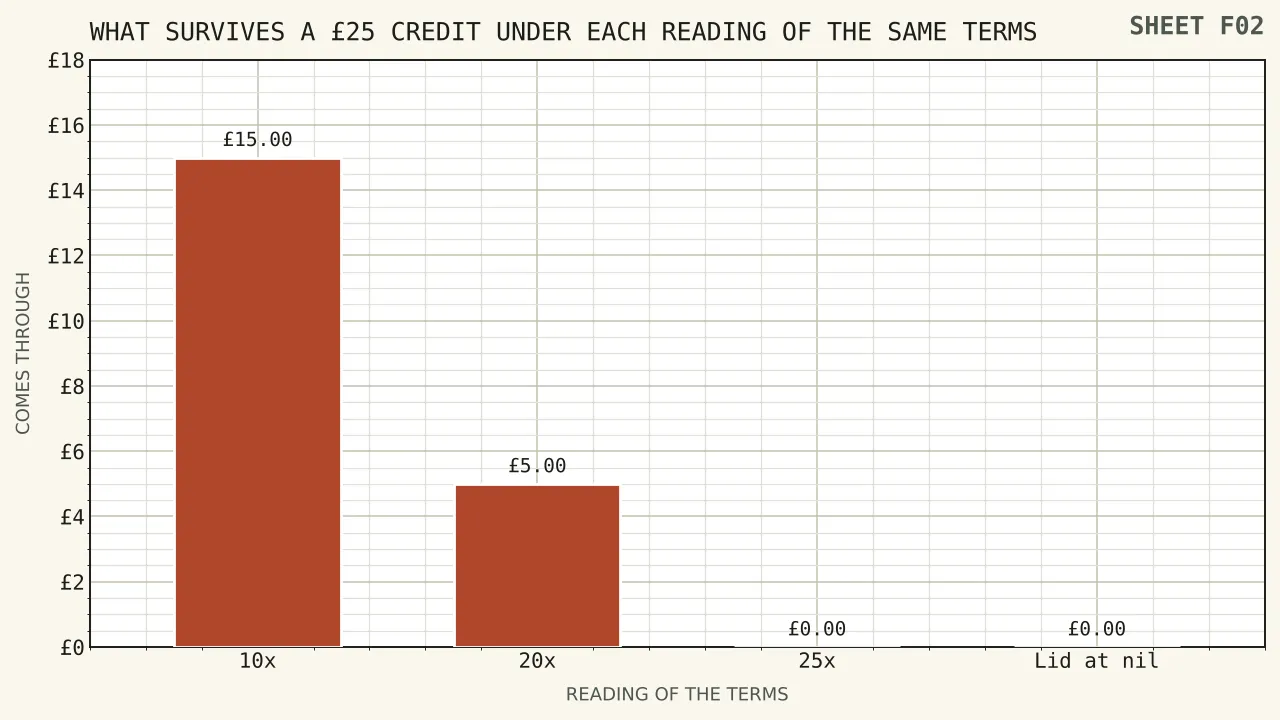
A credit of £25.00 with nothing paid in behind it buys £250.00 of obligation at the British ceiling. Turnover of that size costs £10.00 in expectation, so £15.00 arrives at the far end. Whether £15.00 is money or a number on a screen is then decided by three terms, and this page prices all three.
The face £25.00 What draws it down £10.00 What is stranded £15.00
What a face of this size is worth
Every destination on this rack is bought advertising. The site takes a fee if a reader goes on to register, and no figure printed below moves because of it.
Face and Residue
Strip No 01
Betportal
Ceiling as a multiple
Priced at this site's own 10p a spin
What is printed
What draws it down
What is stranded
No Great Britain licence
Licensed in Anjouan, Comoros, run by BetPortal Gaming Ltd, with Excite Ultra Media Ltd, reference ALSI-202601040-FI2.
Terms read 16 October 2026
Open the offer at Betportal, opens in a new tabFace and Residue
Strip No 02
WinBeast
Ceiling as a sum
Priced at this site's own 10p a spin
What is printed
What draws it down
What is stranded
No Great Britain licence
Licensed in Curaçao, operator not named on the site.
Terms read 16 October 2026
Open the offer at WinBeast, opens in a new tabFace and Residue
Strip No 03
EliteSpin
Longest spin window
Priced at this site's own 10p a spin
What is printed
What draws it down
What is stranded
No Great Britain licence
Licensed in Costa Rica, run by PrimeTier Limited.
Terms read 16 October 2026
Open the offer at EliteSpin, opens in a new tabFace and Residue
Strip No 04
Crown Jewelz
Multiple unpublished
No residue struck
What is printed
What draws it down
What is stranded
No Great Britain licence
Licensed in Curaçao, number not verified, operator not named on the site.
Terms read 16 October 2026
Open the offer at Crown Jewelz, opens in a new tabThe two figures in the second and third registers are this site's own arithmetic and nothing an operator has published: the face as printed, less the share a spin gives back at 96 per cent return to player, less what playing the wagering through costs at the same return, and then less whatever a published ceiling, a charge on the way out or a floor on the smallest withdrawal takes off what survives that. The residue is what is left of the face when all of it is accounted for. It describes the offer, not one reader's afternoon. Where the conditions price above the face the strip prints nothing coming off rather than a negative sum, and where a figure the sum needs is unpublished it prints the condition in the operator's words instead.
A face paid as spins has no unit of its own, so one is supplied. Where an operator publishes what a spin of its own is worth, that figure stands in the first register's own line and is labelled as theirs. Where it does not, this site's own 10p a spin stands there and says so, and every figure below moves in proportion: at half the price, half the money. The share of the face that does come off is also given as pence in the pound, which is the figure that compares a large face against a small one.
Money goes onto a prepaid voucher in fixed denominations, so a smallest deposit published in pounds is rounded up to the first rung of the ladder this site works in, £10, £20, £25, £50, £75 and £100, and the strip prints what that rounding strands. That is the reader's own money and it is never netted into a residue. A smallest deposit published in euros is printed as the operator publishes it, because the ladder here is a sterling one and rounding a euro sum to it would be an invented figure.
Three words stand in the amount column where no figure can. Noted is a published condition that takes value away without leaving the sum a figure to take. Unpriced is a condition whose figure nobody has published, or a credit that is not a sum until a deposit of your own sets it. Own money is money of yours, which is never part of a residue.
Not one of the operators printed above holds a Great Britain licence, so the duties that licence carries do not reach them. All online gambling companies licensed in Great Britain must be part of Gamstop Online, and a reader who has shut themselves out through the scheme is therefore not shut out here. The ceiling of ten times the bonus funds on a wagering requirement, in force since 19 January 2026 under Social Responsibility Code 5.1.1, is a condition of that licence and binds the companies that hold one. On an unlicensed site the Gambling Commission describes consumers as facing unfair gaming practices, financial loss and a lack of recourse if things go wrong, and it names blocked payouts and withdrawal limits set so high they are unattainable among what it has seen. Nobody under 18 may hold an account at any of them.
Every term printed on a strip is the operator's own, and each strip carries the day it was read. The oldest of those readings is 16 October 2026. What binds a reader is the operator's own full terms, and not a line printed here.
1
A credit arrives with a multiplier bolted on
A count of spins has to be converted into money before anybody can argue about it. A cash credit skips that step and arrives as money already, which looks like candour and mostly is not, because the figure deciding its worth is not the credit. It is the multiplier bolted to the credit, and the two are set in wildly different type sizes.
The face worked here is £25.00. That figure is a rung: money goes onto a prepaid instrument in fixed denominations, and the ladder in use across this site is £10, £20, £25, £50, £75, £100. Landing exactly on a rung strands nothing to rounding, which clears the ground and leaves the whole of the residue to be explained by terms rather than by denomination.
Three assumptions carry every sum below and each one is declared, not discovered. A cycle costs 10p. A game gives back 96 of every 100 pence staked. Weighting is set at one, so a pound staked counts a whole pound towards an obligation, until part 3 relaxes that and prices the difference.
Out of those the cost of turnover falls directly. A 96 per cent return leaves 4p of every £1.00 behind. Push £250.00 through a game and £10.00 is the expected cost. Push £1,000.00 through and it is £40.00. A credit does not shrink because a cashier has taken against the reader. It shrinks because the obligation is denominated in turnover, and turnover is charged at 4p a pound.
£25.00 of credit, £250.00 of turnover, £10.00 of expected cost
None of this is a defect in the offer, and the page is not written as though it were. Giving away a credit with nothing paid in behind it is a marketing cost somebody has chosen to carry, and the multiplier is how that cost gets contained. The difficulty for a reader is narrower: the multiplier is the whole arithmetic and it gets a twentieth of the space.
One definition first. A wagering requirement, as the regulator puts it, obliges a customer to place wagers adding up to a stated value, at which point funds become withdrawable. The value is not fixed anywhere in that definition. Nor does anything in it require the obligation to be completable out of the credit. Those two silences generate every figure on this page.
Finally, what the credit is worth before a single term touches it. Stake £25.00 once at 96 per cent and £24.00 comes back, so £1.00 is gone. That solitary pound is the only residue a reader can know ahead of reading anything, and it is also the unit a multiplier works on: charge £1.00 ten times over and £10.00 is gone.
2
Twenty-five pounds against twenty-five times
An arithmetic coincidence makes this page unusually easy to read. The face is £25.00 and the break-even multiple is 25. Nothing connects them: one is a denomination off a voucher ladder, the other is 1 divided by 0.04. Side by side, though, they state the problem in a line, because a £25.00 credit at 25 times is worth exactly £0.00.
Great Britain holds the multiple well below that. On £25.00 the most that may be asked is £250.00 of turnover, ten times the bonus funds and no further. The provision sits at limb 3(a), Social Responsibility Code 5.1.1. Commencement: 19 January 2026. Scope: every licence other than the two technical ones, gambling software and gaming machine technical, so a remote casino licence is inside it.
| Multiple | What that is | Turnover | Expected cost | Never coming off | Comes through |
|---|---|---|---|---|---|
| 10 times | Licensed ceiling | £250.00 | £10.00 | £10.00 | £15.00 |
| 15 times | Two fifths left | £375.00 | £15.00 | £15.00 | £10.00 |
| 20 times | A fifth left | £500.00 | £20.00 | £20.00 | £5.00 |
| 25 times | Nothing left | £625.00 | £25.00 | £25.00 | £0.00 |
| 40 times | £15.00 past nothing | £1,000.00 | £40.00 | £25.00 | £0.00 |
| 50 times | £25.00 past nothing | £1,250.00 | £50.00 | £25.00 | £0.00 |
The residue column is the point of the table. Of a £25.00 headline, £10.00 was never coming off at the ceiling a British licence imposes, £20.00 was never coming off at twice that, and from 25 upward the figure is the whole £25.00. Forty times is the multiple this site assumes, because that is the sort of figure available to a cashier that answers to nobody on the register, and there the obligation runs £15.00 heavier than the credit carrying it.
Negative arithmetic wants explaining rather than dramatising. Nobody finishes £15.00 down on a credit that was never theirs. What happens is that £25.00 cannot discharge an obligation costing £40.00, so either play halts part way and the terms take the balance, or it goes on using the reader’s own money at the same 4p a pound.
Time is the figure no headline carries. Cycles at 10p: 2,500 for £250.00, and 10,000 for £1,000.00. RTS requirement 14D puts 2.5 seconds between one slot cycle and the earliest start of its successor, turning those counts into 6,250 and 25,000 seconds. In plain units: 1 hour 44 minutes 10 seconds, and 6 hours 56 minutes 40 seconds. Divide £15.00 by the shorter and the rate is £8.64 an hour. Divide £0.00 by the longer and the rate is what it appears to be.
6 hours 56 minutes 40 seconds of play, for an expectation of £0.00
3
Weighting, the multiplier nobody prints
A ceiling on the multiple is not a ceiling on turnover, because a third figure sits between them. What weighting fixes is the share of a staked pound that lands on an obligation. Count a game at less than 100p and the staking needed rises, while the printed multiple stays exactly where it was.
One contribution rate can be quoted here with its provenance, and it is quoted as exactly what it is. A respondent to the Commission’s consultation described a game at 30 per cent, so 30 pence of every pound wagered lands on the requirement. The regulator recorded that and acted on none of it. Everything following is this site’s own working against the quoted rate, and not a Commission finding about any market.
On a £25.00 face: ten times asks for £250.00 of contribution. At 30 pence a pound, £250.00 of contribution takes £833.33 of staking. Four per cent of £833.33 is £33.33. So a ten times obligation discharged wholly at 30 per cent costs £33.33 in expectation, against £25.00 of credit, which strands the face entire with £8.33 to spare.
| Contribution | Staking needed | Comes through |
|---|---|---|
| 100 pence a pound | £250.00 | £15.00 |
| 50 pence a pound | £500.00 | £5.00 |
| 40 pence a pound | £625.00 | £0.00 |
| 30 pence a pound | £833.33 | £0.00 |
| 10 pence a pound | £2,500.00 | £0.00 |
Forty pence a pound is the hinge. There a ten times rule needs £625.00 of staking, the expected cost is £25.00, and the credit lands on nothing. Below 40 pence a ten times requirement has already passed break-even while sitting comfortably inside a regulated ceiling of ten. The ceiling holds and the arithmetic walks round it.
That is not an attack on the ceiling, which does real work. Without it the multiple could be 60, and at 60 times no weighting at all is needed to finish a credit: £1,500.00 of turnover costs £60.00 against £25.00 of credit. The warning is against reading one figure alone. Two offers both at ten times are not comparable until the contribution rates sit beside them.
Two honest limits on what this part can say. A current contribution table, whether for one operator or for a whole market, is published by no primary source, so none appears here as a figure. And the combined case, an obligation covering a deposit as well as a credit, goes unpublished: bonus funds are the ceiling’s written subject, and no worked example reaches past them.
Three figures decide a credit. The credit. The multiple. The contribution rate of whatever game the reader will actually play. A headline carrying the first two and leaving the third to the terms has handed over two thirds of a sum, which is not a sum.
4
One incentive, one product, and three exceptions
A second rule landed on the ceiling’s own day, 19 January 2026, with the same scope, and it is routinely described wrongly. One type of gambling product per incentive is the whole of it, and 4 types are named: betting, casino, bingo, lottery.
Narrowly stated is how the aim is put, and that is the part lost in retelling. What the ban reaches is 2 products inside one incentive on linked and shared terms. Then 3 carve-outs run against what a reader would assume, and each bears on a credit.
| Still allowed | The regulator’s example |
|---|---|
| Two products of one type | A lottery scratchcard beside a raffle |
| Two offers in one email | Betting and casino, where both have an opt-in |
| A credit spendable anywhere | £10 usable across betting and casino |
So £25.00 of casino credit playable on slots or on a table is one product, since both are casino. Put casino credit beside bingo tickets and 2 of the 4 named types are in play. That reading comes off the rule’s own list, and it is offered as a reading rather than as something the regulator has worked through in public.
What the rule does not decide is where the turnover may be run, and part 3 has already shown that this is the figure with the money in it. A credit confined to a game weighted under 40 pence a pound is past break-even at ten times. A credit spendable across a casino at a full pound of contribution leaves £15.00. The terms settle that, and a reader has to go and read them.
A related point shows more clearly on a match than on a credit, and it answers the commonest misreading of the ceiling. What is limited is the multiple and not the percentage. Each pound of bonus carries the same turnover whatever the percentage: a larger percentage raises the bonus, and raises the turnover in step with it. Ten to one holds however large the headline, so the only regulated figure in a 400 per cent advertisement is the ten.
| Headline | Bonus | Ceiling on turnover | Expected cost | Ratio |
|---|---|---|---|---|
| 400 per cent | £40.00 | £400.00 | £16.00 | Ten to one |
| 300 per cent | £30.00 | £300.00 | £12.00 | Ten to one |
| 200 per cent | £20.00 | £200.00 | £8.00 | Ten to one |
| 100 per cent | £10.00 | £100.00 | £4.00 | Ten to one |
The ten in that table is the regulated figure. Everything else in it is this site’s own arithmetic, worked at a 96 per cent return, and it is set out to make one point: the bigger headline is the bigger obligation, in exact proportion, and nothing in the ceiling makes it a better deal per pound.
5
A stake cap moves the clock, not the cost
Bonus terms often cap the stake on a single cycle while an obligation is outstanding. How such caps are distributed across this market is not published anywhere, so what follows uses a declared modelling figure and nothing more: one tenth of the credit, floored at 10p. On £25.00 that gives £2.50.
Discharge the obligation at £2.50 a cycle and £250.00 of turnover is 100 cycles. At the 2.5 second minimum, 100 cycles is 250 seconds, or 4 minutes 10 seconds. The same £250.00 at the house cycle price of 10p is 2,500 cycles, 6,250 seconds, 1 hour 44 minutes 10 seconds. So a cap pitched at one tenth of the credit is no restriction whatever: 2,500 cycles divided by 25.
The restrictive case is a cap sitting at or near the cycle price, because then the number of cycles is pinned at its maximum and no willingness to stake larger shortens anything. Priced as time, that term becomes legible at once: 10p a cycle against a 40 times obligation is 10,000 cycles and very nearly seven hours.
| Cap a cycle | Where it bites | Cycles for £250.00 | Seconds at the minimum | Shortest run |
|---|---|---|---|---|
| £0.10 | Hardest, on time | 2,500 | 6,250 | 1 hour 44 minutes |
| £0.50 | Noticeably | 500 | 1,250 | 21 minutes |
| £2.50 | Barely | 100 | 250 | 4 minutes |
| £5.00 | The statutory slot limit | 50 | 125 | 2 minutes |
That final row is no bonus term. A statutory instrument of 25 February 2025 holds one online slot cycle to £5 at 25 or over, and to £2 under 25. Calendar dates for the two came from the Commission rather than the instrument: 9 April 2025, then 21 May 2025. Slots only, in both cases. Roulette and blackjack fall outside.
Why a stake cap matters to a credit at all is that the expected cost of an obligation does not move with the stake. Turnover of £250.00 costs £10.00 in expectation whether it leaves in 50 cycles or in 2,500. What moves is the spread of outcomes about that expectation, and the hours. Fifty cycles at £5.00 is a wide distribution and two minutes of life. Two thousand five hundred cycles at 10p is a narrow one and nearly two hours. Identical expectation, utterly different experience.
Three published design rules cover the same ground where a British licence is held, and each costs an operator something. Set out as a table rather than a paragraph, because what matters is which figure on this page each one protects.
| Rule | What it stops | What it protects here |
|---|---|---|
| RTS 14A | 4 encouragements: chasing a loss, lifting a stake, raising what had been settled on, playing past a stated stop | Guards the 2,500 separate decisions from becoming one slide |
| RTS 14A guidance | Topping a product up unless chosen each time; tempting a departed customer back with a free game | Keeps a second credit away from somebody who has left |
| RTS 14F | Any celebration of a return at or beneath the stake, whether in sound or in vision | Stops 2,500 small losses being dressed as wins |
| RTS 14C | Functionality for several games at once, split screens and multi-screens included | Holds the clock at one cycle every 2.5 seconds |
Hold that table against an offer whose entire purpose is to bring a new account into play, and the British position becomes visible. An incentive is permitted. An incentive engineered to pull somebody back after they have stopped is not. Version 1.0 of the Curaçao responsible gaming policy, which is dated 21 February 2025, has nothing like any of those 4 rows in it.
6
A ceiling pegged to deposits nobody made
Here is the term that does the most damage to a face with nothing paid in behind it, and it does the damage quietly, because at first reading it looks like a safeguard.
Some bonus policies limit what a bonus balance may turn into real money by reference to what the account has deposited over its life. Put as a shape rather than as a counted market figure, which is as far as this site will take it: conversion may not exceed lifetime deposits, frequently with an absolute ceiling above that as well. How common the shape is goes unpublished by every primary source, and no frequency is claimed here.
Apply the shape to a no-deposit face. Lifetime deposits on an account with nothing paid in are £0.00. A conversion ceiling set at lifetime deposits is accordingly £0.00. The £15.00 that survived the obligation turns into nothing whatever, the residue is the entire £25.00, and every step of arithmetic before this one was decoration.
Lifetime deposits of £0.00 make a conversion ceiling of £0.00
Because that is the sharpest claim on the page, its status needs stating twice. It is arithmetic applied to the shape of a term. A reader’s job is to look for the shape in the terms, not to assume it is present. What makes the shape worth modelling is how differently it behaves elsewhere: on a deposit offer, £10 paid in lifts the ceiling to £10 and £50 lifts it to £50. Against a face with nothing paid in, the clause is total.
A flat ceiling on bonus winnings is the second shape, and no standard figure for it is published, so again the shape is modelled and not counted. Set £50.00 against this page’s £15.00 expectation and on average the ceiling strands nothing, because the mean is nowhere near £50.00. What a ceiling deletes is the upper tail, which is the only stretch of the distribution repaying 104 minutes. Expectation untouched; reason for playing deleted; and no mean will ever show it.
Then the rule those two get confused with, which is a different animal. A deposit balance carries no cap on the way out at all. £50 a day with £500 a week is the prohibited wording, and over a year that is a £26,000 lid on money the player already owns. That page adds 2 things: a deposit balance is withdrawable whenever the player likes, winnings included, and reasonableness governs any limit on size or frequency.
A bonus balance is a different account from a deposit balance. So a ceiling on what a bonus converts, and an open door on a reader’s own money, can both stand in one cashier at one moment, and running the two together is an error. No publication date appears on the page carrying that withdrawal rule, so it is cited for the rule alone with no freshness attached.
Forfeiture is the fourth shape, and the only one carrying a penalty in the published record. The figure: £170,000. The licensee: Taichi Tech Limited, Fafabet being its trading name. The decision date: 3 July 2025. The term: a discretion, reserved to itself, over closing an account and over keeping winnings. The finding: the fair and open condition breached. The remedy alongside the £170,000: an audit, independently conducted, covering controls on anti-money-laundering and on safer gambling. A fine over a clause is not a clause struck down, so nothing here calls it void.
7
Getting £15.00 out of a cashier
Suppose part 6 does not apply at all. Ten times, a full pound of contribution, nothing forfeited, £15.00 sitting in the account. Whether £15.00 can leave is a separate question, and it turns on a figure with no connection to bonuses.
Payout floors exist because moving a small sum costs a cashier real money. Put the floor at £10.00, the bottom rung of the ladder in use here, and £15.00 clears it with £5.00 over. Put it at £20.00 and £15.00 does not clear it, so the lot is stranded, £5.00 short. That single line is why a page on credits has to ask the exit question before congratulating anybody on the sums above.
Playing on will not close a gap of that kind. At 4p of expected cost per £1.00 of turnover, £15.00 staked once costs 60p, and £15.00 staked ten times over costs £6.00. Stake size does not lift an expectation, the sign on an edge never changing. Variance is the only road across £5.00, and 4p a pound is the fare.
Adding money runs into the ladder again. A reader needing £5.00 to reach a £20.00 floor cannot buy £5.00 of anything, the smallest rung being £10.00, so £5.00 of the purchase is surplus to its purpose before a penny of it is spent. Residue on the way in, residue on the way out, one ladder producing both.
| Payout floor | Leaves | Stranded |
|---|---|---|
| £5.00 | £15.00 | £0.00 |
| £10.00 | £15.00 | £0.00 |
| £20.00 | £0.00 | £15.00 |
| £25.00 | £0.00 | £15.00 |
Then the clock a reader has if a payout is refused, which is the other half of an exit. It is set out below as a table, because every row of it is a number and the numbers are the whole point.
| Step | Clock | Note |
|---|---|---|
| Acknowledgement | 3 working days | Cut to 24 hours at a cashier open at any hour |
| Whole process | 56 days | The 8 weeks a code provision fixes, escalation included |
| Window to complain | 6 months | From the incident, and no term may shorten it |
| Clock stopped | 7 days | Where a reasonable request goes unanswered, restarting from the same point |
Three jobs fall to the letter ending that process: give the decision, say the operator’s own procedure has run out, explain the route onward. Approved entities alone may be used, and the Commission’s wording puts a licensed operator under a duty to use one or more that it has approved. IBAS, on that same page, is described as adjudicating where a licensed operator and its customer are in dispute, which is a phrase worth reading twice on a site about offers made away from the register.
Coverage by sector differs between the approved entities, and for a casino player that difference decides everything. Remote across all sectors covers 5 of them. Two more, ProMediate and Tattersalls Committee, show for all sectors in the table, though betting alone appears in the Tattersalls Committee entry. Pegasus ADR Service covers 4 sectors: family entertainment centres, adult gaming centres, public houses and members clubs, and bingo away from the internet. Remote casino reads on none of its lines.
8
What the advertising rules make a promotion say
A credit is advertised before it is ever credited, and the advertising is regulated apart from the licence. Two code provisions land on a British licensee here. Social responsibility code 5.1.6 is compliance with the advertising codes. Code 5.1.11 is consent: no direct electronic marketing to a consumer without informed and specific permission, unless some law expressly allows it.
Opt-in marketing, by product type and by channel, started for online gambling on 1 May 2025. One date replaced another there, and the release says so outright: the requirement shifted off 17 January 2025. Nothing on this site puts the January date against the marketing rule, since the source records the move.
Two other changes did land on 17 January 2025, and a reader comparing cashiers can use both. Two figures go in front of a customer as they move: net spend, and time spent gambling. Functionality the operator leads for several products at once is banned, roulette and blackjack tables being the example given.
What a promotion has to say is governed from a different direction, and the duties are short enough to tabulate.
| Duty | Put plainly |
|---|---|
| Do not mislead | The base duty, and the shortest sentence in the whole of it |
| Prominence | Significant terms inside the advertisement, near the headline on a landing or sign-up page. Too little prominence makes the advertisement misleading |
| A casino promotion’s own list | Likely to cover a minimum stake, how to take part, and any wagering requirement |
| Proportionality | Rewards matched to money and time spent, not climbing faster as spending climbs, and not pushing substantial amounts at a fixed frequency |
| The one worked example | A free bet, awarded once, after £50 of wagering. Its condition: a free bet at £50 should not be unusual for the gambling involved |
| Social responsibility | Rule 16.1, with particular regard to children, young persons and other vulnerable persons |
| Not a way out of money trouble | Rule 16.3.4: not a solution to financial concerns, not a substitute for a job, not a route to financial security |
| Not aimed at the young | Rule 16.3.12 on strong appeal, and rule 16.3.14, under which nobody who is or looks under 25 may be shown gambling |
An exception to that last row runs narrow, and it is worth stating because a reader meets it without noticing. Ages 18 to 24 are inside it: a significant role is open to them where the advertisement sits where a bet is placed directly, an operator’s own website for instance, and only with the bet as their subject and no gambling setting around them.
Which codes bite is published rather than inferred. Non-broadcast, 4 sections: 3, 8, 16, 17. Broadcast, 4 again: 3, 17, 18, 22, that last one covering premium-rate telephone services.
A silence belongs here too, because it gets filled in wrongly. Affiliates are not addressed on the Commission’s advertising page. Third parties appear in its digital advertising section alone, where all reasonable steps have to be taken so that contracted third parties also keep off copyright-infringing websites. Nothing beyond that may be attributed to it.
Curaçao does reach affiliates directly. Affiliate compliance with responsible gaming standards is the operator’s responsibility there, enforced through binding contracts, through compliance audits, and through penalties where compliance fails. Its marketing restrictions run to 8 bars. Advertising that misleads. Advertising that is excessive or aggressive. Targeting of the self-excluded, of the problem gambler, of the financially vulnerable. Gambling as a route to financial success. Skill misrepresented against chance. Emotional manipulation. Child-friendly content. And marketing during a live cooling-off or self-exclusion.
On bonuses that same policy runs to two lines, and the two lines are all of it. Transparent communication with clear terms is the first. No encouragement of excessive gambling through aggressive bonus promotion is the second. No ceiling of ten times appears. No mixed-product ban appears. Nothing resembling a worked list of significant conditions appears either.
9
Duties that stop at the edge of the register
Faces of this shape are offered where no Great Britain licence is held, and the useful way to say what that costs is to price it rather than to deplore it. The table below takes duties binding on a British licensee and sets against each the figure it moves on this page’s £25.00 face.
| Duty | Where it comes from | What it moves on £25.00 |
|---|---|---|
| Ten times and no further | Social Responsibility Code 5.1.1 | £15.00 arrives rather than £0.00 |
| A single product per incentive | The companion rule of 19 January 2026 | Keeps one set of linked terms off two kinds of gambling |
| £5 a cycle, £2 under 25 | Regulations made 25 February 2025 | Caps the widest spread a slot cycle can produce |
| 2.5 seconds between cycles | RTS requirement 14D | Puts 6,250 seconds behind £250.00 of turnover |
| No enticement back after stopping | RTS requirement 14A | Rules out a free game aimed at somebody who has left |
| No celebrating a sub-stake return | RTS requirement 14F | Stops 2,500 small losses being dressed as wins |
| No playing several games at once | RTS requirement 14C | Holds the clock at one cycle in 2.5 seconds |
| Net spend shown in real time | In force 17 January 2025 | Makes the £10.00 cost visible while it is being paid |
| Marketing by consent only | Social responsibility code 5.1.11 | No second credit offered without an opt-in |
Nothing in that table appears in the rulebook Curaçao publishes. One point in it is tighter than the British position, and that point is the brake on a deposit limit. A reduction takes hold at once. An increase waits 7 days there, against a British cooling-off period of 24 hours at the least before an increase lands.
Self-exclusion is where the border cuts hardest, because membership tracks the licence rather than the website. Figures went out on 16 July 2026, and four of them bear on a page about a sign-up credit.
| Published figure | Reading |
|---|---|
| Registrations by under-25s, year on year | Up 26 per cent |
| Share of self-exclusions taken by under-25s | Close to 1 in 3 |
| Registrants choosing the longest period | More than 1 in 2 |
| Under-25s choosing six months | 38 per cent |
A cashier absent from the British register sits outside that scheme by construction. The scheme’s own terms say that access to services run by non-participating organisations is something it cannot help prevent, so nothing in those 4 rows is available to anybody at a cashier it has never heard of.
Enforcement closes the account, and it can be shown rather than asserted. The published penalty listing runs from £122,835 up to £10m, with licence suspensions carried on a register of their own. On its own limits the regulator is candid. Fully dismantling the ecosystem is unlikely, it has written, given the revenue at stake. Alongside that it reports traffic falling 32 per cent, measured across 160 websites targeted for action. One further consequence it names is commercial instead of regulatory, and a reader is likelier to meet that one than any of the rest: an unlicensed business may find its payment facilities withdrawn by major payment systems organisations.
Finally the five-minute check that no arithmetic here replaces. Four registers are published: licensed businesses, licensed individuals, regulatory actions, premises, each searchable and downloadable. Four things are to be confirmed. One, a licence held. Two, a licensed status shown on the site. Three, a licence that opens on the register. Four, details there, website domain names and activities among them, agreeing with the claim. No date and no reading guidance appear on the register page itself, so register data needs the date it was checked printed beside it.
Questions
- What is a £25 no deposit bonus actually worth?
- At a ten times obligation, 100 pence of contribution a pound, a 10p cycle and 96 per cent returned, the expectation is £15.00. Turnover of £250.00 costs £10.00 at 4p a pound, and that £10.00 is the part of the face which was never coming off. At forty times the turnover is £1,000.00, the expected cost is £40.00, and the credit runs out before the obligation does.
- Why does break-even sit at 25 times?
- The figure 25 is 1 divided by 0.04. Turnover of £1.00 costs 4p where 96 per cent comes back, so £25.00 of turnover costs £1.00. A credit therefore reaches an expected £0.00 at precisely 25 times. Over 25 the obligation costs more than the credit carrying it, which is why 40 times leaves nothing whatever.
- Can an offer at ten times still be unclearable?
- Yes, through weighting. A game contributing 40 pence a pound turns a ten times rule into £625.00 of staking on a £25.00 credit, and 4 per cent of £625.00 is £25.00, the whole credit. Below 40 pence the arithmetic has passed break-even while the printed multiple sits inside a regulated ceiling of ten. No primary source publishes a contribution table, so no market figure is offered here.
- What is the worst term on a credit with no deposit behind it?
- A conversion ceiling pegged to lifetime deposits. On an account with nothing paid in, lifetime deposits are £0.00, so a ceiling of that shape converts £0.00 and strands the whole face regardless of what happened earlier. The same clause is mild on a deposit offer, where £10 paid in lifts the ceiling to £10. This site models the shape and claims no count of how often it appears.
- Is a ceiling on bonus winnings allowed?
- Yes, and the rule usually meant covers something else. A deposit balance may carry no cap on the way out, and the prohibited wording offered as an example allows £50 a day with £500 a week. A bonus balance is a different account, so a ceiling on bonus conversion can stand beside an open door on a reader’s own money. No standard figure for such a ceiling is published anywhere.
- How many hours sit behind £250.00 of turnover?
- Two thousand five hundred cycles at 10p, and 2.5 seconds is the minimum a British licensed slot leaves between successive cycles. Multiply out: 6,250 seconds, or 104 minutes and 10 seconds with no break in it. Dividing £15.00 of expectation by that time gives £8.64 an hour. A 40 times obligation is 10,000 cycles and 25,000 seconds.
- Does the mixed-product rule stop a credit being spent anywhere?
- No. It stops a single incentive spanning two product types, from betting, casino, bingo and lottery, on terms that are linked and shared. Slots and tables are both casino, so a credit spendable across them is one product. The regulator adds one more thing: a credit whose product the customer picks is outside the ban, and £10 across betting and casino is its example.
- Does a bigger percentage match mean a better deal?
- Not for each pound of bonus. The ceiling governs the multiple, so turnover per pound of bonus is unchanged by the percentage. On a £10 deposit the ceiling on turnover runs £100.00 at 100 per cent, £200.00 at 200 per cent, £300.00 at 300 per cent and £400.00 at 400 per cent, and the ratio is ten to one throughout. The larger headline is the larger obligation.
- What happens to a balance below the payout floor?
- It stays exactly where it is. A balance of £15.00 clears a £10.00 floor with £5.00 over and clears a £20.00 floor not at all, in which case the whole £15.00 is stranded £5.00 short. Playing on does not help, because a pound staked costs 4p in expectation and no stake size lifts an expectation. Adding money meets the denomination ladder, whose lowest rung is £10.00.
- Who settles a dispute if a cashier refuses to pay?
- At a British licensed site, the operator first, inside 56 days of receiving a complaint, and then an approved adjudicator. Coverage by sector differs: remote in all sectors covers 5 of the approved entities, and remote casino is nowhere on the Pegasus ADR Service lines. Offshore the Curaçao policy does provide a route, free to the player, but it contemplates the operator fixing some of its parameters.
- What is given up on an offer with no British licence?
- The nine duties priced in the table in part 9, and three more besides: escalation to an approved adjudicator, the near-miss prohibition in RTS 7C, and membership of Gamstop Online, which follows a British licence rather than a website. Against that, Curaçao does reach affiliates directly where the Commission’s advertising page does not, and its deposit-limit brake of seven days is longer than the British 24 hours.