Note X05 Revision 1 Terms read 16 October 2026
Fast withdrawal casinos: speed moves the date, not the figure
A £75.00 credit at ten turnovers is expected to leave £45.00, and £43.50 of that reaches a bank once £1.50 has come off. Both figures are identical whether the payment lands in ten minutes or in five days, because neither the obligation nor the charge nor the floor is a function of time. What speed does change is the length of the window in which a requested payout can be put back into play, and each turnover it then meets costs four pence in the pound: £18.00 off that £45.00 at ten turnovers, and all of it by twenty-five.
The face A £75.00 credit What draws it down £30.00 of turnover cost What is stranded £31.50, or 42 per cent
What a face of this size is worth
Every destination on this rack is bought advertising. The site takes a fee if a reader goes on to register, and no figure printed below moves because of it.
Face and Residue
Strip No 01
Betportal
Ceiling as a multiple
Priced at this site's own 10p a spin
What is printed
What draws it down
What is stranded
No Great Britain licence
Licensed in Anjouan, Comoros, run by BetPortal Gaming Ltd, with Excite Ultra Media Ltd, reference ALSI-202601040-FI2.
Terms read 16 October 2026
Open the offer at Betportal, opens in a new tabFace and Residue
Strip No 02
WinBeast
Ceiling as a sum
Priced at this site's own 10p a spin
What is printed
What draws it down
What is stranded
No Great Britain licence
Licensed in Curaçao, operator not named on the site.
Terms read 16 October 2026
Open the offer at WinBeast, opens in a new tabFace and Residue
Strip No 03
EliteSpin
Longest spin window
Priced at this site's own 10p a spin
What is printed
What draws it down
What is stranded
No Great Britain licence
Licensed in Costa Rica, run by PrimeTier Limited.
Terms read 16 October 2026
Open the offer at EliteSpin, opens in a new tabFace and Residue
Strip No 04
Crown Jewelz
Multiple unpublished
No residue struck
What is printed
What draws it down
What is stranded
No Great Britain licence
Licensed in Curaçao, number not verified, operator not named on the site.
Terms read 16 October 2026
Open the offer at Crown Jewelz, opens in a new tabThe two figures in the second and third registers are this site's own arithmetic and nothing an operator has published: the face as printed, less the share a spin gives back at 96 per cent return to player, less what playing the wagering through costs at the same return, and then less whatever a published ceiling, a charge on the way out or a floor on the smallest withdrawal takes off what survives that. The residue is what is left of the face when all of it is accounted for. It describes the offer, not one reader's afternoon. Where the conditions price above the face the strip prints nothing coming off rather than a negative sum, and where a figure the sum needs is unpublished it prints the condition in the operator's words instead.
A face paid as spins has no unit of its own, so one is supplied. Where an operator publishes what a spin of its own is worth, that figure stands in the first register's own line and is labelled as theirs. Where it does not, this site's own 10p a spin stands there and says so, and every figure below moves in proportion: at half the price, half the money. The share of the face that does come off is also given as pence in the pound, which is the figure that compares a large face against a small one.
Money goes onto a prepaid voucher in fixed denominations, so a smallest deposit published in pounds is rounded up to the first rung of the ladder this site works in, £10, £20, £25, £50, £75 and £100, and the strip prints what that rounding strands. That is the reader's own money and it is never netted into a residue. A smallest deposit published in euros is printed as the operator publishes it, because the ladder here is a sterling one and rounding a euro sum to it would be an invented figure.
Three words stand in the amount column where no figure can. Noted is a published condition that takes value away without leaving the sum a figure to take. Unpriced is a condition whose figure nobody has published, or a credit that is not a sum until a deposit of your own sets it. Own money is money of yours, which is never part of a residue.
Not one of the operators printed above holds a Great Britain licence, so the duties that licence carries do not reach them. All online gambling companies licensed in Great Britain must be part of Gamstop Online, and a reader who has shut themselves out through the scheme is therefore not shut out here. The ceiling of ten times the bonus funds on a wagering requirement, in force since 19 January 2026 under Social Responsibility Code 5.1.1, is a condition of that licence and binds the companies that hold one. On an unlicensed site the Gambling Commission describes consumers as facing unfair gaming practices, financial loss and a lack of recourse if things go wrong, and it names blocked payouts and withdrawal limits set so high they are unattainable among what it has seen. Nobody under 18 may hold an account at any of them.
Every term printed on a strip is the operator's own, and each strip carries the day it was read. The oldest of those readings is 16 October 2026. What binds a reader is the operator's own full terms, and not a line printed here.
1
When it lands and how much lands
Two questions get asked as one and they have nothing to do with each other. The first is what date the money arrives. The second is what sum arrives. A headline about speed answers the first and says not a word about the second, and every deduction this site prices belongs to the second.
Work the example through once and the separation is obvious. A credit of £75.00 carrying ten turnovers has to be staked £750.00, at an expected four pence in each pound staked, so £30.00 goes and £45.00 is what the arithmetic expects to find at the door. A floor of £10.00 lets that through with £35.00 to spare. A charge of £1.50 takes its cut and £43.50 arrives. Not one of the numbers in that sequence has a date in it.
Quantities fixed on this site and used here: 10p a press, 96 pence back per pound staked, a weighting of unity, six denominations from £10.00 to £100.00, and each multiple named as it appears. Modelled for this page: £1.50 a payment, a floor of £10.00, and in part 4 a floor of £100.00 to show what an unreachable one looks like. Those are parameters, said to be so wherever they are used.
So where can speed cost money? In one place, and the page is built around it. Request a payout, and before the money leaves there is a window in which some counters will take the request back and drop the sum into a playable balance again. A balance back in play meets the house edge again. That window is the only part of a payout timetable carrying a price, and part 3 prices it.
Speed is advertised hardest at counters holding no Great Britain licence, and three duties bearing on this door live on one side of that register only. No term may ceiling payouts out of a deposit balance. No cancellation may be offered on a payout request. And no paperwork obtainable at the start may be made the price of a withdrawal. Parts 3, 5 and 8 take them one at a time.
| The figure | Does speed change it? | Where it comes from |
|---|---|---|
| The turnover cost | No | Four pence in each pound staked |
| The payout charge | No | A fixed sum per payment |
| The payout floor | No | A minimum in the terms |
| A cap on one payment | No, though it sets the count | A maximum in the terms |
| A reversal of a request | Yes, and this is the only one | A window before the money leaves |
2
The one speed nobody publishes
Start with what cannot be said. Not one primary source this site will cite carries a payout speed for a named counter, and the sheet behind these pages records that absence on purpose rather than by oversight. Trade publications print such figures and so do affiliate pages, and neither counts as a source here. Hours, days and any ordering of either are therefore absent from this note.
What is published is a set of clocks that bear on a payout without measuring one, and they are worth laying out because a reader comparing speed claims has nothing else to work with.
| The clock | Length | What it actually governs |
|---|---|---|
| From one slot cycle to the next | 2.5 seconds | A minimum pace of play, not of payment |
| Between cycles, casino games that are not slots | Five seconds | Same again, effective 17 January 2025 |
| Cooling off before a limit loosens | At least a day | Deposits, not payouts |
| A customer-led tightening | At once | Deposits, not payouts |
| Silence on an information request | Seven days | Whether a complaint clock may pause |
| Net spend and time on screen | In real time, from 17 January 2025 | What a player can see, not when they are paid |
| Net deposits in a month, light-touch check | £500.00 from 30 August 2024, £150.00 later | When a check begins, not when a payment lands |
| A payout, from request to arrival | Nothing published | Nothing, which is the point of this part |
Read the last row against the first two and the shape of the regulation becomes clear, and it is the opposite of what a speed headline implies. A British licence puts a floor under how fast a reader may play. It puts no ceiling over how slowly a reader may be paid. The 2.5 seconds is a minimum elapsing before a next press is permitted. Five seconds does the same job for casino games that are not slots, with peer-to-peer poker left out, and that one took effect on 17 January 2025. Neither sentence says anything whatever about a bank transfer.
The nearest thing to a payout duty is a direction rather than a duration: the guidance beside the technical standard asks that the process of withdrawing funds be made as frictionless as possible. That is a direction of travel with no number in it, so no number is invented here. A reader who wants a figure has to read the terms in front of them, and this site’s own position on such a figure is that it is a parameter to be modelled, which is what parts 4 and 8 do.
The threshold row in that table is the one a reader may meet without expecting to, and it moved once. Thirty pounds of net deposits a week reaches the later figure of £150.00 in five weeks; the earlier figure of £500.00 would have taken seventeen. Two prepaid denominations bought in a month, the twenty pound step twice, come to £40.00 and stay well clear of both. Four of the fifty pound step come to £200.00 and pass the later threshold by £50.00. Both figures belong to British duties, so neither applies where a British licence is absent, and that absence cuts two ways: no check made, and no published limit on what a check may be used for.
3
A window in which a payout can go back
Here is the arithmetic that makes speed a money question rather than a convenience question. Where a requested payout sits in a pending state, and where a counter offers to cancel it and return the money to a playable balance, the window is a standing invitation to face the house edge again. Price the invitation and the figures are not small.
Take £45.00 back and stake it once: £1.80 expected to go, four hundredths of the sum. Stake it ten times over and £18.00 goes. Twenty times, £36.00. By twenty-five times the expectation is the full £45.00, 0.04 dividing into 1 exactly that many times, which is the multiple where any expected balance closes to nought.
| Turnovers it then faces | Expected cost | As a share of the payout | Expected to be left | Against the £10.00 floor |
|---|---|---|---|---|
| One | £1.80 | Four hundredths | £43.20 | Clears it easily |
| Five | £9.00 | A fifth | £36.00 | Clears it easily |
| Ten | £18.00 | Two fifths | £27.00 | Clears it |
| Fifteen | £27.00 | Three fifths | £18.00 | Clears it by £8.00 |
| Twenty | £36.00 | Four fifths | £9.00 | Held, by a pound |
| Twenty-five | £45.00 | The whole of it | Nil | Held |
The fifth column is the part that turns a loss into a total loss. At twenty turnovers the expected balance is £9.00, which is a pound under the floor, so the residue is not the £36.00 that the staking cost. It is £45.00, the whole payout, because the remainder cannot be taken out either. A reversal that does not quite destroy a balance can still put it where a floor finishes the job.
Under a British licence that window does not exist at all. Cancelling a payout request may not be put to a consumer as an option, and the guidance beside the rule adds that a sum once requested should not be handed back for depositing again. A requested payout is therefore a one-way door on that side of the register, which makes every figure in the table above unreachable by construction rather than merely unlikely.
Speed interacts with that in the obvious way. The shorter the pending window, the less time there is in which a reversal can be chosen, so a genuinely quick payment is a protection even where the rule is absent. That is the honest case for speed out here, and it gets stated because arithmetic can carry it: a quick payment is worth the expected cost of the reversal it rules out, scaled by how likely that reversal was.
Put a number on that too, as a model. Take a £45.00 payout, a ten turnover habit, and a one in four chance of reversing during a long pending window. A quarter of £18.00 is £4.50, so on those assumptions a short window is worth £4.50, which is three payout charges. Halve the chance and the window is worth £2.25. Take the chance away and it is worth nothing whatever, which is the position of a reader who was never going to press it.
One more table finishes the section, because the floor and the reversal compound and the result is worse than either alone. Run the five banked sums from part 8 back through ten turnovers and look at what is expected to be left.
| Sum put back | Expected cost | Expected to remain | Then the floor | Residue in all |
|---|---|---|---|---|
| £10.50 | £4.20 | £6.30 | Short by £3.70 | £10.50 |
| £13.50 | £5.40 | £8.10 | Short by £1.90 | £13.50 |
| £28.50 | £11.40 | £17.10 | Over by £7.10 | £12.90 |
| £43.50 | £17.40 | £26.10 | Over by £16.10 | £18.90 |
| £58.50 | £23.40 | £35.10 | Over by £25.10 | £24.90 |
The top two rows lose everything and the bottom three lose two fifths. Nothing distinguishes them except size: a sum that only just cleared the floor the first time cannot clear it after four tenths of it has gone, so the staking cost and the whole remainder go together. In cash, £10.50 put back becomes a residue of £10.50, while £58.50 put back becomes a residue of £24.90. The smaller sum lost a smaller number of pounds and a larger share, which is how every deduction in this section behaves.
£18.00 is what reversing a £45.00 payout costs at ten turnovers
4
A floor set past reach, with the figure
The British regulator has named, in its own words, two ways a payout fails at a site without a licence: payouts blocked, and withdrawal limits set so high that they are unattainable. The second of those is a payout floor, and a floor can be priced exactly, so here it is priced.
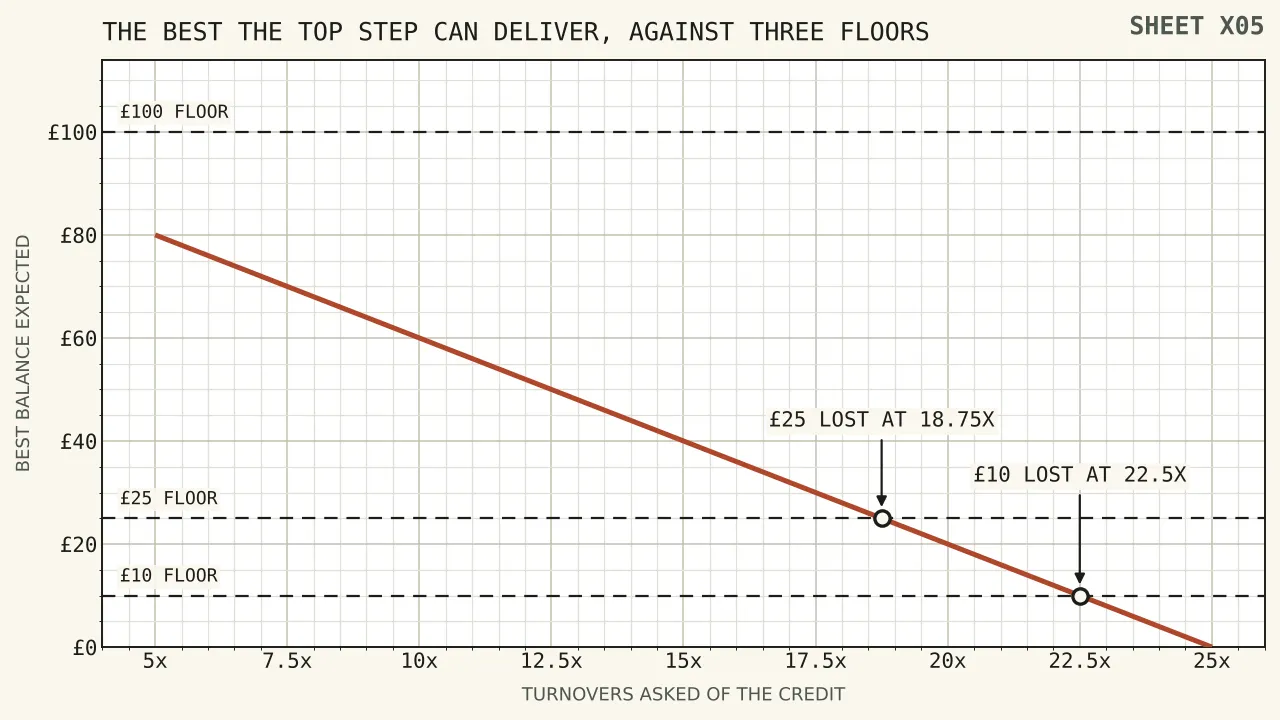
A floor is out of reach when no credit a reader is able to buy is expected to leave a balance that gets to it. The top denomination on this site’s ladder is £100.00, and ten turnovers leave three fifths of a credit, so the largest expected balance this instrument can produce at that multiple is £60.00. Any floor above £60.00 is therefore out of reach from this ladder, whatever a reader does, and the threshold falls as the multiple rises.
| Turnovers asked | Share surviving | Best the ladder can produce | So a floor is unreachable above | Credit a £100.00 floor would need |
|---|---|---|---|---|
| Five | Four fifths | £80.00 | Eighty pounds | £125.00 |
| Ten | Three fifths | £60.00 | Sixty pounds | £166.67 |
| Twelve and a half | A half | £50.00 | Fifty pounds | £200.00 |
| Fifteen | Two fifths | £40.00 | Forty pounds | £250.00 |
| Twenty | A fifth | £20.00 | Twenty pounds | £500.00 |
| Twenty-four | A twenty-fifth | £4.00 | Four pounds | £2,500.00 |
| Twenty-five | Nothing | Nil | Any floor at all | No credit answers |
The fourth column is the finding, and it is blunt. At twenty turnovers a floor of twenty pounds is already beyond what the biggest denomination on this ladder can be expected to produce. At twenty-four turnovers a floor of five pounds is beyond it. And at twenty-five, every floor in existence is unattainable, because nothing survives at all.
The fifth column says the same thing from the other side. A floor of £100.00 needs £166.67 of credit at ten turnovers, £250.00 at fifteen and £500.00 at twenty. The ladder stops at £100.00, so none of those credits can be bought in one denomination, and a reader buying several has merely raised the sum at risk while leaving the share surviving where it was.
Which is why a floor deserves more of a reader’s attention than a speed claim. Speed moves a date. A floor above a balance moves the whole balance into the residue column, and unlike a charge it does not scale: there is no size of balance at which a floor above it costs less than everything.
5
Documents, and a question asked too late
Paperwork is behind most slow payouts, and the British answer is to shift the question to the front. The table below places it, moment by moment, and the figures in the third column are what each placing is worth to a reader waiting on money.
| Moment | Under a British licence | What it costs a reader |
|---|---|---|
| Before a first stake | Three fields, verified | Minutes, once |
| Before a first deposit | A reader is told what may be needed | Nothing, and removes a surprise |
| On a bonus or a free game | The same verification applies | No unverified route exists |
| At a withdrawal | Barred, if it could have come earlier | Zero delay by design |
| Unpaid for want of documents | Possibly a breach of the condition | A complaint, not a fee |
| Where another duty bites | Permitted at that point | The one honest exception |
Three dates go with that table. The plain-language guide for players was put up on 23 September 2020 and last touched on 13 April 2022, so the governing wording now sits in the licence condition and a page leaning on the guide owes a reader that distinction. The tightening underneath took effect on 7 May 2019, and it did three things: three fields to verify before any gambling, age checks pulled across to a free bet and to games costing nothing to play, and an earlier allowance of 72 hours for completing a check taken away. The announcement gives the day and the month without the year, so the year above is this site’s reading rather than a quotation.
Put 72 hours beside the figures in part 3 and the old allowance looks expensive. At 1,440 presses an hour and 10p a press, 72 hours of unverified play is 103,680 presses, £10,368.00 of staking and £414.72 of expected cost, which is a hundred times the top denomination on this ladder four times over. The window is gone on the licensed side. Nothing replaces it anywhere else.
For this page’s subject the consequence is short. Ask the entry question properly and no payout can be slowed by asking it twice. Leave it unasked and the exit is where it surfaces, at which point a reader who picked a counter for its speed has picked on the wrong attribute altogether, since no rail however quick moves money that an unanswered question is holding.
6
Speed limits that run the other way
It is worth dwelling on the asymmetry in part 2’s table, because it explains why speed claims live where they live. Every published speed rule in British online gambling is a minimum on how quickly a reader may act. None is a maximum on how slowly a counter may act.
On slots the gap of 2.5 seconds is a lower bound between cycles, so no reader gets past 1,440 presses inside an hour. At 10p a press an hour of that is £144.00 staked and £5.76 expected to go. The five seconds for casino games other than slots halves the first figure to 720 cycles an hour, £72.00 of staking and £2.88 of expected cost. A reader cannot be made to go slower than those rates; they cannot go faster either.
| Gap between cycles | Presses in an hour | Expected cost at 10p |
|---|---|---|
| Two and a half seconds, slots | One thousand four hundred and forty | £5.76 an hour |
| Five seconds, other casino games | Seven hundred and twenty | £2.88 an hour |
| One second, which no licence allows | Three thousand six hundred | £14.40 an hour |
| Half a second | Seven thousand two hundred | £28.80 an hour |
The last two rows are the ones bearing on this page, because nothing fixes a pace in the places where a British licence is missing. The expected cost of an hour at the reel is set by the number of presses in it, and that number is set by the gap. Shrink the gap from two and a half seconds to half a second and an hour costs five times as much, £28.80 instead of £5.76, with no change at all to the stake or the game.
So a counter can be faster in two different senses, and a reader should be clear which one is being advertised. Faster at paying out is a benefit, unpriced and unpublished. Faster at taking stakes is a cost, and it has a figure: £5.76 an hour becomes £14.40 an hour at a press a second. The second kind of speed is the one a reader can actually verify by watching a reel, and it is the one that empties a balance before any question of a payout arises.
Two more design rules about hurrying sit on the licensed side and nowhere else. The first forbids letting a customer cut short the wait before a result shows, and the guidance beside it names turbo, quick spin and slam stop. The other bars automatic play across online gaming, carving out only the blinds a poker table posts for an absent player. Remove the pair and the £28.80 row stops being hypothetical.
7
One balance at two speeds, worked out
Put the whole argument into one pair of columns. Two readers hold the same £45.00, request it on the same day, and are paid at wildly different speeds. Follow both.
| Stage | Paid in ten minutes | Paid in five days | Difference |
|---|---|---|---|
| Expected survivor at the door | £45.00 | £45.00 | None |
| Floor test at £10.00 | Passed | Passed | None |
| Charge | £1.50 | £1.50 | None |
| Into a bank | £43.50 | £43.50 | None |
| Held at, per day | £43.50 | £8.70 | A measure of the wait |
| Exposure to a reversal | Minimal | Up to £18.00 | The only money at stake |
Four of those six rows are identical and the two that differ are not charges. The fifth row divides the sum by the days, which is a way of sizing a delay rather than costing it: £43.50 held for five days is £8.70 a day, held for four weeks is £1.55 a day, and held across the eight weeks a British complaints process may run is 77.68p a day. Nobody charges any of that. It is simply what the sum is worth while somebody else has it.
The sixth row is the real one, and it is conditional rather than certain. Where no reversal is offered, the figure is nil and the two columns are the same page twice over. Where a reversal is offered and a reader is the sort of reader who takes it, the figure is the expected cost of the staking that follows, which is £18.00 at ten turnovers and the whole £45.00 at twenty-five.
The fifth row deserves one more line of arithmetic, since a reader can use it to size any wait at all. Divide the sum by the days and the answer is a rate: £43.50 across three working days is £14.50 a day, across a week it is £6.21, and stretched over a six-month complaints window of 182 days it is 23.90p. Those rates fall as the wait lengthens, which is the wrong way round from how a wait feels, and the reason is only that the numerator never changes. A delay does not grow the sum. It just spreads the same sum over more days.
From which the conclusion of the page follows, and it is narrower than a speed headline wants. Speed is worth having. It is worth having for one reason that can be priced, which is that it shortens the window in which a payout can be undone, and the price of that window depends on a reader’s own behaviour rather than on the counter’s. Every other deduction on this page is indifferent to the calendar.
8
What the ladder banks at £1.50 a payment
Six denominations, three multiples, one floor and one charge. The survivor is the credit scaled by the share that survives, the floor test comes first, and the charge comes off what passes.
| Credit | Turnovers | Survivor | Floor at £10.00 | Banked | Residue as a share |
|---|---|---|---|---|---|
| £10.00 | Ten over | £6.00 | Short by £4.00 | Nothing at all | The whole credit |
| £20.00 | Ten over | £12.00 | Over by £2.00 | £10.50 | 47.50 per cent |
| £25.00 | Ten over | £15.00 | Over by £5.00 | £13.50 | 46.00 per cent |
| £50.00 | Ten over | £30.00 | Over by £20.00 | £28.50 | 43.00 per cent |
| £75.00 | Ten over | £45.00 | Over by £35.00 | £43.50 | 42.00 per cent |
| £100.00 | Ten over | £60.00 | Over by £50.00 | £58.50 | 41.50 per cent |
| £25.00 | Fifteen over | £10.00 | Level with it | £8.50 | 66.00 per cent |
| £50.00 | Twenty over | £10.00 | Level with it | £8.50 | 83.00 per cent |
| £75.00 | Twenty over | £15.00 | Over by £5.00 | £13.50 | 82.00 per cent |
Two rows come out level with the floor and both then bank £8.50, which is £1.50 below the figure they just matched. Testing against the floor happens ahead of the deduction, and that sequence does all the work. Plan a £25.00 credit at fifteen turnovers around a £10.00 floor and the plan is built on a figure that never arrives.
At ten turnovers the residue share drops from 47.50 per cent at the twenty pound end of the ladder to 41.50 per cent at the hundred pound end. The turnover cost accounts for forty of the points in every row. What is left over is a single £1.50 charge shrinking against a growing survivor, 12.50 per cent of it at the bottom and 2.50 per cent at the top. Not one figure in that column knows how long a payment took.
Turn it round and the smallest workable credit comes out at £19.17 for ten turnovers, £23.00 for twelve and a half, £28.75 for fifteen and £57.50 for twenty. Not one of those is a denomination, which is the usual outcome here: ten turnovers send a reader to the twenty pound step and fifteen send them to the fifty.
£19.17 of credit buys past a £10.00 floor and a £1.50 charge at ten turnovers
9
The absence, priced, and what is withheld
Take the £75.00 denomination and price the missing ceiling on the multiple. Ten turnovers bank £43.50. Fifteen bank £28.50. Twenty bank £13.50. Forty are expected to overshoot the end of the credit by £45.00, so the credit disappears and £45.00 of a reader’s own funds disappears behind it. A British licence stops the climb at ten turnovers, so the span between the capped case and the uncapped one, on this one denomination, runs from £43.50 banked to £45.00 lost.
Three further absences bear directly on the subject of speed, and each has a figure beside it from the parts above. Without the bar on offering a cancellation, a requested payout can be reversed, which the table in part 3 prices at up to £45.00. Without the bar on capping payouts from a deposit balance, a floor can be set above anything this ladder produces, which part 4 puts at £60.00 at ten turnovers. And without the rule that moves the identity question to the entrance, the question arrives at the exit, where part 5 shows it has nowhere useful to go.
Now the withholdings, none of which is a gap in research. A payout speed is given for no counter here, since no citable source publishes one, and a page on speed inventing a figure would be worse than one owning up to the hole. There is no promotion code. There is no statement of which method any counter takes, inward or outward, and no ranking of methods for counters holding no British licence, because such a ranking serves mainly somebody trying to defeat a block. And a reader who has shut an account against themselves will find nothing here about opening it again.
On that last point the facts run the other way and belong here. The national exclusion scheme takes in every company that holds a British licence, because belonging to it is a licence condition, and the scheme is plain that companies outside it are past what it can do. A registration cannot be cut short either: the terms say in capitals that deactivation waits for the end of the minimum period, and leaving it alone keeps it running for as long as another seven years. A helpline number sits in the care note under this page, and the section of this site dealing with faces priced outside the British register carries the blocking software and the free route to it in full.
Questions
- Does a fast payout mean a bigger payout?
- No. A £75.00 credit at ten turnovers is expected to leave £45.00 and to bank £43.50 after a £1.50 charge, and both figures are the same whether the money lands in ten minutes or in five days. The turnover cost, the charge and the floor are all indifferent to the calendar.
- So is speed worth anything at all?
- Yes, for one reason that can be priced. A short pending window leaves less time in which a requested payout can be cancelled and put back into play. On a £45.00 payout, a ten turnover habit and a one in four chance of reversing, that window is worth £4.50, which is three payout charges. For a reader who would never reverse one, it is worth nothing.
- What does reversing a payout cost?
- Four pence in each pound, for every turnover it subsequently meets. On £45.00 that reads £1.80 for a single circuit, £18.00 by ten turnovers, £36.00 by twenty and the whole £45.00 by twenty-five. Worse still, at twenty turnovers the £9.00 expected to survive sits beneath a £10.00 floor, so the residue becomes the entire payout and not merely the staking cost.
- Can a requested payout be cancelled under a British licence?
- No. Cancelling a payout request is not a choice a consumer may be given, and the guidance beside that rule adds that a sum already asked for should not reappear as a deposit. On the licensed side the door swings one way, which is why every reversal figure above is unreachable there by construction.
- What does an unattainable withdrawal limit mean?
- It is a payout floor above anything a reader can produce. The top denomination here is £100.00, and ten turnovers leave three fifths, so £60.00 is the best this ladder is expected to deliver. Any floor above £60.00 is out of reach at that multiple, and the threshold drops to £40.00 at fifteen turnovers and £20.00 at twenty.
- What credit would a £100.00 floor need?
- A hundred and sixty-six pounds sixty-seven at ten turnovers, £250.00 at fifteen and £500.00 at twenty. The ladder stops at £100.00, so none of those can be bought in a single denomination, and buying several raises the sum at risk without changing the share that survives.
- Can identity documents be demanded at the exit?
- Not under a British licence, where asking earlier was reasonably possible, though a separate legal duty arising at that point is left room for. Identity is settled before anybody gambles, across three fields, and the requirement takes in play funded by a bonus as well as a version of a game played for nothing.
- What if a payout is held up for documents anyway?
- In the regulator’s words the operator is then possibly in breach of the condition, which makes this a complaint rather than a cost: nobody has charged a fee, and the route runs through the operator’s own process and then an approved adjudicator. The plain-language guide stating it to players dates from 23 September 2020 with an update on 13 April 2022, so the governing wording is in the condition itself.
- Do any rules fix how fast a payout must be?
- None with a number in it. The guidance asks that the process of withdrawing funds be made as frictionless as possible, which is a direction rather than a duration. Every published speed rule in British online gambling is a minimum on how fast a reader may play, the 2.5 seconds standing between slot cycles among them, rather than a maximum on how slowly anybody may pay.
- What does a faster reel cost?
- A 2.5 second gap permits 1,440 presses inside an hour, staking £144.00 at 10p apiece and expected to cost £5.76. A one second gap permits 3,600, costing £14.40. Half a second permits 7,200, costing £28.80. Where a British licence is absent no rule fixes that gap, and the bars on turbo, quick spin, slam stop and automatic play sit on the licensed side alone.
- What is a wait worth per day?
- Nothing in cash, and it can still be sized. A £43.50 payout held for five days is £8.70 a day, held for four weeks is £1.55 a day, and held across the eight weeks a British complaints process may run is 77.68p a day. Those are not charges. They are what the sum is worth while somebody else holds it.
- Why is no payout speed quoted anywhere on this page?
- Because no primary source carries one, and the places that do are trade publications and affiliate pages, neither citable here. Inventing a figure on a page about speed would be worse than naming the hole. What a page can do instead is put a price on the one part of a timetable with money in it, which is the reversal window.