Note M05 Revision 1 Terms read 16 October 2026
Best gambling sites: what a comparison can honestly rest on
No marks are awarded on this page. What appears is arithmetic. A £75.00 credit at fifteen times needs a weighting above 0.60 before anything survives, and at exactly 0.60 the expected cost is £75.00, which is the whole of it. A larger headline percentage buys a larger obligation in the same ratio. The rung stranded £13.00 at the outset.
The face £75.00 credited What draws it down £75.00 expected What is stranded £13.00 over the line
What a face of this size is worth
Every destination on this rack is bought advertising. The site takes a fee if a reader goes on to register, and no figure printed below moves because of it.
Face and Residue
Strip No 01
Betportal
Ceiling as a multiple
Priced at this site's own 10p a spin
What is printed
What draws it down
What is stranded
No Great Britain licence
Licensed in Anjouan, Comoros, run by BetPortal Gaming Ltd, with Excite Ultra Media Ltd, reference ALSI-202601040-FI2.
Terms read 16 October 2026
Open the offer at Betportal, opens in a new tabFace and Residue
Strip No 02
WinBeast
Ceiling as a sum
Priced at this site's own 10p a spin
What is printed
What draws it down
What is stranded
No Great Britain licence
Licensed in Curaçao, operator not named on the site.
Terms read 16 October 2026
Open the offer at WinBeast, opens in a new tabFace and Residue
Strip No 03
EliteSpin
Longest spin window
Priced at this site's own 10p a spin
What is printed
What draws it down
What is stranded
No Great Britain licence
Licensed in Costa Rica, run by PrimeTier Limited.
Terms read 16 October 2026
Open the offer at EliteSpin, opens in a new tabFace and Residue
Strip No 04
Crown Jewelz
Multiple unpublished
No residue struck
What is printed
What draws it down
What is stranded
No Great Britain licence
Licensed in Curaçao, number not verified, operator not named on the site.
Terms read 16 October 2026
Open the offer at Crown Jewelz, opens in a new tabThe two figures in the second and third registers are this site's own arithmetic and nothing an operator has published: the face as printed, less the share a spin gives back at 96 per cent return to player, less what playing the wagering through costs at the same return, and then less whatever a published ceiling, a charge on the way out or a floor on the smallest withdrawal takes off what survives that. The residue is what is left of the face when all of it is accounted for. It describes the offer, not one reader's afternoon. Where the conditions price above the face the strip prints nothing coming off rather than a negative sum, and where a figure the sum needs is unpublished it prints the condition in the operator's words instead.
A face paid as spins has no unit of its own, so one is supplied. Where an operator publishes what a spin of its own is worth, that figure stands in the first register's own line and is labelled as theirs. Where it does not, this site's own 10p a spin stands there and says so, and every figure below moves in proportion: at half the price, half the money. The share of the face that does come off is also given as pence in the pound, which is the figure that compares a large face against a small one.
Money goes onto a prepaid voucher in fixed denominations, so a smallest deposit published in pounds is rounded up to the first rung of the ladder this site works in, £10, £20, £25, £50, £75 and £100, and the strip prints what that rounding strands. That is the reader's own money and it is never netted into a residue. A smallest deposit published in euros is printed as the operator publishes it, because the ladder here is a sterling one and rounding a euro sum to it would be an invented figure.
Three words stand in the amount column where no figure can. Noted is a published condition that takes value away without leaving the sum a figure to take. Unpriced is a condition whose figure nobody has published, or a credit that is not a sum until a deposit of your own sets it. Own money is money of yours, which is never part of a residue.
Not one of the operators printed above holds a Great Britain licence, so the duties that licence carries do not reach them. All online gambling companies licensed in Great Britain must be part of Gamstop Online, and a reader who has shut themselves out through the scheme is therefore not shut out here. The ceiling of ten times the bonus funds on a wagering requirement, in force since 19 January 2026 under Social Responsibility Code 5.1.1, is a condition of that licence and binds the companies that hold one. On an unlicensed site the Gambling Commission describes consumers as facing unfair gaming practices, financial loss and a lack of recourse if things go wrong, and it names blocked payouts and withdrawal limits set so high they are unattainable among what it has seen. Nobody under 18 may hold an account at any of them.
Every term printed on a strip is the operator's own, and each strip carries the day it was read. The oldest of those readings is 16 October 2026. What binds a reader is the operator's own full terms, and not a line printed here.
1
What a comparison can honestly rest on
A reader looking for the best place to gamble is asking for an order, and an order needs a scale. Inventing one is what this page declines to do. No marks appear below, no rating is awarded, and nothing here was tried out by anybody. What is offered instead is a set of quantities that can be compared, and a statement of which quantities cannot be compared at all.
Four things decide what a credit is worth. The sum credited. The multiple attached to it. The proportion of each stake a game gives back. And the proportion of each stake a room counts towards the requirement. The first is on the banner. The second is usually in the small print. The third is published if the room chooses. The fourth is the one that decides the answer and the one least likely to be anywhere a reader will look.
That fourth proportion is written g on this site. The condition for a credit to survive its requirement is one line long.
g above W ÷ 25: fifteen times therefore wants a band above 0.60
Fifteen times is this page’s multiple, and it is chosen because it is a figure a comparison meets constantly. The band it demands is three fifths. Reels normally count whole and clear that. Table play commonly counts at a fifth or a twentieth and does not come close. So two rooms advertising the same fifteen times requirement can differ by the entire value of the credit, and the difference lives in a schedule neither banner mentions.
Worked on the £75.00 this page uses: full weight asks £1,125.00 of staking and costs £45.00, so £30.00 comes through. A band of exactly 0.60 asks £1,875.00 and costs £75.00, which is the credit, so nothing comes through. One figure moved. The entire outcome went with it.
Three things a comparison cannot honestly do, stated so that their absence is not mistaken for an oversight. Payout speed cannot be ranked, since no primary source publishes one. Nor can the spread of offshore multiples, withdrawal ceilings and spin values, none of which is published anywhere citable. Nor can licensed remote casino operators be counted, because one published sector covers casino alongside betting and bingo.
Pricing is what it can do. Everything below is this site’s own arithmetic, built on figures held constant across these notes, and every regulatory statement carries the rule behind it. Offers at the head of this page hold no Great Britain licence, which part eight prices duty by duty rather than asserting.
Constants on this site: 10p a cycle, 96p back in the pound, forty times as the house figure, and g at 1.00 except where a sentence moves it deliberately. Rooms are this section’s subject, so g moves repeatedly below and each move is named.
2
A £75.00 rung against a £62.00 line
Comparison pages tend to skip the entrance, and the entrance is where the first residue appears. Prepaid money arrives in fixed steps, listed in the table below. Suppose the qualifying deposit is £62.00. Nothing on the ladder sits at £62.00, so the £75.00 step is the smallest adequate one and £13.00 of the purchase earned no eligibility.
| Step | Clears it | Surplus |
|---|---|---|
| £10.00 | Not enough | Nothing opens |
| £20.00 | Not enough | Nothing opens |
| £25.00 | Not enough | Nothing opens |
| £50.00 | Not enough | Nothing opens |
| £75.00 | Enough | £13.00 over |
| £100.00 | Enough | £38.00 over |
Thirteen pounds is above the payout floor this site assumes, which is £10.00, so it differs from the small residues elsewhere in these notes: it can in principle come off. What it cannot do is earn anything. It sits in the account as money that bought no part of the offer, and if it is staked at all it meets the same 4p in the pound as everything else.
The arithmetic of staking it is quick. One circuit of £13.00 at a 96 per cent return costs 52p expected. Ten circuits cost £5.20. Twenty-five circuits cost £13.00, which is all of it. So the £13.00 is either withdrawn unused, in which case the purchase was £13.00 larger than it needed to be, or it is played, in which case it is worth 48p in the pound less with every circuit.
Four steps on that ladder open nothing at all, which is a point about comparison rather than about arithmetic. A room advertising a £62.00 qualifying deposit has effectively set its minimum at £75.00 for anybody paying by prepaid voucher, and no banner anywhere says so. Comparing two rooms on their stated minimums compares figures that neither reader can actually pay.
One rule protects the deposited part on the way out and admits no exception. A term of a British licensee may not put a maximum on a deposit-balance withdrawal. What the regulator prints as forbidden: a £50 day beside a £500 week. Annualised, that is £26,000 on money the player already owns. Its reach is the deposit balance alone, so any ceiling on bonus conversion is a different question.
3
Fifteen times, and the band it demands
One credit, fifteen times throughout, and the weighting doing the work. Contribution required is £1,125.00 in every row, since neither credit nor multiple moves.
| Band | Where such a band tends to sit | Staking asked | Reading | Cycles | Cost expected | What survives |
|---|---|---|---|---|---|---|
| 1.00 | Reels, counting whole | £1,125.00 | Two fifths of margin | 11,250 | £45.00 | thirty pounds |
| 0.60 | Exactly at the crossing | £1,875.00 | No margin at all | 18,750 | £75.00 | nothing |
| 0.40 | Other table games | £2,812.50 | Half as much again | 28,125 | £112.50 | short by £37.50 |
| 0.10 | A tenth counted | £11,250.00 | Ten times over | 112,500 | £450.00 | short by £375.00 |
Row two is where this page is written. A band of 0.60 against a multiple of fifteen gives an expected cost identical to the credit, so draw-down and face are one figure and the residue is the face. No term broken, no clock expired, nothing taken back. Three fifths counted, three fifths eaten.
The last row needs care, because £450.00 against a £75.00 credit is easy to misread. Nobody finishes £375.00 behind on money never held. What it says is that the credit cannot finish the requirement. Play stops short and the credit goes, or the reader funds the remainder at 4p in the pound.
British practice bounds all of this. Bonus funds times ten, since 19 January 2026. Provision 5.1.1 holds it, third prohibition, letter (a). Two classes stand outside: technical machines, and gambling software. Ten times wants 0.40, which the third row above sits on precisely.
Two gaps stay open. What the lid governs is bonus funds, and a requirement reaching the deposit has no published example against it. A spin’s own status under that heading is unpublished too.
Time is the other axis a comparison should carry, and on the licensed side it computes. Each reel cycle has 2.5 seconds beneath it, from a game’s start to the earliest start of another, with the control released and depressed between. So 11,250 cycles fill 28,125 seconds, or 7 hours 48 minutes 45 seconds. The crossing row fills 46,875, which is 13 hours 1 minute 15 seconds.
Scaling the credit changes none of the proportions, which is worth one paragraph of proof because it is what makes a comparison possible at all. Take the crossing band of 0.60 at fifteen times. Credit of £10.00: staking £250.00, cost £10.00. Credit of £25.00: staking £625.00, cost £25.00. Credit of £50.00: staking £1,250.00, cost £50.00. Credit of £100.00: staking £2,500.00, cost £100.00. Each pound of credit therefore brings twenty-five pounds of staking at that band, and expected cost equals credit on every line. So a reader comparing two rooms does not need the credit size at all. Band and multiple settle the question between them, and the credit settles only how long it takes.
18,750 cycles at the licensed floor: 13 hours 1 minute 15 seconds, for an expected £0.00
4
A bigger percentage is a bigger obligation
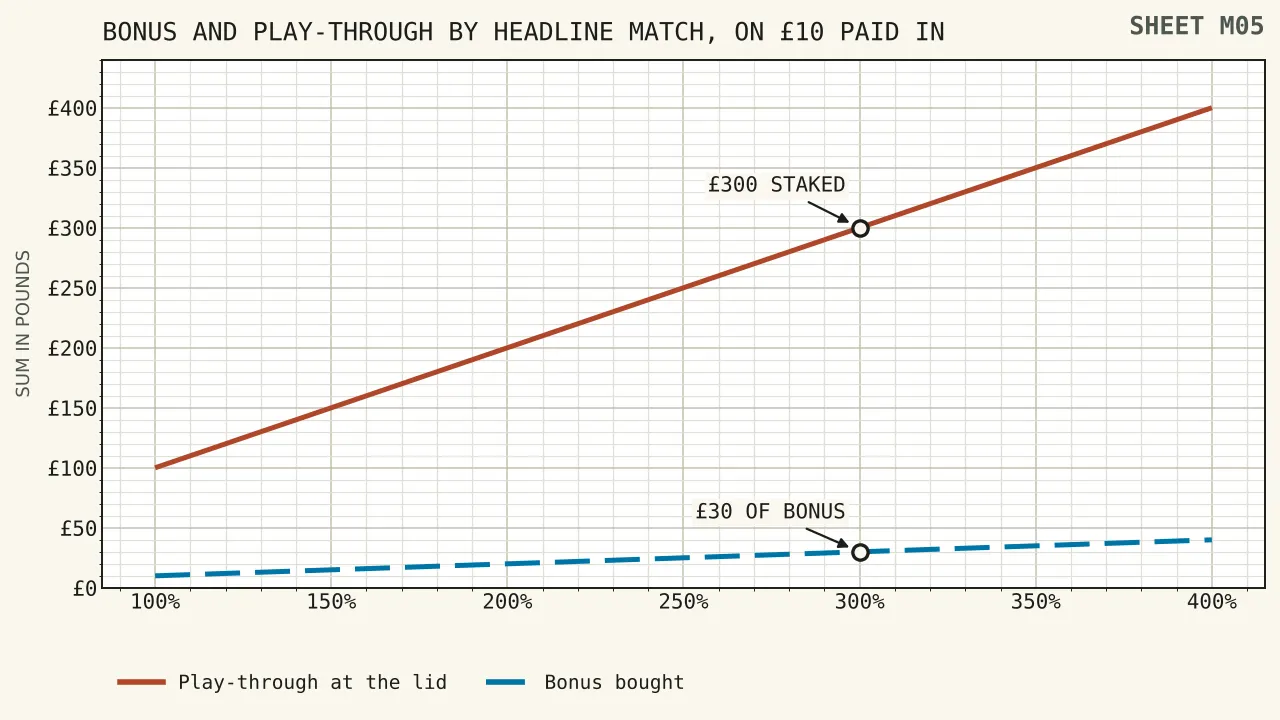
The headline a comparison most often rests on is a percentage, and the arithmetic of a percentage is the clearest thing here. Multiples are what the lid governs. So a larger percentage leaves turnover per pound of bonus untouched and simply buys more bonus, with turnover following in step.
| Headline match | Bonus bought | Reading | Play-through at the lid | Cycles | Cost expected |
|---|---|---|---|---|---|
| 100 per cent | £10.00 of bonus | Ten to one | £100.00 | 1,000 of them | £4.00 |
| 200 per cent | £20.00 of bonus | Ten to one | £200.00 | 2,000 of them | £8.00 |
| 300 per cent | £30.00 of bonus | Ten to one | £300.00 | 3,000 of them | £12.00 |
| 400 per cent | £40.00 of bonus | Ten to one | £400.00 | 4,000 of them | £16.00 |
The ratio column is the finding. Ten to one in every row, a multiple being a thing that scales. Only the ten is regulated; everything else here is working done on this site.
Two further columns would complete it if the figures existed. Weighting would be one, multiplying those cycle counts by anything between one and twenty. A maximum conversion would be the other, which no primary source publishes as a market standard, so the column stays blank rather than being filled from somewhere uncitable.
Advertising rules bear on the top of that table. They are tabled rather than paraphrased.
| What the rules ask | What it rules out |
|---|---|
| Proportion to money and time | A reward outpacing either |
| No faster climb as spend rises | An escalating reward ladder |
| No regular fixed-frequency play | Substantial amounts at set intervals |
| Significant terms up front | Minimum stakes, how to join, wagering |
| Non-broadcast sections | Misleading, promotional, gambling, lotteries |
| Broadcast sections | Misleading, gambling, lotteries, premium-rate lines |
One example is given as capable of acceptability, with a condition travelling beside it: a one-off free bet after £50 of wagering, so long as a free bet of that size is not out of the ordinary for the type of gambling.
Three casino advertising rulings are listed with outcomes and no subject matter. Upheld, 14 October 2026, HRY Games. Upheld, 16 September 2026, Dribble Media Ltd. Not upheld, that same date, White Hat Gaming Ltd. Nothing published says what any of them concerned, so nothing further is said of them here.
One absence in the advertising rules deserves naming, since readers of comparison pages are affected by it. Affiliates are not addressed on the regulator’s advertising page at all, beyond a requirement that operators take all reasonable steps to see that contracted third parties avoid placement on copyright-infringing websites. No wider published affiliate rules exist to cite. Affiliate compliance is the operator’s responsibility under the Curaçao policy, enforced by binding contracts, by audits and by penalties.
5
Four product types, and what one offer may hold
A comparison across gambling sites runs into a rule that changed what there is to compare. Since the same date as the lid, a single incentive may not carry two product types at once. The named types are four: betting, bingo, casino and lottery.
What that removes from a comparison is the cross-product welcome package. One linked set of terms covering a sportsbook and a casino together is no longer something a British licensee may offer. What remains is a market compared within one product at a time, which is more honest and less convenient.
Three carve-outs sit beneath it and each one matters to a comparison.
| Arrangement | Why it survives |
|---|---|
| Two products of one type | Same type, so not mixed |
| Two offers, one email | Consent held for both products |
| A credit the player allocates | Not a mixed incentive at all |
Row three holds the arithmetic, and a comparison should flag it rather than celebrate it. A credit spendable on any product is a credit whose weighting the player picks, and most pickable weightings are worse than the headline implies. Take £20.00 at fifteen times. On reels counting whole, £300.00 of staking clears it. On a game counted at a tenth, £3,000.00 does, and expected cost climbs from £12.00 to £120.00 against a credit of £20.00.
Narrow is the stated aim: no combining of products within one incentive on terms linked and shared between them. Reading it wider would be reading what is absent. A scratchcard with a raffle illustrates a permitted same-type pairing, and £10 usable across betting and casino a permitted allocable credit.
One consequence for this market’s shape is worth printing. Spins added to a match keep inside one product, slots being a casino product. Tickets added to a match move from casino into bingo. So two packages of apparently equal generosity can differ over whether a British licensee may offer either, and no banner carries that distinction.
Provision 5.1.1 sits under all of it. Wherever a licensee sets an incentive, a reward or an arrangement of advantage before a customer, or before somebody who might become one, the provision bites. Two further prohibitions belong to it. Where qualifying activity finishes early, an incentive’s value may not be changed. And travel or lodging, given free or subsidised, may not be hung on a customer’s expected level of gambling.
6
Comparing licences rather than headlines
If a comparison cannot rest on a score, it can rest on what each regulator has published. That is checkable, dated and free, and it produces a ranking of a kind: not of rooms, but of the quantity of published rule standing behind them.
| Authority | What its own pages gave | What is missing |
|---|---|---|
| Great Britain | Conditions, standards, a register, an enforcement record | Nothing published on affiliates beyond third-party placement |
| Curaçao | Two policies, an ordinance named | No lid on a multiple, no stake cap, no cycle floor |
| Malta | A gaming act cited, registers, a complaints form | Time limits, residency rules, binding effect, its own powers |
| Anjouan | A register claimed, a verification tool, lists advertised | No ordinance named, and the complaints page returned an error |
| Kahnawake | A gaming law, five licence types, complaints reviewed | Anything beyond that was not read here |
| Costa Rica | No regulator’s own site was located | Everything, and the absence is the finding |
| Gibraltar | Three attempts returned errors | No regulator facts are carried here |
Two rows above deserve expanding, being the two most often treated as equivalent to the British licence when they are not comparable in those terms.
Malta runs a formal route for players, described on its own pages as the formal channel for lodging a complaint against a licensee. Cases get reviewed in English or Maltese. Identification may be asked for. Trying the operator’s support and management first is the advice given. Four things go unstated: a time limit, any restriction by residence or jurisdiction, any boundary on the authority’s powers, and whether an operator is bound by an outcome. Country of residence is asked on the form, with nothing attached to the answer.
Anjouan’s publisher is a commercial address, not a governmental one, which is the first fact about it. The body styles itself a regulatory authority for internet gaming, refers to the island’s laws in general terms, and names nothing more specific: no ordinance, no Act, no regulation. Claims made: a public register, a verification tool, a complaints page, an adjudicator list. Two of those could not be read, the complaints page returning an error when fetched, so its deadlines and its remedies are not stated here and neither is the question of binding effect.
Costa Rica is the cleanest illustration of why a comparison publishes its gaps. A search for a Costa Rican government gaming authority returned industry and law-firm material only, and none of that is citable on these sheets. So where a room cites a registration there, the honest line is that no rulebook, register or complaints route from a regulator could be located. Nothing is said here about what Costa Rican law requires, because nothing was read.
Two sourced figures put enforcement in proportion without overstating it. Sophisticated, digital and global is how the regulator characterises the illegal market, adding that revenue at that scale makes a complete dismantling improbable. The same post gives a figure: traffic down by 32 per cent, across 160 sites picked out for enforcement action. Both halves belong on a comparison page, because enforcement works partially and partially is the honest word.
7
The exit, and the £13.00 above the line
Take part three’s friendliest row: full weight, fifteen times, no forfeiture, £30.00 expected through. Add the untouched £13.00 and £43.00 stands against a £10.00 payout floor. All of it clears. This is the one note in this section whose residue is not held beneath a floor, and the reason is worth stating.
The £13.00 is stranded in a different sense: it never bought anything. A reader needing £62.00 of eligibility paid £75.00 for it, and the £13.00 difference did no work. Measured against the purchase, 17.3 per cent of what was spent at the entrance was surplus to the requirement, which is a cost no comparison table carries and which exists purely because a ladder has steps.
Measured in cycles rather than pounds, the £13.00 is 130 cycles at 10p, or about 5 minutes 25 seconds of play at the licensed interval. Staked rather than withdrawn it costs 52p in expectation on the first circuit, and a reader who sends it round ten times has paid £5.20 for the privilege of not having withdrawn it.
The surplus a ladder forces also scales, and badly. Measured against the purchase rather than against the credit, the £75.00 step wasted 17.3 per cent of what went in. Had the line been £51.00 instead of £62.00, the same step would have wasted £24.00, or 32 per cent. Had it been £76.00, the £100.00 step would have wasted £24.00 again, this time 24 per cent of a larger purchase. The worst case on each gap sits just above the step below it, which means the cost of a ladder is highest for the reader who needed only a little more than the previous step.
£13.00 surplus on a £75.00 purchase: 17.3 per cent of the entrance, buying nothing
What holds the exit open under a British licence is tabled below, and a comparison between rooms is largely a comparison of whether these apply.
| Under a British licence | Without one |
|---|---|
| No cancelling a request | Nothing published either way |
| No redeposit of requested funds | Nothing published either way |
| No cap on a deposit balance | Nothing published either way |
| Reasonableness on limits | Nothing published either way |
| No late document demand | Documents tied to later milestones |
| Friction kept down | Nothing published either way |
The right-hand column says nothing published rather than no protection, and the distinction is the whole point of doing a comparison this way. Curaçao’s rulebook was read in full for these notes and carries none of those six items. That is an absence from a document rather than a claim about behaviour, and a comparison that overstated it would be as useless as one that ignored it.
What is published about behaviour comes from the British regulator and names two mechanisms: a pay-out blocked, and a withdrawal limit set so high as to be unattainable. Set a threshold above anything a £75.00 credit could plausibly reach and the face strands with no refusal issued at all. What a reader would complain about then runs into the paragraph below.
Neither regulator recovers money. The British one’s description of itself is that it is no ombudsman. It states that it holds no power to settle a gambling complaint, nor to get a consumer’s money returned, and that a withdrawal problem or a game’s technical fault is beyond its reach. Complaining to the business first is the advice it gives. A comparison implying a regulator will retrieve a stranded balance misleads about both jurisdictions at once.
8
The absence, itemised and costed
An offer shaped like this one carries no Great Britain licence behind it. Pricing that rather than mentioning it is a comparison’s job, so each line below is a condition on such a licence with its cost set against the £75.00 credit worked through above.
| Condition | What it is worth here |
|---|---|
| A lid of ten on the multiple | A band of 0.40 needed, not 0.60 |
| The mixing rule | No cross-product terms to compare |
| An interval of 2.5 seconds | 13 hours, not whatever software allows |
| A per-cycle stake lid | Five pounds, and two under 25 |
| Proportionality in promotions | Rewards tied to spend and to time |
| Prominence of significant terms | Minimum stakes and wagering, up front |
| A public register | Account, activities, domains, free to read |
| An approved adjudicator | Eight published, five listed for remote |
| Scheme membership | One registration, every licensed account |
| Financial vulnerability checks | Above £150 of net deposit a month |
Those last two rows carry detail worth having, because both are often misdescribed. Checks of the lighter kind sit over a net deposit figure counted monthly: five hundred pounds a month from 30 August 2024, cut from 28 February 2025 to one hundred and fifty. The enhanced assessments are a separate thing, still a pilot, not run live, leaving consumers unaffected meanwhile, and a credit rating is touched by neither of them.
Two items in that table concern information rather than money, and a comparison should weigh them accordingly. What a register entry gives is a fact somebody other than the room has published: an account number, activities with start dates, domains. What a footer gives is the room’s own account of itself. Different kinds of evidence, and only one checkable free inside a minute.
Direct marketing is the other item carrying a date, and the date moved once, so it needs care. Consent by product type and by channel has been required for online gambling since 1 May 2025. The release records the move in terms, and a page writing any other date for this rule writes something its own source contradicts.
Scale belongs in a comparison, and the published figures are tabled below.
| Measure, year to March 2026 | Figure |
|---|---|
| Gross gambling yield | £17.5 billion |
| Reported lotteries taken out | £13.2 billion |
| Remote casino, betting, bingo | £8.3 billion |
| Arcades and the rest, on the ground | £4.9 billion |
| Licensed premises | 8,081 of them |
| Betting shops | 5,617 of them |
Direction of travel, from the same release: the first four figures rose, by 4.4, 4.7, 6.9 and 1.1 per cent in that order, while premises fell by 2.0 per cent and shops by 3.6 per cent.
| Participation | Figure |
|---|---|
| Gambled across the previous four weeks | Forty-seven per cent of adult participants |
| Lottery-draw-only players taken out | Twenty-seven per cent |
| Scored eight or above on the severity index | Two point four per cent, in 2025 |
| Adults interviewed annually | Around twenty thousand |
A warning travels with those: setting them against surveys that used other methods is not appropriate, so one wave of this survey against the next is the comparison to make.
Where the offshore rulebook is stricter, a comparison says so, and where it is thinner it says that too.
| Under the Curaçao policy | Under a British licence |
|---|---|
| A limit cut takes effect at once | Immediate as well |
| A limit rise waits a week | A day is the brake |
| Cooling-off reachable in one click | Access by fewest clicks possible |
| Four lengths, a day to three months | A day, a week, a month |
| Affiliates bound by contract and audit | Nothing published on affiliates |
| Date of birth at registration | Name, address, date of birth, verified first |
| Identification left to later milestones | Before any gambling at all, bonus included |
| No lid on a multiple | Bonus funds times ten |
| No cap on a stake | Five pounds, and two under 25 |
| No floor under a cycle | Two and a half seconds |
One last quantity belongs in a comparison and it is the only one here that cannot be derived from the others. A payout floor is set by the cashier, not by the offer, and nothing published obliges a room to put it anywhere in particular. On a £75.00 purchase that floor decides whether the surplus £13.00 can move. On a £10.00 purchase it would decide whether anything at all could move. So two rooms with identical bands, identical multiples and identical credits can still differ by the whole residue, and the figure that separates them is one neither banner carries.
Read the bottom three rows against part three and the point of this whole note appears. Those three absences are the entire reason a fifteen times requirement, on a band of 0.60, can be written at all.
The scheme is the final line and the plainest. Participation tracks the British licence, so a room without one is outside by construction. Four registration lengths are offered and the shortest runs half a year. Ending one early is not available, because the minimum period has to expire first.
Questions
- Why is there no score or rating on this page?
- Because a number nobody can check is the easiest invented fact to publish and the hardest to defend. Nothing here was tested by anyone. What is offered instead is arithmetic that a reader can redo: a credit, a multiple, a return and a weighting, with every assumption named. Three things are expressly not ranked, because no primary source publishes them: payout speeds, offshore wagering multiples and spin values.
- What should I actually compare between two sites?
- The weighting first, because it decides whether the credit survives. Then the multiple, then the qualifying deposit measured against the prepaid ladder, then the payout floor. On a £75.00 credit at fifteen times, full weight leaves £30.00 and a band of 0.60 leaves nothing, so the two rooms could advertise identical headlines and differ by the whole credit.
- Does a bigger percentage mean a better offer?
- A bigger obligation, in the same proportion. Ten is the lid on the multiple and the percentage carries no lid at all, so each extra pound of bonus brings ten more pounds of play-through. Deposit £10.00: at 100 per cent the bonus is £10.00 and the cycles 1,000; at 400 per cent the bonus is £40.00 and the cycles 4,000. Expected cost climbs from £4.00 to £16.00.
- What weighting does fifteen times need?
- Above 0.60. Three fifths is what fifteen times demands at a 96 per cent return. Whole-counting reels clear it. A band of 0.40 does not, and it takes staking on £75.00 from £1,125.00 up to £2,812.50, for £112.50 of expected cost against £75.00 of credit.
- Can one welcome offer still cover sport and casino together?
- Not on one set of linked terms, and not from a licensee here. Four types are named: betting, bingo, casino, lottery. Two of them may no longer share a single incentive. What survives is a credit the player allocates, illustrated at £10 across betting and casino, and that is where the weighting risk lives rather than where the generosity does.
- How do the licences themselves compare?
- By what each authority has published. Great Britain: conditions, technical standards, a register, an enforcement record. Curaçao: two policies, neither lidding a multiple. Malta: a complaints form silent on time limits and on binding effect. Anjouan: no ordinance named and a complaints page that would not load. Costa Rica: no regulator site located at all.
- Is enforcement against unlicensed sites working?
- Partially. Sophisticated, digital and global is the regulator’s own characterisation of the illegal market, with revenue at that scale making a complete dismantling improbable. The same post reports traffic down by 32 per cent across 160 sites picked out for enforcement action.
- What is stranded on this page?
- £13.00, and in an unusual way. A £62.00 qualifying deposit meets a ladder where £75.00 is the smallest adequate step, so £13.00 of the purchase bought no eligibility. It clears the £10.00 payout floor, unlike the small residues elsewhere in these notes, so it can come off. Earning anything is what it cannot do, and staking it costs 52p a circuit in expectation.
- Do financial checks affect my credit rating?
- Neither the light-touch checks nor the separate pilot touches a credit rating, and the regulator says so in terms. Checks of the lighter kind sit over a net deposit figure counted monthly, five hundred pounds a month from 30 August 2024, cut from 28 February 2025 to one hundred and fifty. The enhanced assessments remain a pilot, are not run live, and leave consumers unaffected while that holds.
- How big is the market being compared?
- Yield for the year to March 2026 came to £17.5 billion, or £13.2 billion with all reported lotteries taken out. Remote casino, betting and bingo made £8.3 billion of that. Arcades, betting, bingo and casino on the ground made £4.9 billion. Premises came to 8,081 and betting shops to 5,617, both down against the previous year.
- Will a regulator get my money back?
- No, in either jurisdiction. No ombudsman is the British regulator’s own phrase for itself. It states that resolving a gambling complaint lies beyond its powers, as does helping a consumer recover money, and a withdrawal problem is named among the things it cannot touch. Complaining to the business first is its advice. Curaçao’s authority likewise declines individual disputes while using what it learns for supervision.
- Are comparison pages themselves regulated?
- Less than a reader might assume. Affiliates go unaddressed on the regulator’s advertising page, beyond a requirement that operators take all reasonable steps to see that contracted third parties avoid placement on copyright-infringing websites. No wider published affiliate rules exist to cite. The Curaçao policy goes further, putting affiliate compliance on the operator through binding contracts, audits and penalties.