Note F06 Revision 1 Terms read 16 October 2026
Twenty spins at an unpublished price: £1.00 to £20.00 of face
Twenty spins is not a figure until a spin has a price. At 5p the face is £1.00. At 10p it is £2.00. At £1.00 a spin it is £20.00. No rule fixes which, so the headline a reader acts on is one number short of a sum.
The face £2.00 What draws it down £0.85 What is stranded £1.15
What a face of this size is worth
Every destination on this rack is bought advertising. The site takes a fee if a reader goes on to register, and no figure printed below moves because of it.
Face and Residue
Strip No 01
Betportal
Ceiling as a multiple
Priced at this site's own 10p a spin
What is printed
What draws it down
What is stranded
No Great Britain licence
Licensed in Anjouan, Comoros, run by BetPortal Gaming Ltd, with Excite Ultra Media Ltd, reference ALSI-202601040-FI2.
Terms read 16 October 2026
Open the offer at Betportal, opens in a new tabFace and Residue
Strip No 02
WinBeast
Ceiling as a sum
Priced at this site's own 10p a spin
What is printed
What draws it down
What is stranded
No Great Britain licence
Licensed in Curaçao, operator not named on the site.
Terms read 16 October 2026
Open the offer at WinBeast, opens in a new tabFace and Residue
Strip No 03
EliteSpin
Longest spin window
Priced at this site's own 10p a spin
What is printed
What draws it down
What is stranded
No Great Britain licence
Licensed in Costa Rica, run by PrimeTier Limited.
Terms read 16 October 2026
Open the offer at EliteSpin, opens in a new tabFace and Residue
Strip No 04
Crown Jewelz
Multiple unpublished
No residue struck
What is printed
What draws it down
What is stranded
No Great Britain licence
Licensed in Curaçao, number not verified, operator not named on the site.
Terms read 16 October 2026
Open the offer at Crown Jewelz, opens in a new tabThe two figures in the second and third registers are this site's own arithmetic and nothing an operator has published: the face as printed, less the share a spin gives back at 96 per cent return to player, less what playing the wagering through costs at the same return, and then less whatever a published ceiling, a charge on the way out or a floor on the smallest withdrawal takes off what survives that. The residue is what is left of the face when all of it is accounted for. It describes the offer, not one reader's afternoon. Where the conditions price above the face the strip prints nothing coming off rather than a negative sum, and where a figure the sum needs is unpublished it prints the condition in the operator's words instead.
A face paid as spins has no unit of its own, so one is supplied. Where an operator publishes what a spin of its own is worth, that figure stands in the first register's own line and is labelled as theirs. Where it does not, this site's own 10p a spin stands there and says so, and every figure below moves in proportion: at half the price, half the money. The share of the face that does come off is also given as pence in the pound, which is the figure that compares a large face against a small one.
Money goes onto a prepaid voucher in fixed denominations, so a smallest deposit published in pounds is rounded up to the first rung of the ladder this site works in, £10, £20, £25, £50, £75 and £100, and the strip prints what that rounding strands. That is the reader's own money and it is never netted into a residue. A smallest deposit published in euros is printed as the operator publishes it, because the ladder here is a sterling one and rounding a euro sum to it would be an invented figure.
Three words stand in the amount column where no figure can. Noted is a published condition that takes value away without leaving the sum a figure to take. Unpriced is a condition whose figure nobody has published, or a credit that is not a sum until a deposit of your own sets it. Own money is money of yours, which is never part of a residue.
Not one of the operators printed above holds a Great Britain licence, so the duties that licence carries do not reach them. All online gambling companies licensed in Great Britain must be part of Gamstop Online, and a reader who has shut themselves out through the scheme is therefore not shut out here. The ceiling of ten times the bonus funds on a wagering requirement, in force since 19 January 2026 under Social Responsibility Code 5.1.1, is a condition of that licence and binds the companies that hold one. On an unlicensed site the Gambling Commission describes consumers as facing unfair gaming practices, financial loss and a lack of recourse if things go wrong, and it names blocked payouts and withdrawal limits set so high they are unattainable among what it has seen. Nobody under 18 may hold an account at any of them.
Every term printed on a strip is the operator's own, and each strip carries the day it was read. The oldest of those readings is 16 October 2026. What binds a reader is the operator's own full terms, and not a line printed here.
1
A count with no unit attached
Twenty spins is a count. A count becomes money when it is multiplied by a price, and the price of a spin is the one figure in this whole category that nobody publishes.
What a free spin is worth is defined by no primary source. Searching the regulator’s own site turns up nothing on how a spin’s cash value gets fixed, nothing on who fixes it, and nothing on disclosure of it. The value is whatever the author of a promotion decided, and it can be anything.
Two sourced things can be said about a spin’s value and no more. Chance information has to be easily available before a customer commits, under RTS 3C. And an incentive carries terms that are clear, transparent, fair and easily accessible, under Social Responsibility Code 5.1.1. A spin’s worth in pence is a commercial choice, set by no rule.
So this page does the only honest thing available, which is to run the arithmetic at several prices and let a reader see how far apart the answers are. The house assumption of 10p is kept as the middle case, because every other page here uses it, and four other prices are set beside it.
20 spins: £1.00, £2.00, £4.00, £5.00 or £20.00 of face
That spread is the point of this page. A reader comparing 20 spins at one cashier with 20 spins at another is comparing two counts and nothing else. The faces behind them can differ by a factor of 20, and no published rule narrows the gap. On any other consumer product a quantity without a unit would be unusable; here it is the headline.
One further figure is fixed throughout and declared rather than discovered: a game returns 96 per cent of what is staked. Four pence in the pound is therefore the edge, and it applies to every price in the ladder, which is why the expectation column of the next table is simply 96 per cent of the face column.
2
Five prices, five faces
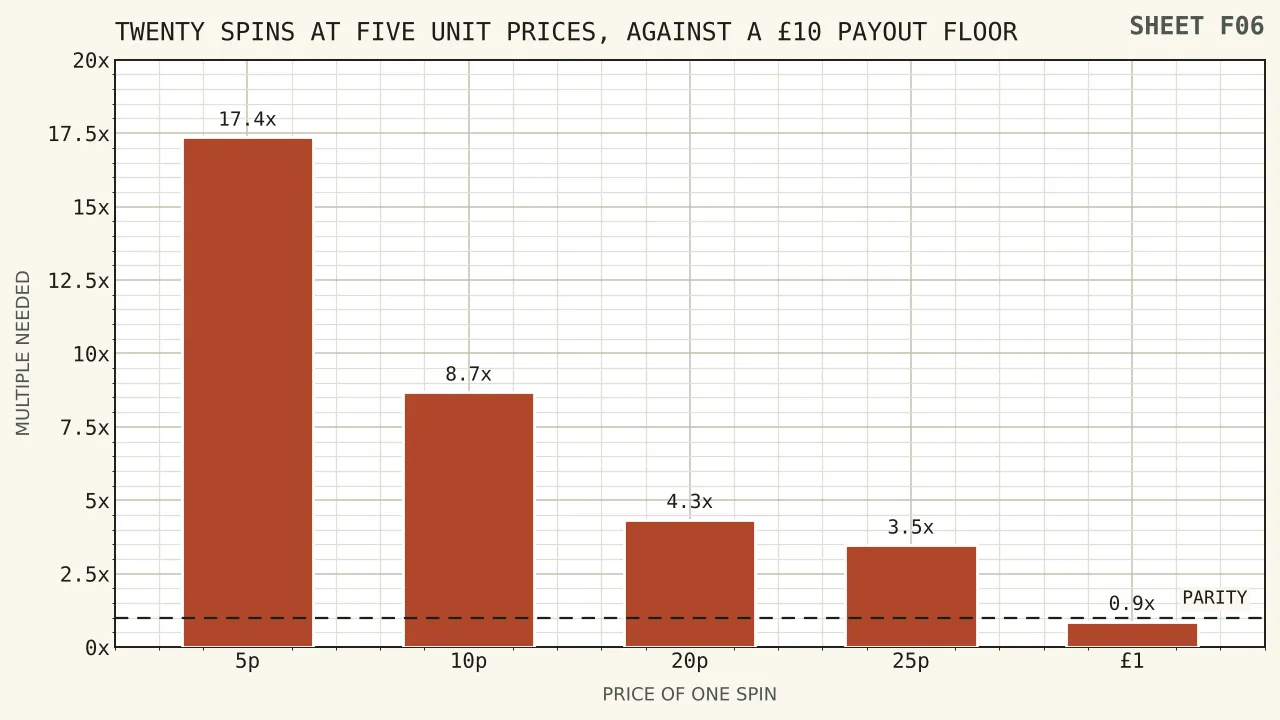
Here is the ladder, with the obligation and the exit attached to each rung of it. The last column is the figure that matters most: how many times a surviving balance has to multiply before a £10.00 payout floor will take it.
| Price a spin | Face | Averages | Multiple to £10.00 | After ten times | Reading |
|---|---|---|---|---|---|
| 5p | £1.00 | £0.96 | 17.36 | £0.58 | Unreachable |
| 10p | £2.00 | £1.92 | 8.68 | £1.15 | The house case |
| 20p | £4.00 | £3.84 | 4.34 | £2.30 | Still short |
| 25p | £5.00 | £4.80 | 3.47 | £2.88 | Still short |
| £1.00 | £20.00 | £19.20 | 0.87 | £11.52 | Clears the floor |
Read the final column downward and the ladder splits in two. Below £1.00 a spin, a mean outcome on 20 spins never reaches a £10.00 floor, so the whole of whatever survived is residue. At £1.00 a spin the expectation clears the floor and the residue drops to the share the obligation took.
One piece of arithmetic sets the split and is worth writing once. The British ceiling sits at ten times the expectation, with 4p of expected cost on each £1.00 of turnover at a 96 per cent return. An expectation keeps 0.6 of itself, so 0.6 of 96 per cent of a face comes to 0.576 of it. A £10.00 floor needs a face of £17.36 before a mean outcome reaches it, which no offer of 20 spins priced under 87p apiece can deliver.
£17.36 of face is what a £10.00 floor needs on a mean outcome
That single figure, £17.36, is the most portable thing on this page. It applies to any no-deposit face at a ten times obligation and a 96 per cent return, whatever the count behind it. Below it, the floor does the stranding. Above it, only the ceiling does.
One caution against over-reading the table. These are mean outcomes, and a mean is not a typical result. The realised figure on 20 spins scatters widely, and most of the scatter falls below the mean because the large outcomes holding an average up are rare. So the 17.36 in the top row is the multiple a mean has to clear, and an individual run can clear a floor from any row by luck or miss it from any row by the same means.
3
What the stake cap does to a large spin value
Unregulated is what the bottom of the price ladder is. The top of it is not, and here a published figure bites directly on what a spin may be worth.
Regulation 5(2) of the 2025 amendment regulations holds the total staked on one game cycle to £5. For anybody under 25 the figure drops to £2. Part 5 of the Act hangs the condition on each remote casino operating licence, a licence issued before those Regulations included. Both figures are slots figures: roulette and blackjack sit outside them.
Now put that beside a spin value, because the two are the same quantity. A free spin notionally worth £5.00 is a £5.00 stake on one cycle. At a British licensed slot that is the ceiling for a player who has reached 25, and twice the ceiling for one who has not.
| Value a spin | Face on 20 | At 25 and over | Under 25 |
|---|---|---|---|
| £0.10 | £2.00 | Inside the cap | Inside the cap |
| £1.00 | £20.00 | Inside the cap | Inside the cap |
| £2.00 | £40.00 | Inside the cap | At the cap exactly |
| £5.00 | £100.00 | At the cap exactly | Above the cap |
| £10.00 | £200.00 | Above the cap | Above the cap |
The bottom row is the interesting one and it is a conclusion rather than a quotation. A spin advertised at £10.00 of value cannot be played at that value on a British licensed slot by anybody, because £10.00 exceeds the per-cycle cap for every age group. The fourth row cannot be played at that value by anybody under 25.
That has a practical consequence a reader can use. A very large per-spin value advertised alongside a slot is either not a slot, or not being played at the advertised value, or not at a British licensed cashier. All three are possible and the terms will say which. What cannot be true is all three at once.
One figure belongs here about the age group that £2 cap was written for, and a guard rail travels with it. Across the previous 12 months, 30 per cent of young people spent money of their own on gambling, on a release of November 2025 covering January to June 2025. An adult participation rate is not what that figure is, and it must never be read as one.
4
Where the stake cap’s own dates come from
A page that cites the stake caps should know that the instrument and the guidance disagree about when they started, and should say which it is using.
Regulation 1(2) brings the Regulations into force 6 weeks from the day of making, 25 February 2025 being that day. A calendar date appears nowhere in the instrument itself. Regulation 6 gave 6 weeks of transition, over which everybody faced a flat £5, so an 18 to 24-year-old met the £2 figure 6 weeks behind the £5 one.
Calendar dates come from the Commission instead. The £5 figure: 9 April 2025. The £2 figure: 21 May 2025. Publication of that guidance was 30 January 2025, with 16 June 2025 as its last update and a note recording the limits as having come into effect.
| Source | What it gives |
|---|---|
| The instrument | A formula: 6 weeks from 25 February 2025, with no calendar date printed |
| The guidance | Two calendar dates: 9 April 2025, then 21 May 2025 |
| This site’s practice | Use the calendar dates, and do not present them as appearing in the instrument |
That is a small point and it is the kind of small point that separates a page written from sources from a page written from other pages. The dates are usable. What is not usable is attributing them to the statutory instrument, which prints a formula and leaves the arithmetic to the reader.
Definitions in the same instrument decide what the caps reach. A reel-based game, played online, is what an online slots game is defined as, and reel-based reaches moving or changing images or text, shown by representations of reels or by other means, whose arrangement at the end settles a prize or some other advantage. A spin on anything matching that is capped. A spin on anything else is not.
5
What a licensed reel is not allowed to do
If the price of a spin is unregulated, the behaviour of the reel it turns is not, and this is the richest set of published rules on any page of this site. They sit in requirement 7 of the technical standards and they are shorter as a table.
| Limb | What it requires or forbids |
|---|---|
| RTS 7A | Acceptably random is what a game result and its underlying number generation both have to be. Adaptive behaviour makes a compensated game, and that is not permitted |
| RTS 7A guidance | Prohibited are interventions that change the probabilities, manual ones as much as automatic ones, and a game’s outcomes are to be distributed as its theoretical probabilities say |
| RTS 7B | Arrival order is the order random numbers get used in, and discarding one for reasons of adaptive behaviour is not allowed |
| RTS 7C | Game designs or features that could reasonably be expected to mislead about the likelihood of particular results are prohibited, and 2 are named |
| RTS 7C, the first named | A near-miss losing event standing where a losing event stood |
| RTS 7C, the second named | A real device simulated on probabilities the device itself does not have |
| RTS 7C guidance | A near-miss result falsely displayed is out, and so is one losing outcome standing in place of another |
| RTS 7D | Rules, payouts and outcome probabilities may not change while a game is in play, and a change has to be brought to a customer’s attention |
| RTS 7D guidance | Changes belong offline, or with a game suspended. An unacceptable clause is named: one stating that rules of a game are changeable whenever the operator likes. Properly describing a bonus round to a customer makes it a permitted change |
| RTS 7E | A game or event’s result, together with the customer’s gamble, displayed clearly, accurately, and for a period that could reasonably be called sufficient |
Gaming with bingo inside it, lotteries, and betting on a virtual event make up the scope of RTS 7, and 7 May 2024 is the last update on its page.
Three of those rows do work that a reader of a free-spin offer should understand. The compensated-game prohibition means a licensed game cannot adjust its probabilities in response to what has happened, so 20 free spins are drawn from the same distribution as 20 paid ones. The near-miss prohibition means the apparatus cannot manufacture the feeling of nearly winning by substituting one losing outcome for another. And the rule against changing rules in play means the terms a reader read are the terms that apply for the duration of the game.
Nothing in that table turns up in the policy Curaçao publishes for its licensees. An allegation about conduct is not what that amounts to, and none is made here. A statement about what is written down is what it is, and the distinction between those two is this site’s whole method.
One more rule bears on a spin specifically and sits outside requirement 7. Autoplay is unavailable for online gaming, with each game cycle committed to on its own, so twenty spins is 20 separate decisions rather than one setting. Hurrying a result is out as well, so a British licensed reel carries no turbo, no quick spin and no slam stop.
6
What a reader is entitled to be told
Given that no rule fixes a spin’s price, the next question is what a reader can insist on being told, and the answer is more modest than most pages imply.
More modest than most pages imply is the answer. RTS requirement 3C joins 4 items with the word or, so an operator picks among them rather than publishing the set. An average theoretical return to player percentage is what the guidance specifies, where a percentage is the item picked. RTS 3 carries that same date of 7 May 2024, alongside a note stating there are no changes to show.
So a reader is entitled to chance information before committing, and not entitled to a particular form of it. A game publishing its house edge has satisfied the requirement. A game publishing the probability of winning events has satisfied it too. Neither of those tells a reader what a free spin on that game is worth, because the value of the spin is a term of the promotion rather than a property of the game.
Three further requirements in the same series fill out the picture, and one of them is the useful one here. RTS 3A wants the applicable rules easily reachable and accurate before a commitment. RTS 3B wants enough shown during play for the current state to be clear. RTS 3D covers prizes and payouts available, or the method working them out, reachable before a commitment is made, and RTS 3 finishes at 3D with nothing after it.
What that adds up to, for somebody holding 20 free spins, is a short checklist with one gap in the middle of it. The rules of the game: available. The prizes and payouts: available. Chance information in whichever form an operator has picked: available. What one spin is worth in cash: covered by none of them, and therefore wherever the promotion’s own terms put it.
Three disclosure duties, and none of them prices a spin
The practical reading is simple enough to be worth stating as an instruction. Find the spin value in the terms ahead of everything else, because a factor of 20 separates the top of this page’s ladder from the bottom. A promotion that gives a count and withholds the unit has given a reader the smaller half of the information.
7
Twenty spins through a ten times rule
Take the house case of 10p and follow it to the end. Twenty spins is £2.00 of face and £1.92 of expectation. The British ceiling of ten times puts £19.20 of turnover on that, which at 10p is 192 cycles.
Expected cost on £19.20 of turnover is 77p at 4p a pound, leaving £1.15. Against a £10.00 floor that balance is 8.68 times short, so the residue is the whole £1.15 plus the 8p of edge that went before any term applied.
| Multiple | Reading | Turnover | Cycles | Cost | Arrives |
|---|---|---|---|---|---|
| None | Paid as cash | £0.00 | 0 | £0.00 | £1.92 |
| 5 times | Four fifths kept | £9.60 | 96 | £0.38 | £1.54 |
| 10 times | The British ceiling | £19.20 | 192 | £0.77 | £1.15 |
| 25 times | Exactly nothing | £48.00 | 480 | £1.92 | £0.00 |
| 40 times | £1.15 beyond nothing | £76.80 | 768 | £3.07 | £0.00 |
Zero is met at 25 on a face of any size, 25 being the reciprocal of 0.04. At forty times, the multiple this site takes for a cashier beyond the register, an obligation runs £1.15 heavier than the expectation behind it.
Cycles convert into time at a British licensed slot, and the figures here are small enough for seconds. At 2.5 seconds a cycle, 192 cycles is 480 seconds, which is 8 minutes. Seven hundred and sixty-eight cycles is 1,920 seconds, or 32 minutes. The 20 spins themselves are 50 seconds.
50 seconds of face, 8 minutes of obligation, £1.15 at the end
Playing on does not close a gap to a floor. Expected cost runs at 4p for each £1.00 of turnover, so £1.15 once over comes to 5p and ten times over to 46p. Nothing lifts an expectation, whatever the stake, since the edge keeps its sign. Reaching £10.00 takes variance, at 4p a pound.
Where the spin price is higher the same arithmetic runs at a different scale, and the scale is what decides everything. At £1.00 a spin the obligation is £192.00 of turnover across 192 cycles of £1.00 each, the expected cost is £7.68, and £11.52 arrives, which clears a £10.00 floor. The count did not change. The unit did.
8
An unpublished unit with no British licence behind it
No Great Britain licence stands behind offers of this shape. On a page about an unpublished unit the loss is specific: the rules that would otherwise constrain what a reel does with that unit, whatever it turns out to be.
| Duty | What it protects on 20 spins |
|---|---|
| Acceptably random results | Twenty free spins drawn from the same distribution as 20 paid ones |
| No compensated game | Probabilities that do not react to what has already happened |
| Random numbers in arrival order | No discarding of a number for adaptive reasons |
| No near-miss substitution | No manufactured feeling of nearly winning |
| No rule change mid-game | The terms read at the start still applying at the end |
| £5 and £2 a cycle | A ceiling over what a spin may be worth at all |
Specific to this page is the last row. No published ceiling sits over a spin value away from the British register, which cuts both ways and should be read both ways. A larger permitted stake is a larger face, and it is also a wider distribution and a faster drawdown. The arithmetic on this page does not say that a bigger spin is worse. It says instead that a bigger spin enlarges the arithmetic throughout, in the same proportion everywhere.
Three further duties sit beyond the table and each is a figure rather than a principle. Ten times rather than any multiple a cashier prefers, which on £1.92 is the difference between £1.15 and nothing. Two and a half seconds between cycles, which turns 192 cycles into 8 minutes. And identity settled ahead of all play, bonus play included, which is why a registration offer at a British licensed cashier arrives behind the documents instead of ahead of them.
A British licence rather than a website is what the national scheme’s membership tracks, and anything a non-member runs is past what the scheme prevents. Nobody who has already decided to stop can be helped by that, which is the plainest available reading of what absence from the register means, and the help below exists for the same reason.
Two things cut the other way and both are sourced. Curaçao’s policy publishes a complaints route, six months from an incident, costing a player nothing. Nor does the British regulator recover money: not an ombudsman is its own phrase, and a withdrawal dispute lies outside what it settles.
Finally, the one check that costs nothing and that no arithmetic here replaces. Confirm 4 things. A licence held. A licensed status on display. A licence that opens on the register. Details on the register agreeing with the claim on the site is the fourth. Neither a date nor any reading guidance appears on that register page, so a check wants its own date noted next to it.
Questions
- What is 20 free spins on registration worth?
- It depends entirely on the price of a spin, and no rule fixes that. At 5p the face is £1.00 and the expectation 96p. At 10p, the figure used across this site, the face is £2.00 and the expectation £1.92. At £1.00 a spin the face is £20.00 and the expectation £19.20. The count is identical in all three.
- Is a spin value published anywhere?
- No. What a free spin is worth is defined by no primary source. Nothing addresses how a cash value gets fixed, nobody is named as fixing it, and no disclosure duty attaches to it. Two things are sourced and no more. Chance information has to be easily available before a customer commits. And an incentive carries terms that are clear, transparent, fair and easily reachable.
- Why does 10p appear on every page here?
- Because an assumption stated once and held everywhere is more useful than a guess varied page by page. Ten pence is declared rather than discovered, and it keeps one offer comparable with another. Where a page needs a different price, as this one does, the sentence doing the changing says so and shows the other figures beside it.
- Can a free spin be worth £10?
- Not at a British licensed slot, played at that value. A spin of £10.00 is a £10.00 stake on one game cycle, and the per-cycle cap is £5 at 25 and over and £2 below 25. So a £10.00 spin value exceeds the ceiling for every age group, and a £5.00 one exceeds it for anybody under 25.
- When did the stake caps start?
- The guidance gives 9 April 2025 for £5 and 21 May 2025 for £2. The instrument prints a formula and no calendar date at all: regulation 1(2) brings the Regulations into force six weeks from the day of making, which was 25 February 2025. Six weeks of transition at a flat £5 is what regulation 6 gave, and that is why the two dates sit 6 weeks apart.
- Can a licensed game adjust its odds as I play?
- No. Acceptably random is what a game result and its underlying number generation both have to be, and a compensated game, adaptive in its behaviour, is not permitted. Manual interventions as much as automatic ones are prohibited where they change the probabilities, and a game’s outcomes are to be distributed as its theoretical probabilities say.
- Are near misses allowed?
- Not as a design feature. Game designs or features that could reasonably be expected to mislead about the likelihood of particular results are prohibited, and two are named. A near-miss losing event standing where a losing event stood is the first. A simulation of a real device built on probabilities the real device lacks is the second.
- Can the rules of a game change while I am playing?
- Not while a game is running. Rules, payouts and probabilities of outcome stay put mid-game, and a change has to be brought to a customer’s attention. The guidance says changes belong offline or with a game suspended, and names an unacceptable clause: one stating that rules of a game are changeable whenever the operator likes. A properly described bonus round is a permitted change.
- Is a percentage return figure compulsory?
- No. RTS requirement 3C holds 4 items joined by or, among which an operator picks, and publishing a house edge instead, or a probability of winning events, satisfies it. Where a percentage is the item chosen, the guidance specifies an average theoretical return to player percentage.
- How long does a 20-spin obligation take?
- At 10p, a ten times rule is £19.20 of turnover and 192 cycles, which at the 2.5 second minimum is 480 seconds, or 8 minutes. At forty times it is 768 cycles and 1,920 seconds, or 32 minutes. The 20 spins themselves are 50 seconds, so the obligation is roughly ten times the length of the thing that was advertised.
- Why can a £1.15 balance not be withdrawn?
- Because £10.00 is where the ladder this site uses opens, and a payout floor on its lowest rung wants 8.68 times whatever survived. More generally a £10.00 floor needs a face of £17.36 before a mean outcome reaches it, so 20 spins priced under 87p apiece sits under that line.
- What is lost at a cashier with no British licence?
- Six duties about the reel itself are priced in part 8. Alongside them: a ceiling of ten times, a minimum cycle of 2.5 seconds, and identity settled ahead of play. Away from the register there is also no published ceiling over what a spin may be worth, which makes the arithmetic larger throughout rather than better.