Note K06 Revision 1 Terms read 16 October 2026
No verification casinos: a promise about the door, and the bill at the exit
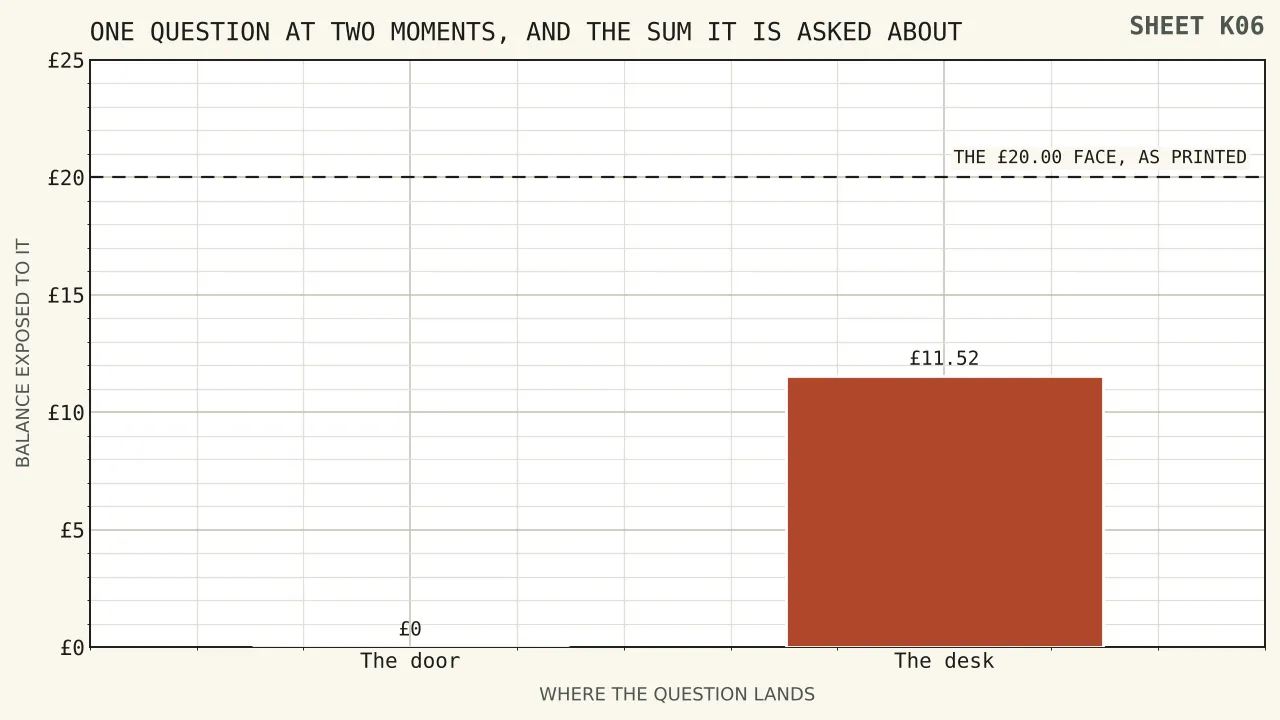
Verification is a question, and the only thing a cashier can change about it is when the question gets asked. A £20.00 rung averages £19.20, and ten turnovers leave £11.52 of it standing. Forty turnovers turn that same £11.52 into overshoot. Move the question from the entrance to the cashier’s desk and the figure at stake is the £11.52, every penny of it, at the one moment money is trying to leave.
The printed face £20.00 Taken by the spend-down £8.48 What is stranded £11.52
What a face of this size is worth
Every destination on this rack is bought advertising. The site takes a fee if a reader goes on to register, and no figure printed below moves because of it.
Face and Residue
Strip No 01
Betportal
Ceiling as a multiple
Priced at this site's own 10p a spin
What is printed
What draws it down
What is stranded
No Great Britain licence
Licensed in Anjouan, Comoros, run by BetPortal Gaming Ltd, with Excite Ultra Media Ltd, reference ALSI-202601040-FI2.
Terms read 16 October 2026
Open the offer at Betportal, opens in a new tabFace and Residue
Strip No 02
WinBeast
Ceiling as a sum
Priced at this site's own 10p a spin
What is printed
What draws it down
What is stranded
No Great Britain licence
Licensed in Curaçao, operator not named on the site.
Terms read 16 October 2026
Open the offer at WinBeast, opens in a new tabFace and Residue
Strip No 03
EliteSpin
Longest spin window
Priced at this site's own 10p a spin
What is printed
What draws it down
What is stranded
No Great Britain licence
Licensed in Costa Rica, run by PrimeTier Limited.
Terms read 16 October 2026
Open the offer at EliteSpin, opens in a new tabFace and Residue
Strip No 04
Crown Jewelz
Multiple unpublished
No residue struck
What is printed
What draws it down
What is stranded
No Great Britain licence
Licensed in Curaçao, number not verified, operator not named on the site.
Terms read 16 October 2026
Open the offer at Crown Jewelz, opens in a new tabThe two figures in the second and third registers are this site's own arithmetic and nothing an operator has published: the face as printed, less the share a spin gives back at 96 per cent return to player, less what playing the wagering through costs at the same return, and then less whatever a published ceiling, a charge on the way out or a floor on the smallest withdrawal takes off what survives that. The residue is what is left of the face when all of it is accounted for. It describes the offer, not one reader's afternoon. Where the conditions price above the face the strip prints nothing coming off rather than a negative sum, and where a figure the sum needs is unpublished it prints the condition in the operator's words instead.
A face paid as spins has no unit of its own, so one is supplied. Where an operator publishes what a spin of its own is worth, that figure stands in the first register's own line and is labelled as theirs. Where it does not, this site's own 10p a spin stands there and says so, and every figure below moves in proportion: at half the price, half the money. The share of the face that does come off is also given as pence in the pound, which is the figure that compares a large face against a small one.
Money goes onto a prepaid voucher in fixed denominations, so a smallest deposit published in pounds is rounded up to the first rung of the ladder this site works in, £10, £20, £25, £50, £75 and £100, and the strip prints what that rounding strands. That is the reader's own money and it is never netted into a residue. A smallest deposit published in euros is printed as the operator publishes it, because the ladder here is a sterling one and rounding a euro sum to it would be an invented figure.
Three words stand in the amount column where no figure can. Noted is a published condition that takes value away without leaving the sum a figure to take. Unpriced is a condition whose figure nobody has published, or a credit that is not a sum until a deposit of your own sets it. Own money is money of yours, which is never part of a residue.
Not one of the operators printed above holds a Great Britain licence, so the duties that licence carries do not reach them. All online gambling companies licensed in Great Britain must be part of Gamstop Online, and a reader who has shut themselves out through the scheme is therefore not shut out here. The ceiling of ten times the bonus funds on a wagering requirement, in force since 19 January 2026 under Social Responsibility Code 5.1.1, is a condition of that licence and binds the companies that hold one. On an unlicensed site the Gambling Commission describes consumers as facing unfair gaming practices, financial loss and a lack of recourse if things go wrong, and it names blocked payouts and withdrawal limits set so high they are unattainable among what it has seen. Nobody under 18 may hold an account at any of them.
Every term printed on a strip is the operator's own, and each strip carries the day it was read. The oldest of those readings is 16 October 2026. What binds a reader is the operator's own full terms, and not a line printed here.
1
A question, and when it gets asked
Nobody runs a cashier without ever asking who holds an account. Money moving in and out of a business gets questions attached to it sooner or later, and a phrase promising none is a phrase about timing. So the useful reading is not whether a question comes but where in the life of a balance it lands.
Two places are available. Ask at the entrance and a reader is stopped before anything is credited, which costs them a few minutes and nothing else. Ask at the cashier’s desk and the reader is stopped with a balance already standing, which costs them the balance until the question is answered and possibly for good. The size of that balance is the whole of what this note prices.
Fix the face at £20.00, the second rung on this site’s prepaid ladder. Set a press at 10p and a return of 96 per cent, both of them declared assumptions of this site rather than findings about any particular game. A £20.00 face then averages £19.20, and 80p of it has gone to the house edge before one term has been read.
Run that credit through the obligation a British licence permits at most, which is ten turnovers, and £11.52 comes through. That is the figure a deferred question is asked about. It is also, at the obligation written instead where no such ceiling applies, exactly the amount by which the charge overshoots the credit. One number, two readings, and timing decides neither of them: the obligation does.
A face of this shape carries no British licence behind it, and the absence is a price rather than a label. Part 7 breaks the price into the four moments at which a licensed cashier is held to something. What a reader gives up is the question at the door, a ceiling on the turnover, a published pace under a reel, an exit nobody may cap, and a clock on an answer when something goes wrong.
| Asked at | What it costs the reader | At stake |
|---|---|---|
| The entrance | Minutes, before a penny is credited | £0.00 |
| The cashier’s desk | The whole balance, for an unstated time | £11.52 |
| Never, as advertised | Nothing, until money tries to move | Not published |
Nothing on this page helps anybody open an account without documents, and the omission is deliberate. A registration on the national scheme protects somebody. So does a bank’s gambling block. So does a question at a door. This note prices what each of those is worth and stops there.
2
Why the question comes first here
Great Britain does not merely require the question. It fixes the moment, and the moment is ahead of any gambling whatever. Condition 17.1.1 of the licence is where that sits, and the condition is worth reading field by field rather than in a sentence, because each field does separate work.
| What the condition settles | The requirement | Why it matters to a face |
|---|---|---|
| The moment | Before a customer may gamble | Nothing is credited until it is done |
| The minimum fields | A name, a date of birth, an address | Not restricted to those three |
| Telling the customer | Before any deposit is taken | What may be wanted, when, and how to send it |
| Keeping it right | Reasonable steps to stay accurate | A stale record is the licensee’s problem |
| Which licences | All remote ones, telephone and email included | A reel sits squarely inside it |
| Effective date | None printed on the condition page | So none is claimed on this page |
Then the extension that reaches this site’s whole subject, and it comes from the announcement of the rules rather than from the condition. Three fields verified first: name, address, date of birth. The age check applied not only where a customer stakes their own money but where a bonus or a free bet funds the play. The same check carried further still, to free-to-play games hosted on a licensee’s own site. And before any of that, 72 hours had been allowed for finishing an age check.
One caution on the date, of the sort a page gets wrong by being confident. The article carries 7 February 2019. Commencement is printed as 7 May, and the year is not printed at all. Only one reading survives that, namely 2019, and this page carries the date as a reading rather than as a printed fact.
Put to players, the rule is one sentence: proof of age and identity is required of a customer before gambling at any online business. That consumer guide is the oldest source in this part. Published 23 September 2020. Revised 13 April 2022. So the operative wording is taken from the condition instead.
A £19.20 credit exists at a licensed cashier only after three fields have been verified
3
The trapdoor that front-loading shuts
Here is the part most readers of a no verification headline have never been told, and it is the reason the British question sits at the entrance rather than anywhere else. Front-loading is not about tidiness. It exists so that the question cannot be turned into a condition of getting money out.
| The bar | How far it goes |
|---|---|
| Triggering a demand on withdrawal | Not where the asking could reasonably have come earlier |
| The one exception | Information another legal duty requires at that point |
| Money-laundering material | Asked promptly, not saved for a withdrawal |
| Which documents | Passports, driving licences, household bills are listed |
| Who picks them | The business; the regulator does not specify |
| A delayed payout | The operator may be in breach of condition 17 |
Read the first row of that table against the headline this page is written under and the arithmetic falls out. A cashier that asks nothing at the entrance has not abolished the question. It has placed itself in the one position a British licensee is forbidden to occupy, which is holding a balance and asking for documents at the moment the balance is leaving.
Price it on this page’s figures. At the entrance, the sum exposed to an unanswered question is £0.00, because nothing has been credited. At the exit, after a clean run at ten turnovers, the sum exposed is £11.52. The difference between those two positions is £11.52, which happens to be the entire survivor of the face, and that is the first residue this note names.
£0.00 exposed to the question at the door, £11.52 exposed to it at the desk
Two further exit rules hold the licensed side open, and neither turns on documents. No licensee may offer to cancel a withdrawal once the request has gone in, with the guidance adding that requested funds should stay out of reach for depositing and that friction should be low. Capping the draw from a deposit balance is barred outright. The regulator’s example of barred wording permits £50.00 daily and £500.00 weekly, and 52 weeks at the weekly figure makes a lid of £26,000.00 a year on a player’s own money.
4
The £20.00 rung at six obligations
Before the exit there is the obligation, and the obligation is where most of a face goes. Staking is the obligation times the credit. The charge is four pence on each pound of staking, taken on every circuit rather than once at the start. Standing is credit minus charge, floored at nothing.
| Turnovers | Reading | Staking | Presses at 10p | Charge | Standing | Residue off £20.00 |
|---|---|---|---|---|---|---|
| None at all | Credited as cash | £0.00 | None | £0.00 | £19.20 | £0.80 |
| Five | Four fifths of it left | £96.00 | 960 | £3.84 | £15.36 | £4.64 |
| Ten | The British maximum | £192.00 | 1,920 | £7.68 | £11.52 | £8.48 |
| Twenty | A fifth of it left | £384.00 | 3,840 | £15.36 | £3.84 | £16.16 |
| Twenty-five | Nothing left, exactly | £480.00 | 4,800 | £19.20 | £0.00 | £20.00 |
| Forty | Overshoots by £11.52 | £768.00 | 7,680 | £30.72 | £0.00 | £20.00 |
Twenty-five is the hinge, and no convention put it there. Four pence into one pound goes twenty-five times, which is where expected survival reaches nothing on a game returning 96 per cent. Below it a balance remains for somebody to ask about. Above it the asking is academic, because nothing is left to ask about.
Which produces the oddest finding on this page. At forty turnovers, the obligation most commonly written where no British ceiling applies, a deferred identity question costs a reader nothing at all, because the expected balance it would be asked about is £0.00. The question only has a price where the obligation is low enough to leave a survivor, and the obligation is low enough only where something holds it down.
Ten turnovers keep 60p of every pound of credit; twenty-five keep none; forty overshoot by 60p
Weighting sits beneath all of that. Where a game counts for less than the stake put through it, the staking rises and the stated obligation does not move. One contribution rate exists on any primary source this network opened: 30 pence in the pound, from a consultation respondent rather than from the regulator. Ten turnovers on £19.20 need £192.00 of contribution, which at that rate takes £640.00 of staking and makes the effective obligation 33.33 turnovers. Ten is still what is written down, and the survivor has already gone.
Hours come out of the same figures. At 10p a press, £192.00 of staking is 1,920 presses and £768.00 is 7,680. A licensed reel holds at least 2.5 seconds from the moment a game starts to the soonest the following cycle may, so those two figures become 4,800 and 19,200 seconds: 1 hour 20 minutes at the ceiling, 5 hours 20 minutes at forty.
5
Where the offshore rulebook puts it
One offshore regulator publishes a responsible gaming policy that can be read in full, which makes the comparison a matter of reading rather than of assertion. The document is version 1.0 and it carries 21 February 2025, and on identity it is tighter than a reader of this page’s headline might expect and looser than Great Britain in one specific way: the timing.
| The step | Under a British licence | Under that policy |
|---|---|---|
| Before a deposit | Identity obtained and verified | Operator satisfied the player is over 18 |
| At registration | Name, address, date of birth | Date of birth confirmed |
| Also at registration | Told what documents may be wanted | Where possible: a tick box, open sources, a payment method |
| Government photo identification | Part of the check before play | Hung on money-laundering milestones that come later |
| Brought forward when | Always, by the condition itself | Where any doubt about age exists |
| Bonus play | Inside the age check | Not addressed in the policy read |
| Free-to-play games | Inside the age check | Not addressed in the policy read |
So the honest summary is narrow and worth more than a slogan. That policy does require an operator to be satisfied about age before a deposit or a wager, and it does require a date of birth at registration. What it defers is the documentary check, which is attached to milestones that arrive later. A face can therefore be credited, played and exhausted with no document seen, and the document question waits for the moment money moves.
Two places where that policy runs tighter than Great Britain belong here, since a page printing only the weaknesses is as inaccurate as one printing none. A cut to a deposit limit bites at once under it, while an increase waits seven days against a British brake of 24 hours at the least. Its cooling-off periods arrive on one click, needing no email and no approval, in lengths of a day, a week, a month and a quarter.
What the policy leaves out is the part that prices this page. Nowhere in it is a ceiling on a wagering requirement. Nor a stake lid, nor a floor under a game cycle, nor a bar on autoplay or on turbo, nor anything preventing a return at or under the stake from being celebrated. Eight mandatory areas are listed and none of them covers any of that.
6
A question at the exit, priced in days
A balance held against an unanswered question is a balance held for some number of days, so the next thing to price is the clock. Great Britain publishes one. The comparison is instructive because the maximum spans match and the authorship does not.
| The step | Great Britain | The Curacao policy |
|---|---|---|
| Acknowledging a complaint | Inside three working days; 24 hours at an all-hours operator | Confirmed in writing within one week |
| The outside limit | Eight weeks from receipt, escalation included | Four weeks, with one extension of four |
| The same span in days | 56 | 56 |
| How long a reader has | Six months from the incident, at the least | Six months from settlement or incident |
| Pausing it | After seven days of silence from the customer | Where the player is slow to respond |
| Cost to the player | Not stated on the pages read | Nothing, with the operator paying for ADR |
| Who picks the referee | A list of eight, approved by the Commission | Parameters contemplated for the operator |
Now the arithmetic that makes this part worth its space. Fifty-six days is 8 weeks, and on a £11.52 balance it is the longest a licensed process may take before a final answer has to exist. Divide the balance by the days and the exposure is 20.6p a day. That looks trivial until the denominator is removed, which is what happens where no clock is published at all: an unanswered question has no end date, so the daily figure is undefined and the balance is simply gone until it is not.
£11.52 across 56 days is 20.6p a day; with no published clock the denominator vanishes
What closes the licensed process is a final letter, and three things have to be in it: the decision itself, confirmation that the operator’s procedure has run out, and the route to an independent body. The Commission approves that body, nothing unapproved will do, and the list runs to eight names. Coverage across them is uneven, which matters here because a dispute over identity at a reel is a remote casino matter.
| On the approved list | Remote casino coverage |
|---|---|
| Centre for Effective Dispute Resolution | Remote, across all sectors |
| eCOGRA | Remote, across all sectors |
| IBAS | Remote, across all sectors |
| Blexr Limited | Remote, across all sectors |
| ADR Group | Remote, across all sectors |
| ProMediate | All sectors, as the page’s table has it |
| Tattersalls Committee | Across all sectors on the page; betting in its entry |
| Pegasus ADR Service | Nothing listed for remote casino |
One correction belongs beside that, because the easy version of this page would overstate a licence. Nothing is recovered by the British regulator, which denies being an ombudsman: no power to resolve a gambling complaint, nothing available to get a consumer’s money back, no sight of an account at all. Two matters it names as outside its reach are a technical fault in a game and a problem over a withdrawal.
7
Four moments, and what each one holds
The duties a British licence carries are easier to price when they are sorted by the moment they bite rather than listed in a row. Four moments matter in the life of a face: the door, the obligation, the exit, and the aftermath. Each line below binds the holder of a British licence, each is absent from the offshore policy read for this note, and each carries a figure on this page’s £20.00 face.
| Moment | The duty | Worth on this face |
|---|---|---|
| At the door | Three fields verified before any play | £0.00 exposed instead of £11.52 |
| At the door | A credit card may not pay for gambling | No borrowed money in the face |
| At the door | A limit prompted, and set as the default | A ceiling the reader writes themselves |
| While it runs | Ten turnovers, and no more | £11.52 standing rather than nothing |
| While it runs | £5.00 the most on one game cycle | 192 presses rather than four |
| While it runs | 2.5 seconds between game cycles | 1 hour 20 minutes at the ceiling |
| At the exit | No demand that could have come earlier | The balance is not held hostage |
| At the exit | A withdrawal request stands once made | Nothing offered back for depositing |
| At the exit | No cap on a deposit balance | A £26,000 annual lid not imposed |
| Afterwards | Eight weeks, then an approved referee | 20.6p a day on a held balance |
Three of those rows need their sources on the page rather than in a footnote, so here they are.
| The row | Its source |
|---|---|
| A credit card may not pay | Licence condition 6.1.2, biting from 14 April 2020 |
| Also caught | A credit-card payment routed via a money service business |
| £5.00 a game cycle | An instrument made on 25 February 2025 |
| £2.00 below the age of 25 | The same instrument |
| The later of the two dates | 21 May 2025 |
| The earlier of the two dates | 9 April 2025 |
| Where the dates are printed | In guidance, since the instrument gives a formula |
| How far the lid reaches | Online reel games, and no other casino game |
Roulette and blackjack therefore sit outside both figures.
The limit-setting row is the third, and it holds more than a reader expects, so it goes in a table of its own.
| The field | The requirement |
|---|---|
| Facilities | Easily reachable, from registration onward |
| The prompt | At registration, or when the first payment goes in |
| The default | Setting one; declining takes a deliberate act |
| Before play proceeds | A confirmation that none is wanted |
| The input | A free text box, or a telephone equivalent |
| Gross deposit limits | Carried with equal prominence |
| The reserved phrase | Deposit limit, for a genuine gross limit |
| Applied at | Account level, as a minimum |
Then the two directions, which move at unequal speeds.
| The move | What has to happen |
|---|---|
| Downward | Immediately, barring a technical failure |
| Upward | A request, then 24 hours, then a positive act |
| Durations offered | At least 24 hours, 7 days, and 1 month |
| Two limits at once | The tighter one wins |
| The worked example | £10.00 daily with £100.00 weekly gives £70.00 a week |
| A review prompt | Every six months on an account used inside a year |
| Existing customers without one | Prompted to review it annually at the least |
And a threshold that catches a reader rather than a term. A monthly net deposit figure switches on light-touch financial vulnerability checks. The opening figure was a monthly £500.00, set on 30 August 2024. From 28 February 2025 the figure became £150.00 a month, which across an average month is about £4.93 a day. Enhanced assessments are a separate thing and still a pilot, run outside any live environment, and the regulator states a credit rating is untouched by either.
Then the term with a penalty behind it instead of a figure on this face. The decision date is 3 July 2025. The fine is £170,000. The licence belonged to Taichi Tech Limited, trading as Fafabet. Among the bonus rules it wrote for new casino promotions sat a discretion kept back for itself: shut an account, or withhold winnings. Four findings: the condition on fair and open licensing breached; transparency missing; unfair outcomes possible; and an independent third party’s audit ordered over controls for money laundering and for safer gambling. The published record holds a fine and not a struck-down term, so void is a word this page avoids.
8
The second of the three reasons
The regulator gives three reasons for the check at the door, and they are worth setting out in order, because the middle one explains why a page of this kind has to be written with care.
| The reason | What the check is doing |
|---|---|
| First | Establishing that a customer is old enough |
| Second | Establishing their self-exclusion status |
| Third | Confirming a person is who they claim to be |
A cashier that asks nothing cannot perform the second of those. That is not a side effect of a no verification policy: it is the whole mechanism by which such a cashier is reachable at all by somebody who has registered with the scheme. So a promise about documents is also a statement about that register, whether or not the promise says so.
The scheme’s own fields, spelled its way, since the spelling has been got wrong across this network before.
| The field | What it is | Where it comes from |
|---|---|---|
| Spelling | Gamstop, lower case s, full name Gamstop Online | Its own page title |
| The identity | Refreshed in November 2025, with a new website | Its corporate history |
| Who must join | Any online gambling company holding a British licence | Its own help centre |
| Since when | A licence condition from March 2020 | Its corporate history |
| How often checked | The whole customer base, at least daily | From April 2020 onward |
| Where it stops | Short of any operator that does not participate | Its terms of use |
| Those terms revised | 20 May 2026 | The terms page itself |
The last two rows repay a second reading. On its own account the scheme excludes a person from operators that participate, and states it cannot stop that person reaching services run by bodies outside. No British licence means outside without a decision being taken, which is the whole of what the absence is.
Nor is a registration something a headline can unwind. Ending one early: unavailable, and the terms use capitals to say so. Falling away by itself: it does not, since nothing is lifted when a minimum period expires, and inaction keeps it running for a further seven years at the outside. Deactivating: the contact centre first, then 24 hours minimum with the exclusion still live, then seven years in which operators are told the person self-excluded before.
The scale says who reads a page like this. On 16 July 2026 the published total was 614,738 registrations. Under-25s account for close to a third, and their numbers rose by 26 per cent against the previous year. One registrant in four across all ages picks six months; among the under-25s the figure is 38 per cent, so the shortest option is also the commonest among the youngest.
The notice is dated 20 January 2025. It records websites without a licence often aiming at customers who have excluded themselves through the scheme, and lists what such sites may lack: controls over social responsibility, controls over money laundering, and cover against fraud, data privacy trouble and unfair practice. A post of 21 October 2025 names mechanics seen in practice, payouts blocked among them and withdrawal limits pitched beyond reach. Put a floor above any plausible balance and £11.52 is stranded with no refusal ever issued.
So this page will not help anybody reach such a cashier, and that is a decision and not an oversight. No addresses, no phrasing to search with, no routes round a block, and nothing on which way of paying gets through where. The arithmetic is the argument instead: every obligation written where no ceiling applies leaves less at the end than ten turnovers would, and from twenty-five upward it leaves nothing for a question to be asked about.
9
What is free, and what is merely cheap
A face advertised as asking nothing is cheap at the entrance and expensive at the desk. Four things on this page are free at both ends, and they are the only items here with a positive expected value for a reader.
| What | Reached by | Open when | Charge |
|---|---|---|---|
| The National Gambling Helpline | 0808 8020 133, or live chat, or WhatsApp | Every hour, every day of the year | None |
| Dialled internationally | +44 8088 020 133 | Identical hours | Free |
| Blocking software | The main app stores, any major platform | One licence, across a household | Free by way of the helpline |
| A registration in place | Doing nothing whatever to it | Up to seven more years | None |
GamCare answers that line, whether a reader is worried about their own gambling or about somebody else’s, and a referral can come from a professional with the person’s agreement. The number is written 0808 8020 133 in its header and with different spacing in its footer, and the header form is the one used here.
| Who | The number |
|---|---|
| A company in England | 03297914 |
| A charity in England | 1060005 |
| In Scotland | SC050547 |
Two more entries on that table need their own fields, because the detail is where the useful part sits.
| The field | What it is | Who publishes it |
|---|---|---|
| Spelling | Gamban, lower case b | Its own footer |
| What it blocks | Tens of thousands of sites and apps | Its own site |
| Where it installs | Any major device platform, one licence | Its own site |
| Its own free offer | Seven days of trial after registering | Its own site |
| A named free route | Residents of one American state | Its own site |
| A British free route | Absent from the company’s own pages | Nobody |
| The free British route | Named TalkBanStop, pairing three bodies | GamCare |
| Talk | The helpline above | GamCare |
| Ban | The blocking software | GamCare |
| Stop | The national self-exclusion scheme | GamCare |
| Who pays | Nobody ringing the helpline pays for the software | GamCare |
| The source for that | A news article of 12 April 2021 | GamCare |
| What it omits | Any duration, so none is stated here | Nobody |
Two rows there carry the limit of what can honestly be said about free access. No duration is published, and no device count is current, so neither appears on this page as a figure.
Free to a caller on that line, and free to anybody inside GamCare’s support or treatment services: that is what the article states. Three rungs of this site’s prepaid ladder could be bought for the price of the whole of part 9, which is nothing at all.
The last line of the arithmetic, to finish where the note started. A question asked at the door costs a reader minutes. A question asked at the desk costs a reader £11.52 on this face, for a number of days nobody has published. A conversation on the helpline costs nothing at either end, and it is the only item on this page whose price is zero in both directions.
Questions
- Does a no verification casino really never ask anything?
- Treat the phrase as being about timing rather than about absence. Money moving into and out of a business attracts questions sooner or later, so the useful question is where in the life of a balance the asking lands. At the entrance it costs a reader minutes. At the cashier’s desk it costs a reader the balance, which on this page is £11.52, for a number of days nobody publishes.
- What is the balance at risk worth on a £20.00 face?
- £11.52. A £20.00 face averages £19.20 once the house edge has taken 80p. Ten turnovers, which is the most a British licence permits, charge £7.68 and leave £11.52 standing. At forty turnovers the charge is £30.72, so the credit is finished and the same £11.52 becomes the overshoot. Whichever reading applies, £8.48 of the printed face was never coming off at the ceiling.
- Can documents be demanded at the moment I withdraw?
- Not at a licensed cashier, not where the asking could reasonably have come sooner. Putting the question at the entrance is what prevents it: a withdrawal request cannot be the trigger for a demand the licensee had an earlier opportunity to make. One exception survives, for information that some other legal duty attaches to that moment. Material going to money laundering should be requested early and not banked for the exit.
- What documents can be asked for?
- Passports, driving licences and household bills appear as examples. Which of those a business asks for is its own choice, since the regulator declines to specify. Where a payout is delayed because identity information is missing, licence condition 17 may have been breached. No part of this page assists anybody wanting an account without documents, and that silence is deliberate.
- Does the British check reach bonus play?
- It does, and free-to-play games with it. Verification comes before any gambling at all, across the three fields part 2 sets out. Play funded out of a bonus, or out of a free bet, falls inside the age check rather than outside it, and so do the free-to-play titles on a licensee’s site. The announcement carries 7 February 2019 and prints commencement as 7 May with no year, which its own date settles.
- Does the offshore rulebook simply skip the question?
- No, and that version is wrong. The responsible gaming policy read for this note, version 1.0 of 21 February 2025, wants an operator satisfied a player is over 18 before a deposit or a wager, and wants a date of birth at registration. Deferred is the documentary part, hung on milestones that arrive later, so a credit can be spent in full with no document seen and the question left waiting at the exit.
- How long can a held balance be held for?
- Under a British licence the outside limit is eight weeks from receipt of a complaint, escalation included, after which a final letter has to exist. Fifty-six days against £11.52 works out at 20.6p a day of exposure. Where no clock is published the denominator disappears, so the daily figure cannot be calculated and the balance is simply unavailable until it is not.
- What happens to the question at forty turnovers?
- It stops mattering, which is the oddest result on this page. Forty turnovers on a £19.20 credit charge £30.72 in expectation, so the expected balance for anybody to ask about is £0.00. A deferred identity question only has a price where the obligation is low enough to leave a survivor, and the obligation is low enough only where a rule holds it down.
- Why do cashiers like this reach people who have self-excluded?
- Because the check at the door is the thing that would stop it. Three reasons are given for asking: age, status on the self-exclusion register, and confirmation that a person is who they claim. Asking nothing makes the second impossible. The scheme states its own limit, excluding a person from the operators taking part while being unable to keep them away from services run by bodies outside it.
- Can a registration be lifted to use a cashier of this kind?
- It cannot, and the terms say so in capitals: no deactivation before a minimum period has run. Neither does it fall away, because nothing is lifted when a period expires, and inaction keeps the registration running for seven further years at the outside. Deactivation runs through the contact centre, and then 24 hours of waiting at the minimum, with the exclusion live throughout.
- What is free at both ends?
- Four things, and part 9 prices every one of them at nothing. A call on 0808 8020 133 to the helpline GamCare answers, at any hour on any day. The international form of that number, +44 8088 020 133. Blocking software, free to a caller on that line through the route GamCare publishes under the name TalkBanStop. And a registration already made, which keeps working for up to seven more years if nobody touches it.