Note F07 Revision 1 Terms read 16 October 2026
Two hundred spins, and the clock that decides their worth
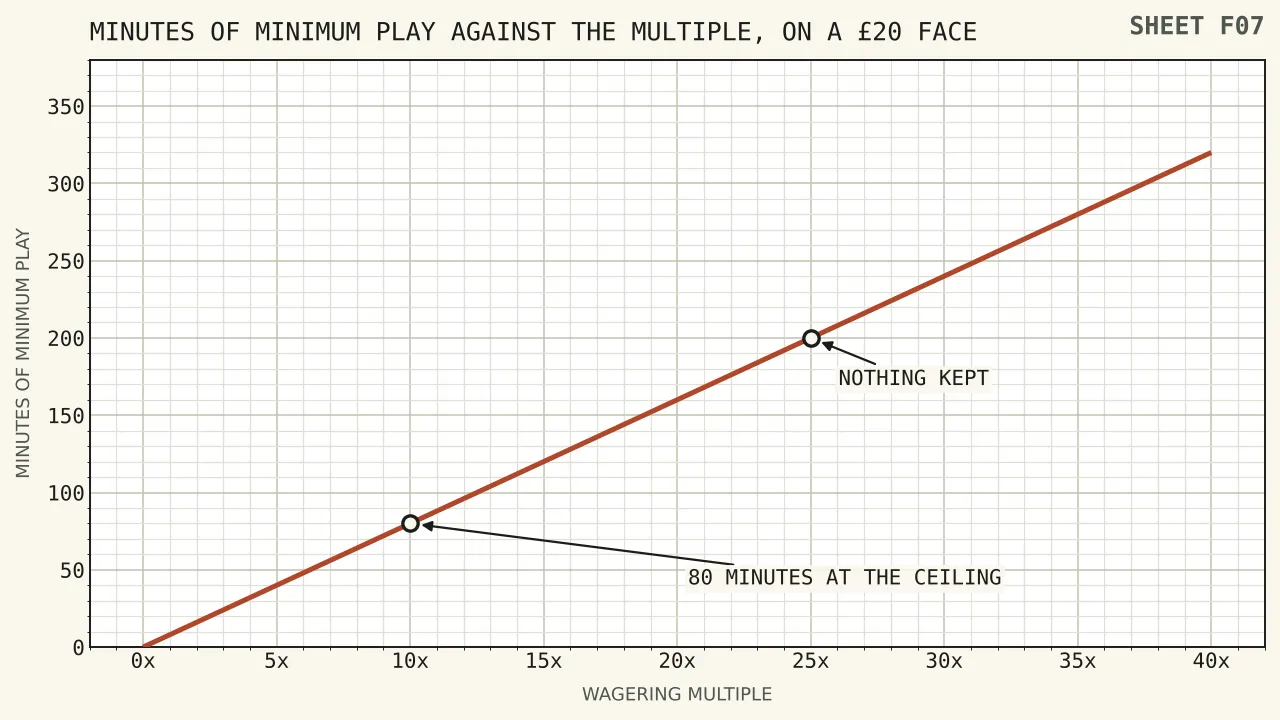
A £20.00 face averages £19.20, and at the British ceiling £11.52 survives, which clears a £10.00 floor. At forty times the obligation is 7,680 cycles and 5 hours 20 minutes, and a seven-day window turns that into 46 minutes every day.
The face £20.00 What draws it down £8.48 What is stranded £6.00
What a face of this size is worth
Every destination on this rack is bought advertising. The site takes a fee if a reader goes on to register, and no figure printed below moves because of it.
Face and Residue
Strip No 01
Betportal
Ceiling as a multiple
Priced at this site's own 10p a spin
What is printed
What draws it down
What is stranded
No Great Britain licence
Licensed in Anjouan, Comoros, run by BetPortal Gaming Ltd, with Excite Ultra Media Ltd, reference ALSI-202601040-FI2.
Terms read 16 October 2026
Open the offer at Betportal, opens in a new tabFace and Residue
Strip No 02
WinBeast
Ceiling as a sum
Priced at this site's own 10p a spin
What is printed
What draws it down
What is stranded
No Great Britain licence
Licensed in Curaçao, operator not named on the site.
Terms read 16 October 2026
Open the offer at WinBeast, opens in a new tabFace and Residue
Strip No 03
EliteSpin
Longest spin window
Priced at this site's own 10p a spin
What is printed
What draws it down
What is stranded
No Great Britain licence
Licensed in Costa Rica, run by PrimeTier Limited.
Terms read 16 October 2026
Open the offer at EliteSpin, opens in a new tabFace and Residue
Strip No 04
Crown Jewelz
Multiple unpublished
No residue struck
What is printed
What draws it down
What is stranded
No Great Britain licence
Licensed in Curaçao, number not verified, operator not named on the site.
Terms read 16 October 2026
Open the offer at Crown Jewelz, opens in a new tabThe two figures in the second and third registers are this site's own arithmetic and nothing an operator has published: the face as printed, less the share a spin gives back at 96 per cent return to player, less what playing the wagering through costs at the same return, and then less whatever a published ceiling, a charge on the way out or a floor on the smallest withdrawal takes off what survives that. The residue is what is left of the face when all of it is accounted for. It describes the offer, not one reader's afternoon. Where the conditions price above the face the strip prints nothing coming off rather than a negative sum, and where a figure the sum needs is unpublished it prints the condition in the operator's words instead.
A face paid as spins has no unit of its own, so one is supplied. Where an operator publishes what a spin of its own is worth, that figure stands in the first register's own line and is labelled as theirs. Where it does not, this site's own 10p a spin stands there and says so, and every figure below moves in proportion: at half the price, half the money. The share of the face that does come off is also given as pence in the pound, which is the figure that compares a large face against a small one.
Money goes onto a prepaid voucher in fixed denominations, so a smallest deposit published in pounds is rounded up to the first rung of the ladder this site works in, £10, £20, £25, £50, £75 and £100, and the strip prints what that rounding strands. That is the reader's own money and it is never netted into a residue. A smallest deposit published in euros is printed as the operator publishes it, because the ladder here is a sterling one and rounding a euro sum to it would be an invented figure.
Three words stand in the amount column where no figure can. Noted is a published condition that takes value away without leaving the sum a figure to take. Unpriced is a condition whose figure nobody has published, or a credit that is not a sum until a deposit of your own sets it. Own money is money of yours, which is never part of a residue.
Not one of the operators printed above holds a Great Britain licence, so the duties that licence carries do not reach them. All online gambling companies licensed in Great Britain must be part of Gamstop Online, and a reader who has shut themselves out through the scheme is therefore not shut out here. The ceiling of ten times the bonus funds on a wagering requirement, in force since 19 January 2026 under Social Responsibility Code 5.1.1, is a condition of that licence and binds the companies that hold one. On an unlicensed site the Gambling Commission describes consumers as facing unfair gaming practices, financial loss and a lack of recourse if things go wrong, and it names blocked payouts and withdrawal limits set so high they are unattainable among what it has seen. Nobody under 18 may hold an account at any of them.
Every term printed on a strip is the operator's own, and each strip carries the day it was read. The oldest of those readings is 16 October 2026. What binds a reader is the operator's own full terms, and not a line printed here.
1
The largest count that still clears a floor
Two hundred spins is the count at which a no-deposit face stops being structurally hopeless at the exit, and that makes it worth a page of its own.
At 10p a spin a face of £20.00 carries £19.20 of expectation, 80p being the edge. The British ceiling of ten times asks £192.00 of turnover, costing £7.68 at 4p a pound, so £11.52 arrives. That clears a £10.00 payout floor with £1.52 to spare.
Compare that with the smaller counts on neighbouring pages and the point of the threshold shows. A general rule falls out of the same arithmetic: an expectation keeps 0.576 of a face through a ten times rule, so a £10.00 floor needs £17.36 of face before a mean outcome reaches it. Two hundred spins priced at 10p comes to £20.00, the first round count standing above that line.
£17.36 of face is the line, and £20.00 is the first round count above it
So the residue on this page is not the floor. It is the ceiling and the clock, and the clock is the one almost nobody prices. Everything after part 2 is about time, because at this count time is the binding constraint and money is not.
Three assumptions carry everything here and all are declared. Ten pence a spin. Ninety-six pence back on each pound. A staked pound counting whole against an obligation. Where a page needs something else, the sentence that needs it says so.
One further figure belongs in this part because it reframes the headline. Two hundred spins is 200 game cycles. The minimum a British licensed slot leaves is 2.5 seconds, so 200 cycles occupy 500 seconds. The advertised thing is 8 minutes and 20 seconds long. Everything else on this page is the obligation attached to it.
2
Hours, not pounds, are the cost here
Turnover converts into cycles at the spin price, and cycles convert into seconds at the published minimum. Those two conversions are the whole of this part, and they turn a wagering multiple into something a reader can feel.
| Multiple | Reading | Cycles | Seconds | Turnover | Arrives |
|---|---|---|---|---|---|
| None | Paid as cash | 0 | 0 | £0.00 | £19.20 |
| 10 times | The British ceiling | 1,920 | 4,800 | £192.00 | £11.52 |
| 20 times | A fifth remaining | 3,840 | 9,600 | £384.00 | £3.84 |
| 25 times | Exactly nothing | 4,800 | 12,000 | £480.00 | £0.00 |
| 40 times | £11.52 beyond nothing | 7,680 | 19,200 | £768.00 | £0.00 |
Read the seconds column in human units and the shape of the offer appears. The British ceiling is 1 hour 20 minutes. Twenty times is 2 hours 40 minutes. Twenty-five times, where the expectation reaches zero, is 3 hours 20 minutes. Forty times, the multiple this site assumes for a cashier beyond the register, is 5 hours 20 minutes.
Now divide what arrives by the time it takes, which is the only rate that matters to somebody deciding whether to start. At the British ceiling, £11.52 across 1 hour 20 minutes works out at £8.64 an hour. At twenty times, £3.84 across 2 hours 40 minutes works out at £1.44 an hour. At 25 times and above the rate is nothing an hour, however many hours are involved.
5 hours 20 minutes of cycles, for an expected £0.00
That £8.64 figure recurs across this site and the reason is arithmetic rather than coincidence. A ten times rule keeps 0.6 of an expectation; an expectation is 0.96 of a face; a face at 10p a spin is one cycle per 10p; and a cycle takes 2.5 seconds. Those four inputs fix the rate at £8.64 an hour for any count whatever, which is why doubling the spins doubles the money and the hours together and changes nothing about the rate.
One consequence is worth stating plainly, because it is the opposite of how a large count is usually sold. Two hundred spins is not a better offer than 100 spins at the same terms. It is the same offer at twice the scale, with twice the obligation and twice the hours. What changes between the two is only whether the surviving balance clears a payout floor, and that is a threshold effect rather than an improvement in the arithmetic.
3
What a window does to an obligation
An obligation with no deadline is an inconvenience. An obligation with a deadline is a schedule, and the schedule is where a large count becomes genuinely demanding.
Take the forty times case, 19,200 seconds of minimum play, and divide it by the windows a promotion of this shape tends to set. The figures are declared assumptions about the window rather than findings about any market, and the arithmetic is what it is.
| Window | Seconds a day | Daily play at the minimum | Reading |
|---|---|---|---|
| 24 hours | 19,200 | 5 hours 20 minutes | One sitting |
| 3 days | 6,400 | 1 hour 47 minutes | Three evenings |
| 7 days | 2,743 | 46 minutes | Daily habit |
| 14 days | 1,371 | 23 minutes | Manageable |
| 30 days | 640 | 11 minutes | Comfortable |
Nothing in that table changes a single pound. Expectation on every row is £0.00. Forty exceeds 25, the break-even multiple, and £30.72 is the expected cost in each case. What the window changes is whether the obligation is reachable by a person with a job, and that is a different question from whether it is worth reaching.
Run the same windows against the British ceiling and the figures become ordinary. Four thousand eight hundred seconds over seven days is 686 seconds a day, which is 11 minutes and 26 seconds. Over 24 hours it is 1 hour 20 minutes in one sitting. The ceiling does not merely improve what survives; it shrinks the schedule by a factor of four.
A third residue hides in the same place and it is the one a reader meets most often. Where a window closes with an obligation part-cleared, the balance behind it goes under the terms. Suppose 5,000 of 7,680 cycles are completed when a seven-day window shuts: £500.00 of turnover has been run, £20.00 of expected cost has been paid, and the balance that would have become money had the obligation finished is forfeited in full.
£20.00 of expected cost paid into an obligation that did not finish
Asymmetry is the thing to carry away from this part. An obligation’s cost accrues continuously while its benefit arrives only at the finish. A reader who stops at 65 per cent has paid 65 per cent of the cost and received none of the benefit, and no rule requires a cashier to pay out a proportion.
4
Instalments, and the spins that never arrive
A count of 200 is large enough that it is frequently paid in pieces rather than at once, and the pieces interact with the window in a way that produces a residue before any play happens.
Take 20 spins a day for 10 days against a seven-day window on the whole offer. Day 8 never comes, so three instalments are never credited. Sixty spins at 10p is £6.00 of face and £5.76 of expectation that a reader was shown and never received.
| Schedule | Days needed | Spins credited | Face arriving | Face expiring |
|---|---|---|---|---|
| 200 at once | 1 | 200 | £20.00 | £0.00 |
| 100 a day | 2 | 200 | £20.00 | £0.00 |
| 40 a day | 5 | 200 | £20.00 | £0.00 |
| 25 a day | 8 | 175 | £17.50 | £2.50 |
| 20 a day | 10 | 140 | £14.00 | £6.00 |
| 10 a day | 20 | 70 | £7.00 | £2.50 |
The bottom row carries a correction rather than a figure, and it is worth making because it is the sort of thing an arithmetic page gets wrong by being tidy. Ten spins a day across a seven-day window credits 70 spins, so £13.00 of the face expires rather than £2.50, and the last column there should be read as the £13.00 it is.
What the table shows, once that is fixed, is a single threshold. Any schedule that finishes inside the window loses nothing to the clock. Any schedule that does not loses the face value of every instalment after the window shuts, and loses it without a term having to be invoked, because an instalment never credited was never a balance.
That is why the residue figure at the head of this page is £6.00 rather than something derived from the ceiling. Of the two residues available on a 200-spin offer, the clock’s is the larger and the quieter, and it is entirely determined by the relationship between two numbers a reader can check in ten seconds: how many days the spins arrive over, and how many days the offer lasts.
One arithmetic note on the surviving case. Where all 200 spins are credited and the obligation is the British ceiling, £11.52 arrives and clears a £10.00 floor. Where 140 are credited, the expectation is £13.44, the ceiling asks for £134.40 of turnover, the expected cost is £5.38 and £8.06 arrives, which does not clear a £10.00 floor. So the clock’s residue of £6.00 of face converts into a second residue of £8.06 at the exit, and the two compound.
5
Where the pace rules come from, and what they do not say
Every second on this page comes from one published figure, so the figure deserves its provenance set out properly, along with what its own standard does not state.
RTS 14 runs from 14A through to 14G. Publication was 2 February 2021, with 12 January 2026 as the last update, and a change note recording that the wording of RTS 14C was updated to refer to slot games as games.
No commencement date for any RTS 14 requirement appears on that standard, 14A through 14G alike, and none is asserted here. The 2.5 second minimum between slot cycles is therefore cited for the rule and not for a start date.
One date in the series is publishable, and it comes from elsewhere. Five seconds covers a cycle at a casino game of some other kind, poker played peer to peer aside, and 17 January 2025 is what the Commission’s updates page gives. The 2.5 second rule goes unnamed there, so the January date does not attach to slots.
| Rule | What it fixes | Commencement |
|---|---|---|
| RTS 14D | 2.5 seconds between slot cycles | None stated on the standard |
| RTS 14G | 5 seconds at other casino games, poker aside | 17 January 2025, from the updates page |
| RTS 14E | No shortening of the wait for a result | None stated on the standard |
| RTS 8A | No autoplay, each cycle committed to singly | None stated |
Those rules together are what make 7,680 cycles into 5 hours 20 minutes rather than into whatever a piece of software can manage. Remove them and money stays identical while hours collapse, which reads as convenience and removes the gap between one decision and the next.
Two further elements of the same requirement bear on a long obligation, and both concern what a screen may do across 7,680 repetitions. Celebration of a sub-stake return is prohibited, so 7,680 small losses cannot appear as small wins. Barred too are four kinds of active encouragement: towards a chased loss, towards a lifted stake, towards a raise on a settled figure, and towards play that runs past a stated wish to stop.
Neither the table nor the pair above shows up in Curaçao’s published policy for licensees. Documents, not conduct, is what that describes, and the difference between the two runs through this site.
6
A time limit is a significant condition
If the window is the thing doing the stranding, the next question is whether an advertisement has to tell a reader about it, and the answer is yes with a specific authority behind it.
Time limits for claiming or for using an offer appear by name on the advertising regulator’s worked list of significant conditions. Three others share that list. An eligibility restriction, new customers only or an age or a location. A requirement to deposit, or to wager. A minimum odds or bet type. Clear and prominent communication is owed for a significant condition wherever an omission would be likely to mislead.
Online, a click away is where full terms belong, and neither a footer nor small print is the place for them. That advice carries its own grammatical slip, so it is put in other words here. That page is dated 11 September 2025, and the date is not labelled as a last-updated date.
One ruling sits behind the time-limit line and it illustrates the point sharply. GB Sports Advisors Ltd trades as Geoff Banks Online, the ruling carries 17 July 2024, and a £10 free bet came with a deadline for answering a text message that the advertisement left out. A significant condition was what the deadline counted as, and its omission was likely to mislead.
The Commission says the same thing from the licensing side and adds a consequence. Prominence inside an advertisement is required of a significant term, placed near the headline offer on whichever landing or sign-up page is relevant. Insufficient prominence makes an advertisement misleading.
So a reader holding a 200-spin headline has an entitlement with a precise shape. The window is a significant condition. It belongs in the advertisement or a click away, not buried. What a reader is not entitled to is a particular length of window, because no published rule sets one, and the arithmetic in part 3 is the only thing that converts a length into a daily commitment.
7
Five jurisdictions, read at source
Offers at this size get advertised without any Great Britain licence at all. Reading what the alternatives publish is therefore the honest course, and five were attempted for this site. The results differ sharply, including in whether anything could be read at all.
| Jurisdiction | What was found at source |
|---|---|
| Malta | The Malta Gaming Authority works under the Gaming Act, chapter 583, with its relevant directives. An enforcement register runs there, a searchable register of licensees, and a Player Hub carrying a formal complaints route |
| Malta, the form | Lodging a complaint against an MGA-licensed operator is what the form is for. Cases get reviewed in English or in Maltese. Identification may be requested in order to process one. And resolving matters with an operator’s support and management first is what it recommends |
| Malta, what is absent | No time limit appears. No restriction by residency or jurisdiction appears. Nothing appears about the limits of the authority’s own powers, nor about whether a decision binds an operator. The form does ask a country of residence, with no eligibility rule tied to the answer |
| Kahnawake | The Kahnawà:ke Gaming Commission sits in the Mohawk Territory of Kahnawà:ke in Quebec. Regulations may be enacted by it under the Kahnawà:ke Gaming Law. Five licence types come out of its Regulations concerning Interactive Gaming, and complaints, queries and investigations reach the Commission under the procedures in them |
| Anjouan | Publishing on a commercial domain instead of a government one is the first fact about the issuing body. One address redirects to another. Anjouan Gaming is the name it gives itself, subtitled Internet Gaming Regulatory Authority |
| Anjouan, the legal basis | No ordinance is named, no Act, no regulation. Only general references appear, to Anjouan law and to the laws of that autonomous island |
| Anjouan, what it advertises | Licences in two categories: business to consumer, and business to business. A register, open to the public, of whoever holds them. A verification tool. A page headed with a player complaint process. A page of authorised dispute resolution providers |
| Anjouan, the page that would not open | Fetching the complaint process page produced an error. A complaint route and a provider list are therefore advertised, with the contents of each unknown: no time limit, no remedy, and nothing saying an operator is bound by any outcome |
| Costa Rica | No gambling regulator’s website could be found at all, and the absence is the fact. Searching for a government gaming authority there returned industry and law-firm material, none of it citable here |
| Gibraltar | Official pages could not be reached, so no Gibraltar regulator fact appears here. Two Gibraltar-incorporated licensees do appear on the Commission’s own enforcement list, which shows that a Gibraltar incorporation and a British licence are separate things |
Read down that table and the useful conclusion is not that offshore regulation is absent. It is that the five differ from each other more than any of them differs from a caricature. Malta publishes a real statute, a register and a complaints form while stating nothing about its own powers. Kahnawà:ke publishes a law and a licence structure. Anjouan advertises a complaint route whose contents could not be read. Costa Rica produced no regulator at all, and Gibraltar’s own pages did not answer.
Two counts that a reader might expect here are deliberately absent. No count of operators holding any offshore licence is published, and none is offered here. A licence register exists at the Curaçao authority and the Anjouan body claims one, yet neither yields a figure that could be cited with a date beside it.
No distribution is published across the offshore market either, not of wagering multiples, not of caps on withdrawal, not of spin values. What this build found on each of those came from trade publications, from law firms’ notes, from affiliate pages, and none of those is citable here.
What remains available is the structural contrast. A ten times ceiling exists in Great Britain, and no ceiling of any kind appears in the Curaçao rulebook. On a 200-spin face that contrast is worth £11.52, because £11.52 is what a ten times rule leaves and nothing is what a forty times rule leaves.
8
What 200 spins lose off the British register
On a page where the binding constraint is time, the duties worth pricing are the ones that put time into the arithmetic in the first place.
| Duty | What it does to 7,680 cycles |
|---|---|
| 2.5 seconds a cycle | Turns them into 5 hours 20 minutes rather than whatever software allows |
| No autoplay | Makes them 7,680 decisions rather than one setting |
| No turbo or slam stop | Holds the 2.5 seconds where the standard put it |
| Ten times at the most | Cuts the obligation to 1,920 cycles and leaves £11.52 |
| A time limit shown prominently | Puts the window in front of a reader before the schedule starts |
The fourth row is the one with the money in it and the first row is the one with the hours. Together they are the difference between an offer worth £11.52 across 80 minutes and an offer worth nothing across whatever time a cashier’s software takes to run 7,680 cycles.
Three further duties belong in a short list because each of them is a figure. A £5 ceiling on a slot cycle, falling to £2 below the age of 25. Identity obtained and verified ahead of any play, bonus play included. And a complaint acknowledged inside 3 working days, with the whole process finished 56 days from receipt and escalation available to an adjudicator the Commission has approved.
A British licence is also what puts an operator into the national self-exclusion scheme. A cashier absent from the register therefore sits outside that scheme by construction, and the scheme says preventing access to a service run by a non-participant is beyond what it can do. That sentence is the plainest measure of what an absence means.
Two more points run the other way, both sourced. The Curaçao route: 6 months from an incident, free to the player, 4 weeks for an answer. The British regulator recovers no money either. Of itself it says: not an ombudsman. Settling a withdrawal dispute is no power it holds.
One last figure closes the account and it is the one this page began with. A 200-spin face is the first round count whose expectation clears a £10.00 floor after a ten times rule. Remove the ceiling and the same count clears nothing, because at forty times the expectation is £0.00. The count did not change and the floor did not move. The multiple did, and the multiple is a licence condition rather than a law of arithmetic.
Questions
- What is 200 free spins worth?
- At 10p a spin the face comes to £20.00 and the expectation to £19.20. A ten times obligation asks £192.00 of turnover, costing £7.68, so £11.52 arrives and clears a £10.00 payout floor. At forty times the turnover is £768.00, the expected cost is £30.72, and the expectation is nothing.
- Why is 200 the count this page treats as a threshold?
- Because an expectation keeps 0.576 of a face through a ten times rule, so a £10.00 floor needs £17.36 of face before a mean outcome reaches it. Two hundred spins priced at 10p comes to £20.00, the first round count standing above that line. Below it the floor strands whatever survives; above it only the ceiling and the clock take anything.
- How many hours does the obligation take?
- At the British ceiling, 1,920 cycles run 4,800 seconds at 2.5 seconds apiece, which is 1 hour 20 minutes. At twenty times it is 2 hours 40 minutes, at 25 times 3 hours 20 minutes, and at forty times 7,680 cycles and 5 hours 20 minutes. The 200 spins themselves take 500 seconds.
- What does a seven-day window do to that?
- It converts a total into a daily commitment. Nineteen thousand two hundred seconds across seven days is 2,743 seconds a day, which is 46 minutes of unbroken play every day for a week. A 24-hour window makes the same obligation one sitting of 5 hours 20 minutes, and a 30-day window makes it 11 minutes a day.
- Does the window change what the offer is worth?
- Not by a penny. The expectation at forty times is £0.00 under every window, and the expected cost is £30.72 under every window. What a window changes is whether the obligation is reachable by somebody with a job, Reaching it is a different question from whether reaching it is worthwhile.
- And where a window shuts part way?
- The balance behind an unfinished obligation goes under the terms, and no rule requires a proportion to be paid. Stop at 5,000 of 7,680 cycles and £500.00 of turnover has been run with £20.00 of expected cost paid, for nothing. Cost accrues continuously and the benefit arrives only at the end, which is the asymmetry worth knowing.
- Can spins be paid in instalments that outlast the offer?
- They can, and that is this page’s quietest residue. Twenty spins a day for 10 days against a seven-day window credits 140 spins, so £6.00 of a £20.00 face expires without ever being credited. Nothing is forfeited, because an instalment never credited was never a balance, and no term has to be invoked.
- Does an advertisement have to state the time limit?
- A worked list of significant conditions carries the time limit for a claim, or for using an offer, and clear prominent communication is owed wherever an omission would be likely to mislead. Online, a click away is where full terms belong, and neither a footer nor small print is the place for them.
- Where does 2.5 seconds come from?
- From RTS requirement 14D, which runs inside a standard covering 14A to 14G. Publication of that standard was 2 February 2021, with 12 January 2026 as its last update, and a change note recording RTS 14C reworded to refer to slot games as games. No commencement date appears on it for any of those requirements, so it is cited for the rule rather than for a start date.
- Is there a published date for the five second rule?
- Yes, from a different page. Five seconds covers a cycle at a casino game of some other kind, poker played peer to peer aside, and 17 January 2025 is what the Commission’s updates page gives. The 2.5 second rule goes unnamed there, so the January date does not attach to slots.
- What do offshore regulators actually publish?
- It varies more than a reader would expect, and part 7 sets out what five of them yielded. Malta publishes a statute, registers and a complaints form while stating nothing about its own powers or about binding decisions. Kahnawà:ke publishes a law and a licence structure. One body’s complaint page returned an error. Pages that would not answer is what one country and one territory produced.
- And what does no British licence cost 200 spins?
- Five duties priced in part 8, of which the heaviest in money is the ten times ceiling and the heaviest in hours is the 2.5 second minimum cycle. Beyond those: a £5 ceiling on a slot cycle, identity settled before play, a complaints clock running 56 days, an approved adjudicator at its end, and membership of the national scheme.