Note F08 Revision 1 Terms read 16 October 2026
One hundred of what? A headline with two readings
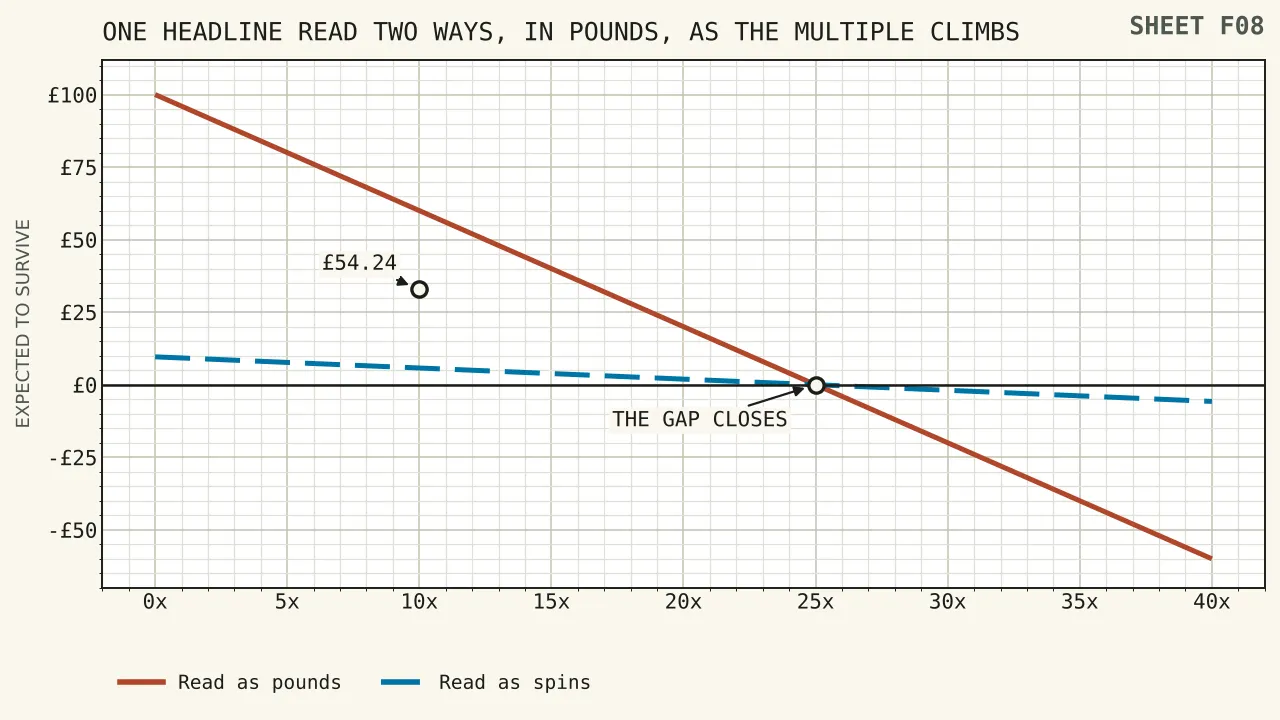
Read as pounds, the figure survives a ten times rule at £60.00. Read as a count of 10p spins, it survives at £5.76. The gap between those readings is £54.24, and a headline carrying no unit does not say which one a reader is holding.
The face £100.00 What draws it down £40.00 What is stranded £94.24
What a face of this size is worth
Every destination on this rack is bought advertising. The site takes a fee if a reader goes on to register, and no figure printed below moves because of it.
Face and Residue
Strip No 01
Betportal
Ceiling as a multiple
Priced at this site's own 10p a spin
What is printed
What draws it down
What is stranded
No Great Britain licence
Licensed in Anjouan, Comoros, run by BetPortal Gaming Ltd, with Excite Ultra Media Ltd, reference ALSI-202601040-FI2.
Terms read 16 October 2026
Open the offer at Betportal, opens in a new tabFace and Residue
Strip No 02
WinBeast
Ceiling as a sum
Priced at this site's own 10p a spin
What is printed
What draws it down
What is stranded
No Great Britain licence
Licensed in Curaçao, operator not named on the site.
Terms read 16 October 2026
Open the offer at WinBeast, opens in a new tabFace and Residue
Strip No 03
EliteSpin
Longest spin window
Priced at this site's own 10p a spin
What is printed
What draws it down
What is stranded
No Great Britain licence
Licensed in Costa Rica, run by PrimeTier Limited.
Terms read 16 October 2026
Open the offer at EliteSpin, opens in a new tabFace and Residue
Strip No 04
Crown Jewelz
Multiple unpublished
No residue struck
What is printed
What draws it down
What is stranded
No Great Britain licence
Licensed in Curaçao, number not verified, operator not named on the site.
Terms read 16 October 2026
Open the offer at Crown Jewelz, opens in a new tabThe two figures in the second and third registers are this site's own arithmetic and nothing an operator has published: the face as printed, less the share a spin gives back at 96 per cent return to player, less what playing the wagering through costs at the same return, and then less whatever a published ceiling, a charge on the way out or a floor on the smallest withdrawal takes off what survives that. The residue is what is left of the face when all of it is accounted for. It describes the offer, not one reader's afternoon. Where the conditions price above the face the strip prints nothing coming off rather than a negative sum, and where a figure the sum needs is unpublished it prints the condition in the operator's words instead.
A face paid as spins has no unit of its own, so one is supplied. Where an operator publishes what a spin of its own is worth, that figure stands in the first register's own line and is labelled as theirs. Where it does not, this site's own 10p a spin stands there and says so, and every figure below moves in proportion: at half the price, half the money. The share of the face that does come off is also given as pence in the pound, which is the figure that compares a large face against a small one.
Money goes onto a prepaid voucher in fixed denominations, so a smallest deposit published in pounds is rounded up to the first rung of the ladder this site works in, £10, £20, £25, £50, £75 and £100, and the strip prints what that rounding strands. That is the reader's own money and it is never netted into a residue. A smallest deposit published in euros is printed as the operator publishes it, because the ladder here is a sterling one and rounding a euro sum to it would be an invented figure.
Three words stand in the amount column where no figure can. Noted is a published condition that takes value away without leaving the sum a figure to take. Unpriced is a condition whose figure nobody has published, or a credit that is not a sum until a deposit of your own sets it. Own money is money of yours, which is never part of a residue.
Not one of the operators printed above holds a Great Britain licence, so the duties that licence carries do not reach them. All online gambling companies licensed in Great Britain must be part of Gamstop Online, and a reader who has shut themselves out through the scheme is therefore not shut out here. The ceiling of ten times the bonus funds on a wagering requirement, in force since 19 January 2026 under Social Responsibility Code 5.1.1, is a condition of that licence and binds the companies that hold one. On an unlicensed site the Gambling Commission describes consumers as facing unfair gaming practices, financial loss and a lack of recourse if things go wrong, and it names blocked payouts and withdrawal limits set so high they are unattainable among what it has seen. Nobody under 18 may hold an account at any of them.
Every term printed on a strip is the operator's own, and each strip carries the day it was read. The oldest of those readings is 16 October 2026. What binds a reader is the operator's own full terms, and not a line printed here.
1
A number without a unit
Every other page in this section starts from a quantity and finds its residue in the terms. This one has a residue before the terms are opened, because the headline is a bare 100 and a bare 100 is not a quantity.
Two readings are available and both are ordinary. One hundred pounds of bonus credit is the first. One hundred free spins is the second. A promotion that prints the figure without the noun has handed a reader something that could be either, and the two are not close: at a ten times obligation the first survives at £60.00 and the second at £5.76.
£54.24 between two readings of the same four characters
That £54.24 is the subject of this page. It is not a term, not a ceiling and not a forfeiture. It is ambiguity, priced, and it is the only residue on this site that can be removed entirely by reading one line of the terms.
Three assumptions carry the arithmetic and each is declared. Where the spins reading applies a spin costs 10p. Ninety-six pence returns on each pound staked. An obligation counts a staked pound whole. Ten times is a British ceiling rather than an assumption, and forty times is what this site assumes of a cashier off the register.
One more thing is worth settling at the start, because it decides how the rest of this page is written. What a free spin is worth is fixed by nothing published, so pricing the spins reading takes an assumed unit. The pounds reading needs no assumption at all: £100 of credit is £100 of credit. So the two readings are not merely different in size. One of them is knowable from the headline and the other is not.
What follows takes the two in parallel, column by column, and then asks the question a reader actually faces, which is what to do when the headline will not say which it is.
2
Both readings, priced side by side
Here are the two, carried through the same five multiples. Nothing in the method changes between them; only the face changes, and everything else follows from it.
| Multiple | Pounds: turnover | Pounds: arrives | Spins: turnover | Spins: arrives | Gap |
|---|---|---|---|---|---|
| None | £0.00 | £100.00 | £0.00 | £9.60 | £90.40 |
| 5 times | £500.00 | £80.00 | £48.00 | £7.68 | £72.32 |
| 10 times | £1,000.00 | £60.00 | £96.00 | £5.76 | £54.24 |
| 20 times | £2,000.00 | £20.00 | £192.00 | £1.92 | £18.08 |
| 25 times | £2,500.00 | £0.00 | £240.00 | £0.00 | £0.00 |
The pounds reading takes no deduction for a spin price, so its face is £100.00 and the cash credit is the expectation. On the spins reading, 100 cycles at 10p gives £10.00 of face, and £9.60 of expectation once 4 per cent is off. From there the arithmetic is shared: the multiple times the credit gives turnover, 4p rides on each pound of it, and the difference arrives.
Read the gap column and the ambiguity is at its most expensive where the terms are kindest. With no obligation at all, the two readings are £90.40 apart. At the British ceiling they are £54.24 apart. By 25 times they have converged on nothing, because 25 is 1 divided by 0.04 and the break-even multiple does not care how big a face is.
That last point is worth dwelling on, because it inverts the usual advice. A reader facing an ambiguous headline has most to gain from resolving it when the wagering requirement is low, and nothing whatever to gain when the requirement is 25 times or above. At 25 times both readings are worth £0.00, and the ambiguity has become free of charge.
At 25 times both readings are worth £0.00 and the gap closes
The exit works differently on the two as well, and the difference is a threshold rather than a proportion. At the British ceiling the pounds reading arrives at £60.00, which clears a £10.00 payout floor six times over. The spins reading arrives at £5.76, which does not clear it at all and is stranded in full. So one reading produces money and the other produces a balance, and the headline does not distinguish between those two outcomes either.
3
The third reading, which pays nothing at all
A third reading of the same headline exists and it is worth pricing because it is the one most often intended by a 100 in gambling advertising: 100 per cent.
A 100 per cent match doubles whatever a reader puts in. With nothing put in, it doubles nothing. On a no-deposit offer that reading resolves to £0.00 of face, £0.00 of expectation, and £0.00 of everything else, which is why the phrase no deposit required sits in the headline at all: it is the part of the wording that rules this reading out.
That is not a quibble. It is the clearest demonstration available of why a percentage and a sum are different objects. What a ceiling on wagering governs is the multiple, not the percentage, so raising the percentage raises the bonus and raises turnover in step with it, which leaves the ratio at ten to one throughout. A percentage with no deposit behind it raises nothing, because the thing it multiplies is zero.
| Reading | Face | Arrives at ten times |
|---|---|---|
| £100 of credit | £100.00 | £60.00 |
| 100 spins at 10p | £10.00 | £5.76 |
| 100 per cent of nothing | £0.00 | £0.00 |
A fourth possibility deserves a sentence because it collapses the first two together. One hundred spins priced at £1.00 each is £100.00 of face, identical in money to the credit reading and different in every other respect: 100 cycles rather than 1,000, a wider distribution, and a per-cycle value at the ceiling of what a British licensed slot allows for a player aged 25 or over.
So the headline admits four readings whose faces are £100.00, £100.00, £10.00 and £0.00. Two of them are worth £60.00 at the British ceiling, one is worth £5.76, and one is worth nothing. A reader who finds the unit in the terms has resolved the whole of that in a single line, and a promotion that will not say which is a promotion worth ten seconds of reading.
4
How far the word free can stretch
One other word in the headline is doing work, and unlike the number it has a published constraint on it.
Calling an offer free is something a marketer should not do where a customer, in order to qualify, must put money of their own at stake. Pairing risk with the word free is to be avoided as well, unless losing funds of a customer’s own is genuinely impossible.
That advice belongs to the advertising regulator rather than to a licence condition, and it is the reason this site never uses the second of those two phrasings anywhere, on any page. It also sets a test a reader can apply to the headline on this page. Where no deposit is required and no own-money stake is needed to qualify, the word is doing honest work. Where a qualifying stake is buried in the terms, it is not.
Alongside that sits the base duty, which is shorter still: marketing communications must not mislead consumers. Prominence inside an advertisement is owed to a significant term, set near the headline offer on whatever landing or sign-up page applies, and too little of it makes an advertisement misleading.
Every line of an offer like this one is reached by that worked list. A deposit requirement, or a wagering one. A limit of time on a claim, or on use. Eligibility: new customers only, or a stated age, or a location. Odds or bet type, at a minimum.
What the list leaves out, and this is the gap this page exists to fill, is the unit. Nothing in the published material requires an advertisement to say whether 100 means pounds or spins, because the unit is not a condition. It is the subject of the sentence, and a worked list of conditions does not reach it.
The unit is not a significant condition, so no rule requires it in the headline
5
Six limbs of the code that governs an incentive
One code provision governs every incentive a British licensee offers, whatever unit it is denominated in, and it is worth setting out in full because most pages quote only its ceiling.
Social Responsibility Code 5.1.1 bites wherever a licensee offers any customer, or any potential customer, an incentive, a reward, or an arrangement handing over money, goods, services or an advantage of some other kind. Its second limb wants terms for the incentive that are clear, transparent and fair, reachable with ease by whoever is offered the thing.
Four prohibitions follow. Wagering above ten times the bonus funds. Two gambling product types inside a single incentive. An incentive whose value changes where the qualifying activity finishes inside less than the whole offer period. And travel or accommodation, free or subsidised, that encourages attendance at a premises on terms tied to a customer’s expected gambling.
Two further limbs reach a customer marked high value, or VIP, or anything equivalent. An incentive aimed at them has to be consistent with the licensing objectives, and the Commission’s own guidance on incentives for such customers has to be taken into account.
Scope covers all licences, ancillary remote ones among them, with 2 exceptions. Gaming machine technical licences, and gambling software ones, are those. That condition page shows no effective date.
The third prohibition in that list is the one nobody quotes and the one that bears hardest on a headline like this. Value may not change where a qualifying activity finishes inside less than the whole offer period. A reader who finishes early cannot therefore be paid less for finishing early, which is a protection against a particular shape of term rather than against a figure.
On the ceiling itself, two figures belong here from opposite directions. Up to 60 times was in use at some licensees before the ceiling, and that figure belongs to the Commission rather than to this site. One respondent to the same consultation said that 75 per cent of its offers apply within 1 to 10 times wagering. That is a single operator’s statement about its own offers rather than any finding about a market, and it is attributed here as such.
Run the first of those against the pounds reading on this page. Sixty times on £100.00 is £6,000.00 of turnover. Six thousand pounds of turnover costs £240.00 against £100.00 of credit, so the obligation runs £140.00 heavier than the thing it hangs on, which is what a ceiling of ten exists to prevent.
6
Twenty-eight hours on the larger reading
The pounds reading is worth more money and costs vastly more time, and the time is the part no headline carries.
Turnover converts into cycles at the stake. Cycles become seconds at the published minimum, and that minimum is 2.5 seconds from a slot cycle beginning to the earliest start of its successor. At 10p a cycle, the pounds reading at the British ceiling asks £1,000.00 of turnover, in other words, which comes to 10,000 cycles and 25,000 seconds.
| Reading and multiple | In plain units | Cycles at 10p | Seconds | Rate an hour |
|---|---|---|---|---|
| Spins, ten times | 40 minutes | 960 | 2,400 | £8.64 |
| Pounds, ten times | 6 hours 57 minutes | 10,000 | 25,000 | £8.64 |
| Spins, forty times | 2 hours 40 minutes | 3,840 | 9,600 | £0.00 |
| Pounds, forty times | 27 hours 47 minutes | 40,000 | 100,000 | £0.00 |
Identical rates on those two ten times rows are no coincidence. A ten times rule retains 0.6 of an expectation. An expectation stands at 0.96 of a face. A face priced at 10p runs a cycle for every 10p of it. Each cycle takes 2.5 seconds. Four inputs fix £8.64 an hour for any face whatever, so the larger reading pays ten times as much across ten times as long.
The bottom row is the figure to carry away from this part. Forty times on a £100.00 credit is 100,000 seconds of minimum play, which is 27 hours and 47 minutes, for an expectation of nothing. Spread across a seven-day window that is 3 hours 58 minutes every day. Across a 30-day window it is 56 minutes a day.
100,000 seconds of cycles behind a £100.00 credit at forty times
One other thing changes with the stake, and it is worth a line because it is the only way the hours come down. Raise the stake to £1.00 a cycle and the pounds reading at ten times is 1,000 cycles rather than 10,000, which is 2,500 seconds or 42 minutes. The expected cost is unchanged at £40.00, because expected cost depends on turnover rather than on stake size. What changes is the number of decisions and the spread of outcomes around the same mean.
At £5.00 a cycle the same obligation is 200 cycles and 500 seconds, which is 8 minutes and 20 seconds, and £5.00 is the ceiling a British licensed slot allows for a player who has reached 25. Under 25 the ceiling is £2.00, which makes the same obligation 500 cycles and 1,250 seconds. So the hours behind an obligation are a function of the stake cap as much as of the multiple.
7
What a reader is told to look for
The regulator publishes advice to players about exactly this kind of headline, and the advice names the thing a no-deposit figure hides.
A reader is told by the regulator to look for precisely what a no-deposit headline hides: any restriction attaching to an introductory offer or to a bonus, with a minimum spend ahead of payment as the example. The published wording carries a grammatical slip, so it is paraphrased here.
Four checks appear on the same page. A licence from the Commission. A licensed status displayed by the website itself. A click that reaches the public register and the licence standing there. And details on that register, activities and website domain names among them, matching what is claimed. Publication was 20 September 2020, with 23 August 2021 as the last update.
Five minutes covers all of them, and they are worth more than any arithmetic on this page, because the arithmetic assumes the terms will be honoured while the checks test whether anybody is obliged to honour them.
On the terms themselves, the practical sequence for a headline of this shape is short enough to be a list. Find the unit, which decides whether the face is £100.00 or £10.00. Find the multiple, which decides what fraction of the face survives. Find the window, which decides whether the obligation is reachable. Find the payout floor, which decides whether what survives can leave.
Four figures, in other words, and the headline supplies none of them. That is not a complaint about any particular promotion. Until a reader knows what comes off a face, the face is not a quantity, and that is why this site exists.
8
Winnings, tax, and a 1925 case about a habit
A reader who gets £60.00 out of this offer will want to know whether any of it is taxable, and the published position is more interesting than the usual one-line answer.
At BIM22015 the HMRC manual records betting and gambling as not being, in themselves, trading. Normally amounting to trading, it adds, is an organised activity whose aim is profit from the gambling public. A spread-betting taxpayer is normally carrying on no trade, so no profits are taxable and no losses attract relief, while the bookmaker organising a bet is taxable on what it makes.
Case law arrives at BIM22017. A taxpayer in Graham v Green, from 1925 and reported at 9 TC 309, drew their whole livelihood from betting on horses at starting prices, and Rowlatt J held no trade existed in it. His words were that no tax falls on a habit.
Having a system for placing bets makes an activity no trade of itself, HMRC records. Living on the proceeds does not either. Expertise, or studying form systematically, is not enough.
Where a gambler can be trading is noted on the same page. Money for appearing on a television programme is the example, and trade proceeds, or not, would turn on the facts.
Here, then, is the honest formulation: HMRC’s published position makes betting and gambling no trade of themselves, leaving winnings outside trading income, rather than any rule declaring winnings tax-free. Nothing here is tax advice.
No single page at HMRC or on gov.uk was found to say in terms that winnings from gambling are untaxed. What exists is the pair of manual pages above, addressing whether gambling amounts to a trade.
Duty does exist and it falls on the operator, following a player rather than a licence. The charge on remote gaming reaches an operator’s profits from remote gaming played by a customer usually living in the United Kingdom. Forty per cent is the rate from 1 April 2026, so an offshore cashier taking money from a British player falls inside the charge, whatever register it is missing from.
9
Both readings, off the British register
Faces like this get advertised with no Great Britain licence at all, and on a page about ambiguity the loss takes a particular shape: the duties that would otherwise constrain what a term can do once the unit turns out to be the smaller one.
| Duty | On the pounds reading | On the spins reading |
|---|---|---|
| Ten times at the most | £60.00 arrives instead of £0.00 | £5.76 arrives instead of £0.00 |
| Clear, accessible terms | Puts the multiple in front of the reader | Puts the unit there too |
| No value change for finishing early | £60.00 stays £60.00 | £5.76 stays £5.76 |
| One product per incentive | Two kinds of gambling kept off one set of linked terms | The same |
| 2.5 seconds a cycle | 25,000 seconds rather than whatever software allows | 2,400 seconds |
| £5 a cycle, £2 under 25 | A ceiling over the widest spread one cycle can produce | The same |
Of those six duties, none appears in Curaçao’s responsible gaming policy for licensees, whose version is 1.0 and whose date is 21 February 2025. Two lines are all that document says about bonuses. Communication that is transparent, with terms that are clear, is the first. Excessive gambling not encouraged by aggressive bonus promotion is the second.
Three further duties go in a short list because each is a figure instead of a principle. Identity obtained and verified ahead of all play, bonus play included. A complaint acknowledged inside 3 working days, the whole process done within 56 days of receipt. And escalation to an adjudicator the Commission has approved, with approved ones alone usable.
A British licence, not a website, is what national scheme membership follows, and the scheme states that a service run by an organisation outside it is past what it can prevent. Registration numbered 614,738 on 16 July 2026.
Two points run the other way, both sourced. Curaçao publishes a complaints route, free to the player, 6 months from an incident, 4 weeks for an answer. Nor does the British regulator recover anybody’s money, describing itself as no ombudsman and holding no power over a withdrawal dispute.
One closing figure ties the page together. The residue printed at the head of this page is £94.24, which is the £100.00 headline less the £5.76 that survives on the smaller reading at the British ceiling. That figure is not a term and nobody wrote it into a contract. It is what a reader loses by not knowing which of two ordinary words the headline meant, and it is the easiest £94.24 on this site to avoid losing.
Questions
- Does 100 free mean £100 or 100 spins?
- The headline does not say, and that is this page’s subject. Read as pounds, the face is £100.00 and a ten times obligation leaves £60.00. Read as 100 spins at 10p, the face is £10.00 and the same obligation leaves £5.76. The gap is £54.24, and one line of the terms resolves it.
- Can it mean 100 per cent?
- Not on an offer with nothing deposited behind it. A percentage multiplies a deposit, and with no deposit it multiplies nothing, so that reading resolves to £0.00 of face and £0.00 of everything else. The words no deposit required are what rule it out, which is the clearest demonstration that a percentage and a sum are different objects.
- Which reading is worth more?
- The pounds reading, by a factor of ten at every multiple below break-even. At the British ceiling it arrives at £60.00 against £5.76, and with no obligation at all the two are £90.40 apart. By 25 times both are worth £0.00, because 25 is 1 divided by 0.04 and the break-even multiple does not depend on the size of a face.
- Does the ambiguity always cost £54.24?
- No, and the pattern is the opposite of what most advice implies. The gap is widest where the terms are kindest: £90.40 with no obligation, £54.24 at ten times, £18.08 at twenty times, and £0.00 at 25 times and above. Resolving the unit matters most when the wagering requirement is low.
- How long does the larger reading take to clear?
- At 10p a cycle, £1,000.00 of turnover runs 10,000 cycles, which at 2.5 seconds apiece is 25,000 seconds, or 6 hours 57 minutes. At forty times it is 40,000 cycles and 100,000 seconds, which is 27 hours 47 minutes for an expectation of nothing. A seven-day window would make that 3 hours 58 minutes a day.
- Does playing at a bigger stake help?
- It shortens the time and changes nothing about the expectation. At £1.00 a cycle the pounds reading at ten times is 1,000 cycles and 2,500 seconds rather than 10,000 cycles and 25,000. The expected cost stays £40.00, because expected cost follows turnover rather than stake size. What changes is the number of decisions and the spread around the same mean.
- When may an offer be described as free?
- Not where a customer must stake money of their own in order to qualify, on the advertising regulator’s own advice, and risk paired with free is likewise to be avoided unless losing a customer’s own funds is genuinely impossible. That gives a reader a test: if a qualifying stake is buried in the terms, the word is not doing honest work.
- Must an advertisement state the unit?
- Nothing published requires it. What the worked list of significant conditions covers is a deposit or wagering requirement, a time limit, an eligibility restriction, a minimum odds or bet type. The unit is not a condition at all; it is the subject of the sentence, so a list of conditions does not reach it.
- What does the code say about an incentive besides the ceiling?
- Rather a lot. Clear, transparent and fair terms, reachable with ease. No two product types inside one incentive. No change in an incentive’s value where a qualifying activity finishes inside less than the whole offer period. Travel or accommodation tied to expected gambling at a premises is prohibited. And incentives for high-value customers have their own two limbs.
- What was the ceiling fixing?
- Up to 60 times was in use at some licensees before it arrived, and that figure is the Commission’s. On £100.00 of credit, 60 times is £6,000.00 of turnover and £240.00 of expected cost, so the obligation runs £140.00 heavier than the credit. One respondent separately said 75 per cent of its own offers sat within 1 to 10 times, which is one operator’s statement about itself.
- Are winnings taxed?
- Nothing here is tax advice, and no page was found at HMRC or on gov.uk saying in terms that winnings go untaxed. What is published is that betting and gambling are not trading in themselves, with an old case holding that a livelihood drawn from betting was no trade at all. The duty falls on the operator instead, following where a customer usually lives rather than where the operator is licensed.
- What do both readings lose off the British register?
- Six duties priced in part 9, of which the ten times ceiling is the difference between £60.00 and nothing on the larger reading and between £5.76 and nothing on the smaller. Beyond those: identity settled before play, a 56-day complaints clock ending at an approved adjudicator, and national scheme membership.