Note F12 Revision 1 Terms read 16 October 2026
A hundred and fifty cycles, and the £1.36 that decides them
At 10p apiece, 150 cycles are a face of £15.00. Clear a ten times rule and £8.64 survives, which is £1.36 below the smallest rung a cashier can pay out. The nearest miss on this site is also its most expensive one, and this page shows why.
The face £15.00 What draws it down £6.36 What is stranded £8.64
What a face of this size is worth
Every destination on this rack is bought advertising. The site takes a fee if a reader goes on to register, and no figure printed below moves because of it.
Face and Residue
Strip No 01
Betportal
Ceiling as a multiple
Priced at this site's own 10p a spin
What is printed
What draws it down
What is stranded
No Great Britain licence
Licensed in Anjouan, Comoros, run by BetPortal Gaming Ltd, with Excite Ultra Media Ltd, reference ALSI-202601040-FI2.
Terms read 16 October 2026
Open the offer at Betportal, opens in a new tabFace and Residue
Strip No 02
WinBeast
Ceiling as a sum
Priced at this site's own 10p a spin
What is printed
What draws it down
What is stranded
No Great Britain licence
Licensed in Curaçao, operator not named on the site.
Terms read 16 October 2026
Open the offer at WinBeast, opens in a new tabFace and Residue
Strip No 03
EliteSpin
Longest spin window
Priced at this site's own 10p a spin
What is printed
What draws it down
What is stranded
No Great Britain licence
Licensed in Costa Rica, run by PrimeTier Limited.
Terms read 16 October 2026
Open the offer at EliteSpin, opens in a new tabFace and Residue
Strip No 04
Crown Jewelz
Multiple unpublished
No residue struck
What is printed
What draws it down
What is stranded
No Great Britain licence
Licensed in Curaçao, number not verified, operator not named on the site.
Terms read 16 October 2026
Open the offer at Crown Jewelz, opens in a new tabThe two figures in the second and third registers are this site's own arithmetic and nothing an operator has published: the face as printed, less the share a spin gives back at 96 per cent return to player, less what playing the wagering through costs at the same return, and then less whatever a published ceiling, a charge on the way out or a floor on the smallest withdrawal takes off what survives that. The residue is what is left of the face when all of it is accounted for. It describes the offer, not one reader's afternoon. Where the conditions price above the face the strip prints nothing coming off rather than a negative sum, and where a figure the sum needs is unpublished it prints the condition in the operator's words instead.
A face paid as spins has no unit of its own, so one is supplied. Where an operator publishes what a spin of its own is worth, that figure stands in the first register's own line and is labelled as theirs. Where it does not, this site's own 10p a spin stands there and says so, and every figure below moves in proportion: at half the price, half the money. The share of the face that does come off is also given as pence in the pound, which is the figure that compares a large face against a small one.
Money goes onto a prepaid voucher in fixed denominations, so a smallest deposit published in pounds is rounded up to the first rung of the ladder this site works in, £10, £20, £25, £50, £75 and £100, and the strip prints what that rounding strands. That is the reader's own money and it is never netted into a residue. A smallest deposit published in euros is printed as the operator publishes it, because the ladder here is a sterling one and rounding a euro sum to it would be an invented figure.
Three words stand in the amount column where no figure can. Noted is a published condition that takes value away without leaving the sum a figure to take. Unpriced is a condition whose figure nobody has published, or a credit that is not a sum until a deposit of your own sets it. Own money is money of yours, which is never part of a residue.
Not one of the operators printed above holds a Great Britain licence, so the duties that licence carries do not reach them. All online gambling companies licensed in Great Britain must be part of Gamstop Online, and a reader who has shut themselves out through the scheme is therefore not shut out here. The ceiling of ten times the bonus funds on a wagering requirement, in force since 19 January 2026 under Social Responsibility Code 5.1.1, is a condition of that licence and binds the companies that hold one. On an unlicensed site the Gambling Commission describes consumers as facing unfair gaming practices, financial loss and a lack of recourse if things go wrong, and it names blocked payouts and withdrawal limits set so high they are unattainable among what it has seen. Nobody under 18 may hold an account at any of them.
Every term printed on a strip is the operator's own, and each strip carries the day it was read. The oldest of those readings is 16 October 2026. What binds a reader is the operator's own full terms, and not a line printed here.
1
Fifteen pounds, built from a count
Three figures turn 150 into money and a headline supplies only one of them. The count is given. The price per cycle is not, and neither is the share of a stake a game hands back.
Nothing published fixes the second figure. No floor sits beneath a free cycle’s value, no lid sits above it, and nothing obliges anybody to print it. Two sourced duties graze it and that is all. The chance of a winning event must be findable before anyone commits to gamble. Terms on an incentive have three properties to meet, being fairness and transparency and clarity, plus a duty to keep them within reach of whoever is offered the thing.
So the price is declared. Ten pence a cycle, which makes 150 cycles a face of £15.00. The return is declared too, at 96 per cent, which hands back 96p per pound crossing a game. Those two give the opening figure without argument: £15.00 multiplied by 0.96 is £14.40, and 60p of the face has gone before any term is read.
150 x £0.10 = £15.00, and £15.00 x 0.96 = £14.40
Sixty pence is the first residue on the page and the only one knowable in advance. Everything that follows is subtraction from £14.40, and the subtractions are larger than the deduction that got us here.
| Stage | Figure |
|---|---|
| The printed count | 150 |
| Price per cycle, declared | £0.10 |
| Face value | £15.00 |
| Average at 96 per cent | £14.40 |
| Gone to the edge already | £0.60 |
An average theoretical return is the regulator’s phrase for the 96 per cent, and it describes a design across a very long run. Over 150 cycles the realised figure scatters, and it scatters lopsidedly, since the handful of large outcomes propping the mean up appear in hardly any sitting. The typical result therefore lands under £14.40 rather than beside it.
2
One pound thirty-six from the money
Four pence leaves each pound crossing a 96 per cent game. A play-through charges that four pence as many times as it sends the same pound round, which is the entire mechanism of a wagering requirement and the entire reason a credit shrinks.
At ten times on £14.40 the turnover asked is £144.00. Four per cent of £144.00 is £5.76. Subtract and £8.64 comes through.
Ten times is no market habit but a licence condition. The citation: social responsibility code 5.1.1, limb 3(a). Live since 19 January 2026. Two licence kinds sit outside it, the software one and the machine-technical one. What it caps is tightly defined, as wagers summing to a stated value which fall due before funds turn withdrawable.
| Multiple | Turnover | Cost | Survives | Against a £10.00 floor |
|---|---|---|---|---|
| Nothing attached | £0.00 | £0.00 | £14.40 | Clears it with £4.40 to spare |
| Five times | £72.00 | £2.88 | £11.52 | Clears it with £1.52 to spare |
| Ten times | £144.00 | £5.76 | £8.64 | Short by £1.36 |
| Twenty times | £288.00 | £11.52 | £2.88 | Short by £7.12 |
| Twenty-five times | £360.00 | £14.40 | £0.00 | Nothing to pay out |
| Forty times | £576.00 | £23.04 | £0.00 | £8.64 past nothing |
Read the right-hand column and this page’s whole argument is in two rows. At five times a reader finishes with money. At ten times, which is the strictest multiple any licence permits, a reader finishes £1.36 away from being allowed to collect. The British ceiling does not strand this face. The floor does, and the floor is nobody’s published figure.
Twenty-five is where the cost of a requirement exactly equals the credit under it, because 25 inverts four pence in the pound. Beyond 25 the obligation outruns the credit: at forty times the expected cost is £23.04 against £14.40, so the requirement is £8.64 larger than the thing it was fastened to.
One published gap belongs here. The ceiling addresses bonus funds, so a bonus balance receiving a cycle’s winnings is bound at ten times. Whether a free cycle is bonus funds by itself goes unanswered in every primary source, so this page leaves the point alone.
3
Why a near miss costs the most
Six denominations make the ladder used throughout this site: £10 and £20, £25 and £50, then £75 and £100. A cashier whose minimum payout sits on the bottom rung has a floor of £10.00, and £8.64 is £1.36 under that.
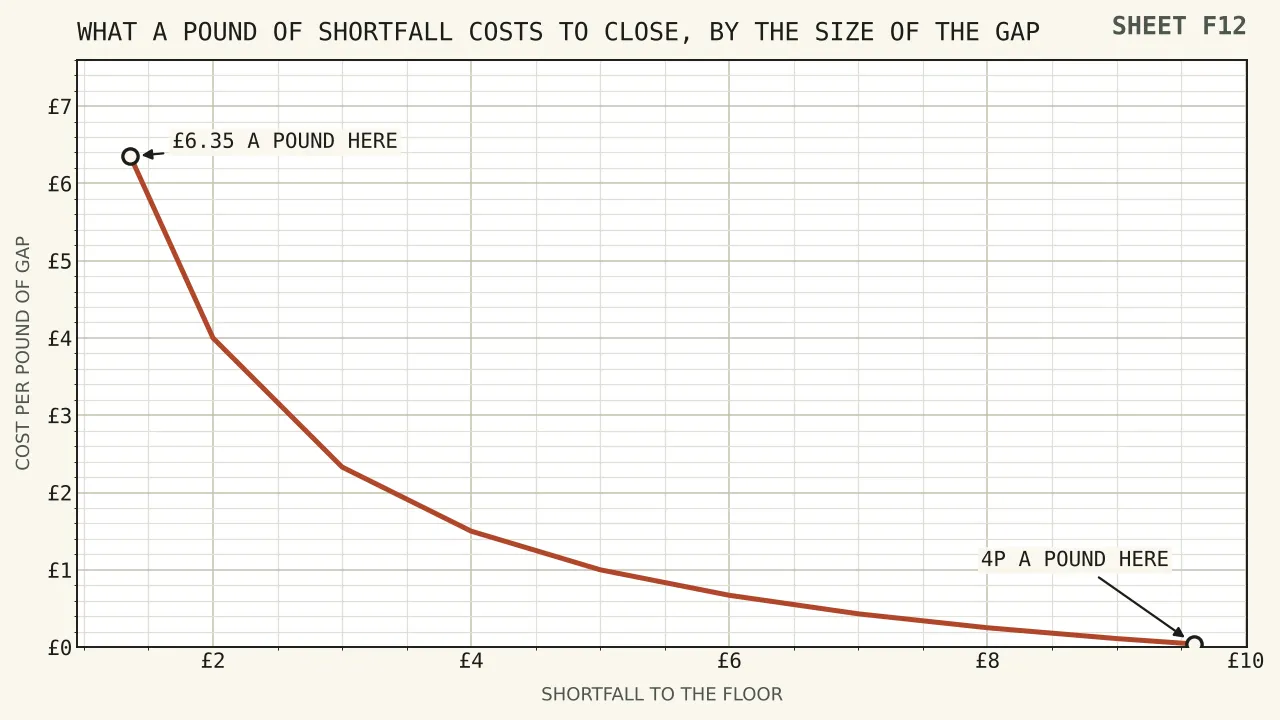
A £1.36 gap looks like the best outcome in section f and it is the worst. The reason is a property of ladders rather than of gambling, so it can be stated as a rule: what a purchase strands is the rung less the shortfall. A large shortfall uses most of the rung. A small one wastes nearly all of it.
| Balance held | Shortfall | Cheapest cover | Surplus to the purpose | Waste per pound of gap |
|---|---|---|---|---|
| £8.64, this page | £1.36 | A £10 rung | £8.64 | £6.35 |
| £7.00 | £3.00 | A £10 rung | £7.00 | £2.33 |
| £5.00 | £5.00 | A £10 rung | £5.00 | £1.00 |
| £2.00 | £8.00 | A £10 rung | £2.00 | £0.25 |
| £0.40 | £9.60 | A £10 rung | £0.40 | £0.04 |
The last column is the unfamiliar one. It divides the surplus by the gap, so it reads as the price of closing a pound of shortfall. At a £1.36 gap the price is £6.35 for each pound of it. At a £9.60 gap the price is 4p. A reader who is nearly there pays about a hundred and sixty times as much per pound of progress as a reader who is nowhere near.
A second identity is worth printing because it recurs across this site. Where a cashier’s minimum payout coincides with the bottom denomination, the surplus from covering a shortfall always equals the balance already held. Here it is £8.64 either way. Subtraction explains it: the balance and the shortfall together make the floor, and the surplus is the rung less the shortfall.
£1.36 of shortfall costs £10.00 to cover, which is £6.35 per pound of gap
Playing on is the other route and it does not improve. Turning £8.64 over once expects to cost 35p; ten times over, £3.46. An expectation does not rise with the stake, the charge having the same sign at any size. Variance alone crosses £1.36, and 4p a pound is the fee for putting the question.
No rule sets a minimum payout. None exists to find. The £10.00 used here is declared as the bottom rung of an assumed ladder, and a reader wanting the real figure will find it in a cashier’s own terms rather than in any standard, register or code.
4
Exactly one hour of obligation
Turnover is money and it is spent in seconds. A licensed slot has a published minimum between cycles, and on this face that minimum turns the obligation into a round number of hours, which is rare enough to be worth the arithmetic.
Two and a half seconds is the figure, set by RTS requirement 14D and measured from a game starting to the first moment another may start. Releasing and depressing a start control, or an equivalent act, is required too, so a held key starts nothing. That standard page gives no commencement date, and this page claims none for it.
At ten times the turnover is £144.00, which at 10p a cycle is 1,440 cycles, which at 2.5 seconds each is 3,600 seconds. One hour, to the second.
| Multiple | Cycles | Seconds | Shortest sitting | Expected pay per hour |
|---|---|---|---|---|
| The credit itself | 150 | 375 | 6 minutes 15 seconds | £138.24 |
| Five times | 720 | 1,800 | 30 minutes | £23.04 |
| Ten times | 1,440 | 3,600 | 1 hour exactly | £8.64 |
| Twenty times | 2,880 | 7,200 | 2 hours exactly | £1.44 |
| Forty times | 5,760 | 14,400 | 4 hours exactly | £0.00 |
The right-hand column divides the surviving sum by the shortest time the obligation can occupy. Five times pays £23.04 an hour in expectation. Ten times pays £8.64. Twenty times pays £1.44. Forty times pays nothing across four hours, and four hours is a minimum rather than a forecast, since 2.5 seconds is a floor and not a pace.
One row deserves a caveat. The credit itself, played out with no requirement attached, shows £138.24 an hour, and that figure is arithmetic rather than opportunity: it is £14.40 of expected winnings divided by 375 seconds, and it describes a quarter of an hour that cannot be repeated.
Past the British licence none of the pacing holds. Eight mandatory areas appear in Curacao’s responsible gaming document, version 1.0, and no minimum between game cycles appears in any of them. The 5,760 cycles of a forty times rule still have to be played. They can simply be played faster, and faster is worse, since the gap between cycles is where a decision happens.
5
One incentive, one kind of gambling
A count this size is rarely advertised on its own. It gets bundled, and bundling has been regulated since the same day the wagering ceiling arrived.
Two product types cannot share one incentive at a licensed cashier. Four are named: betting, casino, bingo, lottery. Commencement and scope copy the wagering ceiling, at 19 January 2026 and all licences but the software and machine-technical kinds. Between consultation and final text one word moved, an indefinite article replacing a definite one in front of the word incentive.
What the stated aim is matters as much as the wording. Mixing products inside a single incentive is aimed at where terms are linked and shared together, which is narrower than the headline of the rule suggests.
Applied here the reading is plain. Slots count as casino, so a cash match beside 150 cycles stays within one type and the ban does not reach it. Put the same 150 cycles beside bingo tickets and two types are inside one incentive. That follows from the list of four, and a page may say so as a reading of that list.
| What a headline bundles | Types involved | Reading of the rule |
|---|---|---|
| 150 cycles plus a cash match | Casino only | One type, so untouched |
| 150 cycles plus bingo tickets | Casino and bingo | Two types inside one incentive |
| 150 cycles plus a free bet | Casino and betting | Two types inside one incentive |
| 150 cycles plus a scratchcard draw | Casino and lottery | Two types inside one incentive |
| A scratchcard with a raffle | Lottery twice over | Same type twice, which is allowed |
Where the cycles can be spent is what makes this a residue question. A bundle ties 150 cycles to something carrying its own clock and its own conditions, and whichever half expires first takes its share of the face away. Terms linked and shared, in the rule’s own phrase, mean failure on one half can forfeit the other. On a £15.00 face that is £15.00 of exposure manufactured by a second product the reader may never have wanted.
6
Three carve-outs nobody expects
Three exceptions sit on the bundling rule, each published, and together they run against what its headline suggests. A page stating the ban without them has overstated it.
First exception. A single incentive may hold one type twice over, which the regulator illustrates with a raffle and a lottery scratchcard together.
Second exception. Casino and betting offers may ride separately inside one email, provided marketing for each product has been opted into. One envelope, no breach.
Third exception, and the widest. A credit the holder spends on any product of their choosing is outside the ban entirely, illustrated by £10 good for betting and for casino alike.
Apply that third exception here and the figures are worth stating. A £15.00 credit spendable anywhere on a site is not a bundled incentive, so nothing in the ban reaches it, and yet it is the arrangement under which cycles are least likely to be spent at 10p on a slot. Spent elsewhere, the spin price assumption stops holding, and with it every figure on this page.
A £15.00 free-choice credit sits outside the ban and outside this page’s 10p assumption
Three further marketing facts bear on how a 150-cycle headline reaches a reader at all. Online gambling has required an opt-in for direct marketing since 1 May 2025, type by type and channel by channel, and the date for that duty moved once, away from 17 January 2025, so the earlier date should never be attached to it. Direct electronic marketing needs consent that is informed and specific. Third parties reach the Commission’s advertising page only in its digital section, where operators are asked for reasonable steps about placement on copyright-infringing sites, so nothing wider should be claimed as published affiliate rules.
7
What the screen may not do meanwhile
An hour of cycles at the British ceiling, four hours at the multiple used here past the register. Four published design rules govern what a licensed screen may do across that time, and each has a figure attached on this face.
| The rule | What it forbids | What it is worth here |
|---|---|---|
| Several games at once | Functionality enabling simultaneous play, split screens and multiple screens included | The 1,440 cycles cannot run four reel sets wide |
| Hurrying a result | Turbo, quick spin, slam stop: all three named as impermissible | The hour resists compression by any setting |
| Celebrating a small return | Win effects where a return does not exceed the stake | On a 10p cycle a 6p return reads as the loss it is |
| Committing once for many | Autoplay, with every cycle needing its own commitment | The figure is 1,440 separate decisions, not one setting |
Take the first row at its figure. Four reel sets running together would put 1,440 cycles inside 900 seconds instead of 3,600, and the pacing minimum would be worth a quarter of its value. A ban on concurrent play is therefore what gives the 2.5 seconds any meaning at all.
The second row has a precise boundary. Shortening the wait for a result is the thing prohibited. Scratch-all and reveal-all features stay allowed. Bonus or feature games carrying no extra stake lie outside it. So does a game that takes a stake unless the customer moves to end it.
The third row shapes the hour most and gets noticed least. Across 1,440 cycles at 10p almost every outcome is a return beneath the stake, so the rule governs the texture of nearly the whole sitting. In place of a fanfare the guidance suggests the total awarded, winning lines displayed briefly, and one short sound as the result is credited.
A fifth rule stands behind the four without a row of its own. Design may not mislead anyone about how probable a result is. Two examples carry names in the provision. One swaps a loss for a near miss. The other builds a real device out of probabilities it lacks. None of the five has an answering line in Curacao’s eight mandatory areas.
8
Duties priced on fifteen pounds
Faces this large are advertised mostly from addresses the Commission register does not carry, which means no Great Britain licence and a list of absent duties worth costing out. Each row below attaches to a British operating licence. A cashier without one is bound by no row of it, and the Curacao document read for this site contains no counterpart to any row either.
| Duty under a British licence | Its value on £15.00 |
|---|---|
| Ten times as the hard ceiling | £8.64 survives instead of nothing |
| One product type per incentive | £15.00 not left hostage to a second clock |
| A 2.5 second minimum between cycles | One hour of obligation rather than software speed |
| No simultaneous play | Keeps that hour from shrinking to fifteen minutes |
| No compression of a result | No setting shortens the 1,440 cycles |
| No autoplay | Each of the 1,440 cycles is chosen |
| No fanfare under the stake | Roughly an hour of honest screen |
| No near-miss substitution | A loss is not dressed up as a nearly |
| Identity before any gambling | The face cannot be credited to an unverified account |
| No lid on taking out a deposit balance | Money a reader paid in leaves without a ceiling |
| Membership of the national scheme | One registration covering every licensed cashier |
Two rows of that table deserve figures of their own, because this page is about an hour and about a bundle.
Pacing first. One hour at the ceiling, four at forty times. Lift the minimum between cycles, the ban on concurrent play and the ban on compressing a result, and the arithmetic holds still while the time collapses. Identical money. A different number of decisions per minute, and a decision is where a reader can still stop.
Then the bundle. A second product fastened into one incentive, on terms linked and shared, stands the whole £15.00 behind whichever condition fails earliest. That linkage is the published aim of the ban. Without the ban a 150-cycle headline can be tied to a bingo condition, a sports condition or a lottery entry, and meeting one while missing another can leave a reader with none of it.
Self-exclusion is the row carrying no figure, and two of its mechanics matter more than its headline. A registration does not expire by itself: no exclusion lifts automatically when a minimum period runs out. A registrant may extend by a further six months, a year or five years, or ask for deactivation. Deactivation runs through the scheme’s contact centre, takes a minimum cooling-off day, and leaves the exclusion live throughout. For a further seven years the operators are told of the earlier self-exclusion, and across that stretch no duty to block access applies. The terms holding all of that were last revised on 20 May 2026.
Three figures close the page. A face of £15.00. A drawdown of £6.36, being 60p of edge with £5.76 of expected cost above it at the British ceiling. And £8.64 of residue, which is the surviving balance entire rather than a slice of it, sitting £1.36 under a floor no rule obliges a cashier to publish.
Questions
- What is 150 free spins no deposit worth?
- At the declared price of 10p a cycle, 150 cycles are a face of £15.00, averaging £14.40 where a game returns 96 per cent. A ten times rule asks £144.00 of turnover, which expects to cost £5.76, so £8.64 comes through. At forty times the expected cost is £23.04 and nothing survives.
- Why does £8.64 count as stranded?
- Because the smallest rung on the ladder used here is £10.00, and a cashier setting its minimum payout there leaves £8.64 standing £1.36 below the line. The balance exists and cannot be collected, which is the definition of a residue on this site. Nothing in the wagering rules caused it.
- Is a small shortfall really worse than a large one?
- Worse per pound of gap, yes, and it is a property of denominations rather than of gambling. Covering a shortfall leaves the rung less the shortfall as surplus. A £1.36 gap covered by a £10.00 rung wastes £8.64, which is £6.35 for every pound of progress. A £9.60 gap covered by the same rung wastes 40p, which is 4p a pound.
- How long does a ten times rule take on this face?
- One hour exactly. The turnover is £144.00, being 1,440 cycles at 10p, and RTS requirement 14D puts 2.5 seconds beneath each cycle of a licensed slot, so those cycles fill 3,600 seconds. Forty times gives 5,760 cycles and four hours, at the close of which the expectation is nothing.
- Can a headline bundle spins with bingo tickets?
- Not within one incentive at a licensed cashier. A single incentive may not hold two types of gambling product, the four being betting, casino, bingo, lottery. A slot is casino, so cycles beside a cash match keep to one type while cycles beside tickets cross two. That rule took effect on 19 January 2026.
- Are there exceptions to that bundling ban?
- Three, all published. One type appearing twice in an incentive is allowed, illustrated by a raffle with a lottery scratchcard. Casino and betting offers may ride separately inside one email where marketing for each has been opted into. And the ban misses a credit spendable on whatever product the holder picks, the illustration being £10 good across betting and casino.
- Why does bundling matter to the money?
- Linkage is the reason. The published aim targets products mixed inside one incentive on terms that are linked and shared, and linked terms mean failing one half can forfeit the other. On a £15.00 face the entire face then stands behind whichever condition expires or fails earliest, including a condition belonging to a product the reader never asked for.
- What may a licensed screen not do during that hour?
- Four things. Concurrent play cannot be offered, split screens and multiple screens included. The wait for a result cannot be shortened, turbo and quick spin and slam stop being named. No win effects may greet a return the stake already covers. And cycles cannot run off one commitment, autoplay being unavailable for online gaming.
- Does a self-exclusion end on its own?
- No. An exclusion is not lifted automatically when a minimum period ends. Extension by a further six months, a further year or a further five is available, as is deactivation, and deactivation runs through the contact centre with a cooling-off day at the least while the exclusion stays live. Operators hear of a past self-exclusion for seven years afterwards and are under no duty to block access then.
- What does the absent licence cost on £15.00?
- Part 8 prices eleven duties. The wagering ceiling is worth £8.64. The pacing rules are worth the difference between one hour and whatever the software manages. The bundling ban is worth keeping £15.00 clear of a second product’s clock. Carrying no figure at all is the national scheme, whose reach is set by a licence rather than by a domain name.