Note F14 Revision 1 Terms read 16 October 2026
Ten pounds as a sum, which is not ten pounds as a count
A credit of £10.00 arrives whole, where a hundred cycles priced at 10p arrive already worth £9.60. That 40p of difference is the subject of this page. At the British ceiling the sum leaves £6.00, which is £4.00 below the smallest sum a cashier’s ladder can pay out.
Face as printed £10.00 What draws it down £4.00 What is stranded £6.00
What a face of this size is worth
Every destination on this rack is bought advertising. The site takes a fee if a reader goes on to register, and no figure printed below moves because of it.
Face and Residue
Strip No 01
Betportal
Ceiling as a multiple
Priced at this site's own 10p a spin
What is printed
What draws it down
What is stranded
No Great Britain licence
Licensed in Anjouan, Comoros, run by BetPortal Gaming Ltd, with Excite Ultra Media Ltd, reference ALSI-202601040-FI2.
Terms read 16 October 2026
Open the offer at Betportal, opens in a new tabFace and Residue
Strip No 02
WinBeast
Ceiling as a sum
Priced at this site's own 10p a spin
What is printed
What draws it down
What is stranded
No Great Britain licence
Licensed in Curaçao, operator not named on the site.
Terms read 16 October 2026
Open the offer at WinBeast, opens in a new tabFace and Residue
Strip No 03
EliteSpin
Longest spin window
Priced at this site's own 10p a spin
What is printed
What draws it down
What is stranded
No Great Britain licence
Licensed in Costa Rica, run by PrimeTier Limited.
Terms read 16 October 2026
Open the offer at EliteSpin, opens in a new tabFace and Residue
Strip No 04
Crown Jewelz
Multiple unpublished
No residue struck
What is printed
What draws it down
What is stranded
No Great Britain licence
Licensed in Curaçao, number not verified, operator not named on the site.
Terms read 16 October 2026
Open the offer at Crown Jewelz, opens in a new tabThe two figures in the second and third registers are this site's own arithmetic and nothing an operator has published: the face as printed, less the share a spin gives back at 96 per cent return to player, less what playing the wagering through costs at the same return, and then less whatever a published ceiling, a charge on the way out or a floor on the smallest withdrawal takes off what survives that. The residue is what is left of the face when all of it is accounted for. It describes the offer, not one reader's afternoon. Where the conditions price above the face the strip prints nothing coming off rather than a negative sum, and where a figure the sum needs is unpublished it prints the condition in the operator's words instead.
A face paid as spins has no unit of its own, so one is supplied. Where an operator publishes what a spin of its own is worth, that figure stands in the first register's own line and is labelled as theirs. Where it does not, this site's own 10p a spin stands there and says so, and every figure below moves in proportion: at half the price, half the money. The share of the face that does come off is also given as pence in the pound, which is the figure that compares a large face against a small one.
Money goes onto a prepaid voucher in fixed denominations, so a smallest deposit published in pounds is rounded up to the first rung of the ladder this site works in, £10, £20, £25, £50, £75 and £100, and the strip prints what that rounding strands. That is the reader's own money and it is never netted into a residue. A smallest deposit published in euros is printed as the operator publishes it, because the ladder here is a sterling one and rounding a euro sum to it would be an invented figure.
Three words stand in the amount column where no figure can. Noted is a published condition that takes value away without leaving the sum a figure to take. Unpriced is a condition whose figure nobody has published, or a credit that is not a sum until a deposit of your own sets it. Own money is money of yours, which is never part of a residue.
Not one of the operators printed above holds a Great Britain licence, so the duties that licence carries do not reach them. All online gambling companies licensed in Great Britain must be part of Gamstop Online, and a reader who has shut themselves out through the scheme is therefore not shut out here. The ceiling of ten times the bonus funds on a wagering requirement, in force since 19 January 2026 under Social Responsibility Code 5.1.1, is a condition of that licence and binds the companies that hold one. On an unlicensed site the Gambling Commission describes consumers as facing unfair gaming practices, financial loss and a lack of recourse if things go wrong, and it names blocked payouts and withdrawal limits set so high they are unattainable among what it has seen. Nobody under 18 may hold an account at any of them.
Every term printed on a strip is the operator's own, and each strip carries the day it was read. The oldest of those readings is 16 October 2026. What binds a reader is the operator's own full terms, and not a line printed here.
1
A sum arrives whole
Most faces in this section are counts. A count needs a price before it means anything, and the price is not published anywhere, so every count page on this site has to declare one. A sum needs nothing declared. Ten pounds is ten pounds.
That difference has a figure attached and the figure is 40p. Where a game returns 96 per cent the edge takes 4p from each staked pound, and cycles are stakes, so a hundred of them at 10p average £9.60. A credit of £10.00 is not yet a stake. It sits in a balance, and the edge has had nothing to charge.
£10.00 credited is £10.00; £10.00 spent as 100 cycles is £9.60
So the opening figure on this page is better than the opening figure on any count page of the same size, by exactly 40p. Whether that advantage lasts is the next question, and the answer is that it decays.
| What arrives | What it is at the moment of crediting | Value |
|---|---|---|
| A credit of £10.00 | A balance, unstaked | £10.00 |
| One hundred cycles at 10p | Stakes already committed | £9.60 |
| The difference | Edge not yet charged | £0.40 |
Nothing here is a claim about which arrangement a cashier offers. The point is narrower and it is arithmetic: a headline naming a sum of money has one fewer unknown in it than a headline naming a number of cycles, and the missing unknown is worth 4 per cent of the face.
A spin’s value has no regulated floor, no regulated ceiling and no duty of disclosure behind it. Two sourced obligations come close without touching it. The chance of a winning event has to be reachable ahead of a commitment to gamble. And an incentive carries terms owed to whoever is offered it: clarity, transparency, fairness, and easy reach. Neither says what a cycle costs, which is why a count has to be priced by assumption and a sum does not.
2
The forty pence a count surrenders
Follow both arrangements through a play-through and the 40p behaves in a way worth setting out, because it does not stay 40p.
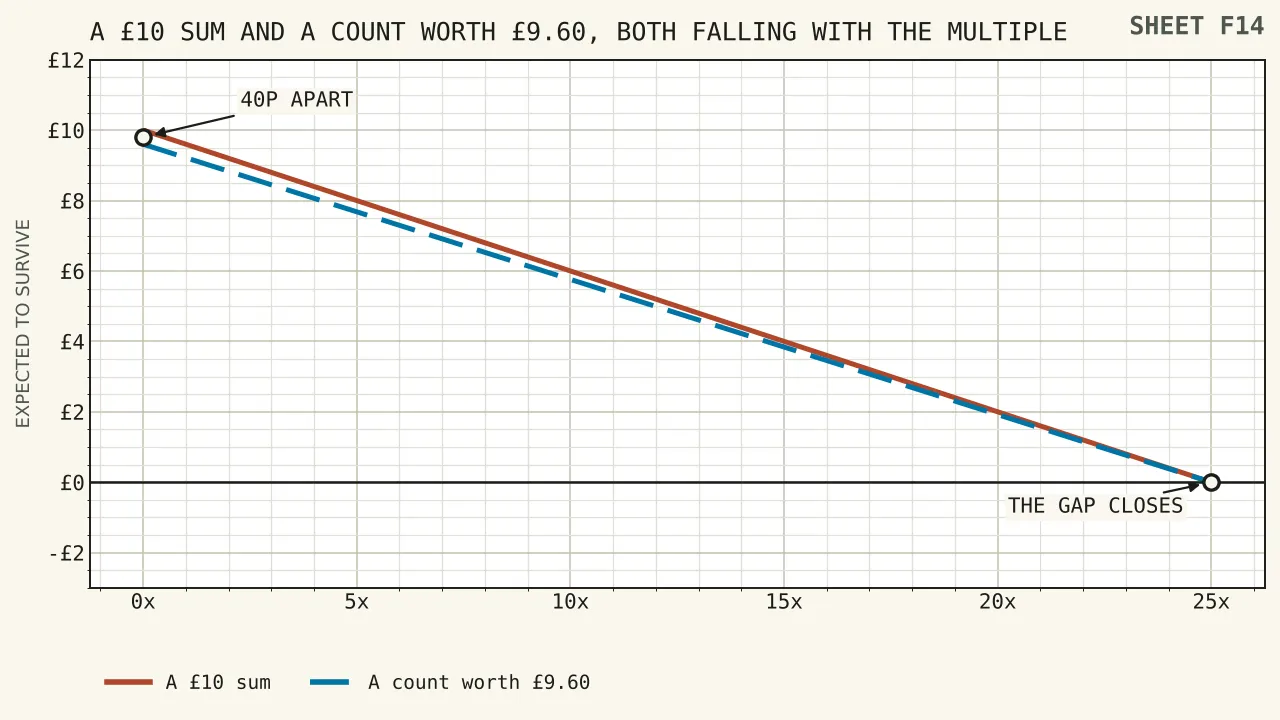
Survival scales the credit by one minus 0.04 times the multiple. On a sum of £10.00 at ten times that is £10.00 less £4.00, so £6.00. On a count worth £9.60 at the same multiple it is £9.60 less £3.84, so £5.76. The gap between the two is 24p rather than 40p, the requirement having eaten part of the advantage along with everything else.
| Multiple | Sum of £10.00 leaves | Count worth £9.60 leaves | Gap | Reading |
|---|---|---|---|---|
| Nothing attached | £10.00 | £9.60 | £0.40 | The whole advantage |
| Five times | £8.00 | £7.68 | £0.32 | Four fifths of it |
| Ten times | £6.00 | £5.76 | £0.24 | At the British ceiling |
| Twenty times | £2.00 | £1.92 | £0.08 | A fifth of it |
| Twenty-five times | £0.00 | £0.00 | £0.00 | The advantage is gone |
| Forty times | £0.00 | £0.00 | £0.00 | Both at nothing |
The gap column is the finding. It shrinks in step with survival and reaches nothing at twenty-five times, which is where survival itself reaches nothing. A reader choosing between a sum and a count is choosing between two things that converge: the heavier the requirement, the less the difference matters, and at the pivot it stops mattering at all.
Twenty-five is not a market convention. Four pence in the pound has 25 for its reciprocal, so expected survival on any credit falls to zero exactly there, given a return of 96 per cent. Beneath 25 something comes through. Beyond it a requirement costs more than the credit fastened to it, and the excess lands on money the reader put in.
The 40p advantage is 0.40 x (1 – 0.04W), so it dies where survival dies
3
Where that advantage disappears
Ten times is the strictest multiple any licence permits, imposed as a condition rather than adopted as a convention.
| Element | What is published |
|---|---|
| The figure | Ten times the bonus funds, at most |
| The provision | The code provision numbered 5.1.1, at limb three, paragraph (a) |
| In force | 19 January 2026 |
| Scope | Every licence except two: gambling software, and gaming machine technical |
| What is capped | Wagers summing to a stated value, owed ahead of withdrawability |
| What it was fixing | Requirements reaching up to 60 times, on the regulator’s own figure |
| Weighting | Untouched, so a game counting below par raises the staking needed |
Two things in that table bear on a sum rather than on a count. The capped thing is bonus funds, and a cash credit of £10.00 reaching a bonus balance is bonus funds on any reading, which removes a doubt hanging over every count page here. No primary source settles whether a free cycle is bonus funds in isolation; a £10.00 credit leaves nothing to argue about.
The weighting row is the other. A multiple has a ceiling; turnover does not. Where a game contributes less than a pound of progress per pound staked, the staking needed climbs in proportion while the multiple stays inside its ceiling. The regulator’s consultation page carries a contribution rate of 30 per cent, quoted there by a respondent: ten times on £10.00 then means £100.00 of required contribution, which calls for about £333.33 of staking. The sum is this site’s, worked against that quoted rate.
One figure on that page needs attributing rather than borrowing. A single operator described its own book to the consultation, saying three quarters of what it offered asked between one and ten times. That is a respondent speaking about itself rather than a market finding, and the label travels with it here. The page carries a publication date of 26 March 2025 and a last update of 27 January 2026.
4
Six pounds at the ceiling, four pounds short
Take the cleanest run available. A credit of £10.00, nothing forfeited, the multiple held at ten times, and £6.00 comes through.
Prepaid money moves in fixed denominations. Six rungs carry the ladder used across this site, beginning at £10 and going on through £20, £25, £50 and £75 to £100 at the top. Put a cashier’s smallest payout on the bottom rung and the line is £10.00. A balance of £6.00 falls £4.00 under that line, and the whole £6.00 is stranded.
Two routes exist across a £4.00 gap and both carry prices.
| Route | What it involves | Expected cost | What is left over |
|---|---|---|---|
| Play the balance once | £6.00 of turnover | £0.24 | A smaller balance, same gap |
| Play it ten times over | £60.00 of turnover | £2.40 | A much smaller balance |
| Buy the smallest rung | A £10.00 purchase | £10.00 | £6.00 surplus to the purpose |
The first two rows go the wrong way, and the reason is structural rather than bad luck: an expectation does not rise with a stake, four pence leaving each pound whatever company the pound keeps. Variance alone crosses £4.00, and 4p a pound is the standing charge for asking it to.
The third row is certain and wasteful in a way that has a general form. A purchase leaves over the rung less the shortfall. Here £4.00 is short and £10.00 is the rung, so £6.00 serves no purpose, equalling the balance already held. That equality holds wherever a cashier’s minimum payout and the smallest denomination coincide.
£6.00 held under a £10.00 line, and a £10.00 purchase to cover £4.00 of it
No minimum payout is published by anybody. The £10.00 here is the lowest rung of a ladder this site declares rather than a figure found in a market, and a cashier’s own terms are where the real one lives. What is published runs the other way: a term may not lid what leaves a deposit balance, with £50 daily beside £500 weekly offered as the illustration of barred wording, and reasonableness governs any limit on the size or the count of withdrawals.
5
A thousand cycles, forty-one minutes
A requirement is money and it is also time. Ten times on £10.00 asks £100.00 of turnover, and at 10p a cycle that is 1,000 cycles.
Between one cycle and the next, 2.5 seconds at the least separates them on a licensed slot, under RTS requirement 14D, timed from a game beginning to the earliest moment another may. The same requirement asks for a start control to be let go and depressed afresh, or an equivalent act, so nothing begins from a held key. No commencement date sits on that page and none is claimed.
| Multiple | Turnover | Shortest run | Cycles | Expected pay an hour |
|---|---|---|---|---|
| Five times | £50.00 | 20 minutes 50 seconds | 500 | £23.04 |
| Ten times | £100.00 | 41 minutes 40 seconds | 1,000 | £8.64 |
| Twenty times | £200.00 | 1 hour 23 minutes 20 seconds | 2,000 | £1.44 |
| Twenty-five times | £250.00 | 1 hour 44 minutes 10 seconds | 2,500 | £0.00 |
| Forty times | £400.00 | 2 hours 46 minutes 40 seconds | 4,000 | £0.00 |
The hourly column takes what survives and divides by the briefest run a requirement could occupy. Ten times yields £8.64 an hour in expectation. Twenty yields £1.44. Twenty-five yields nothing, and so does every multiple above it, for as long as the hours run.
Autoplay is the rule making those minutes real. It cannot be offered for online gaming, each game cycle calling for a commitment of its own, and the guidance carves out exactly one thing, automatic blind posting at poker played between customers. A thousand cycles therefore means a thousand deliberate acts rather than one setting and a kettle.
Two further rules hold the same line, and a table is the honest place for them because neither needs a paragraph of its own.
| What is out | What the guidance names |
|---|---|
| Shortening a result | Slam stop, quick spin and turbo, all three by name |
| Running games together | Split-screen and multi-screen arrangements, and games combined to allow it |
Neither row shows up in the eight areas Curacao makes mandatory for its licensees, so a forty times rule’s 4,000 cycles can be run at whatever pace the software reaches.
6
One word the advertising code polices
A page about a sum described as free owes a reader the published position on the word itself, and there is one.
Two limbs make the advice up, and a table sets them beside the figures on this page.
| The limb | What it bars |
|---|---|
| The description | Calling an offer free where a customer’s own money must go in first |
| The pairing | Setting the word beside freedom from risk, unless funds of the customer’s genuinely cannot go |
That second limb is why this site never prints the pairing. The reason is a published rule and not a matter of taste.
Applied to a £10.00 credit with nothing paid in behind it, the first limb is satisfied on its face: no qualifying stake, so the description holds. The second limb is where this page bites, because turning a credit over at any multiple is a route by which money of the reader’s own can go. Forty times expects to cost £16.00 against a credit of £10.00, which puts £6.00 of the reader’s money into the expectation.
£16.00 of expected cost on a £10.00 credit leaves £6.00 falling on the reader
Alongside the word sits a duty covering the rest of the small print. The table lists the items the advertising regulator treats as significant, each with the figure it carries on a £10.00 credit.
| Condition named | What it is on a £10.00 credit |
|---|---|
| Who qualifies | A status, an age, a place |
| What must be deposited or wagered | The multiple, deciding between £6.00 and nothing |
| The clock on claiming and using | A window set against 1,000 cycles of obligation |
| Required odds or bet types | In a casino setting, a stake ceiling while a requirement runs |
Where the terms sit is specified as a distance rather than a principle. Online, a click is the span: full terms about one click from the advertisement, and no link tucked away in small print. Encouragement to take part repeatedly or frequently is out as well, along with encouragement to spend more than a person is able to lose.
Getting prominence wrong has a stated consequence, and it is a finding rather than a penalty: an advertisement whose significant conditions are shown without enough prominence will be seen as misleading.
7
What the entrance asks before a credit lands
A face with no deposit behind it still has a door, and the lock on it is specified. The table sets out each element, and two rows of it carry a figure on this page.
| Element | What the condition requires |
|---|---|
| Identity, before play | Three items settled first: name, address, date of birth |
| Told in advance | Ahead of a deposit: what papers might be asked for, when, and how to send them |
| Kept accurate | Reasonable steps to keep the identity information held accurate |
| No trapdoor at the exit | A withdrawal request must not trigger a demand that could reasonably have come earlier |
| Scope | All remote licences, telephone and email betting included |
| Outside scope | Low-frequency and subscription lottery licences, machine technical, software, host, and ancillary remote casino and bingo |
| Effective date | None stated on the condition page |
Row two is usable straight away. A duty to say in advance which documents may be wanted is owed before money goes in, so on an offer with nothing going in it is owed before the credit arrives. A £10.00 credit uncollectable because a document went unmentioned is £10.00 of residue produced by silence.
Row four shuts the other end. A withdrawal request is no occasion to begin asking for what an earlier opportunity would have covered, the single exception being information another legal duty demands at that point.
The identity rule’s reach is the detail most often missed, and it is the floor under every offer in this section. Three items are verified before anybody may gamble. The age check reaches play paid for by a bonus, play paid for by a free bet, and the free-to-play build of a game. Seventy-two hours used to be allowed for completing an age check.
One date needs care. February 2019 is the announcement’s own date. The commencement given on it reads 7 May, with no year beside the day. That leaves 7 May 2019 as the only available reading, and it appears here on that basis rather than as something the source states.
8
Duties priced on ten pounds
Ten pounds of credit offered from outside the British licensing regime loses a reader eleven specific duties, and this part puts money against each. Every row below attaches to a licence issued in Great Britain. A cashier without one is bound by none of them, and the Curacao document read for this build answers to no row either.
| What a British licence imposes | Its value on this credit |
|---|---|
| Ten times as the hard ceiling | £6.00 comes through rather than nothing |
| A 2.5 second minimum between cycles | 1,000 cycles spread across 41 minutes 40 seconds |
| No autoplay on online gaming | A thousand deliberate acts instead of one setting |
| No speed control on a result | Those minutes cannot be compressed away |
| No concurrent play | The obligation cannot be run several reel sets wide |
| The word free, policed | No qualifying stake may hide behind the description |
| Significant conditions shown prominently | The multiple appears beside the headline, not below it |
| Identity settled before play | Nothing is credited to an unverified account |
| Documents named in advance | No £10.00 lost to a demand nobody mentioned |
| No lid on a deposit balance leaving | Nothing caps what a reader paid in |
| The scheme for excluding oneself | One registration, and the whole licensed side is covered |
Four of those rows carry a figure and the figures are this page in miniature. The ceiling is worth £6.00. The pacing minimum is worth 41 minutes 40 seconds of spacing. Advance notice of documents is worth the entire £10.00 in the case where a document surfaces only at the exit. And the rule about a deposit balance is worth the gap between collectable money and a term lidding it.
The last row carries no figure and it is the heaviest, so the scheme’s own boundary belongs here in substance. Exclusion reaches gambling services offered by participating operators. Preventing a person from reaching services provided by organisations outside the scheme is something it says it cannot do. A British licence brings an online gambling company inside, so a cashier lacking one stands outside by construction rather than by choice.
Two sourced statements belong beside that, since the easy version of the comparison goes wrong in both directions. A complaints route can exist offshore: the Curacao framework publishes a window of six months for bringing one, a timetable of eight weeks for finishing it, and adjudication the operator pays for and the player cannot be charged for. And the British regulator recovers no money either, saying in its own words that it is not an ombudsman and that a gambling complaint is beyond its powers to settle.
Three figures finish this page. A face of £10.00, which is a sum and so needs no declared price. A drawdown of £4.00, which is what ten times expects to cost on that sum. And £6.00 of residue, the surviving balance entire, standing £4.00 beneath the smallest rung the ladder carries.
Questions
- What does a free £10 credit come to?
- A credit of £10.00 arrives whole, so no spin price has to be declared for it. Ten times asks £100.00 of turnover, which expects to cost £4.00, leaving £6.00. Forty times expects to cost £16.00 against a credit of £10.00, which puts £6.00 of the reader’s money into the expectation.
- Why is a £10 credit worth more than 100 spins at 10p?
- By 40p. Where a game returns 96 per cent the edge takes 4p from each staked pound, and cycles are stakes, so a hundred of them at 10p average £9.60. A credit sits in a balance the edge has had nothing to charge. The advantage then decays: 24p at ten times, 8p at twenty, and nothing at twenty-five, where survival itself reaches nothing.
- Is a cash credit definitely bonus funds for the ceiling?
- The capped thing is bonus funds, and a cash credit of £10.00 reaching a bonus balance is bonus funds on any reading, which removes a doubt hanging over every count page here. No primary source settles whether a free cycle is bonus funds in isolation; a £10.00 credit leaves nothing to argue about.
- Does the ten times ceiling cap the turnover as well?
- A multiple has a ceiling; turnover does not. Where a game contributes less than a pound of progress per pound staked, the staking needed climbs in proportion while the multiple stays inside its ceiling. The regulator’s consultation page carries a contribution rate of 30 per cent, quoted there by a respondent: ten times on £10.00 then means £100.00 of required contribution, which calls for about £333.33 of staking.
- How many hours does the obligation take?
- Ten times asks £100.00 of turnover, and at 10p a cycle that is 1,000 cycles. Between one cycle and the next, 2.5 seconds at the least separates them on a licensed slot, under RTS requirement 14D, so the briefest run is 2,500 seconds: 41 minutes 40 seconds. Forty times gives 4,000 cycles and 2 hours 46 minutes 40 seconds.
- What is stranded on a clean run?
- The whole £6.00. Put a cashier’s smallest payout on the bottom rung and the line is £10.00, so a balance of £6.00 falls £4.00 under that line and none of it can be collected. An expectation does not rise with a stake, four pence leaving each pound whatever company the pound keeps.
- Is covering the gap better than playing on?
- Certain rather than cheap. A purchase leaves over the rung less the shortfall. Here £4.00 is short and £10.00 is the rung, so £6.00 serves no purpose, equalling the balance already held. That equality holds wherever a cashier’s minimum payout and the smallest denomination coincide.
- Can an offer with a wagering requirement be called free?
- Two limbs make the advice up. One bars calling an offer free where a customer’s own money must go in first. The other bars setting the word beside freedom from risk, unless funds of the customer’s genuinely cannot go. Turning a credit over at any multiple is a route by which money of the reader’s own can go.
- Which conditions have to be shown prominently?
- Four kinds: who qualifies, what must be deposited or wagered, what clock applies to claiming and using the offer, and what odds or bet types are required. Getting prominence wrong has a stated consequence, and it is a finding rather than a penalty: an advertisement whose significant conditions are shown without enough prominence will be seen as misleading.
- Do I have to verify identity for a credit I did not pay for?
- At a British licensed cashier, yes, and before any gambling rather than before any payment. Three items are verified before anybody may gamble. The age check reaches play paid for by a bonus, play paid for by a free bet, and the free-to-play build of a game. Seventy-two hours used to be allowed for completing an age check.
- What does the absent licence cost on £10.00?
- Part 8 prices eleven duties. The ceiling is worth £6.00. The pacing minimum is worth 41 minutes 40 seconds of spacing. Advance notice of documents is worth the entire £10.00 in the case where a document surfaces only at the exit. The row carrying no figure is the national scheme, which says it cannot prevent a person reaching services run by organisations outside it.