Note F17 Revision 1 Terms read 16 October 2026
Fifty pence, and the two pence that goes first
Five cycles at 10p are a face of £0.50, and 48p is what they average. A ten times rule takes 19.2p of that, leaving 28.8p, which stands 34.72 times below the smallest payout the ladder can reach. A maximum bet pegged to a tenth of the credit comes out at 4.8p, below the price of the cycle it governs.
The face, as counted £0.50 What draws it down 21.2p What no floor will take 28.8p
What a face of this size is worth
Every destination on this rack is bought advertising. The site takes a fee if a reader goes on to register, and no figure printed below moves because of it.
Face and Residue
Strip No 01
Betportal
Ceiling as a multiple
Priced at this site's own 10p a spin
What is printed
What draws it down
What is stranded
No Great Britain licence
Licensed in Anjouan, Comoros, run by BetPortal Gaming Ltd, with Excite Ultra Media Ltd, reference ALSI-202601040-FI2.
Terms read 16 October 2026
Open the offer at Betportal, opens in a new tabFace and Residue
Strip No 02
WinBeast
Ceiling as a sum
Priced at this site's own 10p a spin
What is printed
What draws it down
What is stranded
No Great Britain licence
Licensed in Curaçao, operator not named on the site.
Terms read 16 October 2026
Open the offer at WinBeast, opens in a new tabFace and Residue
Strip No 03
EliteSpin
Longest spin window
Priced at this site's own 10p a spin
What is printed
What draws it down
What is stranded
No Great Britain licence
Licensed in Costa Rica, run by PrimeTier Limited.
Terms read 16 October 2026
Open the offer at EliteSpin, opens in a new tabFace and Residue
Strip No 04
Crown Jewelz
Multiple unpublished
No residue struck
What is printed
What draws it down
What is stranded
No Great Britain licence
Licensed in Curaçao, number not verified, operator not named on the site.
Terms read 16 October 2026
Open the offer at Crown Jewelz, opens in a new tabThe two figures in the second and third registers are this site's own arithmetic and nothing an operator has published: the face as printed, less the share a spin gives back at 96 per cent return to player, less what playing the wagering through costs at the same return, and then less whatever a published ceiling, a charge on the way out or a floor on the smallest withdrawal takes off what survives that. The residue is what is left of the face when all of it is accounted for. It describes the offer, not one reader's afternoon. Where the conditions price above the face the strip prints nothing coming off rather than a negative sum, and where a figure the sum needs is unpublished it prints the condition in the operator's words instead.
A face paid as spins has no unit of its own, so one is supplied. Where an operator publishes what a spin of its own is worth, that figure stands in the first register's own line and is labelled as theirs. Where it does not, this site's own 10p a spin stands there and says so, and every figure below moves in proportion: at half the price, half the money. The share of the face that does come off is also given as pence in the pound, which is the figure that compares a large face against a small one.
Money goes onto a prepaid voucher in fixed denominations, so a smallest deposit published in pounds is rounded up to the first rung of the ladder this site works in, £10, £20, £25, £50, £75 and £100, and the strip prints what that rounding strands. That is the reader's own money and it is never netted into a residue. A smallest deposit published in euros is printed as the operator publishes it, because the ladder here is a sterling one and rounding a euro sum to it would be an invented figure.
Three words stand in the amount column where no figure can. Noted is a published condition that takes value away without leaving the sum a figure to take. Unpriced is a condition whose figure nobody has published, or a credit that is not a sum until a deposit of your own sets it. Own money is money of yours, which is never part of a residue.
Not one of the operators printed above holds a Great Britain licence, so the duties that licence carries do not reach them. All online gambling companies licensed in Great Britain must be part of Gamstop Online, and a reader who has shut themselves out through the scheme is therefore not shut out here. The ceiling of ten times the bonus funds on a wagering requirement, in force since 19 January 2026 under Social Responsibility Code 5.1.1, is a condition of that licence and binds the companies that hold one. On an unlicensed site the Gambling Commission describes consumers as facing unfair gaming practices, financial loss and a lack of recourse if things go wrong, and it names blocked payouts and withdrawal limits set so high they are unattainable among what it has seen. Nobody under 18 may hold an account at any of them.
Every term printed on a strip is the operator's own, and each strip carries the day it was read. The oldest of those readings is 16 October 2026. What binds a reader is the operator's own full terms, and not a line printed here.
1
Five cycles, and what they average
Five is the smallest count that gets advertised, and it is also the count that shows the arithmetic of this section at its clearest, because every figure in it is small enough to carry in the head.
What a single free cycle is worth is nobody’s published figure. There is no floor under it, no ceiling over it, and no requirement to state it in pence. The value belongs to whoever writes the promotion, so this site declares its own and keeps to it. Three numbers do the work here and every one is declared. Each cycle is priced at 10p. Each pound staked comes back as 96p. A pound staked counts as a whole pound against an obligation. The ten times figure belongs to a licence rather than to me, and forty is what this site assumes past the register.
Multiply and the face appears. Five cycles at 10p is £0.50, and 96 per cent of that is 48p. Two pence has gone already, with no term yet read, and those two pence are the only part of this page’s residue that is certain in advance.
Then the time, which is shorter than the sentence describing it. Between starting one cycle and being able to start another, a licensed slot leaves 2.5 seconds at the least, which puts five cycles at 12.5 seconds. That is the whole of what the headline entitles a reader to: a quarter of a minute of play, as an outside figure, with 48p of expectation inside it.
Five cycles: 12.5 seconds of entitlement, 48 cycles of obligation
The obligation in that line is what the rest of the page is about. Ten times on 48p asks £4.80 of turnover, which is 48 cycles at 10p, which is 120 seconds. So the obligation runs 9.6 times longer than the entitlement, and that ratio holds for every face in this section, since both sides scale with the count.
A count of five is published in a market holding no Great Britain licence. The costing of that sits in part 8, in pennies, since pennies are what this arithmetic yields. The useful thing about a face this small is that it shows which protections scale down with the money and which do not: the ceiling is worth 19.2p here, and the national self-exclusion scheme is worth exactly what it is worth on any other page.
A requirement may not exceed ten times the credit where a British licence is in force. Provision: 5.1.1, third limb, paragraph (a). Live from 19 January 2026. Outside it sit two licence types: software, and machine technical work.
2
Twenty-nine pence through the ceiling
Here is the whole of the arithmetic in one table, worked on the 48p that five cycles average rather than on the 50p printed in the headline, because the 2p has already gone.
| Multiple | Turnover asked | Cycles | Seconds at the floor | Expected cost | Comes through |
|---|---|---|---|---|---|
| None | £0.00 | 0 | 0 | 0.0p | 48.0p |
| Five times | £2.40 | 24 | 60 | 9.6p | 38.4p |
| Ten times | £4.80 | 48 | 120 | 19.2p | 28.8p |
| Twenty times | £9.60 | 96 | 240 | 38.4p | 9.6p |
| Break-even at 25 times | £12.00 | 120 | 300 | 48.0p | 0.0p |
| Forty times | £19.20 | 192 | 480 | 76.8p | 0.0p |
Nothing in that table depends on the size of the face, which is the reason for printing it on the smallest one. Turnover is the multiple times the credit, and 4p rides on each pound of turnover, so a credit keeps three fifths of itself at ten times and nothing at 25. A face of £100.00 behaves identically with two more digits.
What does depend on the size is everything in the last column once it meets a real threshold. Twenty-nine pence is a balance that no payout floor will accept, and 9.6p at twenty times is a balance that nothing at all will accept. The arithmetic is proportional; the walls are absolute; and that mismatch is the subject of parts 3, 4 and 7.
The forty times row deserves a sentence of its own. A cashier free to write forty asks 192 cycles of a 48p credit, expects 76.8p of the staking to stay with the house, and has fastened on an obligation 28.8p heavier than the credit itself. In seconds that is 480, or eight minutes, for an expectation of nothing.
One caution belongs here and not at the end. That 96 per cent describes the long-run design of a game, not 48 cycles of it. Over a handful of small cycles the outcome scatters widely, and the bulk of the scatter falls under the mean, because the rare big result is what holds a mean up. So 28.8p is the centre of a lopsided spread, and nothing at all is the commonest result of five cycles.
3
A maximum bet that cannot be obeyed
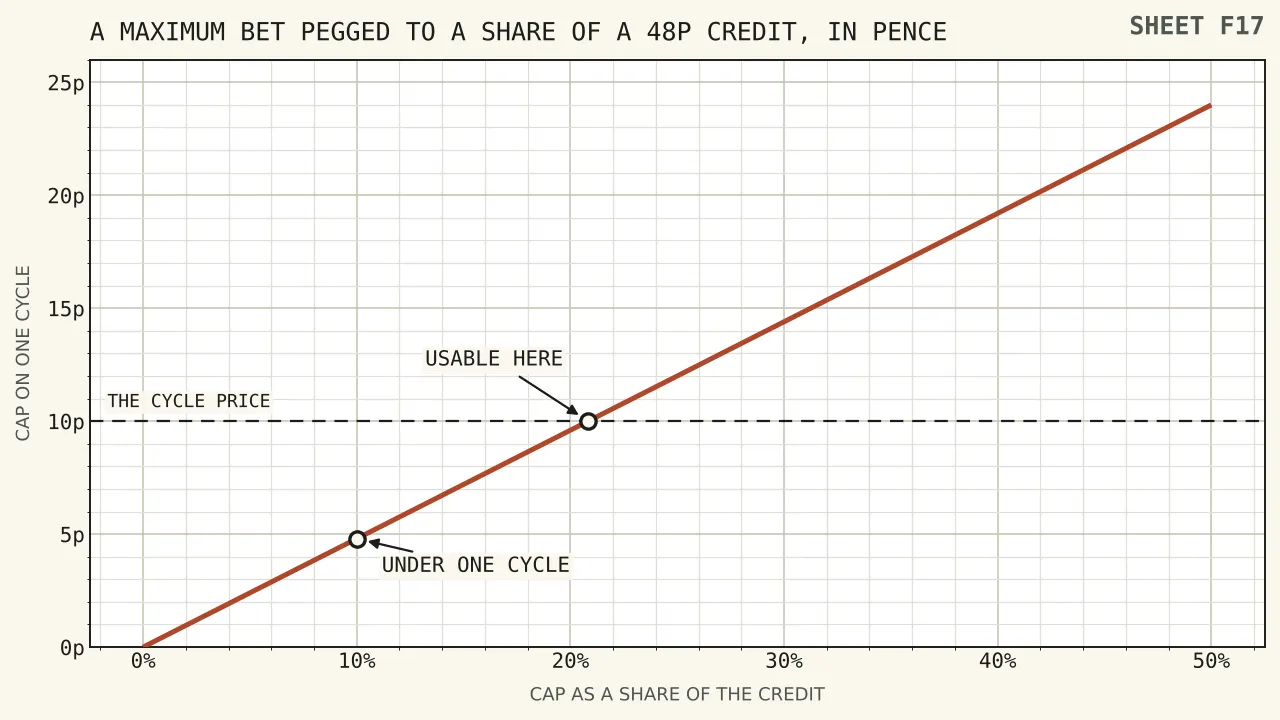
Offers of this shape often cap what may be staked while an obligation is being worked off, and the cap is usually written as a share of the credit. On a credit of 48p that produces a figure smaller than the price of a single cycle, which is a term nobody can comply with.
| What the cap is pegged to | Cap in pence | What it means at 10p a cycle |
|---|---|---|
| A tenth of the credit | 4.8p | Under the price of one cycle, so no lawful stake exists |
| A fifth | 9.6p | Short of the cycle price by 0.4p, and still unusable |
| 20.83 per cent | 10.0p | Exactly one cycle, and the first peg that works |
| A quarter | 12.0p | One cycle, with 2p of the allowance unreachable |
| A half | 24.0p | Two cycles, with 4p of the allowance unreachable |
A cap under 20.83 per cent of the credit cannot be obeyed at 10p a cycle
Two things have to be said plainly about that table. The percentages on the left are declared modelling assumptions rather than market findings, since no distribution of maximum stake terms is published anywhere this site can cite. And the threshold in the middle of it, 20.83 per cent, is arithmetic: 10p divided by 48p, which is the share of the credit a cap must reach before one cycle is lawful under it.
Where a cap falls below that threshold the consequence is total rather than partial. There is no smaller stake to fall back on, since 10p is the cycle price this site works in, so the requirement cannot be started, let alone finished. The credit then expires with its obligation untouched, and nothing was refused, capped or forfeited in any sense a reader could complain about.
A cap of another origin sits over a licensed slot and owes nothing to a bonus term. Under the 2025 amendment regulations the total staked in one game cycle is held to £5, and to £2 where the player is below 25. The Commission’s guidance puts the £5 figure at 9 April 2025, the £2 figure at 21 May 2025, and both of them inside online slots alone. Neither figure constrains a 10p cycle. They are stated here to make the point that the binding cap on a face this small is the one in the promotion, not the one in the statute.
The honest summary is narrow. A maximum stake term is the cheapest way to make a small credit unusable, it requires no bad faith to write, and whether it bites depends on a division a reader is unlikely to do: the cap, divided by the price of one cycle.
4
The penny is the smallest unit there is
Sterling stops at the penny, and this page’s figures do not. Four of them end in a tenth of a penny: the expectation of 48p is exact, but 19.2p of cost, 28.8p of survival, 9.6p a cycle and 76.8p at forty times all name quantities that cannot be held in an account.
Where the rounding goes is a commercial choice nobody publishes, so this part states what each direction does. Round 28.8p down and 0.8p is stranded, which is 2.8 per cent of the balance. Round it up and 0.2p has been created. On a face of £100.00 the same arithmetic produces £57.60 and the question never arises, because the third decimal place of a pound is a tenth of a penny only when the figures are this small.
That is the general shape of the thing this section is for. Proportions hold at every size, and absolute units do not. A tenth of a penny is invisible on a large face and is one part in 288 of a balance of 28.8p, and the smaller the face, the more of its arithmetic falls through the gaps between the units it has to be expressed in.
Three further places on this page run into the same wall. A cap pegged at a tenth of the credit is 4.8p, which no cashier can price a cycle at. An expectation of 9.6p a cycle is a figure no balance ever shows. And a withdrawal of 28.8p is a transaction no payment route is built to carry, whatever the cashier’s own floor happens to be.
None of that is an allegation against anybody. It is what happens when a count of five is multiplied by a price of 10p, and it is the reason this site prices a face in pence before it says anything else about it. A headline of five free spins is not wrong. It is just four decimal places away from being a sum of money.
5
Eight weeks for twenty-nine pence
Suppose 28.8p is refused, forfeited or simply lost in a term nobody showed. A British licence puts a published clock over what happens next, and the clock takes no notice of the size of the sum.
| Stage of a complaint | What the published rule gives |
|---|---|
| Acknowledgement | Three working days at the outside, and 24 hours at a cashier whose gambling never closes |
| The whole process | Eight weeks from receipt, escalation included, with code provision 6.1.1.2 behind the figure |
| The window to complain | Six months as a minimum, measured from the incident |
| A pause | The clock stops where a reasonable information request sits unanswered for seven days, and restarts where it halted |
| The closing letter | The decision, a statement that the process has ended, and how to reach an independent adjudicator |
Set that table beside the money at stake and the mismatch is the finding. Fifty-six days of process stand behind a balance of 28.8p, and the process costs a reader nothing in fees. What it costs is attention, and the rational response to a 28.8p dispute is to drop it, which is exactly why the shape of a small face matters more than its size.
Nothing in the published rules scales the clock to the money, and that cuts both ways. A reader with 28.8p has the same eight weeks as a reader with £5,000, and an operator has the same duty to acknowledge within three working days either way. The protection is real and the economics of using it are hopeless, and both halves of that are worth saying.
One figure keeps the comparison honest. Twenty-nine pence is 2.88 per cent of the £10.00 rung that this site treats as the smallest payout a ladder can make. So the dispute a reader might bring is for a sum that could not have been withdrawn even had it been paid without argument, which is the circularity this section exists to expose.
Away from the British licence a clock still exists, and saying otherwise would be wrong. What differs away from the British licence is authorship: who writes the terms the adjudication runs under, which is part 6.
6
Who is allowed to adjudicate
At the end of an operator’s own process a complaint goes outward, and in Great Britain the body it goes to must be one the Commission has approved. The list is published, and the coverage on it is not uniform.
| Entity holding approval | What the published table shows |
|---|---|
| ADR Group | Remote in all sectors |
| Blexr Limited | Remote in all sectors as well |
| CEDR | Remote in all sectors, under the name Centre for Effective Dispute Resolution |
| eCOGRA | Remote in all sectors too |
| IBAS | Remote in all sectors, with its entry mentioning disputes between licensed operators and their customers |
| ProMediate | All sectors, on the table’s own showing |
| Tattersalls Committee | All sectors in the table, while its own entry names betting only |
| Pegasus ADR Service | Listed for adult gaming centres, for bingo away from the internet, for family entertainment centres, and for pubs and members clubs. Remote casino: absent |
Eight entities hold approval, and the update note on the list records a provider removed from it, Lindsays by name. A licensee is required to use an approved entity and nothing else, which is the whole of the obligation. The list itself was published on 17 May 2021, and the last revision it carries is dated 15 January 2025.
The bottom row is the one a casino player needs. An entity with no remote casino coverage is no use to a dispute about 28.8p of slot credit, however approved it is for other sectors, so the first question at the end of a complaints process is which body the operator actually uses and what that body covers.
Away from the register the arrangement differs in authorship rather than in existence. The Curaçao rulebook makes dispute resolution compulsory and costless to a player, the operator paying for it, and then contemplates the operator setting its parameters. Whether an outcome binds the player is one. Whether escalation needs a claim over some minimum value is another.
On a balance of 28.8p that second parameter is decisive and needs no argument. Any minimum claim value whatever removes this page’s survivor from the process, since there is no plausible floor beneath 28.8p. Independent legal advice is what the regulator there tells an operator to take before imposing such measures, and it says the circumstances will all be weighed, and it names a claim of small value as the case where such a concern may be understood.
So the honest comparison is this. Under a British licence a 28.8p dispute reaches an approved adjudicator whose remit is published, and the economics of pursuing it are poor. Elsewhere the same dispute reaches an adjudicator whose terms the other side may have written, and a value threshold may stop it at the door.
7
A floor set out of reach
A payout floor is the simplest stranding device on this site, because it needs no term about forfeiture and no refusal of anything. It needs only to sit above the balance, and above 28.8p is where every floor sits.
One blog post from inside the regulator, dated 21 October 2025 and signed by the director who runs enforcement and intelligence, names two mechanisms. The first is a payout simply blocked. The second is a floor under a payout, raised until no balance reaches it. Identity theft and fraud are named in the same post, under serious concerns about how player data is handled.
28.8p against a £10.00 floor: 34.72 times short
That multiple is this page’s residue as a ratio instead of as a sum. For 28.8p to clear a £10.00 line it must become 34.72 times itself, and a 96 per cent game charges 4p on each pound sent through it in the attempt. Staking cannot lift an expectation, the edge holding its sign at any size, so only variance crosses the gap and 4p a pound is its fee.
Buying across the gap runs into the instrument. The shortfall is £9.71, the smallest rung is £10.00, and the purchase therefore leaves 29p of itself surplus to the purpose. A reader pays £10.00 to release 28.8p, which is the point at which the arithmetic stops being about gambling at all and becomes about denominations.
Two published rules keep the exit honest wherever a British licence applies. A withdrawal once asked for cannot come with an option to cancel it, nor may the money be handed back to be deposited again. And what leaves a deposit balance may carry no maximum at all: £50 a day beside £500 a week is the specimen of barred wording the regulator prints. What no rule does is set a minimum, which is why the floor on this page is a declared case rather than a sourced figure.
Recognising the game proves nothing about the cashier. Games from licensed suppliers had turned up on sites holding no licence of any kind, and an industry warning notice is where that was recorded. Its date: 20 January 2025. The same notice puts two sets of controls in doubt at such sites, one against money laundering and one for social responsibility, and records that a customer may be left open to fraud, to unfair practice and to the loss of control over personal data.
The same post calls the illegal market sophisticated, digital and global, and says the revenue involved makes dismantling the whole of it unlikely. That is the regulator describing the limit of its own reach, and it belongs here, because a reader holding 28.8p sits at the far end of a long chain.
8
What twenty-nine pence gives up
Each duty below binds whoever holds a British licence. Lacking one, a cashier is bound by nothing in the list, and no row of it turns up in the Curaçao rulebook this site has read. The right-hand column gives what each is worth against a face of 50p, and the pennies are the point: protection does not shrink with the money.
| What a licence imposes | Its worth on 50p |
|---|---|
| Ten times at the most | 28.8p comes through, where forty times leaves nothing |
| A floor under the cycle | Turns 48 cycles into 120 seconds instead of software speed |
| No autoplay | Forty-eight commitments, each made separately |
| Identity before any play | Settled at the entrance rather than demanded at the exit |
| A complaint on a published clock | Three working days, then eight weeks at the outside |
| An adjudicator off an approved list | Eight hold approval, and their sector coverage differs |
| No maximum off a deposit balance | What a reader paid in leaves with no ceiling over it |
| The national scheme | One registration, reaching as far as the licences reach |
The first row is the only one with real money in it, and the money is 19.2p. That is the honest scale of what a wagering ceiling is worth to a reader holding five free cycles, and it is a fair summary of why the small faces in this section are not where the protective rules earn their keep.
Rows two and three are worth more than they look. A minimum interval between cycles and a ban on autoplay together mean 48 decisions taken one at a time across 120 seconds, rather than one setting and a wait. Neither appears in the offshore rulebook read here, so the same 48 cycles can run at whatever pace the software manages. Fewer seconds for identical money reads as an improvement and works as its reverse.
Row four marks the sharpest difference between registering under a licence and registering without one. Identity comes first under a British licence, ahead of any gambling whatever, with bonus play and free-to-play games inside the rule, so five free cycles reach no account until documents have cleared. Curaçao fastens full identity checking to anti-money-laundering milestones further on, so a face there can be credited and played before a document has been looked at, and the checking waits at the exit.
The last row has no price and weighs the most. The national scheme takes in an online company by way of its British licence, so a registration goes precisely as far as the licences go. Gamstop Online says as much itself: participating operators are its reach, and gambling from an organisation standing outside it is access the scheme cannot stop. Nothing here, and nothing elsewhere on this site, deals with getting back into an account somebody has closed to themselves, or with defeating a bank’s block or blocking software.
Three figures settle the account on a 50p face. Two pence, taken by the edge before a term is read. Nineteen point two pence, taken by the obligation the ceiling permits. And 28.8p, which comes through all of it and then sits 34.72 times under the lowest sum this ladder pays out.
Questions
- What are 5 free spins actually worth?
- Fifty pence is the face at 10p a cycle, and 48p is the average, the edge having taken 2p before any term applies. Ten times on 48p asks £4.80 of turnover, costs 19.2p in expectation and leaves 28.8p. In cycles the obligation is 48, or 120 seconds at the pace a licensed slot must keep. Forty times leaves nothing.
- Why is the face only 50p?
- Because a count only becomes money once each unit has a price, and no published rule fixes that price. No minimum exists, no maximum, and no duty to put the figure in pence, so this site declares 10p and keeps to it, which lets five cycles and a thousand of them sit on one scale.
- Can a maximum bet term be impossible to obey?
- Yes, and it takes no bad faith. A cap pegged at a tenth of a 48p credit is 4.8p, and a cycle costs 10p, so no lawful stake exists under the term. The peg has to reach 20.83 per cent of the credit before one cycle becomes possible. Below that the requirement cannot be started, and the credit expires with nobody refusing anything.
- What happens to the eight tenths of a penny?
- Nobody publishes that. Sterling stops at the penny and 28.8p does not, so rounding down strands 0.8p, which is 2.8 per cent of the balance, and rounding up creates 0.2p. On a face of £100.00 the identical arithmetic gives £57.60 and the question never arises. Proportions hold at every size; the units money comes in do not.
- How long could a complaint about 29p take?
- Fifty-six days, being the eight weeks a British licence allows for the whole process, internal escalation included. Acknowledgement falls due within three working days, or within 24 hours at a cashier whose gambling never closes, and no term may shut out a complaint that arrives inside six months of the incident. None of those clocks moves with the size of the sum.
- Who decides the dispute if the operator says no?
- An entity the Commission has approved, and a licensee may use no other. Eight hold approval and the coverage differs between them: remote across the sectors takes in ADR Group, Blexr Limited, the dispute resolution centre known as CEDR, eCOGRA and IBAS, and remote casino carries no Pegasus ADR Service entry at all. So the first question is which body an operator uses and what it covers.
- Is there any payout floor that 29p reaches?
- None that this site has seen published, because no rule sets a minimum at all. Against the £10.00 rung used here, 28.8p would have to become 34.72 times itself. Covering the £9.71 shortfall means buying £10.00, which leaves 29p of the purchase surplus, so a reader pays £10.00 to release 28.8p.
- Can playing on turn 29p into £10.00?
- Only variance can, and it charges for the attempt. Four pence of each pound staked is what a game at 96 per cent expects to retain, so 28.8p sent round once costs about a penny and ten circuits about 12p. Staking more cannot lift an expectation, because the edge holds its sign at any size.
- Does a familiar game mean the cashier is licensed?
- No, and a published notice says why. Games supplied by licensed businesses had shown up on sites with no licence of any kind, which an industry notice of 20 January 2025 recorded. The same notice puts money laundering and social responsibility controls at such sites in doubt, with fraud, unfair practice and data privacy among the risks named.
- What goes missing at a cashier off the register?
- Part 8 sets eight duties against this face. The wagering ceiling is worth 19.2p; the cycle floor and the autoplay ban are worth 48 decisions taken singly across 120 seconds; identity checking moves from the entrance to the exit. The item carrying no price is the national scheme, which follows a licence and not a domain.