Note F19 Revision 1 Terms read 16 October 2026
A pound of face, and the rate that never moves
Ten cycles at 10p make a face of £1.00, which is the unit every other face in this section is built from. Ten times leaves 57.6p, and 5.76p of survivor for each cycle of face is the rate that never moves. A £10.00 payout floor needs 174 cycles before the arithmetic reaches it.
Ten cycles, priced £1.00 What draws it down 42.4p What the £10 line strands 57.6p
What a face of this size is worth
Every destination on this rack is bought advertising. The site takes a fee if a reader goes on to register, and no figure printed below moves because of it.
Face and Residue
Strip No 01
Betportal
Ceiling as a multiple
Priced at this site's own 10p a spin
What is printed
What draws it down
What is stranded
No Great Britain licence
Licensed in Anjouan, Comoros, run by BetPortal Gaming Ltd, with Excite Ultra Media Ltd, reference ALSI-202601040-FI2.
Terms read 16 October 2026
Open the offer at Betportal, opens in a new tabFace and Residue
Strip No 02
WinBeast
Ceiling as a sum
Priced at this site's own 10p a spin
What is printed
What draws it down
What is stranded
No Great Britain licence
Licensed in Curaçao, operator not named on the site.
Terms read 16 October 2026
Open the offer at WinBeast, opens in a new tabFace and Residue
Strip No 03
EliteSpin
Longest spin window
Priced at this site's own 10p a spin
What is printed
What draws it down
What is stranded
No Great Britain licence
Licensed in Costa Rica, run by PrimeTier Limited.
Terms read 16 October 2026
Open the offer at EliteSpin, opens in a new tabFace and Residue
Strip No 04
Crown Jewelz
Multiple unpublished
No residue struck
What is printed
What draws it down
What is stranded
No Great Britain licence
Licensed in Curaçao, number not verified, operator not named on the site.
Terms read 16 October 2026
Open the offer at Crown Jewelz, opens in a new tabThe two figures in the second and third registers are this site's own arithmetic and nothing an operator has published: the face as printed, less the share a spin gives back at 96 per cent return to player, less what playing the wagering through costs at the same return, and then less whatever a published ceiling, a charge on the way out or a floor on the smallest withdrawal takes off what survives that. The residue is what is left of the face when all of it is accounted for. It describes the offer, not one reader's afternoon. Where the conditions price above the face the strip prints nothing coming off rather than a negative sum, and where a figure the sum needs is unpublished it prints the condition in the operator's words instead.
A face paid as spins has no unit of its own, so one is supplied. Where an operator publishes what a spin of its own is worth, that figure stands in the first register's own line and is labelled as theirs. Where it does not, this site's own 10p a spin stands there and says so, and every figure below moves in proportion: at half the price, half the money. The share of the face that does come off is also given as pence in the pound, which is the figure that compares a large face against a small one.
Money goes onto a prepaid voucher in fixed denominations, so a smallest deposit published in pounds is rounded up to the first rung of the ladder this site works in, £10, £20, £25, £50, £75 and £100, and the strip prints what that rounding strands. That is the reader's own money and it is never netted into a residue. A smallest deposit published in euros is printed as the operator publishes it, because the ladder here is a sterling one and rounding a euro sum to it would be an invented figure.
Three words stand in the amount column where no figure can. Noted is a published condition that takes value away without leaving the sum a figure to take. Unpriced is a condition whose figure nobody has published, or a credit that is not a sum until a deposit of your own sets it. Own money is money of yours, which is never part of a residue.
Not one of the operators printed above holds a Great Britain licence, so the duties that licence carries do not reach them. All online gambling companies licensed in Great Britain must be part of Gamstop Online, and a reader who has shut themselves out through the scheme is therefore not shut out here. The ceiling of ten times the bonus funds on a wagering requirement, in force since 19 January 2026 under Social Responsibility Code 5.1.1, is a condition of that licence and binds the companies that hold one. On an unlicensed site the Gambling Commission describes consumers as facing unfair gaming practices, financial loss and a lack of recourse if things go wrong, and it names blocked payouts and withdrawal limits set so high they are unattainable among what it has seen. Nobody under 18 may hold an account at any of them.
Every term printed on a strip is the operator's own, and each strip carries the day it was read. The oldest of those readings is 16 October 2026. What binds a reader is the operator's own full terms, and not a line printed here.
1
One pound, ten cycles
Ten is the count a reader meets most often, because it is small enough to hand out freely and large enough to look like something. At 10p a cycle it is also the cleanest unit in this section: ten cycles make a face of £1.00, and every other face here is that unit multiplied.
Everything below rests on four declared figures: 10p for a cycle, 96p returned on the pound, a pound of stake counting whole against an obligation, and a ceiling of ten times, which comes from a licence condition rather than from me. Forty times is what this site uses beyond the register.
The first two lines of arithmetic follow immediately. A pound of face averages 96p, so 4p has gone before any term is read. Ten times on that 96p asks £9.60 of turnover, which is 96 cycles at 10p, which costs 38.4p in expectation and leaves 57.6p.
Time divides the same way. Another cycle may not begin within 2.5 seconds of the last at a licensed slot, so ten cycles come to 25 seconds. The obligation behind them runs to 96 cycles and 240 seconds, which is four minutes. Twenty-five seconds of entitlement against four minutes of obligation is the shape of the thing, and the ratio of 9.6 to one holds at every count.
Entitlement 25 seconds, obligation 240 seconds, on ten cycles
A count of ten arrives in two ways and the arithmetic does not care which. It arrives alone, as a headline figure with no deposit standing behind it. And it arrives as one instalment of something longer, where a larger count is handed out in daily or weekly pieces. The unit is £1.00 either way, and what differs is only the number of deadlines between a reader and the whole of it.
Counts of ten reach readers from a market where no Great Britain licence is in place. Part 8 divides the cost of that by a hundred, a face of £1.00 being a hundredth of the largest in this section. The interesting result there is not the money. It is that three of the duties shrink with the face and the rest keep their full size however small the face gets.
Ten times the credit is the limit under a British licence. Paragraph (a), third limb, code provision 5.1.1. Binding on licensees from 19 January 2026. Software and machine technical licences are the two kinds it leaves out.
2
Every face in this section is this one multiplied
Because the unit is clean, the whole section can be read off one table. Multiply the count by 5.76p and the result is what survives a ten times rule, and the right-hand column says whether that survivor reaches the lowest rung a cashier’s ladder can pay out on.
| Count of cycles | Face at 10p | Survivor at ten times | Clears a £10.00 floor |
|---|---|---|---|
| 10 | £1.00 | 57.6p | No |
| 20 | £2.00 | £1.15 | No |
| 25 | £2.50 | £1.44 | No |
| 50 | £5.00 | £2.88 | No |
| 100 | £10.00 | £5.76 | No |
| 150 | £15.00 | £8.64 | No |
| 174 | £17.40 | £10.02 | Yes, the first count that does |
| 200 | £20.00 | £11.52 | Yes |
| 1,000 | £100.00 | £57.60 | Yes |
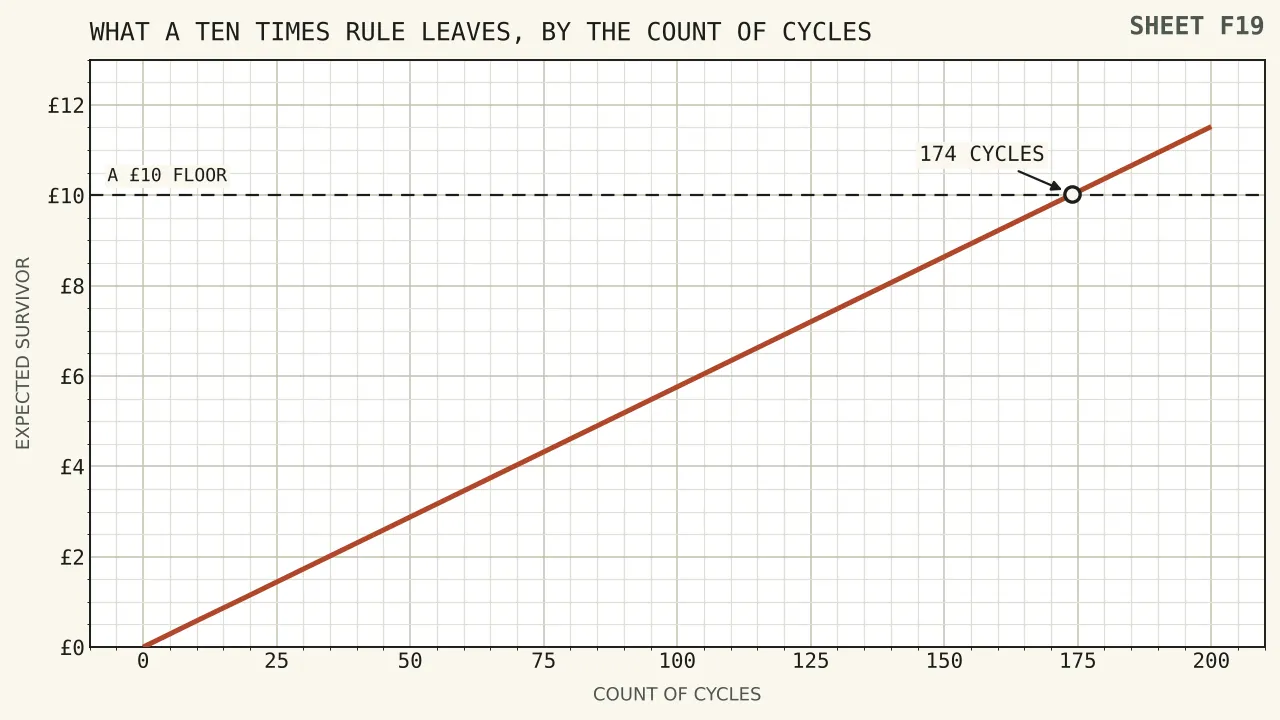
174 cycles is the smallest count whose survivor clears £10.00
That threshold is the most useful figure this page produces, so here is where it comes from. A survivor is the count times 10p times 0.96 times 0.6, which comes to 5.76p a cycle. Divide £10.00 by 5.76p and the answer is 173.6, so 174 cycles is the smallest whole count whose expected survivor reaches a £10.00 floor.
Read the table against the counts this market actually advertises and the finding is uncomfortable. Ten, twenty, twenty-five, forty and fifty are all common headline counts, and not one of them produces a survivor that a £10.00 floor will accept. A hundred does not either. The counts that clear it start at 174, which is not a number anybody advertises, and the next advertised count above it is 200.
Past twenty-five times no count whatever clears a floor, because the survivor is nothing at every size. That is the other half of the table and it needs no column: at the forty times a cashier beyond the register is free to write, 5.76p a cycle becomes nothing a cycle, and multiplying nothing by a thousand leaves nothing.
3
The proportions hold, the thresholds do not
Two kinds of number appear on this site and they behave differently under scaling. A proportion stays put. A threshold does not move at all, which means it moves relative to everything else. The unit table below is the first kind, read in both directions.
| Quantity | Per cycle of face | On ten cycles |
|---|---|---|
| Face | 10.0p | £1.00 |
| Expectation | 9.6p | 96.0p |
| Turnover at ten times | 96.0p | £9.60 |
| Expected cost | 3.84p | 38.4p |
| Survivor | 5.76p | 57.6p |
| Cycles of obligation | 9.6 | 96 |
| Seconds of obligation | 24 | 240 |
5.76p of survivor for each cycle of face, at ten times
Every row in that table is a rate, and a rate ignores the size of the face it is applied to. Three fifths of the credit survives a ten times rule at any count. Nothing survives twenty-five times at any count. Twenty-four seconds of obligation attaches to each cycle of face at any count, because 9.6 cycles of obligation at 2.5 seconds apiece is what one cycle of face carries.
Turn that into an hourly figure and the invariance is easier to feel. An hour of obligation at the licensed floor holds 1,440 cycles, which is fifteen faces of this size, so the survivor across that hour comes to £8.64 whatever face it came off. A reader clearing a ten times rule is working at £8.64 an hour in expectation, and the figure is the same on a 50p face and on a £100.00 one.
Now the second kind of number. A payout floor of £10.00 is not a rate and does not scale: it sits where it sits while the survivor grows past it or fails to. That single fact explains the whole shape of this section. Small faces fail on the floor and not on the arithmetic, which is why the arithmetic looks identical on every page here while the outcomes do not.
The same holds for the other absolute figures a reader meets. A maximum stake written as a share of the credit becomes unobeyable on a small face and harmless on a large one. A conversion ceiling is decorative under a small face and takes real money off a large one. The percentages never change; the walls stay put; and the face decides which walls it hits.
4
Fifty-seven point six pence under a ten pound line
Here is the residue of this page in one figure: 57.6p that no cashier’s ladder will pay out, against a floor nothing in the published rules sets.
| Floor | Multiple the balance must reach | Shortfall |
|---|---|---|
| £10.00 | 17.36 times | £9.42 |
| £20.00 | 34.72 times | £19.42 |
| £25.00 | 43.40 times | £24.42 |
The middle column is the honest way to state a small residue, because a multiple carries the right weight where a sum of pence does not. Fifty-seven point six pence has to become 17.36 times itself before a £10.00 line will let it out, and variance is the only mechanism that ever does it, at a price of 4p for each pound put at risk in the attempt.
Buying across the gap means meeting the ladder instead. A shortfall of £9.42 has a £10.00 rung as its cheapest cover, so 57.6p of what is bought serves no purpose at all. That the surplus equals the balance is not a coincidence of these figures: wherever a floor sits exactly on a rung, the surplus is the balance, because the rung covers the floor and the balance is the part the rung did not need to cover.
Two rules keep the exit honest under a British licence, and each says what a term may not do. One bars a ceiling over what comes out of a deposit balance. The other bars an option to undo a withdrawal already requested. A minimum is the thing no rule sets, which is why every floor on this site is declared rather than sourced.
One further sum belongs here, because it is the question a reader actually asks. If the balance were paid, what would an hour of this be worth? Four minutes of obligation produced 57.6p, so an hour of it produces £8.64, and that is the figure from part 3 arriving by a different route. A reader who reaches the floor by playing longer is working at the same rate and simply working for longer.
5
What a pound of face is worth to the house
A face has two sides and this site has priced only one of them so far. The reader’s expected cost on the obligation is 38.4p. The house’s expected margin on the same obligation is 38.4p. The cost to the reader and the margin to the house are one number seen from two sides, and on this face the number is 38.4p.
Why they are identical is worth a sentence, because it is the clearest thing about a house edge. Four pence rides on each pound of turnover. Turnover at ten times on a 96p credit is £9.60. Four per cent of £9.60 is 38.4p, and that quantity leaves the reader’s side of the ledger and arrives on the operator’s, less whatever the operator pays out of it.
Add the 4p the edge takes off the face itself and the reader’s whole expected loss on a £1.00 face is 42.4p, with 57.6p the expected survivor. At forty times the same arithmetic gives £1.536 of expected margin on a £1.00 face, which is more than the face, which is why nothing survives.
Scale it and the commercial logic appears. A thousand faces of this size are £1,000.00 of printed headline, £960.00 of credit and £384.00 of expected margin at ten times, before any of the readers has deposited a penny. That is the business a no-deposit offer is in: not the margin on one small credit, but the account that follows it.
Which is also why the terms matter more than the size. A margin of 38.4p does not pay for an acquisition, so the offer has to do something else: bring a reader to a cashier, settle an identity, and leave a balance too small to withdraw and too awkward to abandon. Each of the three is a published or arithmetic fact on this page rather than a motive anybody has stated.
6
Where the tax actually falls
A pound of face has a tax line in it, and the tax falls on the operator rather than on the reader. Both halves of that are published and both are worth stating precisely, because this is the part of the subject where guesswork is commonest.
Of an operator’s gaming profits, 40 per cent goes in remote gaming duty where the customer’s usual home is in the United Kingdom, profits meaning stakes received less winnings paid. The rate moved to 40 per cent on 1 April 2026; it had been 21 per cent for seven years before that, and 15 per cent before 2019.
Put that against the margin from part 5 and the arithmetic of a £1.00 face is complete. Of the 38.4p the obligation expects to produce, remote gaming duty takes 15.36p and leaves 23.04p, and the reader’s own expected loss of 42.4p is what funds both figures. On a thousand such faces the duty line is £153.60.
Residence settles it rather than the licence. Remote gambling offered to someone who normally lives in the United Kingdom brings the charge with it, wherever the operator sits, and that is a precise thing to say about a cashier the register does not carry. Being outside the British licensing regime is not the same as being outside British gaming duty, and the published guidance addresses the operator throughout.
The player’s side is reached by absence instead of by a charging provision. Betting and gambling, as the manual has it, are not of themselves a trade, so what comes off them is not income from a trade either. Nothing here is tax advice. No page on this site declares winnings free of tax, because no source reached for it says so in those terms, and the published position answers a question about trading rather than imposing a charge.
One figure from that manual is worth carrying for its own sake. A 1925 case about a man whose living came from betting on horses found no trade in the activity, and the manual records that a system for placing bets, a livelihood drawn from them, or the study of form does not by itself make one.
7
The scheme, and the scheme it is not
The duty with no price in part 8 is belonging to the national scheme for online self-exclusion, and a page about units should say exactly what that scheme is, since its name has changed once and a second scheme shares most of it.
Its legal entity, from the footer of its own site: The National Online Self Exclusion Scheme Limited. The address: 3 Greengate, Cardale Park, Harrogate. Number on the register of companies: 10504973.
A refreshed identity arrived in November 2025 under the name Gamstop Online, with a new website beside it, while the older spelling is what most readers and most searches still produce. This site writes Gamstop Online on first reference and Gamstop after it, and leaves the capitals of a quotation alone where a quotation is used.
One service shares most of the name and does a different job. Betting shops are what Gamstop Betting Shops blocks. It began in 2016 as MOSES, the Multi Operator Self Exclusion Scheme, and became part of the group during July 2023. Registering with one of the two leaves the other untouched.
Being in it is compulsory for an online company with a British gambling licence, which is what makes the licence decide the reach. June 2017 is when it was set up, and the Remote Gambling Association set it up, acting on a request from the Commission and from the government department then responsible for media and sport. From March 2020 belonging to it became a condition on the licences of operators taking business from British residents, and from April 2020 a licensee’s whole customer base had to be checked against it every 24 hours at the least.
Exclusion reaches participating gambling operators, on the scheme’s own terms. An organisation that stays out of the scheme is one whose services the scheme says it cannot block. That is a limit stated by the scheme about itself, and it is the reason a registration and an offshore cashier can both exist at the same time without either being faulty.
Two figures from the scheme’s own published data give the scale. Under-25s make up close to one in three of the self-exclusions on the scheme’s own figures, and more than seven in ten new registrations came from men. Not a word on this page, and not a word anywhere on this site, goes to reaching an account somebody has closed against themselves, or to getting past a gambling block at a bank or a piece of blocking software. The tools in this part are here to be used.
8
Every duty, divided by a hundred
A face of £1.00 is a hundredth of the largest in this section, so the duties can be priced in both columns at once. The left-hand figure is what each duty is worth on ten cycles. The right-hand figure is the same duty on a thousand.
| The duty | Its value on £1.00 of face | Its value on a thousand cycles |
|---|---|---|
| A requirement capped at ten times | 57.6p survives | £57.60 survives |
| Cycles kept 2.5 seconds apart | 240 seconds of obligation | 24,000 seconds |
| No autoplay | 96 commitments, one at a time | 9,600 commitments |
| Identity settled first | The same check at either size | The same check again |
| No cancelling a withdrawal | Protects 57.6p once requested | Protects £57.60 |
| An adjudicator off the approved list | A published remit, whatever the sum | A published remit again |
| The national scheme | One registration, as wide as the licences | One registration, no wider |
Three of those rows shrink with the face and the rest do not, which is the whole of what this page has to say about protection. A ceiling on a wagering requirement is worth pennies on a pound of face and pounds on a hundred of it. A pacing rule is worth minutes against hours. Everything below the third row is worth the same at either size, and that is the part a reader loses in full rather than in proportion when a cashier holds no licence here.
Identity is the clearest case. A check made before any gambling happens, free-to-play games and bonus play alike, is the same check whether the face behind it is 50p or £100.00. Curaçao hangs its full identity checking on later milestones for anti-money-laundering purposes, so a credit there can be taken up and played with no document looked at, the check waiting at the exit. That difference does not get smaller because the credit is small.
Nor does the adjudication. A dispute over 57.6p and a dispute over £57.60 go to the same approved entity under a British licence, with the same published remit and the same eight weeks. Away from the register the terms of an adjudication may be set by the operator, including whether a claim must reach some stated value before anybody will escalate it, and a value of any size at all closes a 57.6p dispute.
And nor does the scheme. One registration reaches as far as the British licences reach, and no further, whatever a reader holds in a balance. That is the row with no price in it, and on a face of £1.00 it is the only row whose value is undiminished by the size of the face.
Three figures close the account on a pound of face. Four pence, which the edge takes before any term is read. Thirty-eight point four pence, which the obligation takes at the British ceiling. And 57.6p, which survives both and then sits 17.36 times beneath the lowest payout this ladder reaches.
Questions
- What are 10 free spins worth?
- A face of £1.00 at 10p a cycle, averaging 96p once the edge has taken 4p. Ten times asks £9.60 of turnover, which is 96 cycles and 240 seconds at the licensed pace, costs 38.4p in expectation and leaves 57.6p. At forty times the expected cost is £1.536, which is more than the credit, so nothing survives.
- Why treat a count of ten as the unit?
- Because at 10p a cycle it is exactly £1.00 of face, which makes every other count in this section a multiple of it. Twenty cycles is two units, a hundred is ten, a thousand is a hundred. Multiply the count by 5.76p and the answer is what a ten times rule leaves, at any size.
- What count does it take to clear a £10 payout floor?
- A hundred and seventy-four cycles, worked at ten times and a 96 per cent return. A survivor is the count times 5.76p, and £10.00 divided by 5.76p is 173.6, so 174 is the smallest whole count that reaches it. Ten, twenty, twenty-five, fifty and a hundred cycles all fall short, and the next advertised count above the threshold is 200.
- Does the proportion change with the size of the face?
- No, and that is the point of this page. Three fifths of a credit survives ten times at any count, nothing survives twenty-five, and an hour of obligation returns £8.64 in expectation whatever face it came off. What changes with size is which absolute thresholds the result runs into, since a payout floor and a maximum stake term stay where they are.
- What is 57.6p short of, and what does closing the gap cost?
- It is £9.42 short of a £10.00 floor, which means becoming 17.36 times itself. Variance is the only mechanism that does that, at 4p for each pound put at risk in the attempt. Buying across the gap costs £10.00 and leaves 57.6p of the purchase unused, which is the size of the balance that purchase was meant to release.
- What does the house expect to make from a £1.00 face?
- Thirty-eight point four pence at ten times, which is the same number as the reader’s expected cost on the obligation, seen from the other side of the ledger. Four pence rides on each pound of the £9.60 of turnover. At forty times the expected margin is £1.536, which is more than the face itself.
- Who pays gambling duty, and at what rate?
- The operator does. Where a customer’s usual home is in the United Kingdom, 40 per cent of the operator’s gaming profits goes in remote gaming duty, profits being stakes received less winnings paid. On the 38.4p this face produces that is 15.36p. Forty per cent has applied since 1 April 2026, and 21 per cent applied for the seven years before it.
- Is a cashier off the register outside British tax as well?
- No. Residence settles the charge rather than the licence, so remote gambling offered to someone who normally lives in the United Kingdom brings the duty with it wherever the operator sits. Being outside the British licensing regime is a different thing from being outside British gaming duty.
- What exactly does the self-exclusion scheme cover?
- Online gambling at participating operators, which is to say the companies a British licence obliges to join. The entity behind it is registered as number 10504973 under the name The National Online Self Exclusion Scheme Limited, and November 2025 brought a refreshed identity as Gamstop Online. Betting shops are a separate service’s job, and one registration does not cover the other.
- Which duties shrink with the face and which do not?
- The wagering ceiling, the pacing rules and the protection of a requested withdrawal all scale with the money: on a pound of face they are worth 57.6p, 240 seconds and 57.6p. Identity checking, the published remit of an adjudicator and membership of the national scheme are worth the same at any size, so a small face loses those in full rather than in proportion.