Note S06 Revision 1 Terms read 16 October 2026
20 free spins, no deposit: a face too small to move
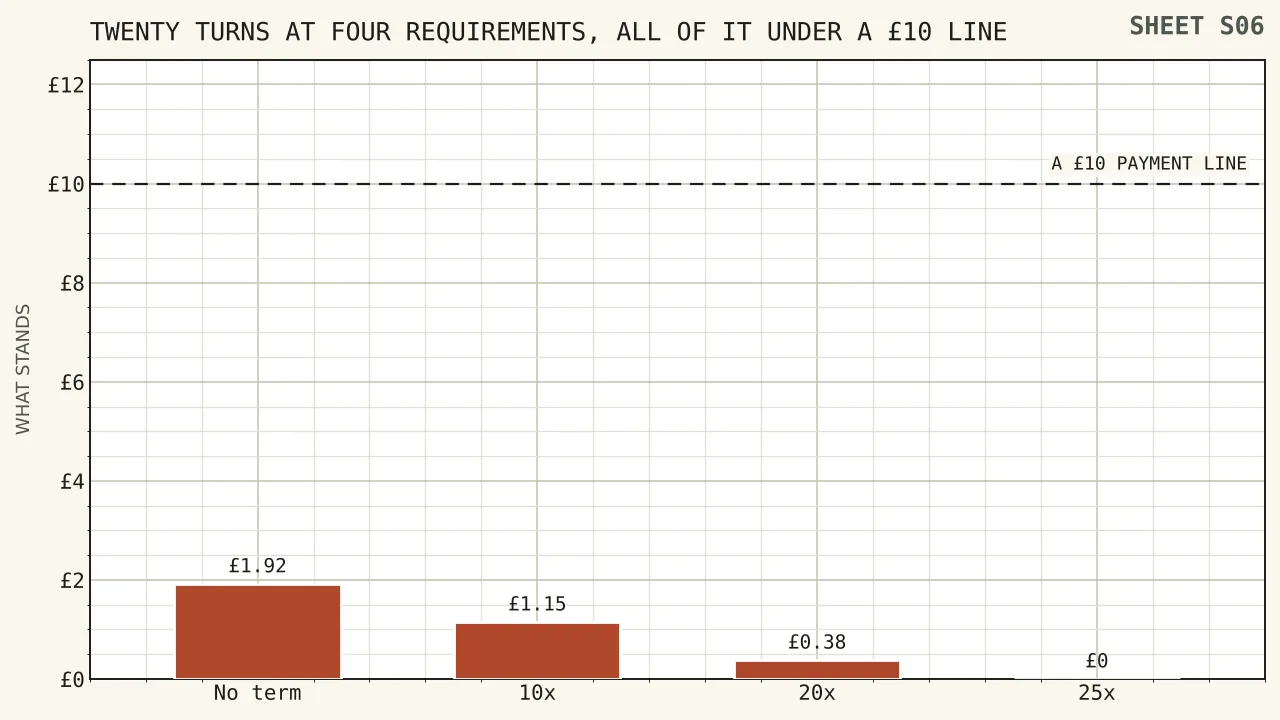
Twenty turns at 10p print £2.00 and average £1.92. No term decides what happens next, because the face is too small either way. A payment line at the lowest prepaid step reads £10.00, and £1.92 comes to 19.2 per cent of that. Eighty-five more turns would be wanted before any of it could travel.
Twenty turns print £2.00 The edge takes £0.08 Too small to move £1.92
What a face of this size is worth
Every destination on this rack is bought advertising. The site takes a fee if a reader goes on to register, and no figure printed below moves because of it.
Face and Residue
Strip No 01
Betportal
Ceiling as a multiple
Priced at this site's own 10p a spin
What is printed
What draws it down
What is stranded
No Great Britain licence
Licensed in Anjouan, Comoros, run by BetPortal Gaming Ltd, with Excite Ultra Media Ltd, reference ALSI-202601040-FI2.
Terms read 16 October 2026
Open the offer at Betportal, opens in a new tabFace and Residue
Strip No 02
WinBeast
Ceiling as a sum
Priced at this site's own 10p a spin
What is printed
What draws it down
What is stranded
No Great Britain licence
Licensed in Curaçao, operator not named on the site.
Terms read 16 October 2026
Open the offer at WinBeast, opens in a new tabFace and Residue
Strip No 03
EliteSpin
Longest spin window
Priced at this site's own 10p a spin
What is printed
What draws it down
What is stranded
No Great Britain licence
Licensed in Costa Rica, run by PrimeTier Limited.
Terms read 16 October 2026
Open the offer at EliteSpin, opens in a new tabFace and Residue
Strip No 04
Crown Jewelz
Multiple unpublished
No residue struck
What is printed
What draws it down
What is stranded
No Great Britain licence
Licensed in Curaçao, number not verified, operator not named on the site.
Terms read 16 October 2026
Open the offer at Crown Jewelz, opens in a new tabThe two figures in the second and third registers are this site's own arithmetic and nothing an operator has published: the face as printed, less the share a spin gives back at 96 per cent return to player, less what playing the wagering through costs at the same return, and then less whatever a published ceiling, a charge on the way out or a floor on the smallest withdrawal takes off what survives that. The residue is what is left of the face when all of it is accounted for. It describes the offer, not one reader's afternoon. Where the conditions price above the face the strip prints nothing coming off rather than a negative sum, and where a figure the sum needs is unpublished it prints the condition in the operator's words instead.
A face paid as spins has no unit of its own, so one is supplied. Where an operator publishes what a spin of its own is worth, that figure stands in the first register's own line and is labelled as theirs. Where it does not, this site's own 10p a spin stands there and says so, and every figure below moves in proportion: at half the price, half the money. The share of the face that does come off is also given as pence in the pound, which is the figure that compares a large face against a small one.
Money goes onto a prepaid voucher in fixed denominations, so a smallest deposit published in pounds is rounded up to the first rung of the ladder this site works in, £10, £20, £25, £50, £75 and £100, and the strip prints what that rounding strands. That is the reader's own money and it is never netted into a residue. A smallest deposit published in euros is printed as the operator publishes it, because the ladder here is a sterling one and rounding a euro sum to it would be an invented figure.
Three words stand in the amount column where no figure can. Noted is a published condition that takes value away without leaving the sum a figure to take. Unpriced is a condition whose figure nobody has published, or a credit that is not a sum until a deposit of your own sets it. Own money is money of yours, which is never part of a residue.
Not one of the operators printed above holds a Great Britain licence, so the duties that licence carries do not reach them. All online gambling companies licensed in Great Britain must be part of Gamstop Online, and a reader who has shut themselves out through the scheme is therefore not shut out here. The ceiling of ten times the bonus funds on a wagering requirement, in force since 19 January 2026 under Social Responsibility Code 5.1.1, is a condition of that licence and binds the companies that hold one. On an unlicensed site the Gambling Commission describes consumers as facing unfair gaming practices, financial loss and a lack of recourse if things go wrong, and it names blocked payouts and withdrawal limits set so high they are unattainable among what it has seen. Nobody under 18 may hold an account at any of them.
Every term printed on a strip is the operator's own, and each strip carries the day it was read. The oldest of those readings is 16 October 2026. What binds a reader is the operator's own full terms, and not a line printed here.
1
At this size the terms decide nothing
Most pages on this site turn on a term. A multiple, a band, a ceiling, a clause: something in the small print decides how much of a face survives, and the arithmetic follows from it.
At twenty turns none of that matters, and the reason is worth putting first. Whatever the terms say, the balance this face can produce is too small to cross the cheapest payment line a cashier is likely to set. The outcome is the same with a requirement and without one.
So this note runs the arithmetic in the other direction. Rather than asking what the terms take, it asks how much face a reader would need before any term became interesting, and it prices the gap.
| Quantity | Figure used |
|---|---|
| One turn on the named reel | Ten pence |
| Given back per pound | 96 pence |
| Turns in the offer | Twenty |
| Lowest prepaid step | Ten pounds |
| Payment line, assumed | The same ten pounds |
The payment line is an assumption and carries a label wherever it appears. Nothing published collects minimum payments into a set, no primary source gives their spread, and £10.00 is used here because the prepaid ladder on this site starts there.
Offers this size come to British readers through cashiers that carry no Great Britain licence, and part eight prices the absence. On a face this small the most valuable thing a licence would supply is not a lid on a multiple. It is the fact that a licensed cashier may not cap what leaves a deposit balance, which matters when a reader finally does put money in.
2
Twenty turns, and the eight pence
Twenty at ten pence prints £2.00. A reel returning 96 per cent makes the average £1.92, so eight pence is the first and smallest deduction on the page.
Eight pence sounds like nothing and it is the only figure here that is certain. The reels produce it, no term waives it, and it is charged whether a reader clears a requirement or never attempts one.
| Stage | What happens there | The figure | Share of the printed face |
|---|---|---|---|
| Printed | Twenty turns at the unit | £2.00 | The whole of it |
| Averaged | The edge takes eight pence | £1.92 | 96 per cent |
| After ten times | £19.20 staked, 77p of cost | £1.15 | 57.5 per cent |
| After twenty times | £38.40 staked, £1.54 of cost | £0.38 | 19 per cent |
| After twenty-five times | £48.00 staked, £1.92 of cost | £0.00 | Nothing at all |
Ten times is the heaviest requirement available under a British licence, so row three is the licensed worst case and £1.15 is what it leaves. Rows four and five belong to cashiers without that licence, and row five is the crossing: twenty-five charges of fourpence consume a pound, so nothing survives there at any face value.
A caution on the averages, as everywhere here. Ninety-six per cent is a long-run figure and twenty turns is the shortest run on this site. The realised total scatters hard, it leans low, and the commonest outcome on twenty small turns is below £1.92 rather than at it.
Twenty turns: £2.00 printed, £1.92 averaged, £1.15 after the British lid
3
What line this face could clear
Turn the usual question upside down. Instead of asking whether a balance clears the line, ask what line a balance of this size could clear, and the answer is a figure no cashier publishes.
| What is left | Where it comes from | Line it would clear | Share of a £10.00 line |
|---|---|---|---|
| £1.92 | No requirement at all | £1.92 or lower | 19.2 per cent |
| £1.15 | The British lid of ten times | £1.15 or lower | 11.5 per cent |
| £0.38 | Twenty times, offshore | 38p or lower | 3.8 per cent |
| £0.00 | Twenty-five times or more | No line at all | Nothing |
A cashier with a payment line at £1.92 would be unusual enough to be worth naming, and nothing read for these sheets names one. So the honest summary of row one is that the best outcome available on this face needs a threshold roughly a fifth of the one this site assumes.
What the published rules say about thresholds is worth setting out, because the list is short and the item that matters is missing from it. Over a deposit balance no maximum may stand, and four verbs are shut out: impose, use, enforce, rely on. Fifty pounds across a day, five hundred across a week: the example printed as forbidden. Reasonableness governs a limit by size or by frequency. And nobody who has asked to withdraw gets cancellation offered back.
Nothing on that list touches a minimum before a payment may begin. The regulator has named the behaviour elsewhere, describing a withdrawal threshold set beyond any reach, and a threshold is not a cap, so no published figure governs one.
So the position at this size is simple to state and hard to escape. A balance of £1.92 is real money in an account, protected against capping once it reaches a deposit balance, and unable to leave because of a threshold nobody regulates.
4
How many turns short it falls
Shortfalls are easier to act on in turns than in pounds, because a count is what an offer advertises. So convert the gap.
A balance has to reach £10.00. With nothing attached that wants a printed face of £10.42, which comes to 105 turns at the unit. With ten times attached it wants £17.37 and 174 turns, since a tenfold requirement lets three fifths of a credit through.
| Requirement | Face needed | Turns needed | Turns missing from twenty | What twenty is of it |
|---|---|---|---|---|
| None | £10.42 | 105 turns | 85 more | 19.0 per cent |
| Five times | £13.03 | 131 turns | 111 more | 15.3 per cent |
| Ten times | £17.37 | 174 turns | 154 more | 11.5 per cent |
| Fifteen times | £26.05 | 261 turns | 241 more | 7.7 per cent |
| Twenty times | £52.09 | 521 turns | 501 more | 3.8 per cent |
| Twenty-five times | No face works | No count works | Unreachable | Nothing |
The fourth column is the page in one strip. Eighty-five more turns on the kindest terms available anywhere. A hundred and fifty-four more at the British lid. Five hundred and one more at the twenty times available to any cashier outside the register.
Read the bottom row as the arithmetic rather than as a flourish. At twenty-five times the expected survival of any credit is nought, so no count of turns produces a movable balance, and a cashier offering a thousand turns at that multiple is offering an obligation rather than a face.
Eighty-five turns short with nothing attached, 154 short at ten times, unreachable at twenty-five
One practical use for that table is comparing offers rather than evaluating this one. A count and a multiple together are enough: find the row for the multiple, compare the count with column three, and the answer is whether the offer can produce money at all. Nothing else in the terms changes it.
5
A stake lid that rounds down to the unit
Suppose a reader does attach the ten times requirement and sets out to clear it. A second rung appears in an unexpected place: the stake ladder inside the game.
Promotions commonly put a ceiling on the stake for as long as a requirement is open, and here that ceiling is pegged at one tenth of what the turns produced. One tenth of £1.92 is 19.2 pence, a stake no reel offers. Stakes come in steps, and on a penny-and-ten-penny ladder the selectable stakes beneath the lid are ten pence and nothing else, because twenty pence exceeds it.
So the lid rounds down to the unit, and the obligation lengthens accordingly.
| Stake a cycle | Available | Cycles | Shortest sitting |
|---|---|---|---|
| 19.2 pence | Not a stake any reel offers | 100 | 4 minutes 10 seconds |
| Nineteen pence | Only where a ladder has it | 102 | 4 minutes 15 seconds |
| Ten pence | The step below the lid | 192 | 8 minutes |
The money is unchanged across those rows, as it always is: four per cent of £19.20 is 77 pence whichever stake is used. What changes is the count of decisions, and rounding down to the unit nearly doubles it, from a hundred cycles to 192.
That is this site’s own idea appearing in a place nobody looks for it. A prepaid ladder strands part of a purchase because money comes in fixed steps. A stake ladder strands part of a permitted stake for the same reason, and what it costs is not money but 92 extra decisions and four more minutes.
One statutory lid sits above all of this and never binds on a face this small. A reel’s single cycle may take no more than five pounds from a player who has turned 25, and no more than two pounds from anyone younger. Reels only, for both figures, and both are over twenty-five times the stake in use here.
A 19.2p lid rounds down to 10p, turning 100 cycles into 192 and four minutes into eight
6
Eight minutes, and a clock that never bites
Clocks are the usual villain on pages about small offers, and on this page a clock is the one term that cannot hurt a reader. The arithmetic shows why.
The whole obligation at ten times is 192 cycles at the rounded stake. At 2.5 seconds a cycle, the licensed floor, those fill 480 seconds. Eight minutes, in other words, the twenty free turns included.
| Window in the terms | What it allows | Whether it binds |
|---|---|---|
| Twenty-four hours | 1,440 minutes | No, by a factor of 180 |
| Seven days | 10,080 minutes | No, by a factor of 1,260 |
| Twenty-eight days | 40,320 minutes | No, by a factor of 5,040 |
| One hour | Sixty minutes | Still no, with 52 to spare |
Every row says the same thing. An eight-minute obligation fits inside any window a promotion of this kind sets, so a reader who means to clear the requirement will clear it, and the clock is decoration.
That makes this page an exception worth stating plainly. On a larger face a clock does the stranding: a requirement of several hundred cycles against a 24-hour window is a sitting a reader may not manage. On a twenty-turn face the obligation is short, the clock is generous by three orders of magnitude, and the thing that strands the money is the payment line.
Two licensed rules hold that eight minutes in place. From one cycle’s start to the next, 2.5 seconds must elapse, and the standard carrying that figure shows no commencement date. Autoplay is out too, so all 192 cycles take a commitment each. Away from a British licence neither holds, and the software then sets the pace.
7
How many people this reaches
Small faces are the commonest kind, so the arithmetic above is not a curiosity. Published statistics give some sense of the population it applies to, and they come with a warning attached that this note respects.
In the third annual survey of gambling in Great Britain, published 16 July 2026, 47 per cent of adults reported gambling within the previous four weeks. Lottery-only players taken out, the figure reads 27 per cent.
The same report scores 2.4 per cent at eight or above on the problem gambling index for 2025, a level it describes as stable across three years of the survey. Roughly twenty thousand adults sit for interview annually, and the span covered is 2023 to 2025.
Those figures carry a warning and this note keeps it. Surveys built on different methods are not to be set against this one, so the comparison a reader wants is between its own successive waves.
| The figure | What it covers |
|---|---|
| 47 per cent | Any gambling, past four weeks |
| 27 per cent | The same, lottery-only players out |
| 2.4 per cent | A score of eight or more, in 2025 |
| Twenty thousand | Adults interviewed in a year |
| Three years | What the report covers, 2023 to 2025 |
Set those beside this page’s figures and one thing follows. A face of £2.00 producing a balance of £1.92 that cannot be withdrawn is not an edge case in a market where nearly half of adults gamble in a month. It is the ordinary experience of the smallest offers on the market.
One more published figure belongs here, because it describes where the money lands rather than who plays. Gross gambling yield from online casino games came to £5.7 billion across the year ending March 2026. Reels alone produced £4.8 billion, on figures published 17 September 2026.
Divide the second of those by this page’s printed face and the proportion goes past useful illustration. What it does show is that the smallest offer and the largest sector figure describe one machine, and parts two to five are the arithmetic connecting them.
8
Twenty turns with no British licence behind them
Twenty turns credited at a cashier with no British licence come without a lid of ten over any requirement, without the prohibition on capping what a deposit balance releases, and without the scheme that blocks a whole licensed market from one form. Each line below is a condition of that licence. Nothing in the offshore policy consulted here answers to any of them.
| What is absent | Its worth at this size |
|---|---|
| Ten times as the ceiling | £1.15 left, against 38p at twenty |
| No cap over a deposit balance | Matters once a reader pays money in |
| Reasonableness over size and frequency | All a withdrawal limit has to meet |
| A cycle’s lid, fixed by statute | Five pounds on a reel |
| An interval under each cycle | 192 cycles fill eight minutes |
| A commitment to each cycle | 192 of them, taken one at a time |
| Identity before any play | A name, an address, a birth date |
| Registration once, blocking once | Every licensee, from a single form |
Row two is the row this page ends on, because it is the one that bites after the page’s arithmetic is over. A reader whose £1.92 cannot move has one obvious route left, which is to put money in and lift the balance over the line. At that moment the protection over a deposit balance becomes the most valuable thing a licence supplies, and at a cashier without one it is simply absent.
Price that route before taking it. A deposit of £10.00 lifts a £1.92 balance to £11.92, which clears the line by £1.92. The deposit is 5.2 times the balance it releases, and the balance released is the only part of it that came from the offer.
Higher rungs make that multiple worse rather than better, because the balance released never changes. A £20 voucher is 10.4 times the £1.92 it frees, £25 is 13.0 times, £50 is 26.0 times, £75 is 39.1 times, and £100 is 52.1 times. Each of those is a purchase of the reader’s own money dressed as a release of the offer’s. The £1.92 is the only part of any of them that came from the twenty turns, and it is the same £1.92 at every rung.
Two things in the offshore document run the reader’s way and belong here for completeness. A cooling-off period there needs one button, no email and nobody’s approval, and four lengths are on offer: a day at the short end, three months at the long, a week and a month filling the gap. Tightening a deposit limit happens at once there as here, while loosening one waits a week rather than a day.
What that document lacks is the rest of this page. Nothing lids a wagering multiple. Nothing limits a stake by statute. Nothing floors a reel’s pace. Two sentences cover promotions: transparency in the terms, and nothing aggressive that drives excess.
The scheme closes the note, as it closes every note here. Membership is a condition of a British licence, so a cashier holding none falls outside, and its terms give the consequence: a registrant cannot be kept from a service whose operator takes no part. Registrations reached 614,738 in the figures of 16 July 2026. Among the under-25s they climbed 26 per cent on the year, and nearly one exclusion in three belonged to that group.
A final summary for the smallest face on this site. Printed £2.00. Averaged £1.92. Left after the British ceiling £1.15. Payment line assumed £10.00. Turns short of it with nothing attached: eighty-five. The residue is the whole of the balance, and no term in any set of terms had to do anything to produce it.
Questions
- What are twenty free spins worth?
- £2.00 as the printed figure. Ten pence a turn, £1.92 as the average on a 96 per cent reel, eight pence to the edge. Ten times, the British ceiling, costs 77 pence and leaves £1.15, while twenty-five times leaves nothing.
- Why can none of it be withdrawn?
- Because of size rather than terms. The lowest prepaid step sets a payment line of £10.00, and the best balance this face produces is £1.92, or 19.2 per cent of the line. That answer holds with a requirement attached and without one.
- What payment line would the balance clear?
- £1.92 or lower with nothing attached, and £1.15 or lower after a tenfold requirement. No primary source reached for these sheets names a cashier with a threshold that low, so the figures describe what would be needed rather than what exists.
- How many more spins would I need?
- Eighty-five more with nothing attached, which is 105 turns in all. A hundred and fifty-four more at ten times, which is 174 turns. Two hundred and forty-one more at fifteen times. Five hundred and one more at twenty times. No count works beyond twenty-five times, since expected survival there is nought.
- Is a minimum payment regulated?
- Not in anything read for these sheets. Regulation runs the other way: a deposit balance may not have a withdrawal maximum put over it, four verbs shut out around the attempt, and the example it forbids pairs fifty pounds over a day with five hundred over a week. A threshold before a payment may start appears nowhere.
- What does a maximum bet rule do here?
- It rounds down to the unit. A tenth of £1.92 is 19.2 pence, which no reel offers as a stake, so the selectable stake beneath the lid is ten pence. That turns a hundred cycles into 192 and four minutes ten seconds into eight minutes, while the expected cost stays at 77 pence either way.
- Does the clock matter on an offer this small?
- No, and that is unusual. The obligation runs to 192 cycles, or eight minutes at a floor of 2.5 seconds. A 24-hour window is 180 times longer than needed, a seven-day window 1,260 times, and even an hour leaves 52 minutes spare.
- What is the statutory limit on a stake?
- Five pounds for one cycle of an online reel at 25 and over, two pounds below that age, with both confined to reels rather than casino games at large. Neither binds a reader staking ten pence, and both are more than twenty-five times the stake in use on this page.
- How common is an offer of this size?
- Commoner than any other. In the survey published 16 July 2026, 47 per cent of adults said they had gambled in some form in the past four weeks, and 27 per cent once lottery-only players are excluded. The Commission warns against comparing that survey with surveys using different methods.
- Where does the sector’s money come from?
- Reels, on figures published 17 September 2026. Across the year ending March 2026, online casino games made £5.7 billion of gross gambling yield, and reels by themselves made £4.8 billion.
- If I deposit to release it, what does that cost?
- A £10.00 deposit lifts a £1.92 balance to £11.92, which clears the line by £1.92. The deposit is 5.2 times the balance it releases, and only that £1.92 came from the offer. At that point the rule against capping what leaves a deposit balance becomes the most useful protection a licence supplies.
- What is absent at a cashier with no British licence?
- Ten times as the ceiling on a requirement, the bar on a maximum over what a deposit balance pays out, reasonableness as all a withdrawal limit must meet, the statutory lid on one cycle, the 2.5 seconds under each cycle, the commitment taken cycle by cycle, identity settled before play, and one registration covering every licensee.