Note K02 Revision 1 Terms read 16 October 2026
No deposit bonuses off the register: a £15.00 face, costed to the penny
Nothing goes in, so no rung gets bought and nothing rounds away at the door. A face of £15.00 averages £14.40 the instant it is credited. Ten turnovers charge £5.76 against that, leaving £8.64. Write forty turnovers instead and the identical £8.64 turns into the overshoot. One figure, two directions, and the ceiling is what picks between them.
The face, with nothing deposited £15.00 What draws it down £5.76 What is stranded £8.64
What a face of this size is worth
Every destination on this rack is bought advertising. The site takes a fee if a reader goes on to register, and no figure printed below moves because of it.
Face and Residue
Strip No 01
Betportal
Ceiling as a multiple
Priced at this site's own 10p a spin
What is printed
What draws it down
What is stranded
No Great Britain licence
Licensed in Anjouan, Comoros, run by BetPortal Gaming Ltd, with Excite Ultra Media Ltd, reference ALSI-202601040-FI2.
Terms read 16 October 2026
Open the offer at Betportal, opens in a new tabFace and Residue
Strip No 02
WinBeast
Ceiling as a sum
Priced at this site's own 10p a spin
What is printed
What draws it down
What is stranded
No Great Britain licence
Licensed in Curaçao, operator not named on the site.
Terms read 16 October 2026
Open the offer at WinBeast, opens in a new tabFace and Residue
Strip No 03
EliteSpin
Longest spin window
Priced at this site's own 10p a spin
What is printed
What draws it down
What is stranded
No Great Britain licence
Licensed in Costa Rica, run by PrimeTier Limited.
Terms read 16 October 2026
Open the offer at EliteSpin, opens in a new tabFace and Residue
Strip No 04
Crown Jewelz
Multiple unpublished
No residue struck
What is printed
What draws it down
What is stranded
No Great Britain licence
Licensed in Curaçao, number not verified, operator not named on the site.
Terms read 16 October 2026
Open the offer at Crown Jewelz, opens in a new tabThe two figures in the second and third registers are this site's own arithmetic and nothing an operator has published: the face as printed, less the share a spin gives back at 96 per cent return to player, less what playing the wagering through costs at the same return, and then less whatever a published ceiling, a charge on the way out or a floor on the smallest withdrawal takes off what survives that. The residue is what is left of the face when all of it is accounted for. It describes the offer, not one reader's afternoon. Where the conditions price above the face the strip prints nothing coming off rather than a negative sum, and where a figure the sum needs is unpublished it prints the condition in the operator's words instead.
A face paid as spins has no unit of its own, so one is supplied. Where an operator publishes what a spin of its own is worth, that figure stands in the first register's own line and is labelled as theirs. Where it does not, this site's own 10p a spin stands there and says so, and every figure below moves in proportion: at half the price, half the money. The share of the face that does come off is also given as pence in the pound, which is the figure that compares a large face against a small one.
Money goes onto a prepaid voucher in fixed denominations, so a smallest deposit published in pounds is rounded up to the first rung of the ladder this site works in, £10, £20, £25, £50, £75 and £100, and the strip prints what that rounding strands. That is the reader's own money and it is never netted into a residue. A smallest deposit published in euros is printed as the operator publishes it, because the ladder here is a sterling one and rounding a euro sum to it would be an invented figure.
Three words stand in the amount column where no figure can. Noted is a published condition that takes value away without leaving the sum a figure to take. Unpriced is a condition whose figure nobody has published, or a credit that is not a sum until a deposit of your own sets it. Own money is money of yours, which is never part of a residue.
Not one of the operators printed above holds a Great Britain licence, so the duties that licence carries do not reach them. All online gambling companies licensed in Great Britain must be part of Gamstop Online, and a reader who has shut themselves out through the scheme is therefore not shut out here. The ceiling of ten times the bonus funds on a wagering requirement, in force since 19 January 2026 under Social Responsibility Code 5.1.1, is a condition of that licence and binds the companies that hold one. On an unlicensed site the Gambling Commission describes consumers as facing unfair gaming practices, financial loss and a lack of recourse if things go wrong, and it names blocked payouts and withdrawal limits set so high they are unattainable among what it has seen. Nobody under 18 may hold an account at any of them.
Every term printed on a strip is the operator's own, and each strip carries the day it was read. The oldest of those readings is 16 October 2026. What binds a reader is the operator's own full terms, and not a line printed here.
1
A credit that asks for nothing still has a price
An offer needing no deposit looks like the one case where a ladder of fixed denominations cannot bite. No rung gets bought, so no rounding happens, so nothing is stranded before the start. That reading holds, and it holds for about four pence.
Take a headline of 150 spins, priced at the 10p this site uses for a spin throughout. The face is £15.00. At the 96 per cent return assumed on every page here the credit averages £14.40, so 60p of the printed figure is gone before a term has been read. On a face with nothing behind it that 60p is the one residue fixed in advance.
Why 10p? Because the figure is not published anywhere and somebody has to choose it. No rule names a floor or a ceiling for what a spin is worth, and none obliges anybody to print the figure as a figure. Whoever writes a promotion decides it. Two sourced duties touch the edge of the question: the chance information has to be reachable before a customer commits, and whoever offers an incentive must set its terms out clearly, fairly and within reach of the people offered it.
Declare those two assumptions and a count of spins becomes a quantity of money, after which it behaves like any other credit. What follows prices the distance between crediting it and keeping it.
A credit asking for nothing up front is advertised, in this corner of the market, by cashiers with no British licence at all. Part 6 prices that condition lock by lock instead of asserting that it matters.
This note helps nobody reach a cashier. It carries no domain, no search string and no payment route, and not a word about registering anywhere without documents. The sums are the argument, and every line of them says the same thing.
2
Where £14.40 goes at six obligations
An obligation to play through is an obligation to send money round a reel until the wagers add up to a stated figure. Four pence of every pound makes that circuit at a 96 per cent return, and the multiple says how many circuits are owed.
Ten is the most a British licence allows on bonus funds. Against £14.40 of credit that comes to £144.00 of staking, 1,440 cycles of 10p, and a charge of £5.76 in expectation. At forty, the multiple this site assumes wherever a page needs one, the staking is £576.00 across 5,760 cycles and the charge reaches £23.04.
| Turnovers asked | Staking owed | Expected charge | Reading | Survives | Off the £15.00 face |
|---|---|---|---|---|---|
| None at all | £0.00 | £0.00 | Cash on credit | £14.40 | £0.60 |
| Five | £72.00 | £2.88 | Four fifths left | £11.52 | £3.48 |
| Ten | £144.00 | £5.76 | British ceiling | £8.64 | £6.36 |
| Twenty | £288.00 | £11.52 | A fifth left | £2.88 | £12.12 |
| Twenty-five | £360.00 | £14.40 | Nothing, exactly | £0.00 | £15.00 |
| Forty | £576.00 | £23.04 | Past the end | £0.00 | £15.00 |
The final column measures against the printed face, not against the expectation, because the printed face is what a reader was shown. £6.36 of a £15.00 headline was never going to come off at the ceiling. At twenty turnovers the figure is £12.12. From twenty-five upwards the headline is stranded entire and the obligation has begun work on money the reader brought along.
£8.64 alive at ten turnovers; the same £8.64 as overshoot at forty
That mirror is worth a sentence of its own. Three fifths of the credit is what ten turnovers leave standing, and three fifths of the credit is how far forty turnovers run past the end of it. A single ceiling, read forwards and backwards, accounts for the entire distance between a credit worth something and a credit worth nothing.
Nobody finishes £8.64 down on money they never held. The minus sign says the obligation outlasts the credit, so one of two things follows: the reels stop part way and whatever is left goes back, or the reels keep turning on the reader’s own stake, where the same fourpence in the pound is charged all over again.
3
The clock on a free credit, in cycles a day
A multiple says how much staking is owed. A window says how long there is to do it, and the two together decide whether an obligation is reachable at all. Converting a window into cycles a day is the quickest honest test of an offer of this kind.
Take the 1,440 cycles a ten times obligation puts behind this face. Spread across seven days that is 206 cycles a day, which against a 2.5 second floor, the one a licensed reel keeps, is 8 minutes 35 seconds of play daily. Nobody would call that unreachable. Now take the 5,760 cycles a forty times obligation asks for: 823 cycles a day, 34 minutes 17 seconds daily for a week, or four hours in one sitting if the window is 24 hours.
| Window given | Cycles a day at ten times | Daily sitting | Cycles a day at forty times | Daily sitting |
|---|---|---|---|---|
| 24 hours | 1,440 | 1 hour | 5,760 | 4 hours |
| Three days | 480 | 20 minutes | 1,920 | 1 hour 20 minutes |
| Seven days | 206 | 8 minutes 35 seconds | 823 | 34 minutes 17 seconds |
Nothing about the money changed across those rows. The window decided whether the obligation was a nuisance or a second job, and a window is the cheapest term in the world to tighten. A reader comparing two offers on their headlines alone is comparing the one figure that does not move.
One published prohibition bears straight on a clock, and it is the least quoted of the four things a licensee must not do. Where the qualifying activity is finished early, with offer period still to run, no change may be made to what the incentive is worth. A licensed cashier cannot shrink a prize for promptness. That has no counterpart in the Curacao text, and the length of a window is regulated nowhere at all.
Where a window and a weighted game meet, the arithmetic doubles up. On the 30p contribution rate the regulator’s own papers quote, a reel crediting that much per pound staked turns ten turnovers into 33.33 of real staking, which on this face is £480.00 and 4,800 cycles. Across a seven-day window that is 686 cycles a day. The written multiple never moved.
£480.00 of staking and 4,800 cycles behind a ten times obligation at 30p in the pound
4
The ceiling, and exactly where the published words stop
Ten turnovers is where the British ceiling sits. The sentence that matters most about it is the one nobody bothers to write, which is what it fails to reach. A reader who knows where the published wording runs out cannot be told it says more than it does.
| The question | The published answer |
|---|---|
| What does the ceiling bind? | Wagering requirements on bonus funds |
| How high? | Ten times, from 19 January 2026 |
| Which licences? | All but gaming machine technical and software |
| Is a free spin bonus funds? | Not stated either way |
| Spin winnings credited as bonus? | Then ten times binds them |
| Deposit plus bonus as the base? | Not addressed anywhere |
| Does weighting count against it? | Unchanged by the ceiling |
Rows four and six are gaps rather than answers, and this note leaves them as gaps in both directions. The regulator has not said that a spin given away is bonus funds in itself, and has not said it is not. It has not addressed an obligation written on a deposit and a bonus together either. Filling either gap from a secondary source would be the easiest paragraph on this page to write and the first one a reader should distrust.
Scope is the certain part, and scope is why this ceiling bears on this subject. Inside it sits every remote casino licence in the country, and with them every licensed credit of the kind this page prices. A cashier holding no such licence is outside, and version 1.0 of the Curacao responsible gaming policy of 21 February 2025 offers nothing in its place: two lines on bonuses, neither carrying a number.
Row six deserves a line of arithmetic rather than a shrug, because on this particular face the gap closes itself. An obligation written across a deposit and a bonus together needs a deposit to bite on, and here there is none: the base is £14.40 of credit and nothing else, so the figure is the same whichever reading of the ceiling applies. Put £10.00 of real money in alongside it and the question wakes up, because a ten times obligation on the pair is £244.00 of staking rather than £144.00, and the expected charge climbs from £5.76 to £9.76.
So the figure in the second column of part 2 is not a market estimate. It is what the arithmetic gives once the one term that used to be held down is let go, and the gap between £8.64 and nothing is the size of the letting go.
5
Size, proportion and what a regulator calls acceptable
A cashier with no ceiling to beat competes on size, so it is worth knowing what the advertising rules say about size itself. They say something more precise than a reader might expect, and the precision cuts both ways.
Five lines in that advice bear on a headline, and the table sets each against a figure already worked out above. The arithmetic in the right-hand column on the right is arithmetic of this site’s own, and the one on the left summarises published words.
| What is published, in short | Against this face |
|---|---|
| Proportion to money and time spent | £14.40 of credit, £576.00 of staking |
| No steeper climb as spending rises | A 400 per cent headline is a 400 per cent obligation |
| No habit at a fixed frequency | A seven-day window is 823 presses a day |
| Nothing beyond what is affordable | 34 minutes a day for seven days |
| The one example offered | A free bet after £50.00 wagered, where that is not unusual |
That last row is conditional and belongs with its condition attached. Put it beside this page and the proportion is instructive: £50.00 of staking carries £2.00 of expected cost at fourpence in the pound, so a credit worth £14.40 handed out against that spend would be seven times the cost of producing it. Hence the obligation. Hence, in fact, this whole page.
Which is the shape a no-deposit headline takes everywhere: generous at the front, because the obligation at the back is where the money comes from. At forty turnovers this face asks £576.00 of staking, which carries £23.04 of expected cost. The credit was £14.40. The difference, £8.64, is the cashier’s expected margin on a credit it describes as free.
£23.04 of expected cost produced by a £14.40 credit at forty turnovers
Two words get policed, and the policing belongs to the advertising regulator rather than this site’s taste. Calling an offer free is out where the customer’s own stake is what qualifies them for it. Pairing the idea of risk with the word free is out unless losing their own funds is genuinely impossible. On a credit needing nothing deposited, the first word survives at the door and dies at the obligation.
6
The locks a free credit loses
Nothing deposited still buys an entrance, and in Great Britain that entrance has four locks on it: identity settled before play of any sort, bonus play included; a multiple no higher than ten; terms the advertising code calls significant shown next to the headline; and a published penalty behind a clause that forfeits winnings.
Each of those is a duty carried by a licence holder. The third column below is what turns the list into a price rather than a complaint, because it puts the figures from this page beside the words.
| The lock | Where it bites | Figure on this face |
|---|---|---|
| Identity before play | At the door, bonus included | Nothing credited first |
| Ten times at most | On bonus funds | £8.64 |
| Significant conditions | Beside the headline | £144.00 of staking |
| Forfeiture enforced | Afterwards, by penalty | £170,000 |
The first lock has an arithmetical consequence worth stating, since it is the one readers of a no-deposit headline meet first. Nothing may be played at all until identity is settled, so the credit cannot exist before the documents do and the £14.40 of expectation has no date until they clear. Off the register the crediting can come first and the asking later, which moves the same check to the far end of the account, where a balance is already sitting and a reader has already spent the hours in part 3.
Two further duties belong on a list about terms rather than about money. Both describe what a reel may not do while a credit is in play, and both are better read as cells than as sentences.
| The standard, in short | Status | What it rules out |
|---|---|---|
| Compensated outcomes | Not permitted | Probabilities nudged by hand or by software |
| Rules altered in play | Not permitted | Wording that reserves a change at any time |
The second row is the sharpest line on this page for anybody who reads bonus terms away from the register, because the wording the guidance rejects is exactly the wording a cashier with nothing above it has every reason to write. Absent the licence, the objection is absent too.
The fourth lock has one published figure behind it and this note gives the figure once: a penalty dated 3 July 2025, set at £170,000, against an operator whose rules for a new-casino bonus held on to the right to close an account and keep what had been won on it. Fair and open is the condition the regulator found breached. A penalty does not strike a term out, and this page will not call such a clause void.
7
What £8.64 meets on the way out
Assume the clean run. The face was credited, no clause bit, the obligation was the British ceiling of ten, and £8.64 arrives at the cashier. A balance of that size now meets a payout floor it had no hand in setting.
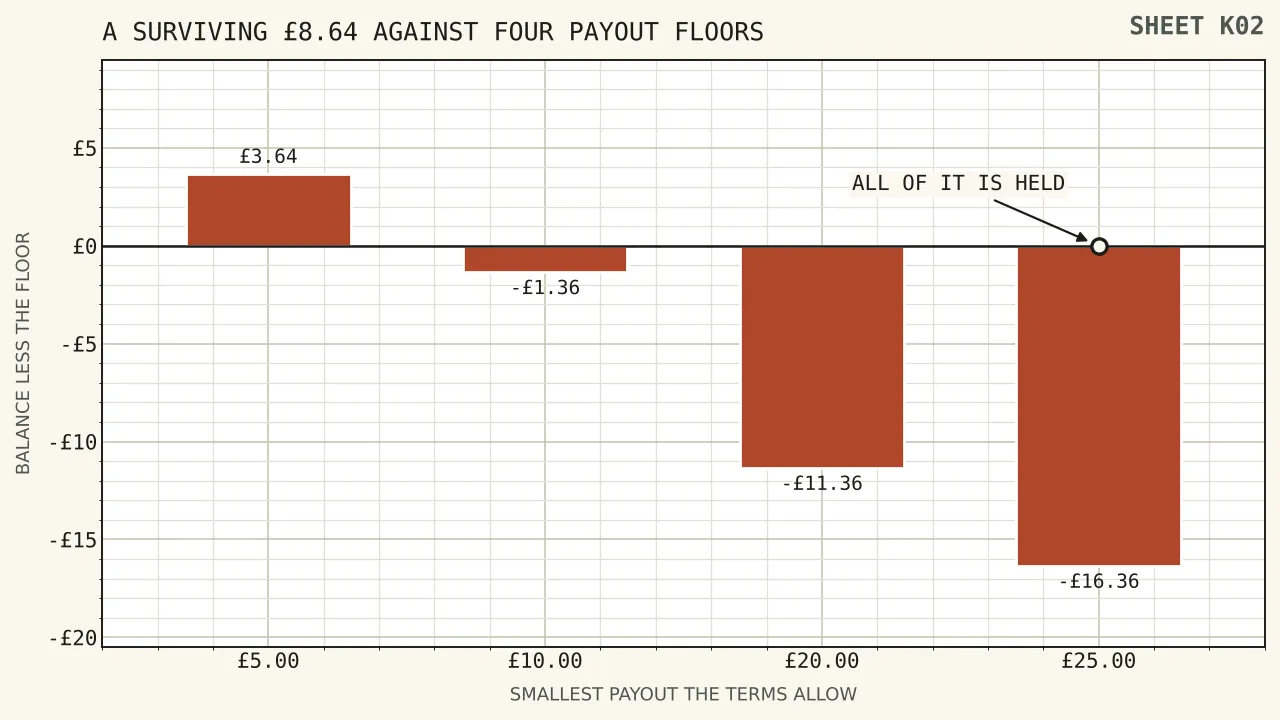
The lowest rung on this site’s assumed ladder is £10.00. Set a minimum payout there and the whole £8.64 is stranded, short by £1.36. Not some of it. All of it. A headline of 150 spins, carried through at the ceiling with nothing going wrong anywhere, ends as a balance nobody can collect and a gap too small to buy a rung with.
| Minimum payout | Balance of £8.64 | Short by |
|---|---|---|
| £5.00 | Collectable | £0.00 |
| £10.00 | Stranded whole | £1.36 |
| £20.00 | Stranded whole | £11.36 |
| £25.00 | Stranded whole | £16.36 |
Only the first row of that table collects, and no published rule sets any of the four. A minimum payout is a commercial choice, like the price of a spin, and it is chosen after the face has been advertised. What is published is the other side of it: where a British licence applies, no lid may be put on what leaves a deposit balance, and the barred example in the guidance pairs a daily figure with a weekly one. A floor and a lid are different animals, though, and the floor is the one that strands £8.64.
Staking the balance does not close a gap of that shape. £8.64 put through the reels once costs 35p in expectation, and put through ten times over it costs £3.46. Attempts never raise an expectation, because the sign on the house edge does not change with how many of them there are. Variance alone crosses a floor, and variance sells at fourpence a pound.
Depositing across the gap inverts the entire exercise. £1.36 is what the floor wants. £10.00 is the smallest thing the ladder sells. Buying that rung to release £8.64 puts £10.00 of real money at a four per cent edge in order to collect a credit that arrived as a free headline, which is the residue of this page stated as a transaction.
One British rule holds that exit open, and it deserves stating alone because it is the one a reader would never think to ask for. No licensed system may offer to undo a withdrawal request after the asking, nor may the same money be re-presented to the reader as a deposit. A cashier with no licence above it may put a cancel button exactly where somebody will find it on the way to bed, and nothing published objects.
8
Who a free headline is aimed at
Among the groups the regulator’s notice of 20 January 2025 says these websites often aim at are people who have already stopped by registering with the scheme. A credit with nothing to pay for it is the least expensive approach anybody can make, which is why it is the one that gets made.
So put the two figures side by side. On one side, a headline of 150 spins, worth £8.64 in expectation at the ceiling and nothing at the multiple this part of the market actually writes, stranded in full under a £10.00 floor. On the other, a registration that cannot be ended early and does not expire by itself. The exchange rate is the argument of this entire note.
The regulator’s January 2025 notice to the industry puts four more things on the record about websites of the kind, and this page prices none of them, because none of them can be priced from anything published. A page that invented a figure for them would deserve no trust for the figures it can stand behind.
| On the record | Priced here? |
|---|---|
| Social responsibility controls | No published figure exists |
| Anti-money-laundering controls | No published figure exists |
| Fraud and data privacy | No published figure exists |
| Unfair practice | No published figure exists |
| Self-excluded customers targeted | The offer is priced, the harm is not |
Help costs nothing and carries no denomination. The helpline GamCare runs picks up round the clock and round the calendar, and the caller may be ringing about somebody else entirely; a referral from a professional needs that person’s consent. GamCare states as well that what it publishes is not intended for anybody under 18, which is a reminder of who else reads a page like this one.
Software that blocks is the other half of it, covering what no register touches. One licence installs on every major platform a household runs, and the block list runs to tens of thousands of gambling addresses, apps included. GamCare, not the software’s maker, is who publishes the free British way in, and the name on it is TalkBanStop. The maker’s own pages carry a seven day trial, with one free route named for Ohio residents and none named for Britain.
One figure belongs beside the free things, because it is the only one on this note with any power to improve a reader’s position. A call costs nothing and the arithmetic of it is unanswerable: against £8.64 of credit that cannot be collected under a £10.00 floor, and nothing at all at the multiple this market writes, an hour spent on the telephone has an expected value that no reel on any licence can match.
A closing honesty, because a page painting the offshore side as lawless deserves to be disbelieved. A complaint may be lodged there inside six months, answered inside four weeks, with four weeks more available where written notice is given, and dispute resolution there is compulsory, with the operator paying. The thing that rulebook has no counterpart for is a ceiling on a multiple, and that ceiling is the single term deciding whether £8.64 exists at all.
Questions
- How much is a no deposit bonus of 150 spins worth?
- Put a spin at 10p with 96 per cent returned and the face is £15.00, while the credit averages £14.40, so 60p of the headline is gone before any term applies. Ten turnovers charge £5.76 more and leave £8.64. Forty turnovers charge £23.04, which finishes the credit and runs £8.64 beyond the end of it.
- Is any wagering ceiling in place away from the British licence?
- None that could be sourced for this note. A ceiling of ten turnovers on bonus funds rides on a Great Britain operating licence, in place from 19 January 2026 onward, with two licence types excepted: technical for gaming machines, and software. Version 1.0 of the Curacao responsible gaming policy of 21 February 2025 puts nothing in its place: two lines on bonuses, neither carrying a number.
- Does the ceiling cover free spins themselves?
- Not stated either way, and this note leaves the gap where it found it. Bonus funds are the ceiling’s subject. Credit what a spin wins as bonus funds and ten turnovers caps what may be asked of them. Whether a spin handed over is itself bonus funds has never been published, and neither has the answer for an obligation written across a deposit and a bonus at once.
- What is stranded when everything goes right?
- All £8.64 of it. That is what a £15.00 face leaves after the house edge and a ten times obligation, and against a £10.00 minimum payout it is £1.36 short, so none of it comes out. The gap is too small to buy the bottom rung of a prepaid ladder, and staking the balance cannot lift its expectation.
- How long does an obligation like this take?
- Turn the staking into presses. £144.00 at 10p is 1,440 of them and £576.00 is 5,760. Against a 2.5 second floor, which a licensed reel keeps, 5,760 presses runs to 14,400 seconds: four hours at one sitting, or 34 minutes 17 seconds a day across a week. That floor is absent off the register, so the same obligation clears faster.
- Can a free credit be called free?
- Not where the customer’s own stake is what qualifies them, which is the advertising regulator’s advice and not a preference of this site’s, and pairing the idea of risk with the word free is out unless losing their own funds is impossible. A credit needing no deposit passes at the door. The obligation behind it is where a reader’s own money arrives.
- What stops a cashier changing the terms mid-game?
- At a licensed one a technical standard does: rules, payouts and outcome probabilities are not to be altered mid-play, with any change surfaced to the customer. Wording that reserves a change to the rules at any moment is named in the guidance as unacceptable. Away from the licence, nothing published objects to wording of that kind.
- Why are these offers aimed at people who have self-excluded?
- Because an approach costing nothing to make is the cheapest one going. Self-excluded customers are named among the people such websites often aim at in a notice the regulator issued on 20 January 2025, which also records social responsibility and money-laundering controls that may fall short, along with fraud, data privacy and unfair practice as exposures.
- What should I do instead?
- Ring the helpline GamCare runs: free, any hour, any day, about yourself or about somebody else. Put blocking software on the devices in the house, which reaches sites no register touches. Leave the self-exclusion registration alone: it cannot be ended early and it does not lapse on its own. GamCare publishes the free British route to all three under the name TalkBanStop.