Note F01 Revision 1 Terms read 16 October 2026
Free spins no deposit: what a count of spins is worth in pence
A hundred spins priced at 10p is a face of £10.00. Take the four per cent house edge off and £9.60 is the whole of what that count averages, before a single term has been read. A ten times play-through then takes £3.84, and the £5.76 left over meets a withdrawal floor it cannot reach. Here is every step of that, costed.
The face £10.00 What draws it down £4.24 What is stranded £5.76
What a face of this size is worth
Every destination on this rack is bought advertising. The site takes a fee if a reader goes on to register, and no figure printed below moves because of it.
Face and Residue
Strip No 01
Betportal
Ceiling as a multiple
Priced at this site's own 10p a spin
What is printed
What draws it down
What is stranded
No Great Britain licence
Licensed in Anjouan, Comoros, run by BetPortal Gaming Ltd, with Excite Ultra Media Ltd, reference ALSI-202601040-FI2.
Terms read 16 October 2026
Open the offer at Betportal, opens in a new tabFace and Residue
Strip No 02
WinBeast
Ceiling as a sum
Priced at this site's own 10p a spin
What is printed
What draws it down
What is stranded
No Great Britain licence
Licensed in Curaçao, operator not named on the site.
Terms read 16 October 2026
Open the offer at WinBeast, opens in a new tabFace and Residue
Strip No 03
EliteSpin
Longest spin window
Priced at this site's own 10p a spin
What is printed
What draws it down
What is stranded
No Great Britain licence
Licensed in Costa Rica, run by PrimeTier Limited.
Terms read 16 October 2026
Open the offer at EliteSpin, opens in a new tabFace and Residue
Strip No 04
Crown Jewelz
Multiple unpublished
No residue struck
What is printed
What draws it down
What is stranded
No Great Britain licence
Licensed in Curaçao, number not verified, operator not named on the site.
Terms read 16 October 2026
Open the offer at Crown Jewelz, opens in a new tabThe two figures in the second and third registers are this site's own arithmetic and nothing an operator has published: the face as printed, less the share a spin gives back at 96 per cent return to player, less what playing the wagering through costs at the same return, and then less whatever a published ceiling, a charge on the way out or a floor on the smallest withdrawal takes off what survives that. The residue is what is left of the face when all of it is accounted for. It describes the offer, not one reader's afternoon. Where the conditions price above the face the strip prints nothing coming off rather than a negative sum, and where a figure the sum needs is unpublished it prints the condition in the operator's words instead.
A face paid as spins has no unit of its own, so one is supplied. Where an operator publishes what a spin of its own is worth, that figure stands in the first register's own line and is labelled as theirs. Where it does not, this site's own 10p a spin stands there and says so, and every figure below moves in proportion: at half the price, half the money. The share of the face that does come off is also given as pence in the pound, which is the figure that compares a large face against a small one.
Money goes onto a prepaid voucher in fixed denominations, so a smallest deposit published in pounds is rounded up to the first rung of the ladder this site works in, £10, £20, £25, £50, £75 and £100, and the strip prints what that rounding strands. That is the reader's own money and it is never netted into a residue. A smallest deposit published in euros is printed as the operator publishes it, because the ladder here is a sterling one and rounding a euro sum to it would be an invented figure.
Three words stand in the amount column where no figure can. Noted is a published condition that takes value away without leaving the sum a figure to take. Unpriced is a condition whose figure nobody has published, or a credit that is not a sum until a deposit of your own sets it. Own money is money of yours, which is never part of a residue.
Not one of the operators printed above holds a Great Britain licence, so the duties that licence carries do not reach them. All online gambling companies licensed in Great Britain must be part of Gamstop Online, and a reader who has shut themselves out through the scheme is therefore not shut out here. The ceiling of ten times the bonus funds on a wagering requirement, in force since 19 January 2026 under Social Responsibility Code 5.1.1, is a condition of that licence and binds the companies that hold one. On an unlicensed site the Gambling Commission describes consumers as facing unfair gaming practices, financial loss and a lack of recourse if things go wrong, and it names blocked payouts and withdrawal limits set so high they are unattainable among what it has seen. Nobody under 18 may hold an account at any of them.
Every term printed on a strip is the operator's own, and each strip carries the day it was read. The oldest of those readings is 16 October 2026. What binds a reader is the operator's own full terms, and not a line printed here.
1
Three numbers turn a count into money
A headline reading 100 spins and nothing else is not a sum of money. It is one figure out of three, and the other two decide nearly everything. Second comes what a single spin costs. Third comes how much of a stake a game gives back. With either missing, a count is a promise carrying no denomination, which is the one condition a prepaid instrument exists to prevent.
Take the second number first, because it is the one a reader almost never gets. Nothing in the regulator’s published rules fixes what a single spin is worth. There is no minimum, no maximum and no required disclosure of the figure as a figure. The value is set by whoever writes the promotion, and the only sourced things that bear on it are the duty to make the chance information available before a customer commits, which is RTS requirement 3C, and the duty under Social Responsibility Code 5.1.1 to set clear, transparent and fair terms and to make them easy to reach.
So this site fixes the figure and says so. A spin costs 10p throughout. That is an assumption, held across every page here so one page’s arithmetic can be set beside another’s, and it is no sort of market finding. The third figure is fixed the same way at 96 per cent, which is to say 96p back for every pound put through a game.
With those two in place, the count becomes money in one multiplication. A hundred spins at 10p is a face of £10.00. Multiply by 0.96 and the expected winnings are £9.60. Forty pence of the face has gone, and it has gone before any term in the promotion has been read. That 40p is the first residue on this page and the only one that is certain in advance.
| Spins | Face at 10p | Averages |
|---|---|---|
| 5 | £0.50 | £0.48 |
| 10 | £1.00 | £0.96 |
| 20 | £2.00 | £1.92 |
| 25 | £2.50 | £2.40 |
| 40 | £4.00 | £3.84 |
| 50 | £5.00 | £4.80 |
| 70 | £7.00 | £6.72 |
| 100 | £10.00 | £9.60 |
| 150 | £15.00 | £14.40 |
| 200 | £20.00 | £19.20 |
| 1,000 | £100.00 | £96.00 |
Read down that right-hand column and the headline loses most of its drama. A thousand spins, which is the largest count a promotion of this shape tends to advertise, averages £96.00. Five spins average 48p. The counts are a thousandfold apart and the arithmetic is identical, which is the useful thing about doing it this way: once a count is turned into a face, every offer in the category can be compared on one scale.
One caution belongs here rather than later. In the regulator’s own guidance the 96 per cent is an average theoretical return, the long-run behaviour of a game’s design. Across 100 spins the realised figure scatters widely either side, and most of the scatter falls below, because the large outcomes that hold the average up are rare. So £9.60 is the mean of a lopsided spread rather than a typical result, and the commonest outcome on 100 small spins lands under it.
A percentage need never appear on a licensed site at all. RTS requirement 3C names four things and joins them with or. One: how a game works, and how winners and prizes get settled. Two: the margin, or the house edge. Three: the return to player. Four: the chance of a winning event occurring. Any single item satisfies it, so silence about the percentage is no breach of itself.
2
The four pence in every pound
The gap between £10.00 and £9.60 is four pence in the pound. That proportion drives everything after it, and precision about what it attaches to matters more than anything else here. It is not deducted from the face once and left alone. It comes off every pound that goes through a game, however often the same pound goes round.
On the face alone the arithmetic is small. A 25 spin count strands 10p. A 50 spin count strands 20p. Two hundred spins strand 80p. A thousand strand £4.00. Nobody writes a page about 10p, and that is precisely why the figure matters: it is the unit the play-through multiplies. Attach a requirement to stake the winnings forty times over and the same four pence is charged forty times, which turns a 40p residue into a £15.36 one on the same £10.00 face.
Here is the mechanism in a single line, with the numbers already in it so there is no algebra to do:
£9.60 × 0.04 × 40 = £15.36 of expected cost on a £9.60 credit
Once the multiple passes 25, the expected cost of clearing a requirement is larger than the credit it hangs on. Twenty-five is no market convention. Twenty-five is the reciprocal of 0.04, and at a 96 per cent return 25 is where expected survival reaches £0.00 exactly. Under it, something is left. Over it, the arithmetic has finished the credit and started on money the reader has put in.
That single number is the most useful thing on this site, so it is worth stating in the other direction as well. If a game returned 98 per cent the edge would be two pence and break-even would sit at 50. At 90 per cent the edge is ten pence and break-even falls to 10. The ceiling a regulator writes and the return a game is built to pay are therefore two halves of one figure, and neither means much on its own.
Every figure from here on is worked at the fixed assumptions: 10p a spin, 96 per cent returned, no game weighting, and a multiple stated wherever one is used. Where a page here deviates from any of those, it says so in the sentence that does the deviating.
3
What a play-through takes away
Here is the regulator’s definition: wagers totalling a stated value, due before funds turn withdrawable. No judgment on the value is passed in it. What it records is the obligation, which is to send money round a game again and again, paying 4p in the pound on every circuit.
Great Britain caps the multiple at ten. On a £9.60 credit that is £96.00 of turnover and nothing beyond it, a ceiling written at limb 3(a) in Social Responsibility Code 5.1.1 and biting from 19 January 2026 onward. Scope: all licences, the gaming machine technical and software ones excepted. On 31 March 2026 the register held 3,097 licensed activities across 2,154 licensed operators, and every remote casino licence among them sits inside the ceiling.
Two things about that ceiling need saying plainly, because a page omitting either one misleads. First, what it was fixing: up to 60 times was being applied by some licensees, and that figure is the Commission’s own. Second, a gap, reported here and not closed. The ceiling’s subject is bonus funds. Credit a spin’s winnings that way and ten times binds them. Is a spin itself bonus funds? No primary source says, so neither does this page, in either direction.
Now the arithmetic, on the £9.60 the hundred spins average. Required turnover is the multiple times the credit. Expected cost is four per cent of that turnover. What survives is the credit less the cost.
| Multiple | Reading | Turnover asked | Cycles at 10p | Expected cost | Survives | Stranded off £10.00 |
|---|---|---|---|---|---|---|
| None | Cash as credited | £0.00 | 0 | £0.00 | £9.60 | £0.40 |
| 5 times | Four fifths kept | £48.00 | 480 | £1.92 | £7.68 | £2.32 |
| 10 times | The British ceiling | £96.00 | 960 | £3.84 | £5.76 | £4.24 |
| 20 times | One fifth kept | £192.00 | 1,920 | £7.68 | £1.92 | £8.08 |
| 25 times | Zero, precisely | £240.00 | 2,400 | £9.60 | £0.00 | £10.00 |
| 40 times | £5.76 beyond zero | £384.00 | 3,840 | £15.36 | £0.00 | £10.00 |
| 60 times | £13.44 beyond zero | £576.00 | 5,760 | £23.04 | £0.00 | £10.00 |
That last column is the residue, measured against the printed face of £10.00 and not against the £9.60. At ten times, £4.24 of a £10.00 headline was never coming off. At twenty times, £8.08. From 25 upward the entire face is stranded, and the reading column says how far beyond zero the requirement has carried. Forty times is the assumption held across this site, and it is the multiple a cashier outside the British licence remains free to write: there, the obligation runs £5.76 heavier than the credit fastened to it.
Negative survival does not mean a reader finishes £5.76 down on money they never had. It means something plainer and worse. The requirement cannot be completed out of the credit, so either the play stops part way and the credit is lost, or it continues on the reader’s own money, and the four pence in the pound keeps being charged on that too.
Game weighting makes the same point from a different direction, and the figure for it comes from the Commission’s own consultation page rather than from this site. A respondent there described a game counting at 30 per cent, so each pound staked contributes 30 pence towards the requirement. Apply that to a ten times requirement and the effective multiple is 33.33, which is past break-even. The ceiling holds at ten and the arithmetic does not.
A 30 per cent weighting turns ten times into 33.33 times
4
The hours buried in the turnover
Turnover is money, but it is spent in units of time, and the time is the cost nobody prices. At 10p a spin, £384.00 of required turnover is 3,840 spins. That is the figure to hold on to, because it converts straight into minutes.
A published floor exists on the licensed side under how fast a slot may run. RTS requirement 14D puts 2.5 seconds there, measured from one game cycle starting to the moment the next may. It also wants a start control let go and pressed again, or something equivalent done, so holding a button down cannot begin a cycle. No commencement date appears on that standard, and none is claimed here.
Multiply out and the hours appear. At 2.5 seconds a cycle, 3,840 spins occupy at least 9,600 seconds, which is 2 hours and 40 minutes of continuous play. Nothing in that figure allows for reading a screen, choosing a game or stopping to think.
| Multiple | Turnover | Spins at 10p | Seconds at the floor | Shortest sitting | Expected pay per hour |
|---|---|---|---|---|---|
| 5 times | £48.00 | 480 | 1,200 | 20 minutes | £23.04 |
| 10 times | £96.00 | 960 | 2,400 | 40 minutes | £8.64 |
| 20 times | £192.00 | 1,920 | 4,800 | 1 hour 20 minutes | £1.44 |
| 25 times | £240.00 | 2,400 | 6,000 | 1 hour 40 minutes | £0.00 |
| 40 times | £384.00 | 3,840 | 9,600 | 2 hours 40 minutes | £0.00 |
The last column divides what survives by the shortest time in which the requirement could be met. At five times a reader is working for £23.04 an hour in expectation, which looks like something. At ten times it is £8.64 an hour. At twenty times it is £1.44 an hour. At the house assumption of forty times it is nothing an hour, for 160 minutes, and the arithmetic has been against the reader the whole way.
Two further published rules hold that floor in place wherever a British licence applies. Autoplay is unavailable for online gaming. RTS requirement 8A asks for each game cycle to be committed to singly, and its guidance carves out one thing alone, blinds posted automatically at peer-to-peer poker. Hurrying a result is out as well. Turbo, quick spin, slam stop: the guidance to RTS 14E names all three as impermissible.
Neither a minimum cycle, nor an autoplay ban, nor any limit on hurrying a result turns up in the responsible gaming rulebook Curaçao publishes for its own licensees. Version 1.0 of that document, dated 21 February 2025, sets out eight mandatory areas and includes not one of the three. So the 3,840 spins can run as fast as the software manages. Identical money, fewer hours, and that reads as an improvement while being its reverse: the floor is there to put a gap between one decision and the next.
5
A stake cap, a conversion ceiling, a clock
Three further terms do the stranding on offers of this shape, and each works in a different way. One limits the stake while a requirement is being cleared. One limits how much of the result can ever become cash. One limits the time available to do any of it.
No primary source publishes a distribution of maximum stake terms across this market, so the figure used here is declared as a modelling assumption and nothing more: a cap at a tenth of the credit, with a 10p floor under it. On a £9.60 credit that is 96p a spin. At 96p a spin, £384.00 of turnover is 400 cycles rather than 3,840, so the cap compresses the time to 1,000 seconds. What it also does is fix the minimum number of decisions a reader must make, and a cap set at the spin price itself removes that compression entirely.
A licensed slot carries a stake ceiling of a different origin, owing nothing to any bonus term. Under the 2025 amendment regulations, £5 is the cap on the total staked in a single game cycle, falling to £2 where the player has not reached 25. The Commission’s guidance dates the £5 figure to 9 April 2025 and the £2 figure to 21 May 2025, and confines the pair of them to online slots: roulette and blackjack sit outside both.
A conversion ceiling is the second term, and the one most often confused with something else. A standard maximum win on bonus money is nowhere published, so no figure for it appears here as a market fact. What can be stated exactly is how such a ceiling sits beside the deposit-balance rule. One term is barred outright: a cap on withdrawals from a deposit balance. The prohibited example names £50 a day beside £500 a week, which is a £26,000 annual lid on money already the player’s. Bonus winnings sit in a separate box. Cap that box, leave the balance open, and both statements hold together; merging the two is an error.
Priced on the face of this page, a conversion ceiling of £50.00 against an expected £5.76 strands nothing in expectation at all. The mean is nowhere near it. What the ceiling removes is the top tail, which is the only part of the distribution that ever repays 160 minutes. The expectation is unchanged and the reason for playing has been deleted, which is a kind of residue the arithmetic alone will not show.
The clock is the third term. Suppose the requirement is £384.00 of turnover and the window is seven days. That is 3,840 spins across the week, 9,600 seconds at the published floor, and 22 minutes 51 seconds of unbroken play every single day. Compress the window to 24 hours and the same obligation becomes one sitting of 2 hours 40 minutes. Nothing about the money changed. The clock decided whether the obligation was reachable.
All three are conditions the advertising regulator wants shown, not buried. Non-broadcast rule 8.17 is the provision. Significant conditions, clearly and prominently, in any case where an omission misleads: that is the ask. Four kinds sit on the worked list. A time limit for claiming or for using the offer. A requirement to deposit or to wager. An eligibility restriction, such as new customers only, an age or a location. A minimum odds or bet type. Online, the full terms belong a click away from the advertisement, and the link to them does not belong in a footer.
Three published rulings sit behind that. SP Graham Retail Ltd, on 27 August 2025: a £5 free bet voucher carried no mention of 14 March, the Cheltenham Gold Cup’s day, on which it did not work, and the code was found breached. WHG (International) Ltd, trading as William Hill Online, 31 July 2024: an excluded payment method sat in the full terms, and that counted as a significant condition shown with too little prominence. Geoff Banks Online is the trading name of GB Sports Advisors Ltd, and the date is 17 July 2024: £10 of free bet, a deadline for answering a text message, an advertisement silent on the deadline.
Forfeiture is the fourth term and the bluntest, and a penalty figure now sits behind it. The fine: £170,000. The date on the decision: 3 July 2025. The operator: Taichi Tech Limited, trading as Fafabet. The wording lived in the bonus rules covering its new casino promotions, and it reserved a discretion to shut an account or take winnings back. The outcome: the fair and open licensing condition breached; transparency said to be lacking; unfair outcomes said to be possible; an independent third-party audit required over anti-money-laundering and safer gambling controls. Nowhere does the published material call a clause of that shape void, and neither does this page.
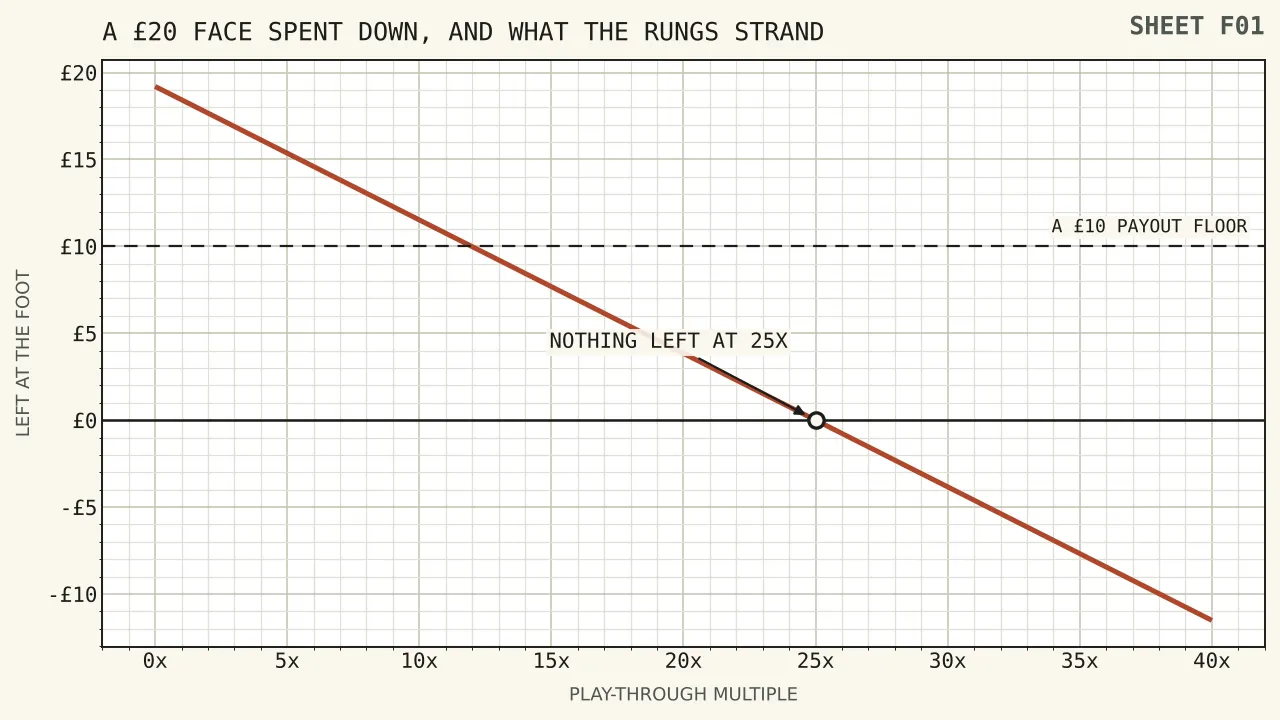
6
The floor the survivor cannot reach
Suppose everything above has gone as well as it can. A hundred spins were credited, nothing was forfeited, the multiple was the British ceiling of ten times, and £5.76 came through the far side. That figure is now a balance. What it is not yet is money a reader can have.
Prepaid instruments move in fixed denominations, and the ladder assumed on this site runs £10, £20, £25, £50, £75 and £100. Where a cashier sets its minimum payout at the lowest of those rungs, the floor is £10.00. Against a balance of £5.76 that floor strands the whole of it. Not part of it: all of it. The residue of a hundred free spins, after a clean run through a ten times requirement, is £5.76 of unreachable balance and a £10.00 line it is £4.24 short of.
Whether playing on closes the gap is the next question, and the arithmetic answers flatly. 4p is the expected cost of each £1.00 sent through a 96 per cent game. So £5.76 once over costs 23p, and £5.76 ten times over costs £2.30. No quantity of staking lifts an expectation, because the sign on the edge never turns. Variance alone crosses the gap, and the expected price of asking variance for £4.24 is 4p on every pound put at it.
£5.76 held under a £10.00 floor, £4.24 short, with no expectation that closes it
The other route is to put money in, and the rung ladder has a second bite waiting there. A reader needs £4.24 to cross the line. The smallest denomination available is £10.00. Buying it leaves £5.76 of the purchase surplus to the purpose, which is a residue of exactly the size of the balance it was bought to release. That symmetry is a coincidence of the figures on this page, but the shape of it is not: a ladder with a £10.00 bottom rung cannot be asked for £4.24, ever, by anybody.
Several rules hold the exit open on the licensed side. RTS requirement 14B takes away the option of cancelling a withdrawal request. Two things come with it in the guidance: funds once requested are not to be offered back for depositing, and friction in the process is to be kept down. Nothing may restrict the maximum taken out at any one time. Reasonableness governs a limit on size or on frequency. And identity information may not be demanded at the exit as a condition of it, where there was an earlier chance to ask.
The regulator has named the failure modes itself. A blog post of 21 October 2025, by its Director of Enforcement and Intelligence, lists three things unlicensed sites often go without: age verification, responsible gambling tools, secure payment systems. For a consumer the post gives unfair gaming practices, money lost, and no recourse. Two further mechanics appear in the post: payouts blocked, and a withdrawal limit pitched high enough to be unreachable. Set a floor above any plausible balance and a face is stranded with no refusal ever issued.
7
What signing up asks before anything is credited
A face with nothing deposited behind it still has an entrance, and in Great Britain a lock sits on it. Licence condition 17.1.1 puts the obtaining and verifying of identity ahead of any gambling at all, and fixes three items as a floor: a name, an address, a date of birth. The condition page shows no effective date.
That lock reaches this page’s subject head on, which makes it the sharpest line of comparison between a licensed sign-up and an unlicensed one. Verification of name, address and date of birth comes ahead of any gambling, on the Commission’s own announcement of the rules. The age check was carried across to play with a bonus or a free bet, not left to apply only to a customer’s own stake, and carried across again to reaching free-to-play versions of games. Before all that, 72 hours were allowed for an age check to be finished. The article is dated 7 February 2019 and gives commencement as 7 May with no year attached, and its own date leaves 7 May 2019 as the one available reading.
So a hundred spins reach no British licensed account until the documents clear, and the £9.60 of expectation does not exist before then. What a reader gets in exchange is a bar at the far end. A demand for information triggered by a withdrawal request is not allowed where the licensee had a reasonable earlier chance to ask, the exception being information some other legal duty requires at that moment.
A second duty at the entrance costs an operator money and deserves a reader’s attention. RTS requirement 12A wants easily reachable facilities on the system, so a customer can fix limits of their own from registration forward, and a prompt at registration or else at the first payment in. A limit then becomes the default under RTS 12E: declining has to be a deliberate act, and a confirmation that none is wanted has to arrive before play or a deposit proceeds.
The shape is specified as well. Not a menu of the operator’s devising but a free text box, or its telephone counterpart. Account level at the least. Gross deposit limits carried as prominently as any other kind, with the phrase deposit limit reserved for a limit that genuinely restricts what goes in across a period. Three durations have to be on offer, which the standard puts as 24 hours, 7 days and 1 month. Set two at once and the tighter one wins: a worked example pairs a daily £10 with a weekly £100 and gets £10 a day and £70 a week out of them.
Those two directions move at unequal speeds, which is the detail with most in it. Downward is immediate, barring a technical failure. Upward waits three steps: the request, then 24 hours at the least, then a positive act by the customer confirming it. A prompt every six months to look over one’s own account and transactions is required as well, on any account active inside a rolling twelve months, with more frequent reminders on offer.
On one of those points the offshore comparison runs the other way, and saying so is part of doing this honestly. Reducing a deposit limit under the Curaçao policy takes effect at once; raising one waits seven days. Seven days is the longer brake, and 24 hours is the British figure. Where that rulebook is thinner is the entrance. Until the operator is satisfied the player has reached 18, nothing goes in and nothing is wagered. A date of birth is confirmed at registration. Where it can be managed, so are three more things: open source checking, a tick box, a payment method. Government-issued identification waits for the later anti-money-laundering milestones, arriving sooner only where age is already in doubt. So a face can be credited and played with no document seen, and the check waits at the exit instead.
8
Costed with no British licence behind it
A face of this shape is printed where no Great Britain licence is held. That sentence is not a warning label. It is a price, and this part sets out what the price is made of. Each item below is a duty fastened to the holder of a British licence. Nothing below binds an operator holding no British licence, and the rulebook Curaçao publishes carries none of it.
Take the figures this page moves first. Ten times, rather than whatever multiple a cashier cares to write, which on a £9.60 credit decides between £5.76 and nothing. A £5 cycle cap on online slots, £2 under the age of 25. The 2.5 seconds that make 3,840 spins into 160 minutes rather than into whatever the software can do. Autoplay: unavailable. Turbo and slam stop: unavailable. A return at or beneath the stake: not celebrated. Several games at once: not offered. Near-miss substitution: prohibited by name in RTS 7C, alongside simulations of real devices built on probabilities the real device does not have.
Then the ones deciding whether money moves at all. Cancelling a withdrawal request, once it is made, cannot be offered. Capping a deposit balance on the way out is not allowed. Identity is settled ahead of all play, bonus and free-to-play included. Credit cards are no longer a way to pay for gambling, and that has held since 14 April 2020. A credit-card payment going via a money service business is caught too. Limits on money in: prompted, defaulted, slow to loosen. Light-touch financial vulnerability checks sit over a monthly net deposit threshold. £500 a month was the opening figure, from 30 August 2024, which is about £16.44 a day. From 28 February 2025 the threshold became £150 a month, or about £4.93 a day.
Then the ones governing what happens once something has gone wrong. Three working days to acknowledge a complaint, falling to 24 hours at an operator whose gambling runs at any hour. The whole process, internal escalation included, finished 56 days from receipt, which is the eight weeks the code provision gives. Six months from an incident is the least a term may allow for complaining at all. A closing letter giving the decision, saying the operator’s own process has finished, and setting out what comes next. The route onward runs to an alternative dispute resolution entity carrying the Commission’s approval, and eight of those are named on the published list. Five are listed for remote in all sectors: IBAS, eCOGRA, ADR Group, Blexr Limited and the Centre for Effective Dispute Resolution. ProMediate and Tattersalls Committee are shown across all sectors in the table, although the latter’s own entry names betting alone. Remote casino carries no entry for Pegasus ADR Service at all.
Last, the one with no money in it. Membership of Gamstop Online is a requirement on every online gambling company that holds a British licence. The licence is what puts a company in. Figures published on 16 July 2026: registrations 614,738; growth 16 per cent across the half year; 12,236 in May 2026, a record month. Its terms state the limit squarely. Exclusion reaches participating operators and stops there, and preventing access to services run by non-participants is beyond what the scheme can do. Absent a British licence, a site is outside it by construction. That is all the absence means, and all of it is enough.
Two things need saying against the easy version of all this, and both are sourced. First: offshore, a complaints route can exist. Curaçao’s player complaints policy gives six months from an incident, at no charge. Four weeks to answer, with one further four weeks on written notice: 56 days in all there too. Alternative dispute resolution is compulsory under it, costless to the player, and paid for by the operator. Authorship is where the difference lies. That policy openly contemplates parameters being fixed by the operator. Two of them: whether an outcome binds the player at all, and whether some floor on claim value has to be cleared first.
Second: the British regulator recovers no money either. Not an ombudsman, in its own words, with no power to settle a gambling complaint and none to get a consumer’s money back. A withdrawal, or a technical fault inside a game, is explicitly outside what it can resolve.
Tax has one precise thing in it and one vague thing to keep out. The precise thing: the duty follows a customer’s usual residence rather than an operator’s licence, so British gaming duty reaches an offshore cashier taking a British player’s money whichever register it is missing from. Remote gaming duty charges 40 per cent. That rate started on 1 April 2026. Before it, 21 per cent for seven years. Before 2019, 15 per cent. The vague thing to keep out is any suggestion that winnings have been declared free of tax. HMRC’s published line is narrower and answers a question about trade rather than imposing a charge. Betting and gambling, on that line, are not of themselves a trade. Nothing on this page is tax advice.
Nor is a familiar game evidence of any of it. One industry warning notice, dated 20 January 2025, recorded games from licensed suppliers appearing on unlicensed websites. Those sites, on that notice, may hold inadequate controls over social responsibility and over anti-money-laundering, and may expose a customer to fraud, to problems with data privacy, and to unfair practices. Nor is that theory. Evolution Malta Holding Limited: £4.75m, agreed 23 July 2026. Six unlicensed websites, reachable from Great Britain, were carrying its games, and visits ran at large volumes from December 2023 onward. A logo on a reel that a reader recognises says nothing at all about the licence behind the cashier.
Questions
- How much is 100 free spins actually worth?
- Worked at this site’s fixed assumptions, a 10p spin and 96 per cent returned, 100 spins is a face of £10.00 averaging £9.60. The house edge has taken 40p before any term applies. Attach a ten times play-through to the winnings and £3.84 more goes in expected cost, leaving £5.76. At forty times the expected cost is £15.36 and nothing is left at all.
- Why do you price a spin at 10p when no site says that is the value?
- Because nothing published fixes it. No rule sets a minimum or maximum value for a free spin and none requires the figure to be disclosed as a figure, so the value is a commercial choice by whoever writes the promotion. Rather than guess at a market average, this site states one assumption, 10p, and uses it everywhere so that one offer can be compared with another on the same scale.
- What is the highest play-through that still leaves anything?
- Twenty-five times, and at exactly 25 the answer is nothing. The figure is the reciprocal of a four per cent house edge, so at a 96 per cent return a credit’s expected survival falls to zero there. Below 25 something is left: at ten times it is 60 per cent of the credit, at twenty times 20 per cent. Above 25 the expected cost of clearing the requirement is larger than the credit it is attached to.
- Is the ten times limit the law everywhere?
- No. Ten times sits as a condition on a Great Britain operating licence, and the provision is limb 3(a) in Social Responsibility Code 5.1.1. In effect since 19 January 2026, it covers every licence except two kinds: gaming machine technical, and gambling software. Hold no British licence and the ceiling is not binding, and version 1.0 of Curaçao’s responsible gaming policy, dated 21 February 2025, carries no equivalent.
- Is a free spin itself bonus funds for that ceiling?
- Not published. The gap is reported here and not filled. Bonus funds are the ceiling’s subject, so crediting a spin’s winnings that way means ten times binds what was credited. Is a spin bonus funds on its own account? No primary source reached for this sheet says either way.
- How long does clearing a wagering requirement take?
- Convert turnover into cycles. £96.00 at 10p is 960 spins; £384.00 is 3,840. A licensed slot’s cycle has 2.5 seconds under it, from RTS requirement 14D, which puts 40 minutes behind 960 spins and 2 hours 40 minutes behind 3,840. Away from the British licence there is no such floor at all.
- What is stranded if everything goes right?
- On this page, £5.76. A hundred spins credited with no forfeiture, cleared at the British ceiling of ten times, leaves that much as a balance. If the cashier’s minimum payout is £10.00, which is the lowest rung on the denomination ladder used here, the balance is £4.24 short of the floor and the whole £5.76 is stranded. Playing on cannot close the gap, because every pound staked costs four pence in expectation.
- Can an operator take the winnings back?
- A penalty has been drawn by a clause of that shape: £170,000, on a decision dated 3 July 2025, against Taichi Tech Limited, trading as Fafabet. The bonus rules covering its new casino promotions reserved a discretion to shut an account or take winnings back. The Commission treated the fair and open licensing condition as breached, and said transparency was lacking and unfair outcomes possible. A fine is not a term struck down, so void is the wrong word for it.
- Do I have to verify my identity for an offer with no deposit?
- At a British licensed site, yes, and ahead of play rather than ahead of payment. Licence condition 17.1.1 has three items obtained and verified before any gambling happens: a name, an address, a date of birth. The age check carries over to play funded by a bonus or by a free bet, and over again to free-to-play versions of games. Curaçao ties full identity checking to later anti-money-laundering milestones instead, so a face can be credited there with no document seen.
- Are winnings from a no-deposit offer taxed?
- No source declares winnings free of tax, and nothing here is tax advice. HMRC’s published position concerns whether an activity amounts to a trade, and its answer is that gambling, as such, is not one. The charge sits with the operator, through a duty that follows a customer’s usual residence rather than an operator’s licence. On 1 April 2026 that rate became 40 per cent.