Note F04 Revision 1 Terms read 16 October 2026
Free daily spins: a face paid in 30 instalments of £1.00
Ten spins a day for a month is £30.00 of face at 10p a spin, and £28.80 of expectation. Collect on 22 days out of 30 and £8.00 of the face expires uncollected. A clock, not a ceiling, is what does the stranding here.
The face £30.00 What draws it down £12.72 What is stranded £17.28
What a face of this size is worth
Every destination on this rack is bought advertising. The site takes a fee if a reader goes on to register, and no figure printed below moves because of it.
Face and Residue
Strip No 01
Betportal
Ceiling as a multiple
Priced at this site's own 10p a spin
What is printed
What draws it down
What is stranded
No Great Britain licence
Licensed in Anjouan, Comoros, run by BetPortal Gaming Ltd, with Excite Ultra Media Ltd, reference ALSI-202601040-FI2.
Terms read 16 October 2026
Open the offer at Betportal, opens in a new tabFace and Residue
Strip No 02
WinBeast
Ceiling as a sum
Priced at this site's own 10p a spin
What is printed
What draws it down
What is stranded
No Great Britain licence
Licensed in Curaçao, operator not named on the site.
Terms read 16 October 2026
Open the offer at WinBeast, opens in a new tabFace and Residue
Strip No 03
EliteSpin
Longest spin window
Priced at this site's own 10p a spin
What is printed
What draws it down
What is stranded
No Great Britain licence
Licensed in Costa Rica, run by PrimeTier Limited.
Terms read 16 October 2026
Open the offer at EliteSpin, opens in a new tabFace and Residue
Strip No 04
Crown Jewelz
Multiple unpublished
No residue struck
What is printed
What draws it down
What is stranded
No Great Britain licence
Licensed in Curaçao, number not verified, operator not named on the site.
Terms read 16 October 2026
Open the offer at Crown Jewelz, opens in a new tabThe two figures in the second and third registers are this site's own arithmetic and nothing an operator has published: the face as printed, less the share a spin gives back at 96 per cent return to player, less what playing the wagering through costs at the same return, and then less whatever a published ceiling, a charge on the way out or a floor on the smallest withdrawal takes off what survives that. The residue is what is left of the face when all of it is accounted for. It describes the offer, not one reader's afternoon. Where the conditions price above the face the strip prints nothing coming off rather than a negative sum, and where a figure the sum needs is unpublished it prints the condition in the operator's words instead.
A face paid as spins has no unit of its own, so one is supplied. Where an operator publishes what a spin of its own is worth, that figure stands in the first register's own line and is labelled as theirs. Where it does not, this site's own 10p a spin stands there and says so, and every figure below moves in proportion: at half the price, half the money. The share of the face that does come off is also given as pence in the pound, which is the figure that compares a large face against a small one.
Money goes onto a prepaid voucher in fixed denominations, so a smallest deposit published in pounds is rounded up to the first rung of the ladder this site works in, £10, £20, £25, £50, £75 and £100, and the strip prints what that rounding strands. That is the reader's own money and it is never netted into a residue. A smallest deposit published in euros is printed as the operator publishes it, because the ladder here is a sterling one and rounding a euro sum to it would be an invented figure.
Three words stand in the amount column where no figure can. Noted is a published condition that takes value away without leaving the sum a figure to take. Unpriced is a condition whose figure nobody has published, or a credit that is not a sum until a deposit of your own sets it. Own money is money of yours, which is never part of a residue.
Not one of the operators printed above holds a Great Britain licence, so the duties that licence carries do not reach them. All online gambling companies licensed in Great Britain must be part of Gamstop Online, and a reader who has shut themselves out through the scheme is therefore not shut out here. The ceiling of ten times the bonus funds on a wagering requirement, in force since 19 January 2026 under Social Responsibility Code 5.1.1, is a condition of that licence and binds the companies that hold one. On an unlicensed site the Gambling Commission describes consumers as facing unfair gaming practices, financial loss and a lack of recourse if things go wrong, and it names blocked payouts and withdrawal limits set so high they are unattainable among what it has seen. Nobody under 18 may hold an account at any of them.
Every term printed on a strip is the operator's own, and each strip carries the day it was read. The oldest of those readings is 16 October 2026. What binds a reader is the operator's own full terms, and not a line printed here.
1
A face split into daily pieces
Every other page in this section prices a face that arrives in one piece. A daily offer arrives in instalments, and that one structural difference changes what the residue is made of. The ceiling matters less. The clock matters more. And the thing doing the stranding is not a rule at all: it is the calendar.
Start with the unit. Ten cycles at 10p is a daily face of £1.00. Apply the 0.96 return this site assumes everywhere and the day averages 96p. Four pence is the edge, and 30 days of edge comes to £1.20.
Thirty of those instalments is a face of £30.00 and an expectation of £28.80. That figure is worth holding on to, because it is larger than almost anything else in this part of the market, and a reader who sees 300 spins advertised as a monthly total is seeing an honest arithmetic total rather than an inflated one. What is not honest, or rather what is simply unstated, is how much of it survives contact with the terms.
£1.00 a day, 96p of expectation, £30.00 and £28.80 across a month
Three assumptions carry everything below and all three are declared. A cycle costs 10p. A game hands back 96p of each pound. Weighting counts a staked pound whole against any obligation. Where a figure here departs from those, the sentence doing the departing says so.
One more input needs fixing before the sums start, and it is the one that makes a daily offer different. Each instalment has its own window. This page assumes a 24-hour window on each of the 30 pieces, because that is what a daily offer means, and it prices what happens when a window closes on an uncollected instalment.
One ratio out of those two figures is worth keeping. Thirty windows of 24 hours is 720 hours of elapsed time, inside which 750 seconds of play is required, which is 12.5 minutes. So the play occupies 0.03 per cent of the period the offer runs for, and the other 99.97 per cent is the part the offer is really buying: 30 occasions on which a reader opens an account they would otherwise have left shut.
The structure to hold in mind is therefore a 30-row ledger rather than a single sum. Each row has a face of £1.00, an expectation of 96p, a window of 24 hours, and an obligation attached to whatever it produces. Thirty rows of that is not the same object as one £30.00 credit, and the rest of this page is about where the two part company.
2
What a missed day costs, day by day
A credit that arrives whole cannot expire in pieces. An instalment can, and that is the first residue on this page. Miss a day and £1.00 of face goes, along with 96p of expectation. Nothing is forfeited, nothing is clawed back, and no term has to be read: the window shut.
Attrition is the word for it and the arithmetic is linear, which makes it easy to price across any pattern of collection.
| Days collected | Face collected | Expectation | Face expired | Reading |
|---|---|---|---|---|
| 30 | £30.00 | £28.80 | £0.00 | A perfect month |
| 28 | £28.00 | £26.88 | £2.00 | Two days away |
| 25 | £25.00 | £24.00 | £5.00 | Five days away |
| 22 | £22.00 | £21.12 | £8.00 | Most weekends missed |
| 20 | £20.00 | £19.20 | £10.00 | Two thirds of the month |
| 15 | £15.00 | £14.40 | £15.00 | Half the face gone |
| 10 | £10.00 | £9.60 | £20.00 | A third collected |
Read the fourth column as the honest headline. A reader who logs in on 22 of 30 days, which is a realistic month for somebody with a job, has already lost £8.00 of a £30.00 advertisement before a single term has been applied to anything. At 20 days the loss is £10.00, exactly a third. At 15 days half the face has expired.
That is a different kind of residue from the ones on the other pages here, and it deserves saying plainly: it is not a trick. No ceiling held the money back and no clause forfeited it. The offer was constructed so that collecting all of it requires 30 consecutive visits, and the economics of the offer assume that most people will not make them. A reader comparing a 300-spin monthly drip with a 300-spin lump is comparing two quite different things, and the drip is worth less by whatever share of the days they will miss.
One asymmetry is worth noticing. The expired face is worth 96p a day to the reader and costs the operator nothing at all, because nothing was ever credited. So an uncollected instalment is the cheapest thing in the whole arrangement, and the arrangement is built to produce a great many of them.
£8.00 of a £30.00 face expired across 8 missed days
3
Twenty-five seconds a day, and then the obligation
Ten cycles is not a session. Under a British licence, 2.5 seconds has to pass before a slot’s next cycle may start, so 10 cycles occupy 25 seconds. That is the whole of what a daily instalment buys in time, and it is the reason a daily offer has to be built around a visit rather than around play.
Autoplay is not available for online gaming. Each game cycle gets committed to on its own under RTS requirement 8A, whose scope reads gaming, bingo included, and whose page was published on 2 February 2021 and updated on 21 January 2025. So 10 cycles is 10 decisions, and 300 across a month is 300 of them.
Then the obligation, which is where the minutes actually are. Ten times the expectation is the British ceiling, so £28.80 of expectation carries at most £288.00 of turnover. At 10p a cycle that is 2,880 cycles, and at 2.5 seconds apiece it is 7,200 seconds. Two hours, in other words, spread across a month as 4 minutes a day.
| Activity | Cycles | Seconds | Across 30 days |
|---|---|---|---|
| The spins themselves | 300 | 750 | 25 seconds a day |
| Ten times on the winnings | 2,880 | 7,200 | 4 minutes a day |
| Twenty times | 5,760 | 14,400 | 8 minutes a day |
| Forty times | 11,520 | 28,800 | 16 minutes a day |
Forty times is the assumed multiple for a cashier beyond the register, and the final row of that table carries the figure a reader should weigh. Eight hours of minimum play across a month, 16 minutes of it daily, fastened to a £30.00 face. The expectation at forty times is nothing whatever, because 40 is past the break-even multiple of 25, so the eight hours buy an expected £0.00.
Ten times is kinder and still sobering. Expected cost runs at 4p for each pound of turnover, so £288.00 costs £11.52 and £17.28 of the £28.80 lives. Divide £17.28 across two hours and £8.64 an hour is the rate, which recurs on every page here because 0.6 of 0.96 over a fixed cycle rate does not vary with the size of a face.
28,800 seconds of minimum play behind a £30.00 face at forty times
4
Whether yesterday’s balance is still there
Here is the question that decides whether a daily offer can ever produce money, and it is almost never answered in a headline. Does a day’s winnings join a balance that persists, or does each day stand alone?
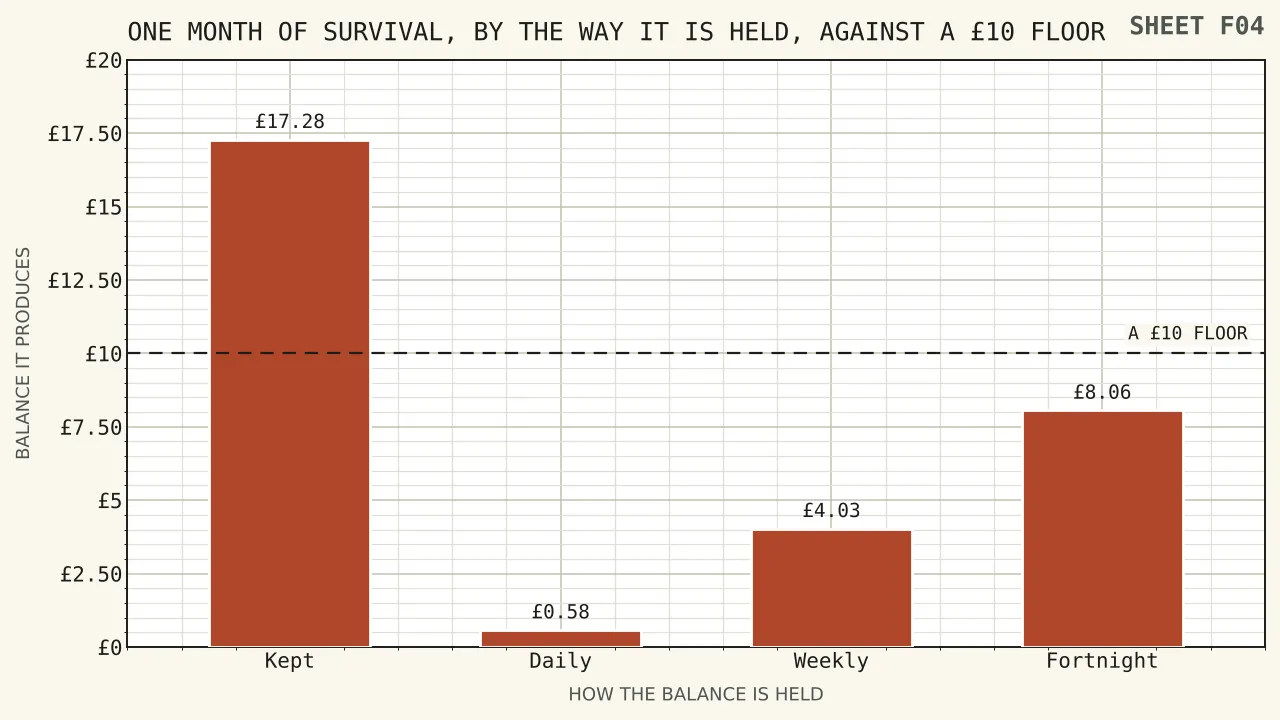
Take the persistent case first. At the British ceiling a perfect month leaves £17.28, which clears a £10.00 payout floor with £7.28 to spare. The floor strands nothing, the arithmetic is the only obstacle, and a reader who collected all 30 instalments has something that can actually leave.
Now take the case where each day stands alone. The daily expectation is 96p. Ten times on 96p is £9.60 of turnover, costing 38.4p, leaving 57.6p. Against a £10.00 floor, 57.6p is 17.36 times short. Every day produces a balance that cannot leave, and 30 days of that produces 30 balances that cannot leave, for a total of £17.28 stranded in full.
| Structure | Survives at ten times | Against a £10.00 floor | Stranded |
|---|---|---|---|
| One balance, kept across the month | £17.28 | Clears by £7.28 | £0.00 |
| Thirty daily balances, each alone | £0.58 a day | 17.36 times short | £17.28 |
| Weekly sweep, four of them | £4.03 a week | 2.48 times short | £16.13 |
| Fortnightly sweep, two of them | £8.06 each | 1.24 times short | £16.13 |
Those middle two rows are the interesting ones, because they are the shapes a reader is most likely to meet without realising it. A balance swept weekly produces £4.03 at a time, which is 2.48 times short of a £10.00 floor. A fortnightly sweep produces £8.06, still 1.24 times short. In both cases the money existed, survived the obligation, and could not leave, so the residue is the whole of it.
Seventeen pounds and twenty-eight pence is therefore the residue figure on this page, and it is the largest residue in this section of the site. Not because the terms are harsher than elsewhere, but because a face delivered in 30 pieces produces small balances, and small balances meet a floor built for a cashier’s convenience rather than for a reader’s.
The arithmetic for closing the gap is the same as everywhere here and just as unhelpful. A pound of turnover costs 4p in expectation, so staking 57.6p once costs 2p and staking it ten times over costs 23p. No stake size lifts an expectation, the edge keeping its sign throughout. Only variance reaches a floor, at 4p a pound.
One question follows from that, and the number of spins has nothing to do with it. Where does the balance go at midnight? If it persists, the offer is a £30.00 face worth £17.28 at the British ceiling. If it does not, the offer is 30 small amounts of money that exist and cannot be taken, and the spin count is irrelevant.
5
How many days before a floor is reachable
How many days before a floor is reachable is the question a daily count answers, and the answer is a count of days rather than a sum of money. It is the most useful figure on this page for comparing one daily offer with another, because it folds the spin count, the obligation and the payout floor into a single integer.
The method is three steps. Take the daily count and price it at 10p. Take 96 per cent of that for the expectation. Apply the British ceiling of ten times, which keeps 0.6 of the expectation, and divide £10.00 by whatever is left. The answer is how many perfect days a reader needs before anything can leave.
| Spins a day | Daily face | Survives daily | Days to £10.00 | A month of it | Monthly face |
|---|---|---|---|---|---|
| 5 | £0.50 | £0.29 | 35 | £8.64 | £15.00 |
| 10 | £1.00 | £0.58 | 18 | £17.28 | £30.00 |
| 20 | £2.00 | £1.15 | 9 | £34.56 | £60.00 |
| 25 | £2.50 | £1.44 | 7 | £43.20 | £75.00 |
| 50 | £5.00 | £2.88 | 4 | £86.40 | £150.00 |
Thirty-five days of unbroken collection at 5 spins a day, before £10.00 is in reach. Eighteen at 10 a day. Nine at 20. Seven at 25. Four at 50. Every one of those counts assumes the balance persists, that no instalment is missed, and that the obligation is cleared at the British ceiling rather than at anything heavier.
The top row is the interesting one, because 35 days is longer than a month. A 5-spin daily offer running for 30 days cannot reach a £10.00 floor even on a perfect run, since 30 days of 28.8p is £8.64. The residue there is not a share of the face. It is the whole of the face, and the offer is arithmetically incapable of paying anything out inside its own duration.
30 perfect days at 5 spins: £8.64, against a £10.00 floor
A year of instalments is the other direction to look in, and the figures get large quickly. Three hundred and sixty-five days at £1.00 is £365.00 of face and £350.40 of expectation. Ten times on £350.40 is £3,504.00 of turnover, which costs £140.16 at 4p a pound and leaves £210.24.
Convert that to cycles and the year holds 35,040 of them, which at 2.5 seconds apiece is 87,600 seconds. Twenty-four hours and twenty minutes of minimum play, for an expected £210.24, or £8.64 an hour again. Put the same year through a forty times obligation and the turnover is £14,016.00, the expected cost is £560.64, and the expectation is nothing at all across 97 hours of cycles.
Those annual figures are the right scale at which to read a daily offer, because a daily offer is not a transaction. It is a subscription, paid in attention rather than money, and the subscription runs until somebody stops renewing it.
6
The five design rules a daily offer runs into
An offer built on a daily visit is, by construction, an offer built on a habit. Where a British licence is held, five published design rules bear on that, and all five come from requirement 14A of the technical standards or from its guidance. The table states them in the order they would bite on a month of instalments.
| Limb | What it does |
|---|---|
| Chasing | Four kinds of active encouragement are barred: towards a chased loss, a lifted stake, a raise on what had been settled, or play continuing past a stated wish to stop |
| Topping up | A top-up needs the customer’s choice each time, rather than happening by itself |
| Poker buy-ins | Customer-initiated, with an automatic re-buy not allowed |
| Winning it back | Content may not encourage a customer to win back a loss |
| A customer who left | No enticement back, and a free game is the named example |
Worth reading twice on this page is that last limb. Somebody who has chosen to stop, offered a free game, is the named case the requirement exists to prevent. A daily spin offer is a free game offered every single day, which is not the same thing at all where the recipient has not chosen to stop, and is very close to it where they have.
The requirement does not flatten everything in its path, and saying so is part of reading it accurately. The blackjack split and features of that familiarity are not the target, and the guidance says as much. What is at issue is encouragement, not the existence of features.
Three further rules sit alongside and each one touches the shape of a daily offer. Celebrating a return at or beneath the total staked is out, so 300 small results cannot be dressed up as 300 small wins. Functionality for several games at once is not to be offered, split screens and multi-screens included. And shortening the wait for a result is out, which keeps the 25 seconds at 25 seconds.
None of those eight items appears in the responsible gaming policy Curaçao publishes for its licensees. What that policy does carry, in its list of eight mandatory areas, is two things a daily offer makes relevant. Age verification. Information made accessible. A self-assessment the player takes. Behaviour, tracked. Deposit limits. Cooling-off and self-exclusion, both in the player’s hands. Training reaching social media influencers, marketing partners, affiliates and employees. And general principles covering advertising and marketing.
Behaviour tracking and a player self-assessment are both in that list, and both are more than the British codes name in those words. So the honest summary is not that one rulebook is thin and the other full. It is that they are differently shaped: the British one is specific about product design and the Curaçao one is specific about monitoring, and the product-design rules are the ones that change the figures on this page.
7
What the advertising advice says about frequency
A daily offer is an advertisement that repeats, and the advertising advice has four things to say about repetition. Each of them is published, and each of them describes a daily spin offer rather precisely.
| Point | The published advice |
|---|---|
| Frequency | Repetitive or frequent participation is not something a promotion should encourage |
| Affordability | Nor should spending above what somebody can lose be encouraged |
| Rising rewards | A promotion rising faster as a player spends more sits outside the advice |
| Fixed rhythm | Substantial amounts gambled regularly, at one fixed frequency, are not to be encouraged |
All of that is advice rather than prohibition, and the distinction matters. A daily offer is not unlawful and nothing here says it is. What the advice does is set the direction a promotion ought to run in, and a reader can hold any particular offer up against the four rows and form their own view of it.
One figure gives the fourth row some scale. At 10p a spin a daily offer moves £1.00 of face a day, which is £365.00 a year of face and £350.40 of expectation. Set a ten times obligation on that and the annual turnover is £3,504.00, with an expected cost of £140.16. Those are not small numbers, and they arrive 10 spins at a time.
The proportionality point behind the third row is published with a worked example, and the example is conditional, so the condition travels with it. A free bet given once, following £50 of wagering, can pass the test. A condition rides with it: at £50, a free bet should not be unusual for whichever kind of gambling is in question. Nothing in that example addresses a reward arriving every day, and nothing published does.
Two financial checks belong here because they are the only published figures that attach to a running total rather than to a single transaction. Light-touch checks apply above a monthly net deposit threshold, which opened at £500 a month and later fell to £150 a month. Enhanced financial risk assessments stay a pilot, not running live, with consumers untouched meanwhile. Credit ratings are unaffected by those or by the light-touch checks, the Commission states.
On a no-deposit daily offer the deposit threshold is not reached, because nothing is deposited. That is worth stating rather than passing over: the one published mechanism that watches a monthly total is triggered by deposits, and an offer that asks for no deposit sits outside it by construction. The offer’s whole function is to establish a daily habit at a cashier, and the habit is not what the threshold measures.
8
Tools built for exactly this shape of offer
A page about a daily habit has an obligation to be useful about the tools that exist, so this part sets them out with their published figures and their published limits.
June 2017 is when the Remote Gambling Association established the scheme, at the request of the Commission and of the department for culture, media and sport. March 2020 made it a licence condition, reaching any operator that takes business from residents of Britain, in addition to an operator’s own scheme. From April 2020, a check of the entire customer base against the register falls due at 24-hour intervals at the least.
That 24-hour figure is the one worth setting beside a daily offer, because the two run on the same clock. A registration propagates to every participating operator inside a day, which is the same interval at which an instalment arrives. Reach, though, is set by the British licence and not by a website, and the scheme says a service outside its membership is past what it can prevent.
The helpline GamCare runs is open round the clock, 365 days a year, and takes phone calls, live chat and WhatsApp. Support covers a person themselves, a friend or a family member. A professional may refer somebody, with that somebody’s consent. Registered details appear in GamCare’s own footer: company limited by guarantee, registered in England as 03297914; a charity in England as 1060005; and in Scotland as SC050547.
Blocking software is the second tool and its pricing has a wrinkle a British reader should know about. The software’s own site offers a 7-day free trial after registration, and states that it is free for all Ohio residents through Time Out Ohio. No British free route appears on the company’s own pages, and its footer gives no company number and no registered address.
GamCare rather than the software company publishes a free British route, and TalkBanStop is its name. Three organisations pair up in it. Talk: GamCare and the helpline. Ban: blocking software, said there to cover up to 15 devices and to work across a household. Stop: the national scheme. The software is described there as free where a person calls the helpline, and free where they use GamCare’s support and treatment services.
One caution on that, and it is the kind of caution this site prints rather than smooths over. What carries that free route is a news article from 2021, dated 12 April, and no duration for the free access appears anywhere on it. So a reader can be told that a free route is published and should not be told how long it lasts or how many devices it covers today, because no fresher source was found.
Lower case letters in the middle of both names are the sort of detail that tells a reader whether a page was written from sources or from memory, and both names are written here as their owners write them.
9
A month of instalments with no British licence behind it
Daily offers of this shape carry no Great Britain licence behind them, and the cost of that concentrates in two places: the product rules holding a 25-second instalment to 25 seconds, and the clock deciding what becomes of a balance overnight.
Here is the first set, priced against this page rather than described in the abstract.
| Duty | What it moves across a month |
|---|---|
| Ten times at the most | £17.28 survives instead of £0.00 |
| 2.5 seconds a cycle | 7,200 seconds behind the obligation, rather than whatever software allows |
| No autoplay | 300 separate decisions across the month, not one setting |
| No enticement back | No instalment aimed at somebody who has stopped |
| No sub-stake celebration | 300 small results that cannot be dressed as wins |
| £5 a cycle, £2 under 25 | Caps the widest spread a single cycle can produce |
None of those six binds a cashier that is absent from the British register, and none of them appears in the rulebook Curaçao publishes. The second row is the one that changes the experience most: without a minimum cycle, the 2,880 cycles of a ten times obligation need not occupy 7,200 seconds, and a month’s worth of required turnover can be run in an evening. Identical money, fewer hours, which reads as convenience and is the removal of a brake.
The complaints position is the second half of the cost, and it is worth stating accurately in both directions. A British licensee acknowledges a complaint inside 3 working days, or inside 24 hours where its gambling runs at any hour, and the whole process finishes 56 days from receipt. Escalation reaches an adjudicator carrying the Commission’s approval, and approved ones alone may be used.
Offshore a route can exist, and this page will not pretend otherwise. Authorship is what differs. The published Curaçao policy contemplates the operator fixing some of the parameters, including whether an outcome is binding on the player. And the British regulator recovers nobody’s money either. Not an ombudsman is its own description of itself. Settling a gambling complaint is not a power it holds, and nor is recovering anybody’s money.
Enforcement is the one difference that can be shown in public records rather than argued. Five suspensions appear on the published register, and the dates are the sharpest part of it: Targetlocal Ltd on 21 September 2026, BresBet Ltd and Bet St George Ltd on 28 August 2026, Deadheat Racing Limited on 21 November 2025, VGC Leeds Limited on 31 October 2025, and Spribe OÜ on 30 October 2025. The enforcement page carries no last-updated date, and the most recent listing on it when checked was 7 October 2026.
A suspension is a sanction with no equivalent off the register, and that is the point of listing the dates rather than the names. Nothing can be suspended that was never issued. A cashier absent from the register has no licence to lose, which is why the published duties above are the right way to measure what a reader gives up, rather than any claim about how any particular business behaves.
Two last things, both arithmetic. A daily offer with no deposit behind it is outside the one published mechanism that monitors a monthly running total, because that mechanism counts deposits. And the tax position follows the player rather than the licence. Duty falls on an operator’s profits from a customer whose usual home is the United Kingdom. British gaming duty therefore reaches an offshore cashier that takes money from a British player, whichever register it happens to be absent from.
Questions
- What is a month of free daily spins worth?
- Ten spins a day at 10p is a daily face of £1.00, £30.00 over 30 days, and £28.80 of expectation at a 96 per cent return. A ten times obligation carries £288.00 of turnover, costing £11.52, so £17.28 lives. Nothing survives at forty times, 40 standing past the break-even multiple of 25.
- And a day gone by uncollected?
- That instalment expires, and nothing is forfeited because nothing was credited. Each missed day costs £1.00 of face and 96p of expectation. Collect on 22 days out of 30 and £8.00 of a £30.00 advertisement has gone before any term applies. At 20 days the loss is £10.00, and at 15 days half the face has expired.
- Is a daily drip worth less than the same spins in one lump?
- Yes, by whatever share of the days a reader misses, and usually by more. A lump of 300 spins has one window and one balance. Thirty instalments have 30 windows and may have 30 balances, and small balances meet a payout floor built for a cashier’s convenience. The lump is worth £28.80 of expectation to anybody who claims it; the drip is worth £28.80 only to somebody who visits 30 times.
- Why does it matter whether the balance carries over?
- Because it decides whether anything can leave. A single balance kept across the month survives at £17.28, which clears a £10.00 floor with £7.28 to spare. Thirty daily balances survive at 57.6p each, and 57.6p is 17.36 times short of £10.00, so all £17.28 is stranded. A weekly sweep gives £4.03 at a time, still 2.48 times short.
- How much time does a daily offer actually take?
- The spins take 25 seconds a day, since 10 cycles at the 2.5 second minimum is 25 seconds. The obligation is where the time is: 2,880 cycles at ten times is 7,200 seconds, which is 4 minutes a day across a month. At forty times the figures are 11,520 cycles and 28,800 seconds, which is 16 minutes a day for an expectation of nothing.
- Is there a rule against offers that run every day?
- Not a prohibition, but published advice points the other way. Repetitive or frequent participation is not something a promotion should encourage, and substantial amounts gambled regularly at one fixed frequency are not to be encouraged either. Those are advice rather than bans, so a reader can hold a particular offer against them and judge it.
- Does a daily offer trigger a financial check?
- Not where nothing is deposited. Light-touch checks apply above a monthly net deposit threshold, which opened at £500 a month and later fell to £150 a month, and a no-deposit offer sits outside that by construction. Separately, the enhanced financial risk assessments stay in pilot, outside any live environment, and leave credit ratings untouched.
- Can an offer be sent to somebody who has stopped playing?
- Not where a British licence applies. The guidance to requirement 14A names enticing a departed customer back as something the rule exists to prevent, and gives a free game as its example. The same requirement bars encouragement to chase a loss, to lift a stake, or to carry on after somebody has indicated they want to stop.
- How quickly does a self-exclusion reach a cashier?
- Inside a day at a British licensed operator. Since April 2020 a check of the whole customer base against the register has fallen due every 24 hours at the least. March 2020 is when the scheme became a licence condition, and June 2017 is when the Remote Gambling Association established it, at the request of the Commission and of the department for culture, media and sport.
- Is blocking software free in Britain?
- A free route is published, by GamCare rather than by the software company, under the name TalkBanStop. The software’s own pages offer a 7-day trial and state that it is free for Ohio residents, with no British free route on them. The page carrying the British route is a news article from 2021 that gives no duration, so no duration or device count is stated here as current.
- What does a cashier with no British licence cost a reader?
- Six duties are priced in part 9, of which the two heaviest here are the ten times ceiling and the 2.5 second cycle. Beyond them: escalation to an approved adjudicator, and membership of the national scheme, whose reach follows a British licence and not a website. Against that, the Curaçao policy does require behaviour tracking and a player self-assessment in terms the British codes do not use.