Note X02 Revision 1 Terms read 16 October 2026
Best bitcoin casino: a comparative with no unit on it
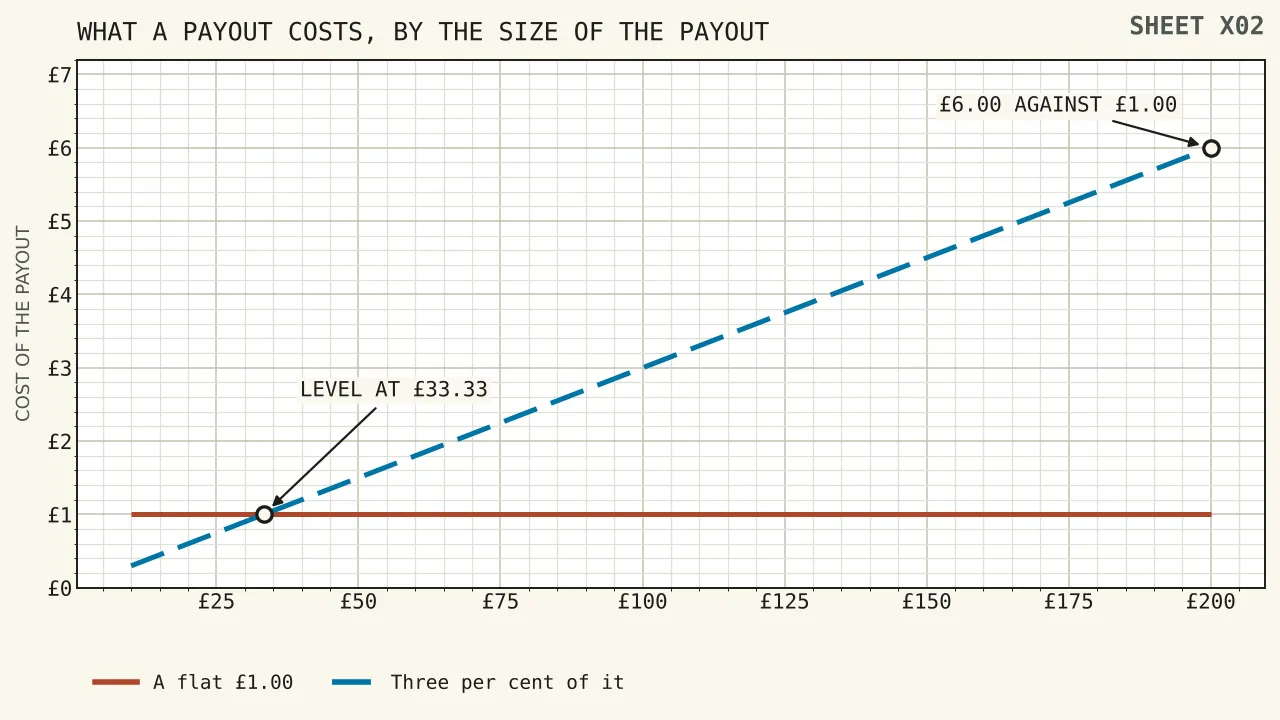
Best is not a measurement until something is being measured, so this note measures one thing: what a sum costs to get out. A £1.00 charge and a three per cent slice are the same price at £33.33 and nowhere else, which makes the cheaper shape a function of the sum rather than of the counter. The same £33.33 is also the smallest credit expected to survive ten times and clear a £20.00 floor, and under that floor the three smallest denominations on the ladder hand back nothing at all.
The face £50.00 credited What draws it down £20.00 cleared What is stranded £21.00, or 42 per cent
What a face of this size is worth
Every destination on this rack is bought advertising. The site takes a fee if a reader goes on to register, and no figure printed below moves because of it.
Face and Residue
Strip No 01
Betportal
Ceiling as a multiple
Priced at this site's own 10p a spin
What is printed
What draws it down
What is stranded
No Great Britain licence
Licensed in Anjouan, Comoros, run by BetPortal Gaming Ltd, with Excite Ultra Media Ltd, reference ALSI-202601040-FI2.
Terms read 16 October 2026
Open the offer at Betportal, opens in a new tabFace and Residue
Strip No 02
WinBeast
Ceiling as a sum
Priced at this site's own 10p a spin
What is printed
What draws it down
What is stranded
No Great Britain licence
Licensed in Curaçao, operator not named on the site.
Terms read 16 October 2026
Open the offer at WinBeast, opens in a new tabFace and Residue
Strip No 03
EliteSpin
Longest spin window
Priced at this site's own 10p a spin
What is printed
What draws it down
What is stranded
No Great Britain licence
Licensed in Costa Rica, run by PrimeTier Limited.
Terms read 16 October 2026
Open the offer at EliteSpin, opens in a new tabFace and Residue
Strip No 04
Crown Jewelz
Multiple unpublished
No residue struck
What is printed
What draws it down
What is stranded
No Great Britain licence
Licensed in Curaçao, number not verified, operator not named on the site.
Terms read 16 October 2026
Open the offer at Crown Jewelz, opens in a new tabThe two figures in the second and third registers are this site's own arithmetic and nothing an operator has published: the face as printed, less the share a spin gives back at 96 per cent return to player, less what playing the wagering through costs at the same return, and then less whatever a published ceiling, a charge on the way out or a floor on the smallest withdrawal takes off what survives that. The residue is what is left of the face when all of it is accounted for. It describes the offer, not one reader's afternoon. Where the conditions price above the face the strip prints nothing coming off rather than a negative sum, and where a figure the sum needs is unpublished it prints the condition in the operator's words instead.
A face paid as spins has no unit of its own, so one is supplied. Where an operator publishes what a spin of its own is worth, that figure stands in the first register's own line and is labelled as theirs. Where it does not, this site's own 10p a spin stands there and says so, and every figure below moves in proportion: at half the price, half the money. The share of the face that does come off is also given as pence in the pound, which is the figure that compares a large face against a small one.
Money goes onto a prepaid voucher in fixed denominations, so a smallest deposit published in pounds is rounded up to the first rung of the ladder this site works in, £10, £20, £25, £50, £75 and £100, and the strip prints what that rounding strands. That is the reader's own money and it is never netted into a residue. A smallest deposit published in euros is printed as the operator publishes it, because the ladder here is a sterling one and rounding a euro sum to it would be an invented figure.
Three words stand in the amount column where no figure can. Noted is a published condition that takes value away without leaving the sum a figure to take. Unpriced is a condition whose figure nobody has published, or a credit that is not a sum until a deposit of your own sets it. Own money is money of yours, which is never part of a residue.
Not one of the operators printed above holds a Great Britain licence, so the duties that licence carries do not reach them. All online gambling companies licensed in Great Britain must be part of Gamstop Online, and a reader who has shut themselves out through the scheme is therefore not shut out here. The ceiling of ten times the bonus funds on a wagering requirement, in force since 19 January 2026 under Social Responsibility Code 5.1.1, is a condition of that licence and binds the companies that hold one. On an unlicensed site the Gambling Commission describes consumers as facing unfair gaming practices, financial loss and a lack of recourse if things go wrong, and it names blocked payouts and withdrawal limits set so high they are unattainable among what it has seen. Nobody under 18 may hold an account at any of them.
Every term printed on a strip is the operator's own, and each strip carries the day it was read. The oldest of those readings is 16 October 2026. What binds a reader is the operator's own full terms, and not a line printed here.
1
Best at what, in what units
A superlative needs a quantity behind it or it is decoration. No star is awarded anywhere on this site and no mark out of anything, because an invented number is the cheapest thing on a page to produce and the dearest to defend. What this note does instead is pick the one quantity at this end of a transaction that can be worked out from first principles, which is the cost of getting a sum away, and then show that the answer changes with the size of the sum.
That last clause is the whole argument. If a cheaper charge shape existed at every size, best would mean something fixed. It does not. A fixed charge and a proportional one cross, and on the modelled figures here they cross at £33.33. Beneath the crossing a share costs less; past it a fixed bill does. So a reader shifting £15.00 and a reader shifting £150.00 need opposite answers to one question.
House figures, as everywhere here: 10p a press, 96 pence returning per pound staked, a weighting of one, and six denominations from £10.00 up to £100.00. The payout floor modelled on this page is £20.00, double the figure used on most of the site, which is deliberate: part 5 shows what doubling a floor does, and the answer is not that it costs twice as much.
Counters pricing a balance in a unit rather than in pounds hold no Great Britain licence. Priced on this page, that absence is worth £21.00 of the £50.00 rung at ten times, since nothing caps the multiple, nothing caps the charge, nothing caps the floor and nothing obliges anybody to settle a complaint inside eight weeks. Part 7 lists the duties line by line and part 8 prices them.
| The question | How this note answers it |
|---|---|
| Which charge is cheaper | Worked out, and the answer turns on the sum |
| What a floor strands | Worked out, rung by rung |
| What a multiple costs | Worked out, at four pence in the pound |
| Which counter is quickest | Not answered; no figure is published |
| Which counter is honest | Not answered; no register records it |
| A mark out of anything | Never awarded on this site |
2
Four charge shapes and one crossing sum
Four shapes cover nearly everything a payout charge can be. A fixed sum, the same whatever moves. A slice, holding its share as the sum grows. A slice with a minimum under it, which is the hybrid part 3 takes apart. And a fixed sum with a slice on top, which is both bills at once.
Model them at £1.00 fixed, three per cent as a slice, and £1.00 plus one per cent for the pair. Then run a balance up from ten pounds to two hundred and watch the ordering change.
| Balance | Fixed | Fixed, as a share | Slice | Fixed and slice | Cheapest of them |
|---|---|---|---|---|---|
| £10.00 | £1.00 | A tenth | £0.30 | £1.10 | The slice, by 70p |
| £15.00 | £1.00 | 6.67 per cent | £0.45 | £1.15 | The slice, by 55p |
| £20.00 | £1.00 | A twentieth | £0.60 | £1.20 | The slice, by 40p |
| £25.00 | £1.00 | A twenty-fifth | £0.75 | £1.25 | The slice, by 25p |
| £33.33 | £1.00 | Three per cent | £1.00 | £1.33 | Level, to the penny |
| £40.00 | £1.00 | 2.50 per cent | £1.20 | £1.40 | The fixed sum, by 20p |
| £50.00 | £1.00 | A fiftieth | £1.50 | £1.50 | The fixed sum, by 50p |
| £100.00 | £1.00 | One per cent | £3.00 | £2.00 | The fixed sum, by £2.00 |
| £200.00 | £1.00 | Half a per cent | £6.00 | £3.00 | The fixed sum, by £5.00 |
Read the last column downwards and the point arrives on its own. The ordering flips once, at £33.33, and £1.00 divided by 0.03 is where it flips. Beneath it, paying a share wins, since a share of something small is small. Past it, paying a fixed bill wins, since a fixed bill is blind to how much moved.
The gap either side grows fast. At £10.00 the wrong shape costs 70p, which is seven times the stake used throughout this site and 7 per cent of the whole balance. At £200.00 the wrong shape costs £5.00, which is five times as much cash and only 2.5 per cent of the balance. So the cash penalty for picking wrongly rises with the sum while the proportional penalty falls, and a reader who only ever moves small sums is the one for whom the choice matters most.
Give the fourth column its own paragraph. A fixed sum carrying a slice on top wins nowhere in that table, which is what you would expect of a shape that collects both bills, but it also never loses by much at the bottom: at £10.00 it is 80p dearer than the slice and at £200.00 it is £3.00 dearer than the fixed sum, against the slice’s £5.00. A shape that is mediocre everywhere beats a shape that is wrong in the place a reader actually stands.
£33.33 is where £1.00 and three per cent cost the same thing
3
The shape that is both at once
A slice with a minimum under it is the shape most worth understanding, because it looks like a percentage and behaves like a fixed charge over exactly the range where a fixed charge hurts. Write it as the larger of £1.00 and three per cent of the balance, and the arithmetic splits in two at the crossing sum.
Beneath £33.33 the minimum is doing all the work, so the charge is £1.00 and the three per cent is decoration. Above it the percentage takes over and the minimum never applies again. A reader moving £12.00 under such a charge is paying 8.33 per cent, not three. A reader moving £20.00 is paying five per cent. A reader moving £100.00 is paying three, exactly as advertised.
| Balance | Charge taken | Share actually paid |
|---|---|---|
| £10.00 | The minimum | A tenth, not three per cent |
| £12.00 | The minimum | 8.33 per cent |
| £20.00 | The minimum | A twentieth |
| £33.33 | Either, they agree | Three per cent |
| £50.00 | The percentage | Three per cent |
| £150.00 | The percentage | Three per cent |
That third column is the one a headline rate conceals. Three per cent is a true statement about the shape and a false statement about the bill on every row above the crossing sum, which is to say on every row where a reader is moving the kind of residue this site keeps finding. Twelve pounds of survivor is a common outcome, being what the twenty pound step is expected to leave once ten turnovers are served. Under this charge shape it pays 8.33 per cent, which is two and three quarter times the advertised rate.
Now put the two devices together, because they interact. A floor decides whether a payout happens at all and a minimum charge decides what it costs when it does. Both of them bite hardest at the bottom, and the bottom is where a residue lives. A £20.00 floor with a £1.00 minimum charge means the smallest payout a reader can receive is £19.00: the floor lets nothing smaller through, and the charge takes a pound off the first sum that gets through. There is no way to receive £19.50 under those two rules, and no way to receive £5.00 at all.
£19.00 is the smallest sum this pair of rules can hand over
4
What a £20.00 floor asks of a credit
Work backwards from the floor and a credit requirement appears. A credit carrying a multiple is expected to leave the credit times one minus 0.04 times that multiple, so the smallest credit that clears a floor is the floor divided by that same bracket. With the floor at £20.00, the ladder of requirements is short and steep.
| Multiple | Fraction surviving | Credit needed | On the ladder? | With £1.00 charge |
|---|---|---|---|---|
| Five times | Four fifths | £25.00 | Yes, a rung exactly | £26.25 |
| Ten times | Three fifths | £33.33 | No, between rungs | £35.00 |
| Twelve and a half | A half | £40.00 | No, between rungs | £42.00 |
| Fifteen times | Two fifths | £50.00 | Yes, a rung exactly | £52.50 |
| Twenty times | A fifth | £100.00 | Yes, the top rung | £105.00 |
| Twenty-two times | Three twenty-fifths | £166.67 | Over the ladder’s top | £175.00 |
| Twenty-five times | Nothing | No answer | No credit of any size | No answer |
Three readings of that table matter. First, the crossing sum from part 2 turns up again at ten times, and the coincidence is worth stating carefully because the two figures are different quantities. £33.33 as a balance is where two charge shapes agree. £33.33 as a credit is what a £20.00 floor demands at ten times. One is a sum being moved and the other is a sum being issued, and they happen to share a number because £1.00 over 0.03 and £20.00 over 0.6 both come to the same thing.
Second, the top rung of the whole ladder is the entry fee at twenty times. A hundred pounds of credit, which is as much as this instrument can express in a single denomination, is the smallest credit expected to leave £20.00 standing at that multiple. Anything above twenty times takes a credit no denomination on this site can buy.
Third, the last column kills three of the exact hits. Twenty-five pounds of credit at five times leaves £20.00, which clears the floor by nothing and then loses a pound to the charge. Fifty pounds at fifteen times does the same. A hundred at twenty times does the same. In every one of those cases a reader clears a floor and receives less than the floor, which is not a trick and not a breach of anything: the test happens before the deduction, and the order of the two operations is doing all the damage.
5
Three rungs that hand back nothing
Doubling a floor does not double a cost. It reclassifies denominations, which is a much blunter thing to do, and the table below is the whole of this section’s argument.
| Credit | Multiple | Survivor | Against the floor | Received | Residue as a share |
|---|---|---|---|---|---|
| £10.00 | Ten turnovers | £6.00 | Held, by £14.00 | Nothing | The whole credit |
| £20.00 | Ten turnovers | £12.00 | Held, by £8.00 | Nothing | The whole credit |
| £25.00 | Ten turnovers | £15.00 | Held, by £5.00 | Nothing | The whole credit |
| £50.00 | Ten turnovers | £30.00 | Pays, by £10.00 | £29.00 | 42.00 per cent |
| £75.00 | Ten turnovers | £45.00 | Pays, by £25.00 | £44.00 | 41.33 per cent |
| £100.00 | Ten turnovers | £60.00 | Pays, by £40.00 | £59.00 | 41.00 per cent |
| £50.00 | Fifteen turnovers | £20.00 | Pays, by nothing | £19.00 | 62.00 per cent |
| £50.00 | Twenty turnovers | £10.00 | Held, by £10.00 | Nothing | The whole credit |
| £100.00 | Twenty turnovers | £20.00 | Pays, by nothing | £19.00 | 81.00 per cent |
The first three rows are the finding. At ten times, a £20.00 floor strands the ten pound, twenty pound and twenty-five pound denominations in full, which is to say three of the six steps this instrument sells. None of those three is close: the nearest miss is £5.00 on the twenty-five pound step, where £15.00 of expected survivor meets a floor a third higher than itself. At twenty times, five of the six steps strand in full and only the top one gets through, and it gets £19.00 through.
Compare that against the same ladder under a £10.00 floor, where the twenty pound step pays £12.00 and the twenty-five pound step pays £15.00. Ten pounds of floor, added, converted £27.00 of expected payout into £45.00 of residue. That is the arithmetic of a floor in one line: the cost of raising it is not the amount it rises by, but every balance that now falls underneath it.
Two more figures finish the section. The residue share at ten times settles into a band between 41.00 and 42.00 per cent for the three rungs that pay, because a four per cent edge over ten turnovers takes two fifths and the charge adds a shrinking remainder on top. And the gap between a payable rung and a stranded one is not gradual: between the twenty-five pound step and the fifty pound step the received figure goes from nothing to £29.00, with no denomination in between to soften it.
6
Comparing without awarding anything
Everything above compares and none of it decides, which is the distinction this section holds. Hand a reader the arithmetic of a charge shape, a floor and a multiple and they can work out which combination suits the sum in front of them. Hand them a figure standing for how good a counter is and they have been handed an invention, because the inputs to such a figure are nowhere.
Three gaps in particular, and each gap is itself the finding. Charges, ceilings and multiples away from the British register have no published distribution, which is why parts 2 and 3 carry models and not measurements. Payout speeds have none either, for anybody. And which jurisdiction licenses which brand, or how many brands sit under any one of them, has no count with a date attached, so counting counters is out as well.
Structure is what remains, and structure beats a mark. Where a British licence stops a play-through is ten turnovers, and it has stopped there since 19 January 2026. The Curaçao responsible gaming document, which anyone may open, holds no such ceiling: the multiple runs free there, so does the stake, so does the pace between cycles, and autoplay, hurried results and the dressing up of a small return are all unmentioned. Incentives get two sentences, one about transparent terms and one against promotion that drives excessive play.
| What a reader wants | What is published |
|---|---|
| A ceiling on the multiple | Ten times, under a British licence only |
| A ceiling on the stake | Slots alone, and only where licensed |
| A ceiling on a payout charge | Nothing, in either regime |
| A ceiling on a payout floor | Nothing beyond a test of reasonableness |
| Typical payout speeds | Nothing citable, anywhere |
| Brands under each jurisdiction | No count carrying a date |
So the honest answer to which is best has a shape and not a name. Cheapest at the exit is wherever the charge shape fits the sum being shifted, the floor sits under the balance being shifted, and the multiple leaves a balance to shift in the first place. Each of those is checkable in published terms before a penny goes in, and not one of them wants anybody’s opinion.
Which raises the question part 8 answers: how much of that has to appear in an advertisement before a reader can check it at all.
7
What a licence settles at this door
A British licence writes a short list of rules about getting money out, and a list beats an adjective. Every line below pairs one published duty with whichever figure above it governs.
| The subject | What is settled | The figure it touches here |
|---|---|---|
| A ceiling over payouts | Barred where a deposit balance is concerned | No instalment ladder on £59.00 |
| A floor under payouts | Permitted, if reasonable | The £20.00 in parts 4 and 5 |
| Cancelling a request | Not to be offered at all | £19.00 cannot go back to a reel |
| Friction | To be kept to a minimum | No number attaches; none invented |
| Documents demanded late | Barred where they could have come earlier | Identity is not a charge shape |
| Identity, up front | Three fields before a first stake | Checked at entry, not at exit |
| First reply to a complaint | Three working days, or one | £19.00 held at £6.33 a day |
| The complaint in full | Eight weeks, and no longer | £19.00 held at 33.93p a day |
| Who adjudicates after that | An approved body, and no other | Seven of eight cover remote casino |
The two clock rows are the ones a reader can price, and the method is simply to divide. A £19.00 payout held for the three working days allowed before a first reply has been held at £6.33 a day. Held across the whole eight weeks allowed for the process, 56 days, it has been held at 33.93p a day. Neither figure is a charge anybody levies, and both are a way of putting a size on a delay that otherwise reads as merely annoying.
The last row wants its number explained rather than asserted. Approval from the British regulator is what an adjudicating body needs, and eight hold it. One of the eight is listed against premises sectors, meaning adult gaming centres, bingo halls, family entertainment centres and licensed premises, and a reader of this page sits in none of those, so seven is the figure that applies to them. The equivalent step exists off the British register and is drafted by a different hand, which is the subject of the note on a balance held in units.
8
The absence, in pounds, and the refusals
Nothing in parts 2 to 5 is checkable unless the terms are in front of a reader before they pay, which turns the comparison into an advertising question. A worked list of the conditions treated as significant in a gambling promotion is published by the advertising regulator itself, and every item on it is a line on the sort of offer this section prices.
| The condition | What it decides here | Figure it changes |
|---|---|---|
| Who may claim at all | New customers, an age, a country | Whether any face is issued |
| What must be paid in | The rung a reader has to buy | £50.00, on the figures above |
| The wagering requirement | The multiple, and therefore the survivor | £30.00 at ten, £10.00 at twenty |
| A limit on time | To claim it, and to use it | Everything, where the clock runs out |
| Minimum odds or bet types | Which games count, and at what weight | The staking needed per pound of credit |
| Excluded payment methods | Whether a rail disqualifies the offer | The whole face, where it does |
Clarity and prominence are what the rule asks of such a condition, and the test it applies is whether omitting one would mislead. Placement has a published answer too: online, a click away rather than down in a footnote. Three dated rulings put figures on all of that, and each turns on something a reader needed before any arithmetic was possible.
| Decided | What was left out | What it was worth |
|---|---|---|
| 17 July 2024 | An hour by which to reply | A £10.00 free bet |
| 31 July 2024 | A payment method, excluded | The face, to a reader on that rail |
| 27 August 2025 | One date in March, and one race | A £5.00 coupon |
Take the middle row first, since it is the one nearest this page. A method shut out of an offer is a term about a rail, so a reader who funds through that rail has bought a face worth nought, and in that case the exclusion went into the small print beneath the full terms and was ruled too faint to count. The first row was an unstated hour. The third was an unstated date, and alone among the three it is called a breach of the code outright on the regulator’s own page.
A deadline, a rail and a date: that is the pattern. Not one of them is a charge or a floor, and each can take a face to nought unaided. Comparing counters on the figures in parts 2 to 5 compares what gets published, and these three decisions are a reminder that what does not get published has historically been the part that voids an offer.
Two more limbs of the British incentive rule bear on what is comparable at all. Product types may not be mixed inside one incentive, so a match carrying free spins stays within casino while a match carrying bingo tickets crosses a boundary, and that arrived the same day the ceiling of ten turnovers did. Nor may an incentive’s value move because a reader completed the qualifying activity early rather than at the close of the offer period, so an early finish keeps the figure advertised. Neither duty reaches a counter holding no British licence, and the second is the one to watch: without it, finishing early is something terms are free to reprice.
Questions
- Which charge shape is cheaper?
- Whichever one the sum points at. A £1.00 fixed charge and a three per cent slice are level at £33.33, because a pound divided by three hundredths is that sum. Under it the slice is cheaper, so £10.00 costs 30p rather than £1.00. Over it the fixed charge is cheaper, so £200.00 costs £1.00 rather than £6.00.
- Why does a three per cent charge sometimes take a tenth?
- Because a minimum sits under it. Written as the larger of £1.00 and three per cent, the charge is a flat pound on everything beneath £33.33, so a £10.00 payout pays a tenth and a £12.00 payout pays 8.33 per cent. The rate becomes true at the crossing sum and stays true above it, and a reader moving a residue is almost always underneath it.
- What is the smallest payout a floor and a minimum charge allow?
- Nineteen pounds, on the figures modelled here. A £20.00 floor refuses everything smaller, and the £1.00 minimum charge takes a pound off the first sum that gets through. So £19.00 exists, £5.00 cannot happen at all, and nothing between £19.00 and £20.00 can be received.
- What credit does a £20.00 floor need at ten times?
- Thirty-three pounds thirty-three, since three fifths of that sum is twenty pounds. No denomination answers it, so a reader is buying the fifty pound step or going without. At fifteen times the requirement is £50.00 exactly and at twenty times it is £100.00, which is the top of the ladder.
- How many denominations does a £20.00 floor strand?
- Three of six at ten times. The ten pound step leaves £6.00, the twenty pound step leaves £12.00 and the twenty-five pound step leaves £15.00, and all three are held in full rather than trimmed. At twenty times five of the six strand, and the one that pays hands over £19.00.
- Is a payout floor allowed under a British licence?
- Yes. Reasonableness is the only published test on the size or the number of payments, and a ceiling is a different object altogether: a term putting a maximum over a deposit balance is barred outright, with a daily figure paired to a weekly one given as the example of that shape. A minimum payment therefore survives the rule where a maximum does not.
- Why award no mark at all?
- Because the inputs do not exist in public. Distributions of payout charges, of withdrawal ceilings and of multiples asked away from the British register go unpublished; so does any payout speed; and so does a dated count of which brand sits under which jurisdiction. A mark resting on none of that is an invention, and none is awarded here.
- What does doubling a floor actually cost?
- Not twice as much. Moving a floor from £10.00 to £20.00 turns two payable rungs into stranded ones at ten times, which converts £27.00 of expected payout into residue on the twenty pound and twenty-five pound steps alone. A floor’s cost is not the distance it moves but every balance that ends up beneath it.
- Can a balance clear a floor and still arrive under it?
- Yes, and three rows of the ladder do exactly that. A survivor of £20.00 passes a £20.00 floor and then loses a pound to the charge, so £19.00 arrives. Nothing has been breached: the floor test runs before the deduction, and the order of those two operations does all the damage.
- What is an uncapped multiple worth on the fifty pound step?
- The whole of a £29.00 payout, and then some. Ten times leaves £30.00, which pays £29.00 after the charge. Twenty times leaves £10.00, which a £20.00 floor holds entire. Forty times is a deficit of £30.00, meaning the credit goes and £30.00 of a reader’s own money goes after it.
- Which conditions have to be in the advertisement?
- Eligibility, what must be paid in, the wagering requirement, time limits for claiming and using, and minimum odds or bet types, where leaving any of them out would mislead. Full terms belong roughly a click from an online advertisement rather than inside its small print. Each item on that list is an input to the arithmetic in parts 2 to 5.
- Has an excluded payment method ever been ruled against?
- Yes, on 31 July 2024, where a method excluded from an offer was set out faintly beneath the full terms and held insufficiently prominent. That ruling is the closest to this page’s subject, because a rail excluded from an offer is worth the whole face to a reader who funded through it. Two other rulings turn on an unstated deadline and an unstated date.